Nicaragua
Leon, Nicaragua
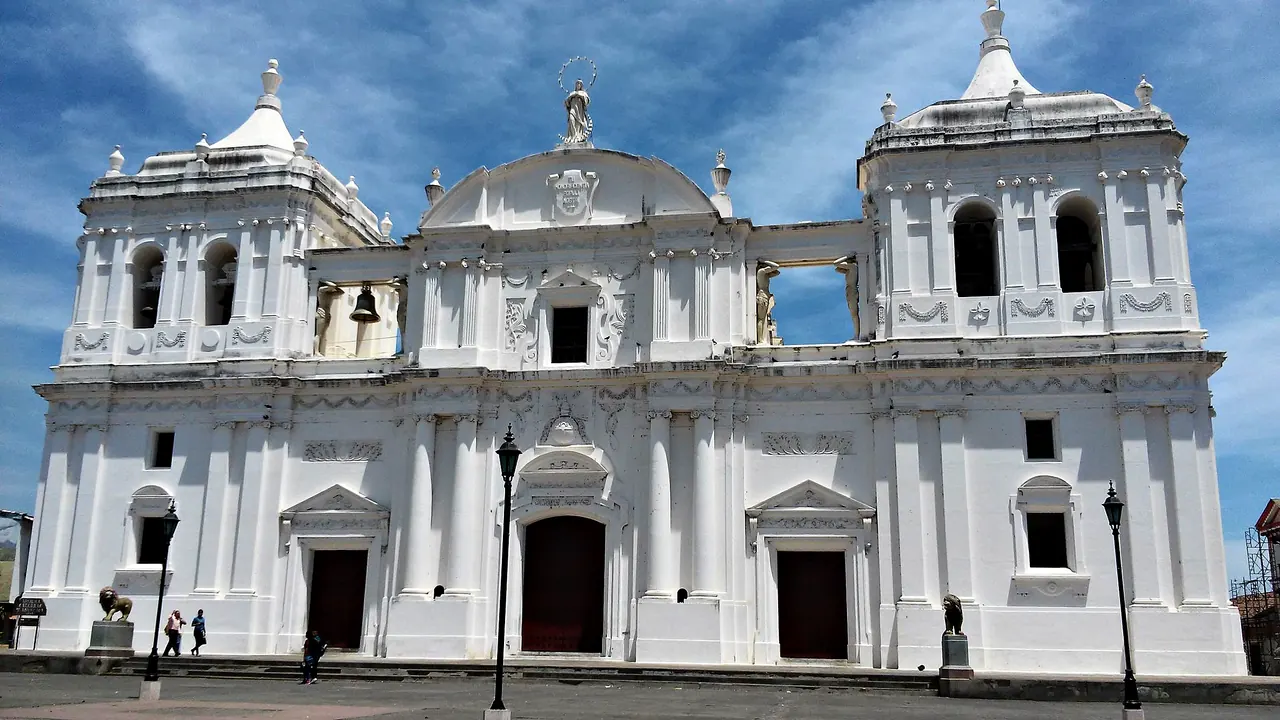
The white cathedral under a blue sky
- Affordable cities91
- Nature & outdoors72
- Culture & sights56
Photo: Byralaal, CC BY-SA 4.0, cropped
Match
44
Every category weighted equally
- Beach & sun46
- Culture & arts44
- Food & nightlife43
- Family trip48
- Outdoors49
- Relax & unwind44
- Shopping & style40
- On a budget49
Leon, Nicaragua in twelve categories
Our verdict on each, scored 0 to 100 against the same fixed benchmark cities, so a score means the same thing on every page.
Beaches & swimming. Scores 50 out of 100.
Food & drink. Scores 40 out of 100.
Culture & sights. Scores 56 out of 100.
Nightlife. Scores 40 out of 100.
Nature & outdoors. Scores 72 out of 100.
Day trips. Scores 38 out of 100.
Good for families. Scores 27 out of 100.
Getting around. Scores 55 out of 100.
Shopping & style. Scores 18 out of 100.
Affordability. Scores 91 out of 100.
Live music & performing arts. Scores 24 out of 100.
Wellness & relaxation. Scores 20 out of 100.
Leon, Nicaragua category by category
Beaches & swimming
50The Pacific is close. Poneloya and Las Peñitas sit about 20km west of the city, a short bus or taxi ride, and the water is warm all year at around 27°C to 29°C. Many visitors split their stay between the colonial centre and a few nights in a beach guesthouse, so the coast plays a real part in a trip.
This is surf coast rather than bathing coast, though. The sand is grey to dark volcanic, the waves are often heavy and rip currents are strong, so swimming means staying in the shallows near other bathers or finding the calmer water at the end of Las Peñitas, opposite the mangrove island. Surfers do well here. Anyone wanting calm, clear water for lazy swimming will not find it.
Food & drink
40Eating in León is cheap, filling and local. Street grills called fritangas set up in the evenings and serve grilled meat, fried plantain, gallo pinto and cabbage salad from the pavement. The Mercado Central behind the cathedral has lunch counters selling soups and the plate of the day. Quesillo, soft cheese rolled in a tortilla with cream and pickled onion, comes from the towns on the road to Managua and is sold everywhere, and nacatamales are a weekend tradition.
The student and backpacker population supports a handful of cafés, juice bars and casual international places in the blocks around the cathedral. Fine dining barely exists, and the cuisine has little range. Rum from the nearby cane fields is the drink of the region.
Culture & sights
56León is one of the great colonial cities of Central America, and its centrepiece is the Cathedral of the Assumption, the largest in the region and a UNESCO World Heritage Site. Visitors can walk on its whitewashed roof among the domes, with the volcano chain on the horizon. A dozen more churches spread across the low grid of the old town. The best known are the yellow baroque façade of La Recolección, El Calvario and the old church of Subtiava in the indigenous quarter.
The museums are small but worth seeing. The Ortiz-Gurdián foundation shows Latin American and European art in restored colonial houses, the poet Rubén Darío's family home is a museum to him, and a former prison holds a museum of local legends. Revolutionary murals on the streets record the city's political past. It is a rewarding place to wander for two or three days.
Nightlife
40As a university town on the backpacker route, León goes out more than most Nicaraguan cities. Hostel bars, rum and beer joints with plastic tables, and a few dance clubs playing reggaeton and salsa fill up at weekends, mostly within a few blocks of the cathedral. Thursday to Saturday is lively, with students and travellers mixing.
The scene is small and short on variety. There are no cocktail bars or club culture to speak of, and midweek nights are quiet. Visitors should take a taxi home late at night rather than walk the darker side streets.
Nature & outdoors
72León sits at the foot of the Maribios range, a line of volcanoes running up the western plain, and that is the main outdoor draw. Cerro Negro, a bare black cone about an hour away, is climbed in under an hour and then descended on a sandboard down loose gravel. Longer guided hikes cross Telica, where at night you can sometimes look into a glowing crater, and the San Cristóbal and Momotombo summits demand a hard, early climb.
On the coast, the Juan Venado island reserve is a long strip of mangrove explored by boat or kayak, with herons, crabs and sea turtles nesting on the beach in season. The surf at Las Peñitas suits beginners and intermediates. The heat is intense, so outings start early, and the green season from May to October makes trails muddy but the landscape lush.
Day trips
38The best day out is León Viejo, the ruins of the original Spanish city abandoned after earthquakes and buried by ash from Momotombo, now a UNESCO site on the shore of Lake Managua about an hour away. To the north, the cane-growing country around Chichigalpa has a historic rum distillery that offers tours, and Chinandega and El Viejo, with its pilgrimage basilica, make a modest outing.
After that the list gets short. Managua is under two hours away but has little to hold a visitor for a day. Granada and the craft market at Masaya are the country's other big draws, but they lie about two and a half hours away and are better treated as a separate stop than as a day trip.
Good for families
27Nicaraguan culture is warm towards children and the centre is small, but León offers little made for them. There are no zoos, theme parks or science museums, the heat is draining for much of the year, pavements are narrow and uneven, and the nearby beaches have strong surf. Teenagers who like adventure may love volcano boarding and a mangrove boat trip. Younger children usually spend most of the time by a hotel pool.
Getting around
55The historic centre is a compact grid of low buildings, and the cathedral, churches, museums and markets are all within about fifteen minutes' walk of each other. Subtiava is a longer walk or a short taxi ride west. Taxis are plentiful and shared, and tricycle taxis cover short hops.
The difficulties are the midday heat and narrow, broken pavements. Beyond the city, the beaches and nearby towns are served by old school buses from the market terminals, which are crowded and slow but get there. Volcano trips and longer journeys are usually done with a tour or a tourist shuttle, and no car is needed.
Shopping & style
18Shopping in León is mostly practical. The Mercado Central and the larger market near the bus terminal sell produce, clothes and household goods, and are interesting to walk through. A few shops near the cathedral sell hammocks, leatherwork, coffee and rum to take home. The country's main craft market is at Masaya, which most people visit from Granada rather than from here.
Affordability
91León is one of the cheapest places to travel in the Americas. Hostels and simple colonial guesthouses cost very little, fritanga suppers and market lunches cost even less, local beer and rum are cheap, and the buses to the coast and nearby towns cost next to nothing. Church and museum entry fees are small.
The main costs are guided volcano trips and the smarter boutique hotels in restored colonial houses, which are still modest by international standards. A tight budget goes a long way here.
Live music & performing arts
24Formal performance is limited. The neoclassical Teatro Municipal José de la Cruz Mena stages occasional concerts, folk dance and student productions, and some bars have live bands at weekends. León's real performance life is in the street. The Gigantona, a towering doll who dances to drums with a big-headed dwarf beside her, is a local tradition, and it fills the streets with verse at festival times.
The city's calendar matters more than any venue. Holy Week brings processions and sawdust carpets in Subtiava, and the Purísima and Gritería in early December fill the streets with altars, singing and fireworks.
Wellness & relaxation
20León is not a place for spas. There is no bathing tradition, wellness amounts to a few cheap massage rooms and the odd yoga class, and the centre is hot, loud with traffic and busy with students. The calm moments come from a shaded colonial courtyard with a hammock and a pool, or from a few slow days in the beach villages to the west.
When should you go?
Pick a month to see what it is like. The climate figures are measured averages, not a forecast.
Leon, Nicaragua in July
Daytime high, °C
Rainfall in the month, mm
The whole year
Shaded against this city’s own year: the deepest cell is its best month for that figure and the palest its weakest.
Where the figures come from
Leon, Nicaragua's temperatures are measured 84 km from the centre, at Managua A. C. Sandino.
Leon, Nicaragua has no rain gauge within 25 km of the centre, so its rainfall comes from a gridded climate dataset read at the city rather than from a gauge further away.
Temperature and rainfall are climate normals, averaged over the years shown. Leon, Nicaragua: 1961-1990 (sunshine 1991-2020, rainfall 1991-2020) normals, Managua A. C. Sandino (83.6 km from centre).
Before you go
| Measure | Leon, Nicaragua |
|---|---|
| Official language | Spanish |
| Currency | Cordoba Oro (NIO) |
| Sockets | AB120 V, 60 Hz |
| Driving side | Right |
| Time zone | UTC-6 |
| Emergency number | Police 118, ambulance 128, fire 115/120 |
| Elevation | 104 m |
| Main airport | Augusto C. Sandino (Managua) International Airport (MGA)84 km from centre11 non-stop destinations |
| Public holidays this year | 12 days |
By the numbers
| Measure | Leon, Nicaragua |
|---|---|
| City population | 174,051 |
| People per km² | 212 |
| Museums within 10 km | 3 |
| UNESCO World Heritage sites within 50 km | 2 |
| Swim season, months above 21 °C | 12 months |
Compare Leon, Nicaragua with
Every comparison with a written verdict behind it.