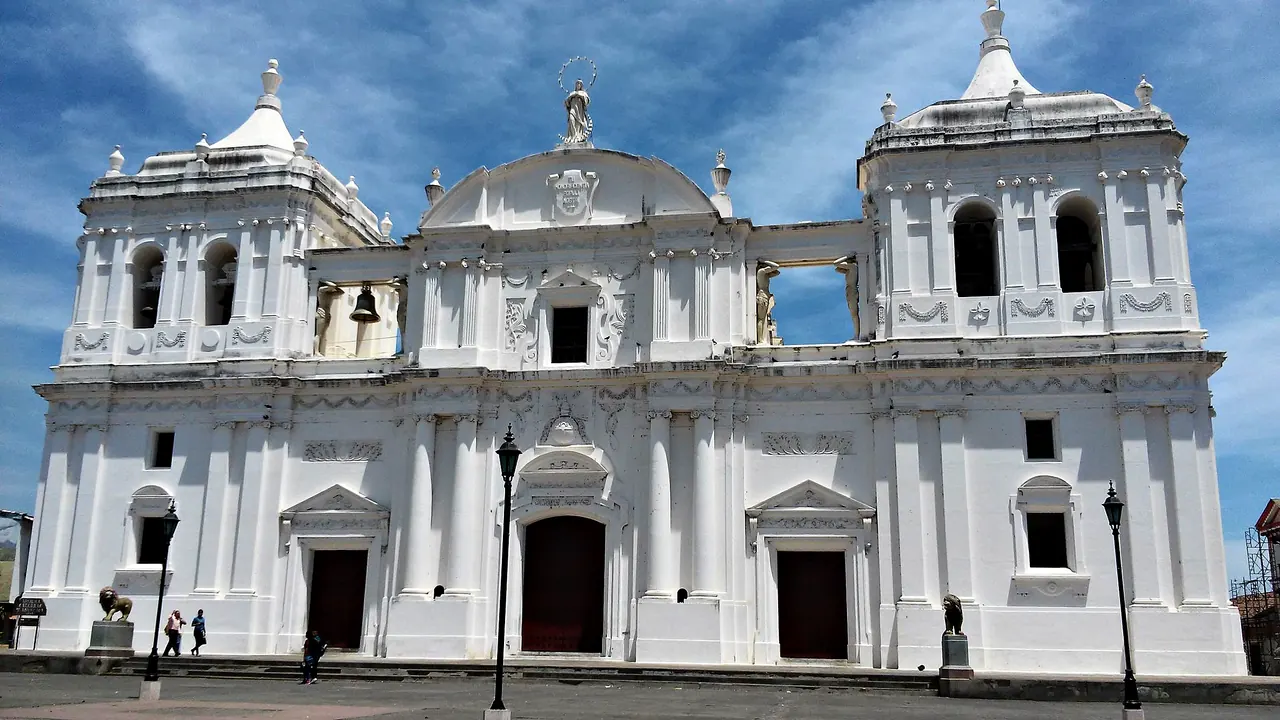
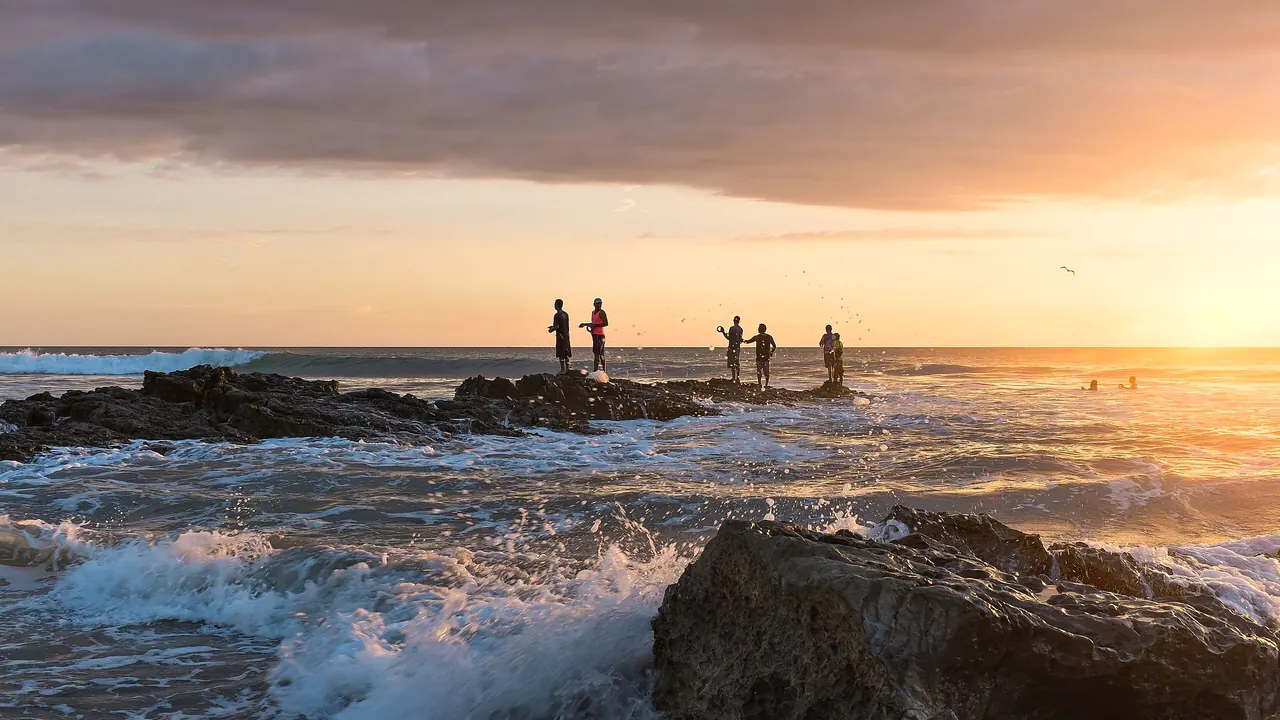
Photos: Leon, Nicaragua by Byralaal, CC BY-SA 4.0, cropped; Santa Teresa, Costa Rica by Christopher Crouzet, CC BY-SA 4.0, cropped.
Leon, Nicaragua or Santa Teresa, Costa Rica?
Our verdict in twelve categories, each scored against the same fixed benchmark cities, and the climate month by month, so you can choose for your trip.
Choose Leon, Nicaragua for
- prices
- culture and sights
- getting around
León suits travellers who want a town to explore more than a beach to lie on. It has a colonial grid of churches, the cathedral roof, small museums and murals, volcano climbs close by and some of the lowest costs in the Americas. The centre is easy to cover on foot, and the Pacific is near enough for a few nights by the surf at Las Peñitas.
Choose Santa Teresa, Costa Rica for
- wellness
- beaches
- families
For a slower, more expensive stay built around the sea, Santa Teresa is the better choice. You get pale sand, surf lessons, yoga in the forest and sunsets that bring everyone down to the beach. There is nothing to sightsee, and getting there and around takes effort. But for a week of surfing, stretching and rest, it gives you what León cannot.
Scoreboard
Twelve categories on one fixed scale from 0 to 100. The shaded stretch is the gap between the two.
Your match
Pick a travel style or drag the sliders, and both match scores follow your weighting.
Wins on prices and culture and sights with your weighting.
Wins on wellness and beaches with your weighting.
What matters to you?
Category by category
What the scores mean for a trip.
Beaches & swimming
Both face the same warm Pacific, and both are surf coast, but the beaches are not equal. León's beaches at Poneloya and Las Peñitas are about 20km away by bus or taxi, with grey volcanic sand. They work best as a few nights added on to a city stay.
In Santa Teresa the beach is the whole point: a long pale strand backed by palms and forest, running into Playa Carmen and the rocks of Mal País, right outside the door. Rip currents are strong in both places. For calm water, try the Mal País pools at low tide or the sheltered end of Las Peñitas.
Food & drink
Neither is a reason to travel for food, but they feed you in opposite ways. León is local and cheap: fritanga grills on the pavement at night, soup and plate-of-the-day counters in the Mercado Central, quesillo everywhere and nacatamales at weekends.
Santa Teresa has no market and no street food. Instead it has a strip of international places along the main road serving pizza, poke, sushi, Israeli plates and good coffee, with casados at the local sodas and fresh fish keeping the Costa Rican side alive.
Culture & sights
León wins this outright. Its cathedral, the largest in Central America and a UNESCO site, lets you walk on the white roof with the volcanoes on the horizon. A dozen more churches, from La Recolección to the old church in Subtiava, share the grid with the Ortiz-Gurdián art collection, Rubén Darío's family home and the revolutionary murals.
Santa Teresa has no museums, monuments or historic quarter at all. What it offers is its setting and its community, so any sightseeing has to happen somewhere else on the trip.
Nightlife
León goes out more because it has students as well as backpackers. From Thursday to Saturday, hostel bars, plastic-table rum joints and salsa and reggaeton clubs near the cathedral fill up, all close enough to walk between, though a taxi home is wiser late at night.
Santa Teresa's evenings start with sunset drinks on the sand and move to a rotating circuit of DJ nights and jungle parties. That can be good on the right night but thin on the others, and you ride a quad along dark roads between venues.
Nature & outdoors
Both are strong, in different terrain. León's outdoors is volcanic: boarding down Cerro Negro, night hikes on Telica to look into a glowing crater, and hard dawn climbs of Momotombo and San Cristóbal, plus boat trips through the Juan Venado mangroves.
Santa Teresa comes out slightly ahead for nature you can reach from the door. It has reliable surf for every level, howler monkeys in the dry forest, the Cabo Blanco trail down to a remote beach, Montezuma's waterfalls and snorkelling off Isla Tortuga. It has no mountains, though, so anyone who wants to climb volcanoes belongs in León.
Day trips
León has more within reach. León Viejo, the ruined first Spanish city buried by ash from Momotombo, is about an hour away. The rum distillery at Chichigalpa and the pilgrimage basilica at El Viejo make further outings, though Granada and Masaya are better as a separate stop.
From near the tip of the Nicoya Peninsula, Santa Teresa offers Montezuma for an afternoon and little else in the way of towns. Most excursions go to reserves and islands, and anything bigger means a ferry and a long day.
Good for families
Neither is built for children, but Santa Teresa works better for outdoorsy families. Children get monkeys in the trees, rock pools at low tide and surf lessons in the white water, and villa pools fill the gaps. The drawbacks are rough seas, a main road full of quads with no pavements, and basic medical care some distance away.
León gives teenagers volcano boarding and a mangrove boat trip. Younger children struggle with the draining heat, broken pavements and heavy surf, and often spend most of the stay at the hotel pool.
Getting around
León is far simpler. The cathedral, churches, markets and museums are all within about fifteen minutes' walk of each other on a flat grid. Taxis and tricycle taxis cover the rest, and old buses run to the coast, so the heat is the main obstacle.
Santa Teresa strings out along one rough road with no pavements and no local transport, so most visitors rent a quad or a scooter. Just getting there means a car ferry and a drive or a small plane to Tambor, and a four-wheel drive helps in the rainy months.
Shopping & style
Shopping is a minor part of a trip to either place. León at least has working markets worth walking through, and a few shops by the cathedral sell hammocks, leatherwork, coffee and rum to take home.
Santa Teresa has a strip of boutiques selling swimwear, linen and surfboards. They are handy if you need a bikini or a board, but there is little local craft.
Affordability
This is the widest gap between the two. León is one of the cheapest places to travel in the Americas. Hostels, colonial guesthouses, fritanga suppers and buses all cost very little, and even its boutique hotels are modest.
Santa Teresa's hotels, villas and meals cost close to what you would pay in North America, and the journey there, quad rental, surf lessons and boat trips add up quickly. Hostels and sodas help, but it is not a cheap tropical escape.
Live music & performing arts
León has more, and most of it happens in the street. There is the Gigantona dancing to drums beside her big-headed dwarf, Holy Week processions over sawdust carpets in Subtiava, and the Purísima and Gritería in early December. The Teatro Municipal adds occasional concerts and folk dance.
Santa Teresa has no stage at all. Music means an acoustic set at a beach bar, drumming and fire dancing at sunset, or a DJ at the weekly party.
Wellness & relaxation
Santa Teresa is the place to unwind. It has yoga shalas in the forest, week-long retreats, breathwork and massage for every level, and hotels built around decks, plunge pools and hammocks. These are most restful up the hill, away from the dusty main road.
León has a few cheap massage rooms and the odd yoga class in a hot, noisy student town. Rest there means a hammock in a shaded colonial courtyard or a few slow days out at Las Peñitas.
When should you go?
Pick your month. The climate figures are measured averages, not a forecast.
Leon, Nicaragua in July
Santa Teresa, Costa Rica in July
Daytime high, °C
Rainfall in the month, mm
Where the figures come from
Leon, Nicaragua's temperatures are measured 84 km from the centre, at Managua A. C. Sandino.
Leon, Nicaragua has no rain gauge within 25 km of the centre, so its rainfall comes from a gridded climate dataset read at the city rather than from a gauge further away.
Santa Teresa, Costa Rica's temperatures are measured 52 km from the centre, at Puntarenas.
Santa Teresa, Costa Rica has no rain gauge within 25 km of the centre, so its rainfall comes from a gridded climate dataset read at the city rather than from a gauge further away.
Temperature and rainfall are climate normals, averaged over the years shown. Leon, Nicaragua: 1961-1990 (sunshine 1991-2020, rainfall 1991-2020) normals, Managua A. C. Sandino (83.6 km from centre). Santa Teresa, Costa Rica: 1961-1990 (sunshine 1981-2010, rainfall 1991-2020) normals, Puntarenas (51.5 km from centre).
The two share the same Pacific weather pattern, so their calendars look much alike. December to April is the dry season in both, almost rainless and very hot. León's highs peak around 35°C in April, and Santa Teresa is just as hot from February onwards, so León's streets are best walked early or late in the day. In both places the sea stays at about 29°C all year, so it is warm enough for swimming in every month.
The rains arrive in May in both places and are heaviest in autumn, with León reaching 389mm in October and Santa Teresa about 400mm in September. Santa Teresa stays noticeably wetter into November, when León is already drying out. León also keeps more sunshine through the green season, which makes its rainy months a little easier for sightseeing than Santa Teresa's are for the beach.
Which traveller are you?
For a culture and arts trip, León is the clear pick. Its cathedral roof, a dozen colonial churches, Rubén Darío's house, the Ortiz-Gurdián collection and the street festivals of Subtiava fill several days, while Santa Teresa has no sights or stage at all.
On a trip on a tight budget, León makes money go much further. Guesthouses, market lunches, local rum and buses to the coast all cost very little. In Santa Teresa, hotels, meals, quad hire and surf lessons cost close to what you would pay in North America.
For a relaxing and wellness trip, Santa Teresa wins easily. Yoga shalas in the forest, retreats, massage, and hotels built around plunge pools and hammocks give the days a slow rhythm of surf, rest and sunset. León is hot, noisy and has almost no spa culture.
Before you go
| Measure | Leon, Nicaragua | Santa Teresa, Costa Rica |
|---|---|---|
| Official language | Spanish | Spanish |
| Currency | Cordoba Oro (NIO) | Costa Rican Colon (CRC) |
| Sockets | AB120 V, 60 Hz | AB120 V, 60 Hz |
| Driving side | Right | Right |
| Time zone | UTC-6 | UTC-6 |
| Emergency number | Police 118, ambulance 128, fire 115/120 | 911 |
| Elevation | 104 m | 19 m |
| Main airport | Augusto C. Sandino (Managua) International Airport (MGA)84 km from centre11 non-stop destinations | Daniel Oduber Quirós International Airport (LIR)113 km from centre30 non-stop destinations |
| Public holidays this year | 12 days | 11 days |
By the numbers
| Measure | Leon, Nicaragua | Santa Teresa, Costa Rica |
|---|---|---|
| City population | 174,051 | - |
| People per km² | 212 | - |
| Museums within 10 km | 3 | 0 |
| UNESCO World Heritage sites within 50 km | 2 | 0 |
| Swim season, months above 21 °C | 12 months | 12 months |
Where else could you go?
Every comparison below shares a destination with this one, so you can follow Leon, Nicaragua or Santa Teresa, Costa Rica somewhere new.
- Tamarindovs Santa Teresa, Costa Rica
- Granada, Nicaraguavs Leon, Nicaragua
- San Jose, Costa Ricavs Santa Teresa, Costa Rica
- Tamarindovs Leon, Nicaragua
- Granada, Nicaraguavs Santa Teresa, Costa Rica
- San Jose, Costa Ricavs Leon, Nicaragua