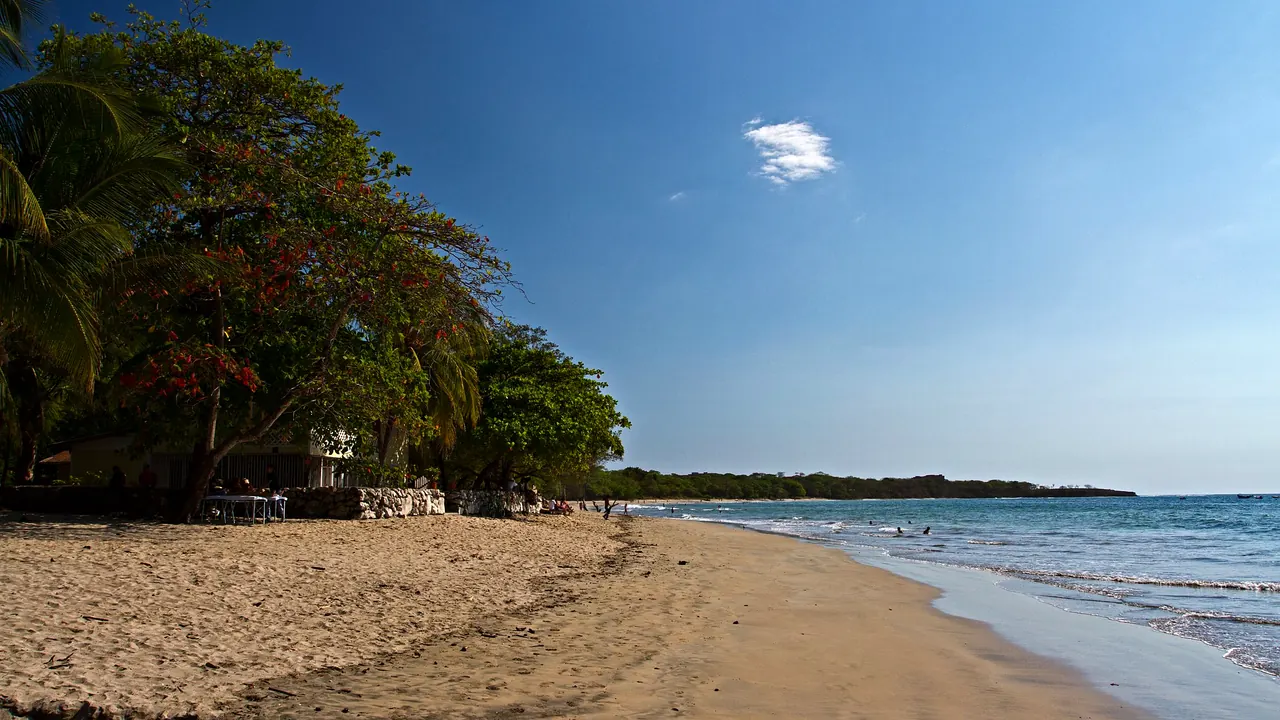
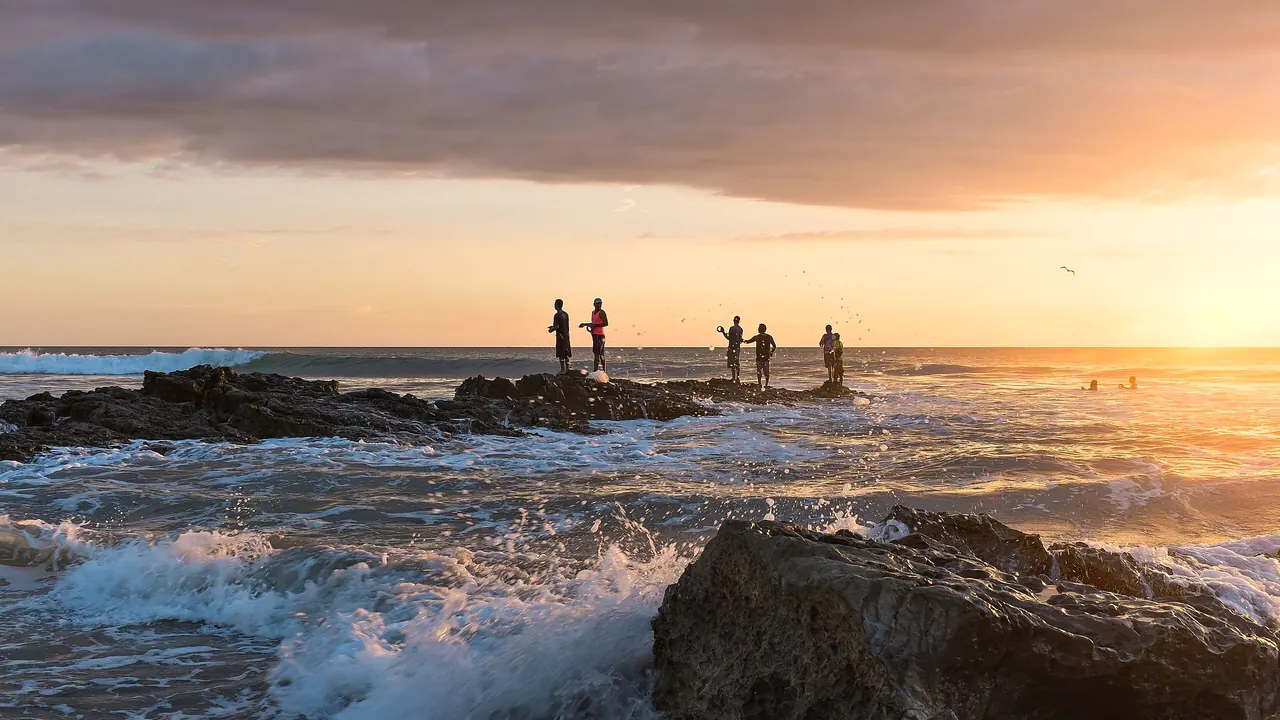
Photos: Tamarindo by Jarle Naustvik, CC BY 2.0, cropped; Santa Teresa, Costa Rica by Christopher Crouzet, CC BY-SA 4.0, cropped.
Tamarindo or Santa Teresa, Costa Rica?
Our verdict in twelve categories, each scored against the same fixed benchmark cities, and the climate month by month, so you can choose for your trip.
Choose Tamarindo for
- families
- getting around
- day trips
Families, first-time surfers who also want a night out, and anyone who dislikes complicated travel will get on better in Tamarindo. It is closer to an airport, the town can be covered on foot, and something is on most evenings. Mangrove boat trips, turtle visits at Playa Grande and the pottery village of Guaitil give children and restless adults more to do when they need a break from the sand.
Choose Santa Teresa, Costa Rica for
- wellness
- food and drink
- nature and the outdoors
Santa Teresa is for travellers who want to slow right down. Its days run on surf, yoga and sunset: shalas in the forest above the beach, retreat programmes, and hotels built around hammocks and plunge pools. The coast feels wilder and less built up than Tamarindo's. It also takes more effort to reach and costs more, so it rewards a longer stay with few plans beyond the tides.
Scoreboard
Twelve categories on one fixed scale from 0 to 100. The shaded stretch is the gap between the two.
Your match
Pick a travel style or drag the sliders, and both match scores follow your weighting.
Wins on families and getting around with your weighting.
Wins on wellness and food and drink with your weighting.
What matters to you?
Category by category
What the scores mean for a trip.
Beaches & swimming
Both are first-rate Pacific beach towns with sea around 28°C, but the beaches are very different. Santa Teresa has a long, wild stretch of pale sand with forest reaching almost to the tideline. It is a surf beach where open swimming is often risky, so careful swimmers head for the rock pools at Mal País at low tide.
Tamarindo's golden bay is gentler and part of the town, with quieter water at the southern end. Its real advantage is choice: calm Langosta, wild Playa Grande, Avellanas and Playa Negra for stronger surfers, and Conchal with its crushed-shell sand for snorkelling. Keep away from the river mouth at the north end, where crocodiles live.
Food & drink
You eat about equally well in both, and in much the same way: wood-fired pizza, poke, Argentine grills and smoothie bowls brought by foreign residents, with small sodas serving casados as the Costa Rican side. Santa Teresa's version is the more relaxed one, open-air places under thatched roofs on a dirt road with very good coffee. Tamarindo adds fish taco stands, fresh ceviche and a few more ambitious dinner places, though more of its menus are aimed at visitors. Neither has a market, and in both the choices start to repeat after a week.
Culture & sights
Neither town has museums, monuments or historic buildings. Both grew from fishing villages into surf towns. What character they have is different: Santa Teresa's comes from its international, yoga-and-surf community and its setting, while Tamarindo is mainly a strip of hotels and surf shops. Anyone who wants Costa Rican heritage should treat sightseeing as a separate part of the vacation.
Nightlife
Tamarindo is the better place to go out. It is the party town of this coast, with sunset drinks leading to open-air bars on the main road and, on busy nights, a few dance clubs playing reggaeton and electronic music. Something is on most evenings, and young Costa Ricans join in at weekends.
Santa Teresa can also go late, but only on the right night of its small weekly circuit of DJ sets and beach or jungle parties. On other nights there is little choice, the roads between venues are dark, and many people turn in early for the morning surf.
Nature & outdoors
Both are excellent for the outdoors and surfing, with beginner breaks in town and reef and point waves nearby, but the wildlife and landscapes differ. Santa Teresa leans towards forest. Howler monkeys and coatis come close to the hotels, Cabo Blanco, the country's oldest reserve, has a trail down to a remote beach, and there are the waterfalls at Montezuma and snorkelling off Isla Tortuga.
Tamarindo leans towards water and volcano. You can kayak through mangroves past crocodiles and herons, dive at the Catalinas Islands and join night visits to see leatherback turtles nesting on Playa Grande. With a full day spare, the fumaroles and mud pots of Rincon de la Vieja are within reach inland.
Day trips
Tamarindo gives you more places to go. Guaitil, where families still fire Chorotega-style pottery in traditional kilns, is under an hour inland. Nicoya has one of the oldest colonial churches in Costa Rica, and Santa Cruz is the region's folkloric centre.
From Santa Teresa, the only real outing to another town is Montezuma, a relaxed little seafront village about forty minutes away. Cóbano and Tambor are working towns rather than sights, and going any further means a ferry and a long journey.
Good for families
Tamarindo is clearly better for children. The town beach has waves gentle enough for children's surf lessons, Langosta is calm at low tide, and mangrove boat trips, zip lines and turtle nights fill the rest of the days. Families can stay at Langosta or Playa Grande, away from the late noise of the strip.
Santa Teresa suits older, outdoorsy children who will enjoy monkeys, rock pools and white-water surf lessons. For younger ones it is harder: the sea is often too rough to swim, quads use a road with no pavements, and medical care is basic and some distance away.
Getting around
Neither is easy, but Tamarindo is the less tiring. The town is small enough to walk, golf carts and bicycles cover the short trip to Langosta, regional buses run to Santa Cruz and Liberia, and Liberia's airport is a little over an hour's drive away.
Santa Teresa stretches along one rough road with no public transport, so most visitors rent a quad or scooter. Getting there takes a car ferry to Paquera and a drive through Cóbano, or a small plane to Tambor and a transfer. A four-wheel drive helps in both towns in the rainy months.
Shopping & style
Neither is a shopping destination, and both offer much the same surf brands, swimwear and linen boutiques. Tamarindo has a little more: souvenir stalls with Guaitil pottery and wooden carvings, plus a supermarket for self-catering. Santa Teresa is fine for a new board or bikini but has almost no local craft.
Affordability
Both towns charge close to what North American visitors pay at home, but Santa Teresa is the dearer of the two. Its boutique hotels and villas set a high baseline, and the journey in by ferry or small plane, the quad most visitors rent, and the surf lessons and boat trips push the total up further.
Tamarindo is easier on the budget. It is a simpler drive from Liberia's airport, and its rates ease off in the wet season from May to November after the December to April peak, although shuttles and taxis still add up beyond the town. In either place, hostels, surf camps and shared surf houses, along with casados at the local sodas, keep costs in check, and the beach is free.
Live music & performing arts
Neither has a theatre or a concert scene. Live music in both means acoustic sets in beach bars and fire dancers on the sand. Santa Teresa adds sunset drumming and DJs at its weekly parties. In Tamarindo, traditional Guanacaste folk music and dance happen mainly at festivals in nearby Santa Cruz, not in town.
Wellness & relaxation
Santa Teresa is the more restorative of the two. Yoga is part of everyday life there, with forest shalas, week-long retreats, breathwork and meditation classes, and hotels built around open decks and hammocks. The quietest places to stay are up the hill or at the ends of the coast.
Tamarindo has yoga studios, surf-and-yoga retreats and massage from beach tables to resort spas, but the strip is not restful, so calm depends on staying at Langosta or Playa Grande. It does have the volcanic hot springs around Rincon de la Vieja about two hours away. Santa Teresa has no thermal bathing at all.
When should you go?
Pick your month. The climate figures are measured averages, not a forecast.
Tamarindo in July
Santa Teresa, Costa Rica in July
Daytime high, °C
Rainfall in the month, mm
Where the figures come from
Tamarindo's temperatures are measured 54 km from the centre, at Liberia.
Tamarindo has no rain gauge within 25 km of the centre, so its rainfall comes from a gridded climate dataset read at the city rather than from a gauge further away.
Santa Teresa, Costa Rica's temperatures are measured 52 km from the centre, at Puntarenas.
Santa Teresa, Costa Rica has no rain gauge within 25 km of the centre, so its rainfall comes from a gridded climate dataset read at the city rather than from a gauge further away.
Temperature and rainfall are climate normals, averaged over the years shown. Tamarindo: 1991-2020 normals, Liberia (53.8 km from centre). Santa Teresa, Costa Rica: 1961-1990 (rainfall 1991-2020) normals, Puntarenas (51.5 km from centre).
Both towns follow the same pattern. The dry season from December to April is the best time for either: almost no rain, the brightest water and, in Santa Teresa, the sunniest skies, which peak at around 283 hours in March. It is hot, though. Highs reach about 35°C in both towns and 36°C in Tamarindo in March and April, so plan walking for the early morning or late afternoon. The sea stays close to 29°C all year in both, warm enough to swim in any month.
The rains arrive in May and are heaviest in September and October, when Santa Teresa gets about 400mm a month and its side roads turn to mud. Tamarindo is a little drier through the whole wet season and has a clearer break in July, so it is the safer choice for a green-season trip. In Santa Teresa the wet months bring bigger swell and greyer skies, with August the dullest.
Which traveller are you?
On a relaxing and wellness trip, Santa Teresa is the better choice, but give it a week or more. The journey there is long, and the calm builds slowly as the days settle into class, surf and rest. Expect yoga and massage rather than thermal baths.
On a family trip with children, Tamarindo is the easier base. The short drive from Liberia spares children a ferry crossing, and a beach morning and an outing fit into the same day. Book somewhere with a pool for the hot afternoons.
For a food and nightlife trip, Tamarindo comes out ahead, though you get a few lively blocks rather than a real scene. Stay within walking distance of the main road so you can get back on foot. Allow about a week before the menus start to repeat.
Before you go
| Measure | Tamarindo | Santa Teresa, Costa Rica |
|---|---|---|
| Official language | Spanish | Spanish |
| Currency | Costa Rican Colon (CRC) | Costa Rican Colon (CRC) |
| Sockets | AB120 V, 60 Hz | AB120 V, 60 Hz |
| Driving side | Right | Right |
| Time zone | UTC-6 | UTC-6 |
| Emergency number | 911 | 911 |
| Elevation | 27 m | 19 m |
| Main airport | Daniel Oduber Quirós International Airport (LIR)43 km from centre30 non-stop destinations | Daniel Oduber Quirós International Airport (LIR)113 km from centre30 non-stop destinations |
| Public holidays this year | 11 days | 11 days |
By the numbers
| Measure | Tamarindo | Santa Teresa, Costa Rica |
|---|---|---|
| City population | 7,132 | - |
| People per km² | 57 | - |
| Museums within 10 km | 0 | 0 |
| UNESCO World Heritage sites within 50 km | 0 | 0 |
| Swim season, months above 21 °C | 12 months | 12 months |
Where else could you go?
Every comparison below shares a destination with this one, so you can follow Tamarindo or Santa Teresa, Costa Rica somewhere new.