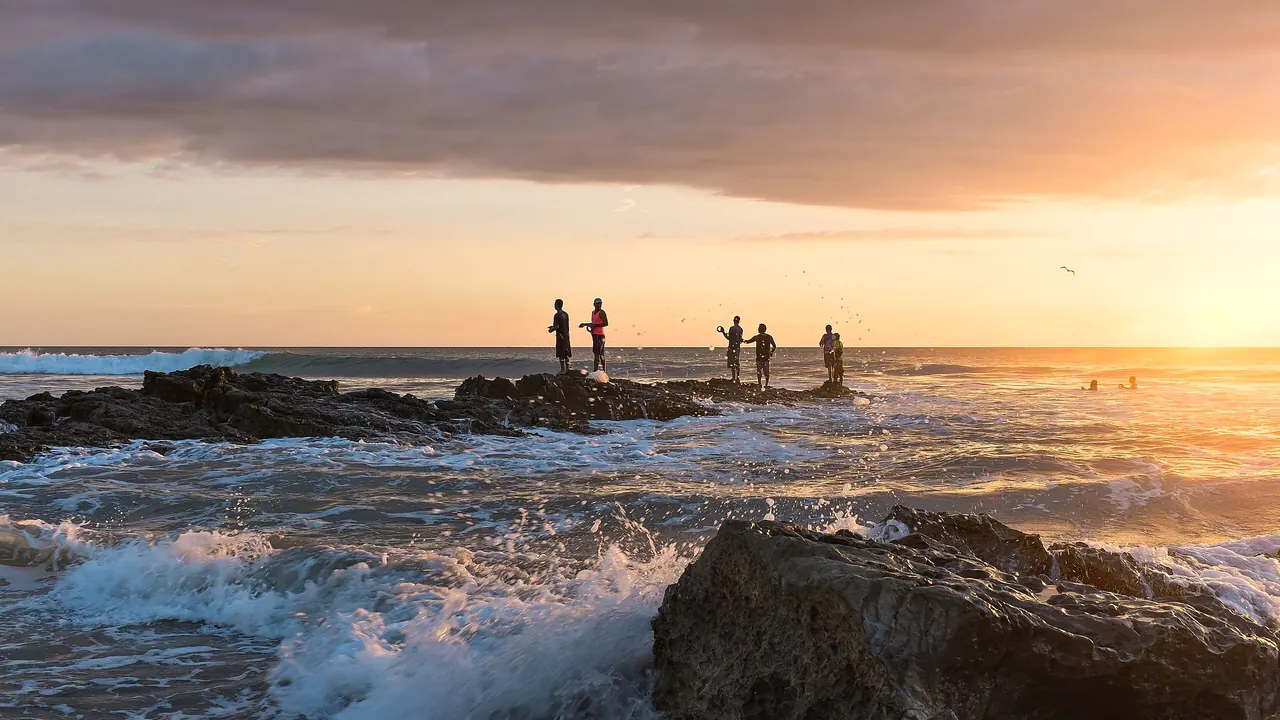
Photos: Santa Teresa, Costa Rica by Christopher Crouzet, CC BY-SA 4.0, cropped.
Monteverde or Santa Teresa, Costa Rica?
Our verdict in twelve categories, each scored against the same fixed benchmark cities, and the climate month by month, so you can choose for your trip.
Choose Monteverde for
- families
- prices
- getting around
Monteverde suits travellers who want the forest itself as the trip: dawn birding for quetzals, hanging bridges through the canopy, night walks with a guide and early nights in cool, misty air. It is the better choice for families with school-age children who love animals, and for anyone who would rather wear boots and a rain jacket than swimwear. Your money also goes a little further there, although guides and tours add up.
Choose Santa Teresa, Costa Rica for
- beaches
- wellness
- nightlife
Santa Teresa is for people who want sand, surf and warm water, with yoga, sunset drinks and the odd late party to fill the hours between tides. Surfers, couples and long-stay wellness travellers will feel at home there, and the food along the main road has more range. It costs more, it is harder to get around, and the sea is not always kind to young swimmers.
Scoreboard
Twelve categories on one fixed scale from 0 to 100. The shaded stretch is the gap between the two.
Your match
Pick a travel style or drag the sliders, and both match scores follow your weighting.
Wins on families and prices with your weighting.
Wins on beaches and wellness with your weighting.
What matters to you?
Category by category
What the scores mean for a trip.
Beaches & swimming
This is the starkest difference between the two. Monteverde sits on a mountain ridge with nowhere to swim, and the nearest coast at Puntarenas is about two hours away on winding roads. Visitors who want the beach usually tack a few nights at the coast onto the trip.
Santa Teresa is built around its beach: a long run of pale sand from Playa Carmen down to the rocky Mal País shore, with forest growing almost to the tideline. It is a surf beach, though, with rip currents on many days, so cautious swimmers head for the rock pools at low tide.
Food & drink
Monteverde's food is plain and honest: casados of rice, beans and plantain in the sodas of Santa Elena, a few more ambitious lodge restaurants, and not much choice once evening comes. Its strength is produce from the place itself. You can taste coffee from the surrounding slopes on farm tours, and the cheese comes from the dairy the Quaker settlers founded.
Santa Teresa eats better overall, with wood-fired pizza, poke, Israeli plates, Argentine grills and fresh seafood under thatched roofs along the main road. That range comes from its international residents rather than from the place, though. There is no market or street food, and after a few days the laid-back cafés start to feel much alike.
Culture & sights
Neither is a place for sightseeing, but Monteverde has a little more of a story. The Quaker settlers who arrived in the early 1950s shaped the community, the dairy and the protection of the forest, and small butterfly and insect exhibits add something. Santa Teresa is a fishing hamlet turned surf town with nothing to visit, so its appeal lies wholly in its setting and its international crowd.
Nightlife
Santa Teresa is where you can stay out. Sunset drinks on the sand lead on to beach bars, and a small circuit of DJ nights and jungle parties moves between venues through the week, so on the right night it goes late. It is still a village, without a bar district.
In Monteverde the evening entertainment is a guided night walk looking for tarantulas and tree frogs, followed by a drink in Santa Elena and an early bed before dawn birding.
Nature & outdoors
Both are outdoor destinations, but Monteverde is the more remarkable. Its cloud forest is hung with moss, orchids and bromeliads, protected in several reserves with marked trails and hanging bridges. Birders come for the resplendent quetzal and the bellbirds, and Costa Rica's canopy zip-lines started here.
Santa Teresa's outdoors centres on the water: consistent surf, snorkelling trips to Isla Tortuga, Montezuma's waterfalls and the trail through Cabo Blanco to a remote beach. Howler monkeys turn up in the dry forest behind the coast, but there are no mountains or misty canopy walks.
Day trips
Neither works well as a base for excursions, because each is a destination in its own right at the end of a slow road. From Santa Teresa, Montezuma makes an easy afternoon, and the reserves and islands nearby fill other days. From Monteverde, Puntarenas is hardly worth the round trip, and Arenal is too far for a day out, so treat it as your next stop.
Good for families
Monteverde is the easier family choice. Hanging bridges, frog and butterfly exhibits and torchlit hunts for sleeping birds keep school-age children busy, and older ones can try the zip-lines. Toddlers are another matter, given the steep, muddy trails and the cool, damp weather.
Santa Teresa suits outdoorsy families who will happily spend their days in hotel pools, rock pools and gentle surf lessons. The open sea is often unsafe for young swimmers, the main road has quads and no pavements, and medical care is some distance away.
Getting around
Both take effort to reach, but Monteverde is easier once you are there. Tour operators collect you from your hotel, a small bus runs to the reserves and taxis are easy to find, so you can manage without a car despite the steep roads.
Santa Teresa is strung along one rough coastal road with no pavements or public transport, so most people rent a quad or scooter. Getting there usually means a car ferry to Paquera and the road through Cóbano, or a small plane to Tambor.
Shopping & style
The real difference is what you take home. From Monteverde it is bags of coffee and chocolate grown nearby, and embroidery from the women's artisan cooperative, which makes the more meaningful souvenir of the two.
From Santa Teresa it is more likely a bikini, linen clothes or a new surfboard from the boutiques along the main road, with little made locally. In both places shopping fills an hour rather than a day.
Affordability
Monteverde is the cheaper of the two, though neither is a bargain. Hostels and sodas keep the basics down, but you will spend on reserve entry, wildlife guides and canopy tours.
Santa Teresa is pricier than most of Costa Rica. Its boutique hotels, villas and international cafés charge close to North American rates, and quad rental, surf lessons and the journey in add to the cost. Shared surf houses and the free beach help those on a budget.
Live music & performing arts
In Monteverde, live music is occasional and low-key: local musicians in a restaurant some evenings, or now and then a small community concert. Santa Teresa's has more of a beach-party feel, with acoustic sets in the bars, drumming and fire dancing at sunset, and DJs at the weekly parties. Neither has a theatre or concert hall, so there is no performance worth planning a trip around.
Wellness & relaxation
Santa Teresa is the wellness destination. Yoga shalas in the forest above the beach, retreat centres, breathwork and massage are all easy to find, and many hotels have open decks and plunge pools. The quieter stays are up the hill, away from the dust of the main road.
Monteverde's version of rest is simpler: cool air, birdsong at dawn and a balcony over the trees, with only a few lodge treatments and yoga classes. Neither has hot springs, and for those you would drive to Arenal.
When should you go?
Pick your month. The climate figures are measured averages, not a forecast.
Monteverde in July
Santa Teresa, Costa Rica in July
Daytime high, °C
Rainfall in the month, mm
Where the figures come from
Monteverde has no weather station within reach, so its figures come from a gridded climate model rather than a measured record, and read a broad area rather than one spot.
Santa Teresa, Costa Rica's temperatures are measured 52 km from the centre, at Puntarenas.
Santa Teresa, Costa Rica has no rain gauge within 25 km of the centre, so its rainfall comes from a gridded climate dataset read at the destination rather than from a gauge further away.
Temperature and rainfall are climate normals, averaged over the years shown. Monteverde: 1991-2020 normals, TerraClimate 4 km grid at the town, no weather station within 90 km. Santa Teresa, Costa Rica: 1961-1990 (sunshine 1981-2010, rainfall 1991-2020) normals, Puntarenas (51.5 km from centre).
Both places follow the same Costa Rican pattern: a dry season from December to April, then heavy rain from May to November that peaks in September and October, when Monteverde can take 459mm in a month. Monteverde stays mild all year, with afternoons around 24°C. That is comfortable for walking at any time, but the dry months are often windy and misty, and the wet months bring downpours most afternoons, so January to April is the easier time for the trails.
Santa Teresa is hot rather than mild. Highs reach 35°C from February to April, and the long sunny days of the dry season make that the classic beach time. The sea stays around 29°C all year, so swimming is never limited by cold. In the green season the sun gives way to cloud and heavy rain, the swell gets bigger and the roads turn to mud, but August and September are a little cooler.
Which traveller are you?
On a beach and sun trip, Santa Teresa is the obvious pick. It has a long stretch of pale sand, sea around 29°C, surf schools on every corner and sunsets that bring everyone onto the sand. Monteverde has no swimming at all.
For a relaxing and wellness trip, Santa Teresa again comes out ahead. Forest yoga shalas, week-long retreats, massage and hammock-strung decks shape the days there. Monteverde offers quiet, birdsong and balconies over the trees, but almost no spa or treatment options.
On a family trip with children, Monteverde works better, especially for school-age animal lovers. There are butterfly gardens, frog exhibits, torchlit night walks and zip-lines for older children. Santa Teresa's rip currents, busy quad traffic and lack of pavements make it harder going.
Before you go
| Measure | Monteverde | Santa Teresa, Costa Rica |
|---|---|---|
| Official language | Spanish | Spanish |
| Currency | Costa Rican Colon (CRC) | Costa Rican Colon (CRC) |
| Sockets | AB120 V, 60 Hz | AB120 V, 60 Hz |
| Driving side | Right | Right |
| Time zone | UTC-6 | UTC-6 |
| Emergency number | 911 | 911 |
| Elevation | 1,330 m | 19 m |
| Main airport | Juan Santamaría International Airport (SJO)76 km from centre49 non-stop destinations | Daniel Oduber Quirós International Airport (LIR)113 km from centre30 non-stop destinations |
| Public holidays this year | 11 days | 11 days |
By the numbers
| Measure | Monteverde | Santa Teresa, Costa Rica |
|---|---|---|
| Population | 5,386 | - |
| People per km² | 101 | - |
| Museums within 10 km | 1 | 0 |
| UNESCO World Heritage sites within 50 km | 1 | 0 |
| Swim season, months above 21 °C | 12 months | 12 months |
Where else could you go?
Every comparison below shares a destination with this one, so you can follow Monteverde or Santa Teresa, Costa Rica somewhere new.
- La Fortunavs Monteverde
- San Jose, Costa Ricavs Monteverde
- Tamarindovs Santa Teresa, Costa Rica
- Tamarindovs Monteverde
- La Fortunavs Santa Teresa, Costa Rica
- San Jose, Costa Ricavs Santa Teresa, Costa Rica