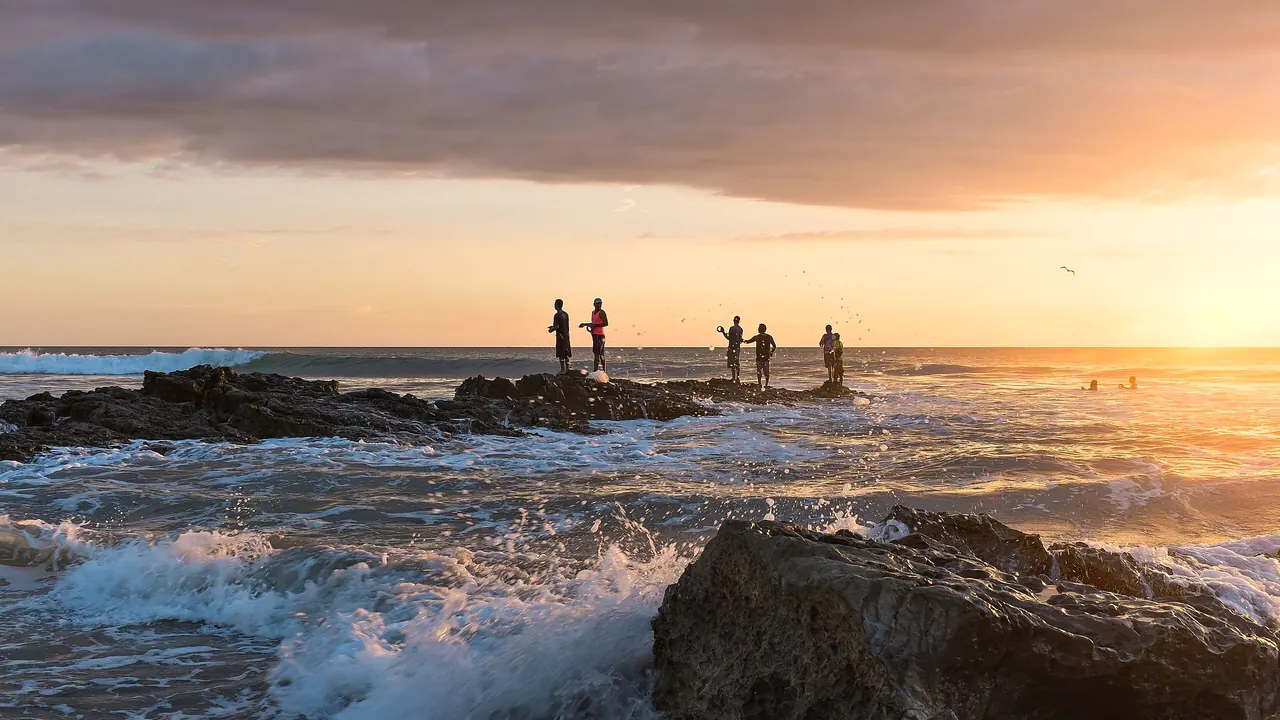
Photos: Santa Teresa, Costa Rica by Christopher Crouzet, CC BY-SA 4.0, cropped.
La Fortuna or Santa Teresa, Costa Rica?
Our verdict in twelve categories, each scored against the same fixed benchmark cities, and the climate month by month, so you can choose for your trip.
Choose La Fortuna for
- families
- nature and the outdoors
- prices
La Fortuna is the better choice for travellers who want rainforest and volcano at the centre of the trip. Days go on lava-flow trails under Arenal, on hanging bridges where sloths and toucans are easy to see, and on rafting and canyoning, and evenings end in hot springs. It is also the easier place for families and the cheaper of the two, although the activities you come for still cost a fair amount.
Choose Santa Teresa, Costa Rica for
- beaches
- nightlife
- food and drink
Pick Santa Teresa if the sea is the point. It has the beach La Fortuna completely lacks: a long run of pale sand with warm water and surf for every level. It also has more going on after dark and a wider choice of food. It suits surfers, couples and yoga-minded travellers who don't mind a remote village on a dirt road and a bigger bill.
Scoreboard
Twelve categories on one fixed scale from 0 to 100. The shaded stretch is the gap between the two.
Your match
Pick a travel style or drag the sliders, and both match scores follow your weighting.
Wins on families and nature and the outdoors with your weighting.
Wins on beaches and nightlife with your weighting.
What matters to you?
Category by category
What the scores mean for a trip.
Beaches & swimming
La Fortuna has no beach at all. Swimming there means the cool plunge pool below the waterfall, a calm spot on a river or a corner of Lake Arenal, and the Pacific is more than three hours away by road.
Santa Teresa is the reverse: a long strand of pale sand running from Playa Carmen down to the rockier shore at Mal País, with palms and forest close to the water. The catch is the surf. Rip currents make open swimming risky on many days, so cautious swimmers head for the rock pools at Mal País at low tide.
Food & drink
Santa Teresa eats more widely. Its international residents have brought wood-fired pizza, poke, Israeli plates and Argentine grills to open-air places along the main road, and sodas and fresh fish cover the local side. La Fortuna's choice is narrower: sodas serving casados and gallo pinto, plus steakhouses and pizza aimed at tour groups.
What La Fortuna offers that the coast doesn't is the farm. You can taste cacao and coffee grown on the volcanic soil just outside town. Neither place has a market.
Culture & sights
Neither is a place for sightseeing, and the little there is differs in kind. La Fortuna has its white church on the central park, best known as a frame for Arenal, and the Maleku indigenous communities to the north make a worthwhile separate outing. Santa Teresa has nothing to visit, and its character comes from its surfing community rather than from any history on show.
Nightlife
Santa Teresa is the place for a night out, though on a small scale. Sunset drinks on the sand lead into a few venues taking turns through the week with DJ nights and beach or jungle parties, and on the right night these go late. La Fortuna winds down early, with a handful of bars, salsa or a band at the weekend, and a town that is quiet by late evening because most visitors are in the hot springs and then in bed.
Nature & outdoors
Both are outdoor destinations, but La Fortuna's landscape is bigger and more varied. Arenal's cone rises above lava-flow trails and primary rainforest, the waterfall drops 70m into a gorge, and Lake Arenal stretches west. There is rafting on the Balsa and Toro rivers and canyoning down waterfalls, and Río Celeste and the Caño Negro wetlands are within reach.
Santa Teresa's outdoors is mostly the ocean: beginners' surf at Playa Carmen, stronger reef and point breaks nearby, and snorkelling trips to Isla Tortuga. Inland is dry forest with howler monkeys and coatis, plus the trail through Cabo Blanco reserve, but there are no mountains.
Day trips
Both are poor bases for visiting other places, and in both the best excursions go into the landscape rather than to towns. La Fortuna has a little more variety, with the topiary garden at Zarcero and the Maleku villages near Guatuso, while the lake crossing to Monteverde works better as a transfer than a day out. From Santa Teresa, Montezuma is about forty minutes away and makes a pleasant afternoon, and anything further means a ferry and a long journey.
Good for families
La Fortuna is the easier base with children. Hot-spring resorts have warm pools with slides, sloths and frogs are easy to spot from the hanging bridges, and gentle horse rides and chocolate-making fill the gaps. Its limits are age minimums on ziplines and rafting and the steep stairs down to the waterfall.
Santa Teresa suits older, sporty children best: rock pools at low tide and surf lessons in the white water. The open sea is unsafe for young swimmers on many days, the main road has no pavements and carries a lot of quads, and medical care is basic and some distance away.
Getting around
La Fortuna at least has a centre you can walk: a few flat blocks around the central park hold the restaurants and tour offices. Everything you come for lies outside it, though, with the hot springs, volcano trails and hanging bridges spread out along the lake road. Tours usually include transport, and a hire car gives you the lake and Río Celeste, on roads that are slow in heavy rain.
Santa Teresa has no real centre, only one rough coastal road with no pavements and no public transport. Visitors rent quads, scooters or bicycles or take taxis, and walking along the beach is often the nicest way between spots. Just getting there is more work, with a car ferry to Paquera or a small plane to Tambor and then a transfer.
Shopping & style
Shopping is an afterthought in both, and what differs is what you take home. La Fortuna sells souvenirs and gifts: carved bowls, hammocks, painted masks, Maleku crafts and bags of local coffee and chocolate. Santa Teresa's boutiques lean towards swimwear, linen clothes and surfboards, and have little local craft.
Affordability
La Fortuna is the more manageable of the two on a budget, as long as you keep an eye on the excursions. Sodas and simple guesthouses in town are fairly priced, and most of the bill comes from rafting, ziplines and the hot-spring resorts. The free warm river and trails you walk on your own keep costs down.
In Santa Teresa the boutique hotels, villas and international cafés charge close to what you would pay in North America. The journey there, a rented quad and surf lessons or boat trips all add to that, so even a stay in a hostel with meals at the sodas costs more than it would inland.
Live music & performing arts
In La Fortuna, live performance means a weekend band in a bar or folkloric dance staged with dinner, and most evenings belong to the hot springs. Santa Teresa's version is looser and happens outdoors: acoustic sets at beach bars, drumming and fire dancing at sunset, and DJs at the weekly parties. Neither town has a theatre or concert hall, so anyone who wants a proper performance should plan it for another part of the trip.
Wellness & relaxation
In La Fortuna, wellness comes from the volcano. Arenal's heat feeds thermal springs that resorts have shaped into terraced pools and cascades among rainforest gardens, and there is a free warm river stretch by the road, with spa treatments and open-air yoga alongside.
Santa Teresa has no hot springs, and its strength is yoga: shalas in the forest above the beach, week-long retreats, breathwork and massage. It works well for a structured retreat, but for long, quiet soaks La Fortuna is the stronger pick.
When should you go?
Pick your month. The climate figures are measured averages, not a forecast.
La Fortuna in July
Santa Teresa, Costa Rica in July
Daytime high, °C
Rainfall in the month, mm
Where the figures come from
La Fortuna's temperatures are measured 60 km from the centre, at Puntarenas.
La Fortuna's station stands 248 m below the city centre, so the centre is likely a little cooler than the figures say.
La Fortuna has no rain gauge within 25 km of the centre, so its rainfall comes from a gridded climate dataset read at the destination rather than from a gauge further away.
Santa Teresa, Costa Rica's temperatures are measured 52 km from the centre, at Puntarenas.
Santa Teresa, Costa Rica has no rain gauge within 25 km of the centre, so its rainfall comes from a gridded climate dataset read at the destination rather than from a gauge further away.
Temperature and rainfall are climate normals, averaged over the years shown. La Fortuna: 1961-1990 (sunshine 1981-2010, rainfall 1991-2020) normals, Puntarenas (59.7 km from centre). Santa Teresa, Costa Rica: 1961-1990 (sunshine 1981-2010, rainfall 1991-2020) normals, Puntarenas (51.5 km from centre).
Both places are hot all year, with highs of around 35°C from February to April and rarely much cooler at other times. Both get their brightest weather in March and their dullest from June to October, so the real difference between them is rain. Santa Teresa has a sharp dry season from December to April, when January sees barely 2mm. That is the time for the beach, with a sea that stays near 29°C in every month. From May the rains arrive, they peak in September and October, and the side roads turn to mud.
La Fortuna is wet in every month. Even its driest stretch in March and April brings about 85mm, and October can bring 422mm. January to April gives the clearest views of the volcano and the most comfortable hiking, though the midday heat is best spent in the water. A trip combining the two works best in those same early months.
Which traveller are you?
On a beach and sun trip, Santa Teresa is the clear choice. La Fortuna is inland, more than three hours from the Pacific. Santa Teresa has a long sandy beach, warm sea all year, surf schools for beginners and almost rainless months from December to April.
On a family trip with young children, La Fortuna is easier. Hot-spring pools with water slides, sloths seen from hanging bridges and chocolate-making visits fill the days. In Santa Teresa, strong currents and a main road without pavements, busy with quads, make life harder.
For a relaxing and wellness trip, La Fortuna's thermal springs fed by Arenal give long, warm soaks in rainforest gardens, with spa treatments alongside. Santa Teresa has no hot water and suits those who would rather unwind through daily yoga and a retreat programme.
Before you go
| Measure | La Fortuna | Santa Teresa, Costa Rica |
|---|---|---|
| Official language | Spanish | Spanish |
| Currency | Costa Rican Colon (CRC) | Costa Rican Colon (CRC) |
| Sockets | AB120 V, 60 Hz | AB120 V, 60 Hz |
| Driving side | Right | Right |
| Time zone | UTC-6 | UTC-6 |
| Emergency number | 911 | 911 |
| Elevation | 253 m | 19 m |
| Main airport | Juan Santamaría International Airport (SJO)71 km from centre49 non-stop destinations | Daniel Oduber Quirós International Airport (LIR)113 km from centre30 non-stop destinations |
| Public holidays this year | 11 days | 11 days |
By the numbers
| Measure | La Fortuna | Santa Teresa, Costa Rica |
|---|---|---|
| Population | 16,150 | - |
| People per km² | 70 | - |
| Museums within 10 km | 0 | 0 |
| UNESCO World Heritage sites within 50 km | 1 | 0 |
| Swim season, months above 21 °C | - | 12 months |
Where else could you go?
Every comparison below shares a destination with this one, so you can follow La Fortuna or Santa Teresa, Costa Rica somewhere new.
- Monteverdevs La Fortuna
- Monteverdevs Santa Teresa, Costa Rica
- San Jose, Costa Ricavs La Fortuna
- Tamarindovs Santa Teresa, Costa Rica
- San Jose, Costa Ricavs Santa Teresa, Costa Rica
- Tamarindovs La Fortuna