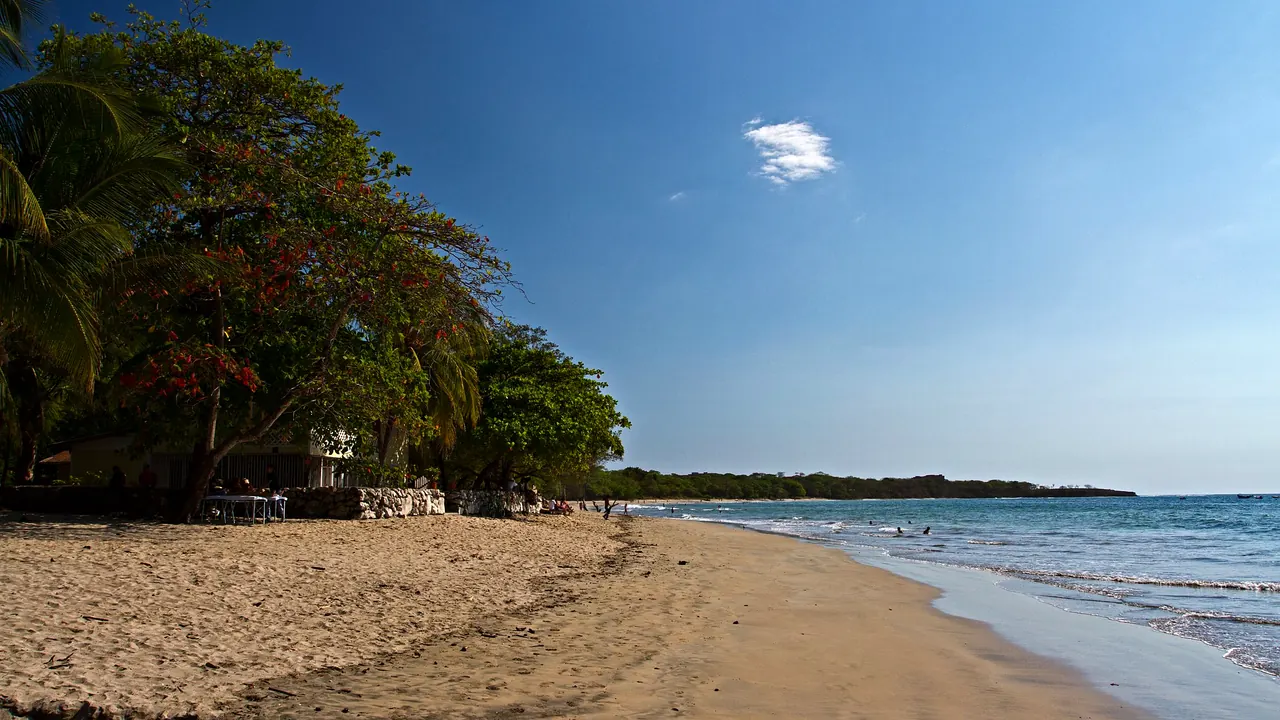
Photos: Tamarindo by Jarle Naustvik, CC BY 2.0, cropped.
Monteverde or Tamarindo?
Our verdict in twelve categories, each scored against the same fixed benchmark cities, and the climate month by month, so you can choose for your trip.
Choose Monteverde for
- nature and the outdoors
- culture and sights
- prices
Monteverde suits travellers who want the forest itself to be the trip: dawn walks in mossy cloud forest, guided night walks, hanging bridges and the chance of a quetzal. It is cool, quiet and early to bed, with no beach and little to do after dark. It works best as two or three nights inland for birders, nature lovers and families with school-age children who like animals.
Choose Tamarindo for
- beaches
- nightlife
- day trips
Tamarindo is the choice for sun, sand and an easy social rhythm. A golden bay with gentle surf, warm water all year, sunset drinks and a few lively bars make it the better base for learning to surf, swimming and evenings out. The nature here is coastal: mangroves, turtles and boat trips rather than deep forest. Many people on a Costa Rica route end up doing both, the mountains first and then the coast.
Scoreboard
Twelve categories on one fixed scale from 0 to 100. The shaded stretch is the gap between the two.
Your match
Pick a travel style or drag the sliders, and both match scores follow your weighting.
Wins on nature and the outdoors and culture and sights with your weighting.
Wins on beaches and nightlife with your weighting.
What matters to you?
Category by category
What the scores mean for a trip.
Beaches & swimming
This is the starkest gap between the two. Monteverde has no beach and no swimming, and the nearest coast at Puntarenas is a couple of hours down winding roads, so anyone wanting sand has to plan separate nights for it.
Tamarindo is built around its bay of golden sand, with warm water and gentle, steady waves for beginners. Within a short drive you have quieter Langosta, wild Playa Grande, Avellanas and Playa Negra for stronger surfers, and the clearer water of Conchal for snorkelling. Watch for rip currents and keep away from the estuary's crocodiles.
Food & drink
Both places rely on the soda and its casado of rice, beans, plantain and grilled meat or fish, but Tamarindo offers more choice. Foreign residents have brought fish tacos, poke bowls, wood-fired pizza and Argentine grills, plus fresh ceviche from the day's catch, though the menus repeat after a week.
Monteverde's range is narrower and the evening choice thin, as most eating happens in small Santa Elena. What it has that the coast lacks is real local produce: coffee grown on the surrounding slopes, tasted on farm tours, and cheese from the dairy the Quaker settlers founded.
Culture & sights
Neither town is a place for museums, monuments or historic architecture, so the difference lies in what little each has. Monteverde has an unusual story, the American Quakers who settled in the early 1950s and helped protect the forest, still visible in the community and its cheese plant. Tamarindo grew from a fishing village into a surf resort, and for heritage you head inland to the older towns of the Nicoya Peninsula.
Nightlife
Tamarindo is the only one of the two with a night out. Evenings begin with drinks on the sand at sunset, move to open-air bars on the main road and, on the busy night of the week, end in a dance club playing reggaeton or electronic music. It is small and the crowd is much the same each night, but something is on most evenings.
Monteverde goes to bed early. A few Santa Elena bars serve a drink after dinner, but the real evening outing is a guided night walk for tree frogs and tarantulas, before an early start for the birds.
Nature & outdoors
Both are strong nature destinations, but Monteverde has the more remarkable landscape. Its moss-hung cloud forest along the continental divide, protected in the Monteverde, Santa Elena and Children's Eternal Rainforest reserves, is the reason to come, with hanging bridges, canopy zip-lines, quetzals, bellbirds and dozens of hummingbird species.
Tamarindo's outdoors is coastal and active: surfing, diving at the Catalinas Islands, kayaking through mangroves full of herons and howler monkeys, and leatherback turtles nesting at Playa Grande in season. The surrounding dry forest turns brown from December, and for volcanic scenery you drive about two hours to Rincon de la Vieja.
Day trips
Tamarindo has more to reach in a day. Guaitil, about 45 minutes inland, is a village of Chorotega-style potters with traditional kilns, Nicoya has one of the country's oldest colonial churches, and coastal towns such as Playas del Coco or Nosara make a change of scene, roads permitting.
From Monteverde there is very little, since the cloud forest is itself the excursion. Puntarenas is hardly worth the round trip, and Arenal and La Fortuna are three hours or more away, better treated as your next stop than as a day out.
Good for families
Both work for families, but for different children. Monteverde suits school-age animal lovers, with butterfly gardens, frog exhibits, hanging bridges and torchlit night walks, though the cool, damp weather, steep wet trails and long drive up make it hard work with toddlers.
Tamarindo is the easier choice with younger children, as days revolve around the sea, gentle surf lessons, calm water at low tide and pools at many rentals. The catches are rip currents, the crocodile-filled estuary and late noise on the main strip, which is why families often stay at Langosta or Playa Grande.
Getting around
Getting around is similar in both: small centres you can walk, with harder going beyond them. In Monteverde the effort is getting up the slow mountain road; once there, tour pick-ups, taxis and a small bus cover the reserves, so a car is unnecessary. Tamarindo is easy on foot along the sand and by golf cart or bicycle to Langosta, but reaching other beaches means shuttles, taxis or a rental car, ideally four-wheel drive in the wet season.
Shopping & style
Tamarindo gives you a little more to browse, almost all of it for the beach, though in neither town would you set aside a day for shopping. In Monteverde the shops in Santa Elena sell souvenirs and outdoor gear, along with bags of coffee and chocolate grown nearby. The best thing to take home is embroidery from the women's artisan cooperative.
Tamarindo adds surf shops for boards, wetsuits and rash guards, small boutiques of swimwear and linen, and stalls with wooden carvings and Guaitil pottery. The pottery is better bought from the potters in the village itself.
Affordability
Expect prices close to North American levels in either place, because Costa Rica is the costliest country in the region. The money just goes on different things. In Monteverde it is reserve entrances, the guide you need to spot wildlife, canopy tours, night walks and the shuttle up the mountain.
In Tamarindo it is resort-town hotels, beachfront meals, drinks and transport, since little beyond the town is reachable on foot. In both places, hostels and the local sodas keep a budget trip possible, and in Tamarindo the beach itself costs nothing.
Live music & performing arts
You are a little more likely to come across live music in Tamarindo, though neither town has a theatre, a concert hall or a programme you could plan a trip around. In Monteverde it comes down to the odd evening of local musicians in a restaurant or bar and the occasional small community concert. Tamarindo has bands and acoustic sets in its beach bars and now and then fire dancers on the sand, while Guanacaste folk music and dance belong to the festivals in nearby Santa Cruz.
Wellness & relaxation
Tamarindo has more on offer for a restorative stay. Yoga studios hold daily classes, surf-and-yoga retreats are common, and massages range from beach tables to resort spas, while Langosta and Playa Grande give you quiet hammock days away from the noisy strip.
Monteverde's version of rest is simpler: cool misty air, birdsong at dawn, lodge balconies over the trees and early nights. Treatments are few, and for hot springs you need to move on to Arenal.
When should you go?
Pick your month. The climate figures are measured averages, not a forecast.
Monteverde in July
Tamarindo in July
Daytime high, °C
Rainfall in the month, mm
Where the figures come from
Monteverde has no weather station within reach, so its figures come from a gridded climate model rather than a measured record, and read a broad area rather than one spot.
Tamarindo's temperatures are measured 54 km from the centre, at Liberia.
Tamarindo has no rain gauge within 25 km of the centre, so its rainfall comes from a gridded climate dataset read at the destination rather than from a gauge further away.
Temperature and rainfall are climate normals, averaged over the years shown. Monteverde: 1991-2020 normals, TerraClimate 4 km grid at the town, no weather station within 90 km. Tamarindo: 1991-2020 normals, Liberia (53.8 km from centre).
Monteverde stays mild all year, with daytime highs rarely above 25°C, so walking the trails is comfortable in any month. The difference is rain. January to April is the drier stretch, though often windy and misty, and from May the afternoons turn very wet, building to around 459mm in October, when trails are at their muddiest. November is a transition month and December starts to dry out again.
Tamarindo follows the same wet-season calendar but is far hotter. December to March is almost rainless, ideal for the beach but hot, peaking near 36°C in March and April, so walking around town is best early or late. Rain arrives in May and is heaviest in September and October, at about 379mm, usually as afternoon storms. The sea stays around 28°C or warmer all year, so swimming is never out of season.
Which traveller are you?
On a beach and sun trip, Tamarindo is the obvious pick. Its long golden bay has gentle waves for surf lessons, and calmer Langosta and Conchal are close by. Monteverde sits on a misty mountain ridge with no swimming at all.
For an outdoors trip built around wildlife and walking, Monteverde has the edge. Its cloud forest reserves offer marked trails, hanging bridges, quetzals and hummingbirds. Tamarindo answers with surfing, mangrove kayaking and turtle nights, which is excellent but more about the sea.
On a food and nightlife trip, Tamarindo wins clearly. Its strip of taco stands, grills and ceviche leads into sunset drinks, open-air bars and a few dance clubs. Monteverde's evenings mean an early dinner in Santa Elena and a night walk with a torch.
Before you go
| Measure | Monteverde | Tamarindo |
|---|---|---|
| Official language | Spanish | Spanish |
| Currency | Costa Rican Colon (CRC) | Costa Rican Colon (CRC) |
| Sockets | AB120 V, 60 Hz | AB120 V, 60 Hz |
| Driving side | Right | Right |
| Time zone | UTC-6 | UTC-6 |
| Emergency number | 911 | 911 |
| Elevation | 1,330 m | 27 m |
| Main airport | Juan Santamaría International Airport (SJO)76 km from centre49 non-stop destinations | Daniel Oduber Quirós International Airport (LIR)43 km from centre30 non-stop destinations |
| Public holidays this year | 11 days | 11 days |
By the numbers
| Measure | Monteverde | Tamarindo |
|---|---|---|
| Population | 5,386 | 7,132 |
| People per km² | 101 | 57 |
| Museums within 10 km | 1 | 0 |
| UNESCO World Heritage sites within 50 km | 1 | 0 |
| Swim season, months above 21 °C | 12 months | 12 months |
Where else could you go?
Every comparison below shares a destination with this one, so you can follow Monteverde or Tamarindo somewhere new.
- La Fortunavs Monteverde
- Santa Teresa, Costa Ricavs Monteverde
- San Jose, Costa Ricavs Monteverde
- Santa Teresa, Costa Ricavs Tamarindo
- La Fortunavs Tamarindo
- Granada, Nicaraguavs Tamarindo