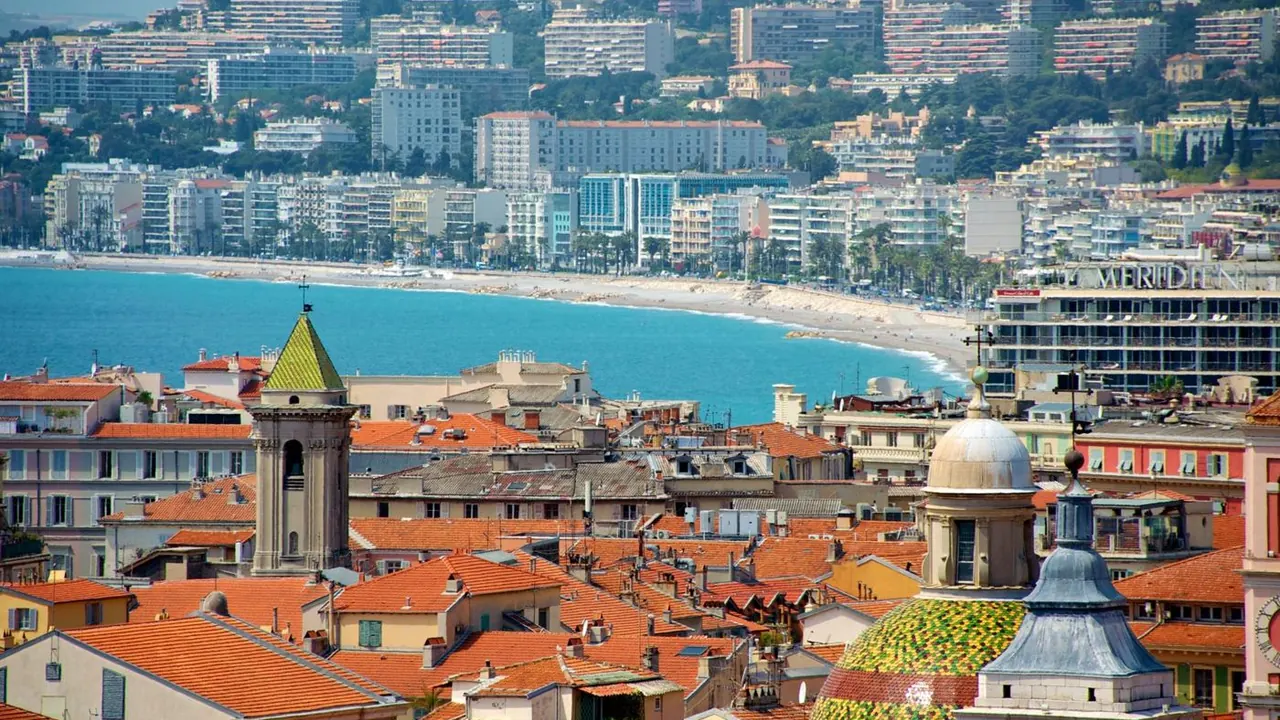
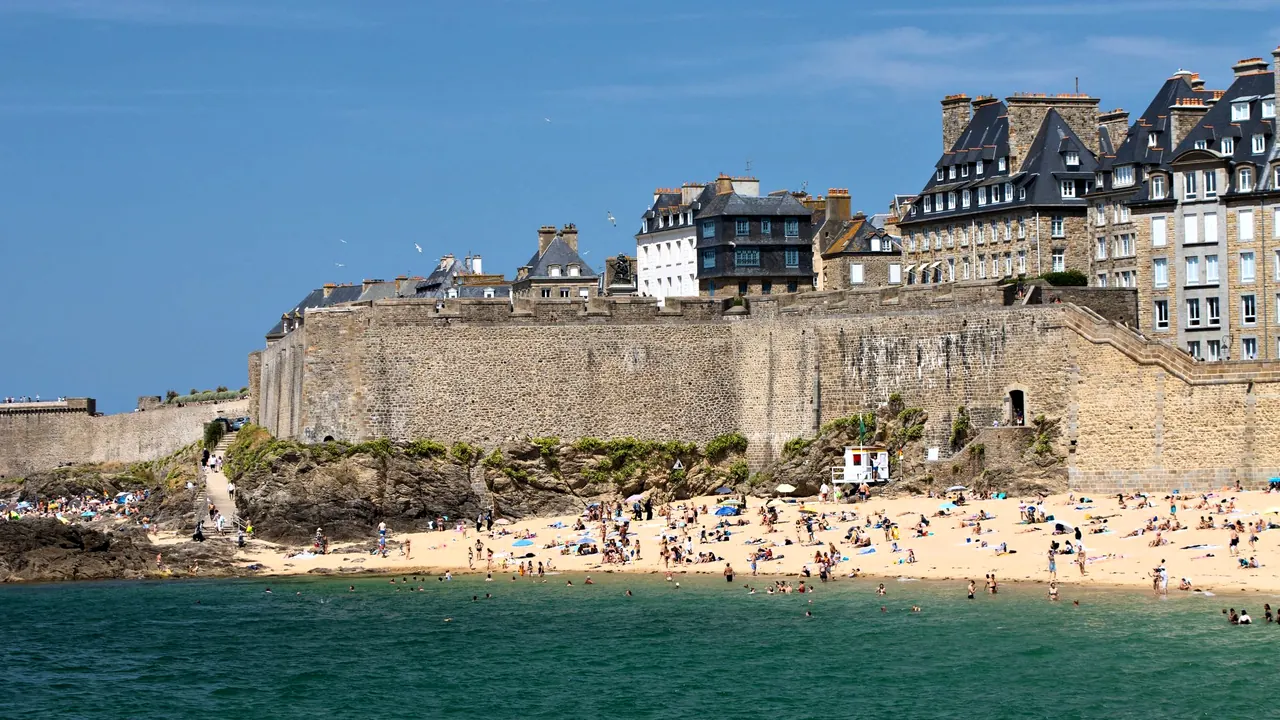
Photos: Nice by Daniel Stockman, CC BY-SA 2.0, cropped; Saint-Malo by Efrem Efre, Pexels License.
Nice or Saint-Malo?
Our verdict in twelve categories, each scored against the same fixed benchmark cities, and the climate month by month, so you can choose for your trip.
Choose Nice for
- beaches
- culture and sights
- nightlife
Nice suits travellers who want a warm sea, a real city around them and a different town to visit every day. The coastal railway puts Monaco, Antibes and Èze within easy reach without a car. The Matisse and Chagall museums in Cimiez give a grey day a purpose, and evenings in the lanes of Vieux Nice run later than anything Saint-Malo can manage.
Choose Saint-Malo for
- wellness
- families
- prices
Saint-Malo makes more sense for a slower seaside break, especially with children. It has wide sandy beaches, a rampart walk around the whole town and island forts you can walk out to at low tide. It also wins for anyone who wants seawater pools and empty winter sand rather than heat and crowds, as long as they accept cold water and a car for the best outings.
Scoreboard
Twelve categories on one fixed scale from 0 to 100. The shaded stretch is the gap between the two.
Your match
Pick a travel style or drag the sliders, and both match scores follow your weighting.
Wins on beaches and culture and sights with your weighting.
Wins on wellness and families with your weighting.
What matters to you?
Category by category
What the scores mean for a trip.
Beaches & swimming
Nice has the better beach life, mainly because of the water. The sea is clear and warm enough to swim from June into October, but the 7km city shore is pebble, and loungers and water shoes help. For sand, you take a short train ride to Villefranche, Beaulieu or Juan-les-Pins.
Saint-Malo has what Nice lacks on its doorstep: real sand, starting right below the walls along the Sillon, with huge tides that double the beach at low water. The drawback is the Channel's chill, which turns beach days into sand days with quick dips, softened by the tidal sea pool at Bon-Secours.
Food & drink
Nice eats better and more variedly, with a cuisine of its own that leans towards Liguria. There is socca hot from wood ovens in the old town, pissaladière and stuffed vegetables, the Cours Saleya market and rare Bellet wines from the hills. The good meals are in modest family places in Vieux Nice and around the port, away from the promenade terraces.
Saint-Malo's table is narrower but has a clear identity: buckwheat galettes with cider, kouign-amann and oysters eaten by the harbour wall at Cancale. Inside the walls quality is uneven, so the better cooking is in Saint-Servan and along the coast towards Cancale.
Culture & sights
Nice offers more to see. The baroque chapels and ochre lanes of Vieux Nice, the Belle Époque villas of Cimiez and the Russian Orthodox Cathedral are backed by a strong art collection: Matisse among Roman ruins, Chagall's biblical cycle and Yves Klein at MAMAC. That fills two or three days.
Saint-Malo is essentially one great sight: the granite walled town, rebuilt stone by stone after 1944, walked from the top of its ramparts. Add the low-tide walk to Chateaubriand's grave on the Grand Bé and the Solidor Tower, and you have a good day, but there is little for museum lovers.
Nightlife
Neither is a clubbing destination, but Nice gives you more of an evening. The lanes of Vieux Nice fill with wine and cocktail bars and a student crowd, the port has quieter grown-up bars, and in summer the beach clubs keep going late. Monaco and Cannes handle the glossier nights.
In Saint-Malo the night out is a drink in a pub or Irish-style bar inside the walls after dinner. Sailors liven things up in July and August, but out of season the town is asleep early and the nearest clubs are in Rennes.
Nature & outdoors
Nice's setting, where the Alps meet the sea, gives it far more range. There are coastal paths round Cap Ferrat, classic cycling on the corniches and the red rocks of the Esterel. Further inland are the larch forests and ibex of the Mercantour, and in winter there are ski resorts such as Auron within about an hour and a half, close enough to ski and see the sea on the same day.
Saint-Malo's outdoors is all about the coast and the tides, which rise and fall by up to about 13m. The GR34 runs to Pointe du Grouin and the cliffs of Cap Fréhel, the Rance estuary suits kayaking, and kitesurfers use the windy beaches. Inland it is flat farmland, with no mountains to escape to.
Day trips
Both are strong bases, but Nice is stronger because so much lies so close and none of it needs a car. Monaco, Menton, Èze, Antibes, Cannes and the Lérins islands, Saint-Paul-de-Vence and even Sanremo in Italy are mostly under an hour away by train or bus.
Saint-Malo has the single grandest outing in Mont-Saint-Michel, and Dinan's half-timbered streets, Dinard by boat and Rennes by train are all good too. Beyond those, Cancale, Fougères and Fort La Latte are much easier with a car.
Good for families
Saint-Malo is the easier seaside town with children. It has wide sand for castles, the diving board at the Bon-Secours sea pool, pirate tales on the ramparts and the Grand Aquarium for wet days. The catch is the tide, which comes in fast over the causeways, and water that is cold for small swimmers.
Nice works well too, with a flat promenade for pushchairs and bikes, water jets on the Promenade du Paillon and Parc Phoenix's greenhouses and animals. Pebbles, steep old-town steps and heavy summer heat make it a little harder work.
Getting around
Nice is the easier city to manage without a car. The centre, old town, port and promenade are a flat walk apart, a tram runs straight from the airport to the centre, and regional trains run the length of the coast.
Saint-Malo is just as easy on foot within the town, with the promenade linking the walls to Paramé, a boat to Dinard and fast trains to Rennes and Paris. Beyond the town, buses are thin, so most people drive.
Shopping & style
Nice has more to offer: a proper high street on Avenue Jean Médecin with Galeries Lafayette, luxury labels around rue Paradis, and olive oil, soaps and Provençal fabrics in Vieux Nice. On Mondays the Cours Saleya turns into an antiques market.
Saint-Malo is mostly for Breton souvenirs done well: striped sailor tops, oilskins, salted butter and caramels, faience and marine prints. For fashion or department stores, you need to go to Rennes.
Affordability
Neither is cheap, and both cost the most in summer and are easier on the budget in spring and autumn. The savings come in different places. In Nice, seafront rooms and private loungers are expensive, but cheap trams and coastal trains make the many day trips affordable, and socca and market picnics keep meals simple.
In Saint-Malo, eating is the easy saving, with galettes, cider and fair set lunches. Rooms inside the walls sell out early in summer, though, and reaching Mont-Saint-Michel or Cancale usually means paying for a car or a tour.
Live music & performing arts
Nice has a real season. The red-and-gold Opéra de Nice hosts opera, ballet and the Nice Philharmonic, and the Théâtre National de Nice stages drama, mostly in French. The year also has two big fixtures in the Nice Jazz Festival in July and the Carnival's flower battles in February.
In Saint-Malo, cultural life comes in bursts: La Route du Rock for indie music, Étonnants Voyageurs for books and Quai des Bulles for comics. Between them there is a modest town theatre and the odd cathedral concert, and opera means a trip to Rennes.
Wellness & relaxation
Saint-Malo is the place for a restorative break. Thalassotherapy is a local tradition, and the big centre on the Sillon seafront offers heated seawater pools and hydrotherapy, ideal after a long low-tide walk in spring or winter.
Nice has no bathing culture of its own. Spa time means seafront hotel treatment rooms or a thalasso centre down the coast, so its calm is more about a mild climate: an early swim, a long lunch and an evening walk on the promenade, best enjoyed outside high summer.
When should you go?
Pick your month. The climate figures are measured averages, not a forecast.
Nice in July
Saint-Malo in July
Daytime high, °C
Rainfall in the month, mm
Where the figures come from
Saint-Malo has no rain gauge within 25 km of the centre, so its rainfall comes from a gridded climate dataset read at the city rather than from a gauge further away.
Saint-Malo's sunshine is measured 68 km from the centre, at Rennes.
Temperature and rainfall are climate normals, averaged over the years shown. Nice: 1991-2020 normals, Nice (8 km from centre). Saint-Malo: 2002-2020 (sunshine 1991-2020, rainfall 1991-2020) normals, Dinard (7.9 km from centre).
Nice has a long, dry summer. From June to early October the days are properly warm, peaking around 28°C in July and August, and the sea reaches about 25°C in August, so swimming is easy for four or five months. The rain comes in autumn: September turns showery and October and November are the wettest months, with about 138mm in November. Midsummer afternoons are too hot for long walks, so spring and early autumn are better for exploring. Winter is mild and fairly sunny, though not beach weather.
Saint-Malo never gets hot. Highs reach only about 22°C in July and August, which makes those months comfortable for walking the walls and the coast path all day. The sea peaks at about 18°C in August and September, so even in summer swims are short. Rain is spread across the year rather than in one season, and late autumn and winter are wet, grey and much less sunny than on the Riviera. The best months are June to September.
Which traveller are you?
On a beach and sun trip, Nice is the clear choice. Its swimming season runs from early summer into autumn under far more sunshine, and the trains reach a different cove each day. In Saint-Malo, beach time happens mostly on the sand rather than in the sea.
On a family trip with children, Saint-Malo has the edge. It is a smaller, gentler seaside town where everything a child wants is within a short walk, and summer stays mild rather than tiring. Nice suits families too, but its heat and stones ask more of young children.
For a relaxing and wellness trip, Saint-Malo is the better fit, because seawater rest is a long local tradition here, not an add-on. A quiet off-season weekend is reason enough to go. Nice can be calm in spring, but serious spa time means travelling down the coast.
Before you go
| Measure | Nice | Saint-Malo |
|---|---|---|
| Official language | French | French |
| Currency | Euro (EUR) | Euro (EUR) |
| Sockets | CE230 V, 50 Hz | CE230 V, 50 Hz |
| Driving side | Right | Right |
| Time zone | UTC+1, UTC+2 in summer | UTC+1, UTC+2 in summer |
| Emergency number | 112 | 112 |
| Elevation | 0 m | 0 m |
| Main airport | Nice-Côte d'Azur Airport (NCE)6 km from centre130 non-stop destinations | Rennes-Saint-Jacques Airport (RNS)68 km from centre15 non-stop destinations |
| Public holidays this year | 11 days | 11 days |
By the numbers
| Measure | Nice | Saint-Malo |
|---|---|---|
| City population | 357,737 | 47,439 |
| People per km² | 4,975 | 1,296 |
| Museums within 10 km | 17 | 3 |
| UNESCO World Heritage sites within 50 km | 2 | 2 |
| Swim season, months above 21 °C | 4 months | None |
Where else could you go?
Every comparison below shares a destination with this one, so you can follow Nice or Saint-Malo somewhere new.