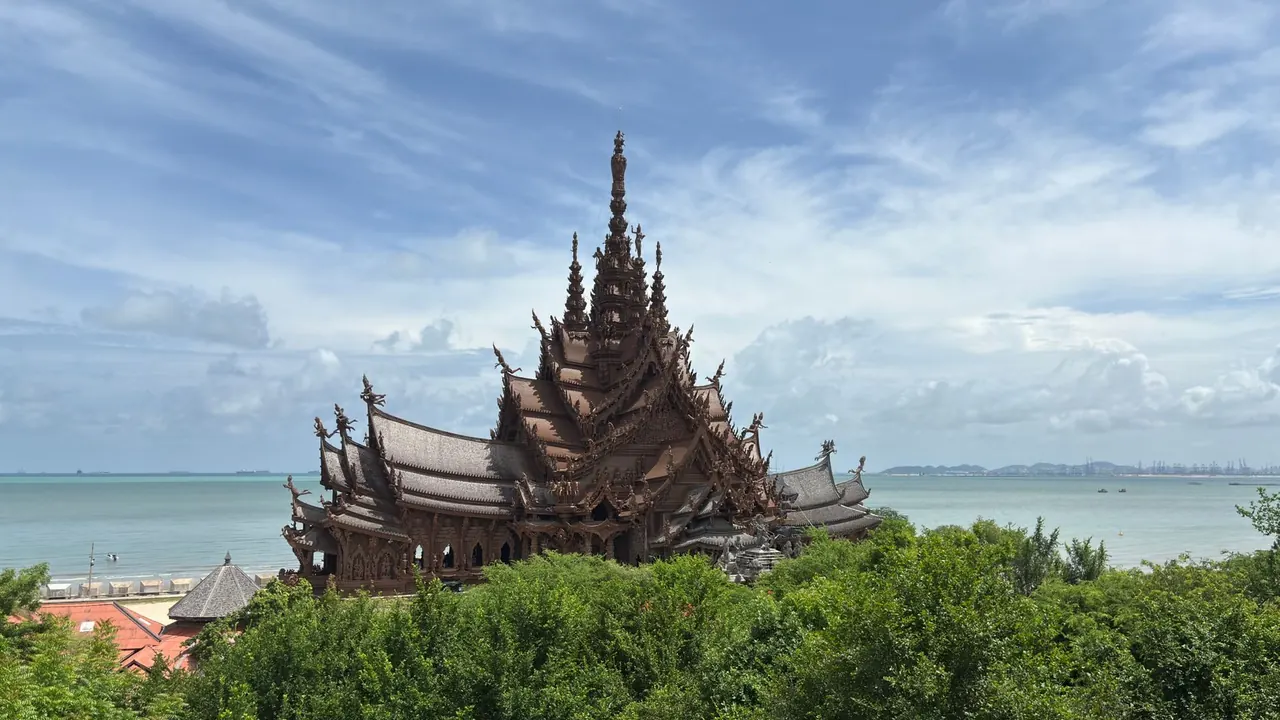
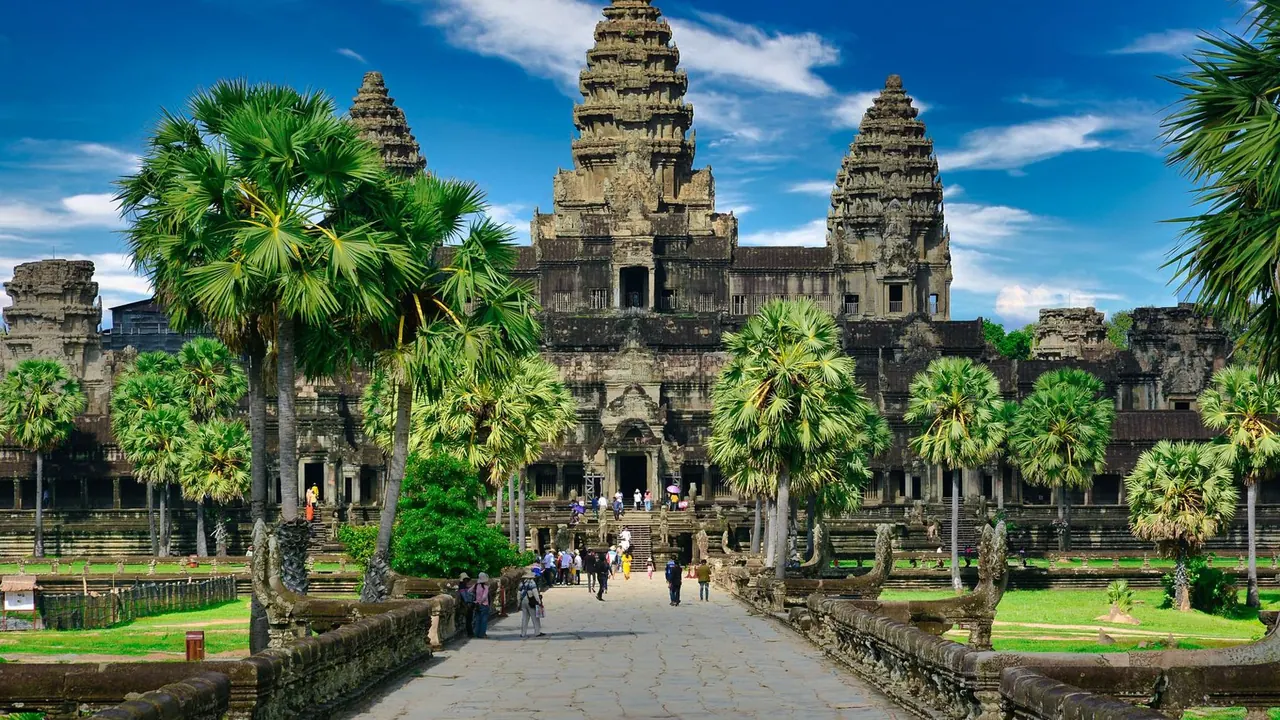
Photos: Pattaya by Matrix, Pexels License; Siem Reap by allPhoto Bangkok, Pexels License.
Pattaya or Siem Reap?
Our verdict in twelve categories, each scored against the same fixed benchmark cities, and the climate month by month, so you can choose for your trip.
Choose Pattaya for
- beaches
- nightlife
- families
Pattaya is the pick for a sun, sea and late-night trip. Jomtien and the beaches of Koh Larn give you warm water to swim in, the evenings run from Walking Street to rooftop bars over the bay, and the water parks and the zoo at Khao Kheow give families plenty to do. Don't come for history, though. Apart from the Sanctuary of Truth, there is little to see that is old.
Choose Siem Reap for
- culture and sights
- prices
- day trips
Travellers who want to see one of the great sights of the world should choose Siem Reap. The temples of Angkor, from Angkor Wat and the Bayon to Ta Prohm and Beng Mealea overgrown by forest, fill several days on their own. Around them the town settles into a gentle routine of dawn starts, afternoons by the pool and Khmer cooking. There is no sea and the nightlife doesn't go much beyond Pub Street, so it suits the curious more than beachgoers or clubbers.
Scoreboard
Twelve categories on one fixed scale from 0 to 100. The shaded stretch is the gap between the two.
Your match
Pick a travel style or drag the sliders, and both match scores follow your weighting.
Wins on beaches and nightlife with your weighting.
Wins on culture and sights and prices with your weighting.
What matters to you?
Category by category
What the scores mean for a trip.
Beaches & swimming
This is Pattaya's category without question. The sand along Pattaya Beach is more for deckchairs than swimming, but Jomtien and Na Jomtien are calmer, and the islands off Bali Hai pier have clear, properly swimmable sea.
Siem Reap is inland. The Tonle Sap is muddy and nobody swims in it, and the coast is most of a day away. Your swimming will be in the hotel pool.
Food & drink
Pattaya eats better overall, mainly thanks to the sea. You can buy fish and shellfish by weight to be grilled along the Naklua waterfront or in the fishing villages to the south, and the night markets are large. The menus for foreign visitors along Beach Road are uneven, but there are plenty of choices.
Siem Reap offers less, but its Khmer cooking is distinctive: amok steamed in banana leaf, num banh chok for breakfast and freshwater fish from the lake. A handful of kitchens rework those ingredients into tasting menus. As in Pattaya, the best meals are away from the strip for tourists.
Culture & sights
Siem Reap lies beside Angkor, and that decides this category. Angkor Wat, the stone faces of the Bayon, the terraces of Angkor Thom and the galleries of Ta Prohm split by trees make up one of the richest archaeological sites anywhere. In town, the colonial quarter by the Old Market and the murals at Wat Bo add a little more.
Pattaya began as a fishing village and has no old quarter. The carved teak Sanctuary of Truth is worth seeing and Big Buddha Hill gives a view, but most of the rest is illusion galleries and wax museums.
Nightlife
Pattaya is built for nights out, and Siem Reap is not. Walking Street, the hundreds of beer bars off Second Road, the large dance clubs, the Jomtien beach bars and the gay quarter at Boyztown keep going into the small hours. The sex trade is part of that picture, so couples often stay in Naklua or Jomtien.
Siem Reap's version is Pub Street: a few cheerful blocks of cheap draught beer and cocktail buckets, with calmer bars by the river. There is no club scene, and sunrise trips to the temples end most evenings early.
Nature & outdoors
Both are modest for the outdoors, but in different directions. Pattaya's nature is out at sea: snorkelling off Koh Larn and Koh Phai, dives to sunken naval ships, and kitesurfing at Na Jomtien in the dry season. The land behind the town is flat and built over.
Siem Reap's outdoors is on land and on the lake. You can cycle through rice paddies and sugar palms, take a boat to the storks and pelicans of Prek Toal, and walk in the forest to the Phnom Kulen waterfall or the carved riverbed at Kbal Spean.
Day trips
The two are about even for excursions, but the outings differ. From Pattaya you can get a taste of Bangkok's palace and riverside temples, see the old royal summer palace on Koh Si Chang, or reach the white beaches of Koh Samet. The choice is varied, but the journeys are long.
Siem Reap's day trips mostly go deeper into one subject. You can see the pink sandstone carving at Banteay Srei, the collapsed temple of Beng Mealea, the pyramid at Koh Ker and the early Roluos group. The stilt villages of Kampong Phluk on the lake are the one change of scene.
Good for families
Pattaya does much more for children. There are large water parks, an aquarium with a tunnel, the night safari at Khao Kheow and the elephant shows at Nong Nooch. Families tend to stay at pool resorts in Jomtien, away from the bar streets.
Siem Reap is best for older children who enjoy an adventure, such as climbing among the roots at Ta Prohm or taking a boat to the stilt villages. Almost nothing is designed for children, though, and steep temple steps in the heat soon tire younger ones.
Getting around
Neither has a metro. Pattaya has a slight edge because its shared songthaew pick-ups run a fixed loop along Beach Road and Second Road and out to Jomtien and Naklua, which makes coastal trips cheap. The zoo, gardens and water parks still need a taxi.
Siem Reap has no public transport, but its centre around the Old Market is small enough to walk. For Angkor, most visitors hire a tuk-tuk driver for the day or ride bicycles around the flat circuits. In both places, broken pavements and the heat cut walking short.
Shopping & style
Neither is a reason to go shopping, but the shopping differs in kind. Pattaya's is practical: air-conditioned malls with chains and supermarkets, tailors who can make a suit within days, and night markets at Thepprasit selling cheap copies.
Siem Reap is better for things made locally. In the artisan workshops you can watch silk weaving, stone carving and lacquerware being made before you buy, and the Old Market sells kramas and silver.
Affordability
Both are very cheap by Western standards, with inexpensive rooms, street food and massages. The extra costs fall differently. In Pattaya they come from speedboat trips to the islands, water parks and shows where foreigners pay more than Thais.
In Siem Reap the one big expense is the Angkor pass, which makes a real dent in a short stay. After that, a tuk-tuk for the whole day at the temples costs little.
Live music & performing arts
Pattaya's evening shows are made to entertain, while Siem Reap's have roots in Khmer tradition. In Pattaya the main show is glittering ladyboy cabaret in large theatres, and cover bands play rock and pop on Walking Street. Neither city has theatre or a classical music season.
In Siem Reap, apsara dance brings the court tradition carved on the temple walls to life, and it is best seen at the smaller, more serious performances. The contemporary circus run by a school for young performers tells Khmer stories through acrobatics, theatre and live music.
Wellness & relaxation
Both make it easy to unwind, with Thai or Khmer massage on almost every street and proper spas at the resorts. In Pattaya, rest depends on where you stay, for example on the Pratamnak headland or in Na Jomtien rather than the loud centre. Choose massage places with care, because some are part of the nightlife trade.
In Siem Reap the rhythm of the day helps you slow down. Early starts at the temples lead to long afternoons in garden hotels, and the lanes across the river are quiet, with yoga classes close at hand.
When should you go?
Pick your month. The climate figures are measured averages, not a forecast.
Pattaya in July
Siem Reap in July
Daytime high, °C
Rainfall in the month, mm
Where the figures come from
Pattaya's temperatures are measured 31 km from the centre, at Sattahip.
Pattaya has no rain gauge within 25 km of the centre, so its rainfall comes from a gridded climate dataset read at the city rather than from a gauge further away.
Pattaya's sunshine is measured 86 km from the centre, at Bangna Agromet / Ban Khlong Samrong.
Siem Reap has no weather station within reach, so its figures come from a gridded climate model rather than a measured record, and read a broad area rather than the city itself.
Temperature and rainfall are climate normals, averaged over the years shown. Pattaya: 1971-2000 (sunshine 1961-1990, rainfall 1991-2020) normals, Sattahip (31.2 km from centre). Siem Reap: 2001-2020 normals, NASA POWER reanalysis grid, no weather station within 90 km.
Pattaya is hot all year, with daytime highs a little above 30°C and a sea of 28°C or warmer every month, so you can go to the beach in any season. December to February is the best time to go, as it is dry and among the sunniest months. Rain starts to build from April, and September and October are the wettest months. October is the peak at 258mm, and the sea is rougher then.
Siem Reap's wet season is heavier in the middle of the year. From June to August it gets clearly more rain than Pattaya, and the rain peaks in September at 231mm, a month before Pattaya's. November to January is the best time for the temples, because it is dry and a little less hot. From February to April highs reach 36°C, which makes walking between the ruins hard work after mid-morning. The wettest months are also when the lake rises and the stilt villages are at their best.
Which traveller are you?
For a beach and sun trip, Pattaya is the clear choice. Jomtien is good for swimming and the ferry to Koh Larn reaches pale sand and clear water. Siem Reap has no coast at all, only hotel pools after the temples.
On a culture and arts trip, Siem Reap is far better. The Angkor temples can fill three days and still leave more, and the Angkor National Museum and apsara dance add context. In Pattaya the Sanctuary of Truth takes an afternoon and the heritage ends there.
For a food and nightlife trip, Pattaya wins. You get seafood cooked to order in Naklua, night markets, and then a night that goes from beer bars to big clubs until very late. Siem Reap offers good Khmer cooking but only the one Pub Street scene.
Before you go
| Measure | Pattaya | Siem Reap |
|---|---|---|
| Official language | Thai | Khmer |
| Currency | Baht (THB) | Riel (KHR) |
| Sockets | ABCF220 V, 50 Hz | ACG230 V, 50 Hz |
| Driving side | Left | Right |
| Time zone | UTC+7 | UTC+7 |
| Emergency number | Police 191, ambulance 1669, fire 199 | Police 117, ambulance 119, fire 118 |
| Elevation | 35 m | 18 m |
| Main airport | Suvarnabhumi Airport (BKK)83 km from centre150 non-stop destinations | Siem Reap-Angkor International Airport (SAI)39 km from centre14 non-stop destinations |
| Public holidays this year | - | 21 days |
By the numbers
| Measure | Pattaya | Siem Reap |
|---|---|---|
| City population | 119,532 | 147,866 |
| Museums within 10 km | 0 | 6 |
| UNESCO World Heritage sites within 50 km | 0 | 1 |
| Swim season, months above 21 °C | 12 months | - |
Where else could you go?
Every comparison below shares a destination with this one, so you can follow Pattaya or Siem Reap somewhere new.