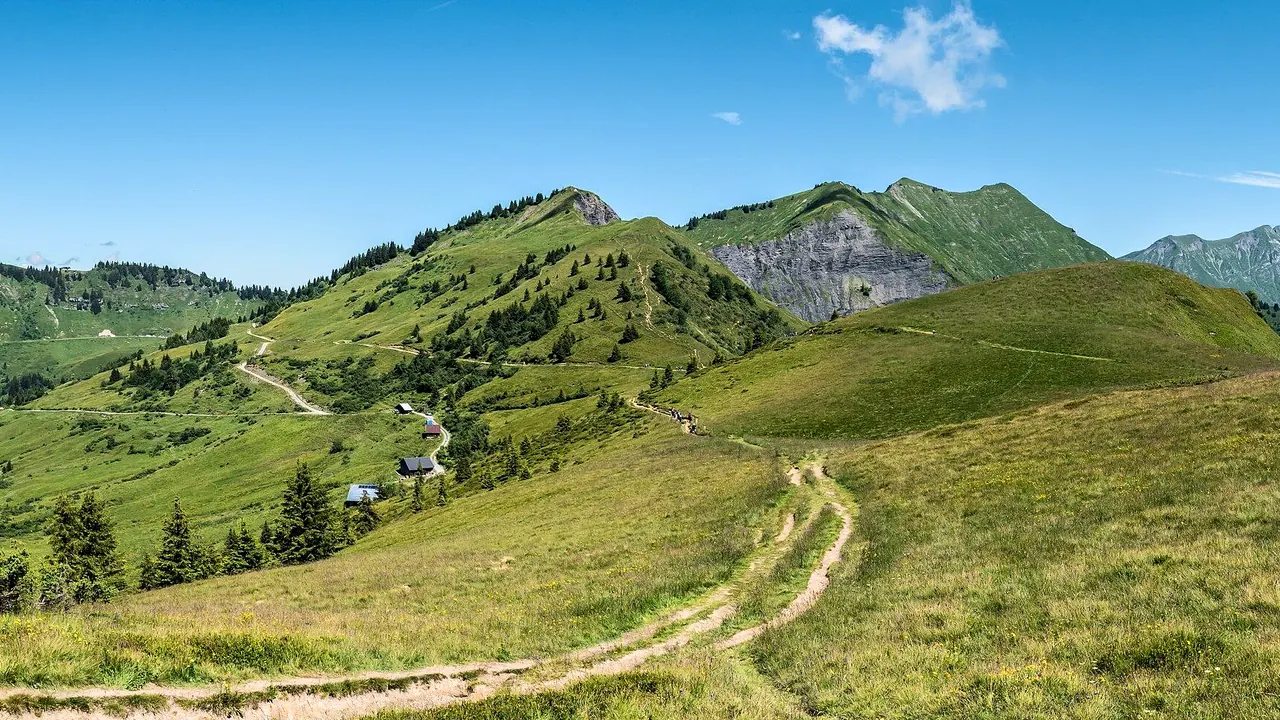
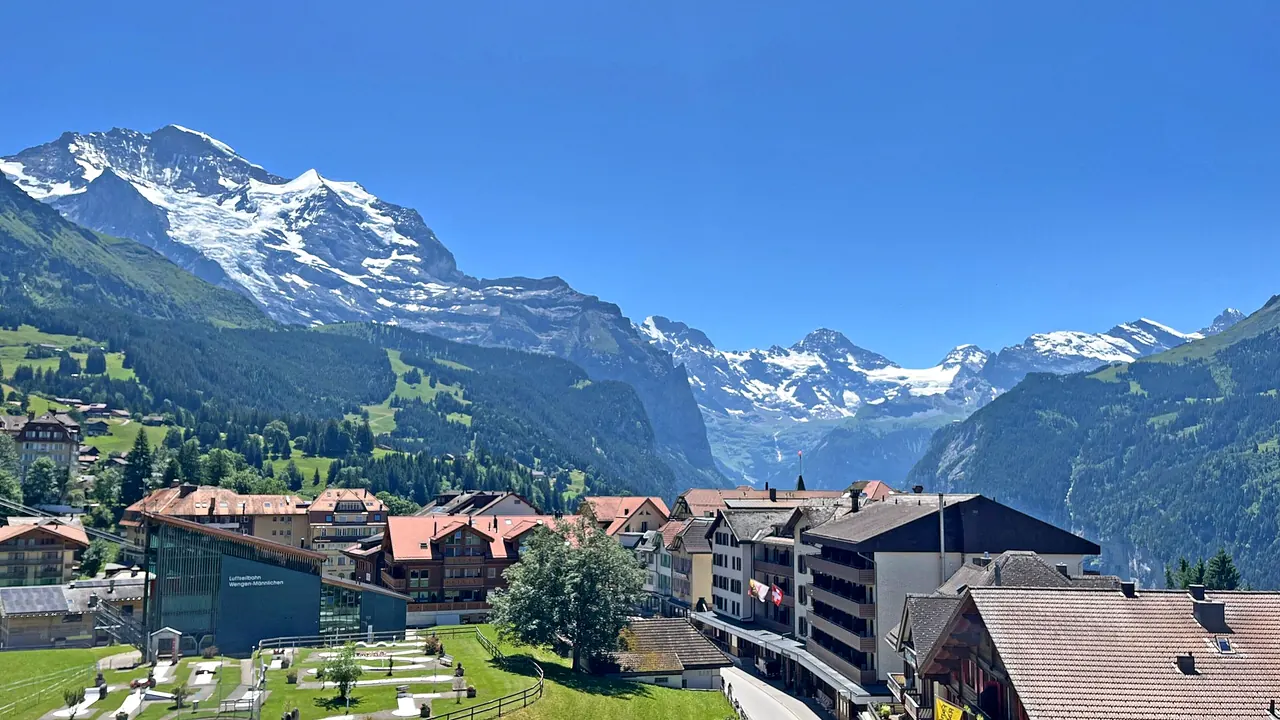
Photos: Samoëns by Krzysztof Golik, CC BY-SA 4.0, cropped; Wengen by Charles J. Sharp, CC BY-SA 4.0, cropped.
Samoëns or Wengen?
Our verdict in twelve categories, each scored against the same fixed benchmark cities, and the climate month by month, so you can choose for your trip.
Choose Samoëns for
- prices
- culture and sights
- food and drink
Samoëns suits families and anyone watching what a mountain trip costs. It is a real stone village with a market, a lake for summer afternoons and plenty of self-catering apartments, and it puts Geneva, Annecy and Chamonix within a drive. Choose it if you want the Alps with a bit more around them and are happy to bring a car.
Choose Wengen for
- getting around
- wellness
- nature and the outdoors
Wengen is for travellers who want the mountains themselves to be the whole point and can pay for the privilege. From a car-free shelf facing the Jungfrau, trains and cable cars take you to ridges, glaciers and the foot of the Eiger without ever starting an engine. There is little to do beyond walking, skiing and looking, but the scenery is in a different league, and the quiet is more complete.
Scoreboard
Twelve categories on one fixed scale from 0 to 100. The shaded stretch is the gap between the two.
Your match
Pick a travel style or drag the sliders, and both match scores follow your weighting.
Wins on prices and culture and sights with your weighting.
Wins on getting around and wellness with your weighting.
What matters to you?
Category by category
What the scores mean for a trip.
Beaches & swimming
Neither is a swimming destination, but Samoëns at least has water on its doorstep: the lifeguarded Lac aux Dames with its grassy shore and outdoor pool makes a proper summer afternoon, and warm July days make it inviting. In Wengen there is nothing in the village, and bathing means an hour's train ride down to the lidos of Lake Thun or the colder, glacier-fed Lake Brienz.
Food & drink
Samoëns gives you more to eat and more ways to eat it. Savoyard dishes like tartiflette and diots with polenta come from cheeses made in the surrounding valleys, there are old farm buildings serving lunch on the slopes, and the weekly market lets you shop for Reblochon, charcuterie and honey and cook for yourself.
Wengen's food is mostly hotel half-board and mountain huts serving rösti and fondue, good but narrow and rarely casual. The memorable meal there is a terrace lunch facing the Jungfrau, which is more about the view than the plate.
Culture & sights
Samoëns has a modest but genuine story to tell: a centre built by the frahans, the stonemasons who worked across Europe, the ancient lime tree on the Grande Place and the Jaÿsinia alpine garden climbing above the church. It fills an afternoon, which is more than Wengen manages. There the interest lies in chalets, a few Belle Époque hotels from the English resort days and ski-racing lore, and anything resembling a museum or old town means a train down to Thun or Bern.
Nightlife
Both are quiet after dark, and both are about après-ski rather than clubs. Samoëns has a couple of pubs open later in winter and drinks on the square or by the gondola, with a calm, family feel all season. Wengen is sleepier most of the year, with walkers in bed early in summer, but the Lauberhorn race weekend in January turns it into a genuine party that Samoëns has no equivalent for.
Nature & outdoors
Both are serious mountain bases, but Wengen is the more dramatic. It looks straight across the sheer walls and waterfalls of the Lauterbrunnen valley to the Jungfrau, with the Eiger and Mönch behind, and its trails and railway reach glacier level at the Jungfraujoch. The linked ski area with Grindelwald includes the long Lauberhorn run.
Samoëns offers more variety at a lower altitude: the big Grand Massif ski area with views to Mont Blanc, rafting and paragliding in the Giffre valley, and the limestone horseshoe of the Cirque du Fer-à-Cheval where ibex and chamois roam. It is excellent country, just a step below Wengen's face-to-face encounter with the high peaks.
Day trips
The range of outings is similar, though Samoëns reaches a little further with less effort. An hour's drive brings Geneva, Chamonix or the Lake Geneva shore with Yvoire and Évian, and Annecy's canals are not much further, but you need a car for most of it.
From Wengen everything starts with the rack railway down, so even Interlaken and the steamer-served castles at Thun, Oberhofen and Spiez take about an hour. Bern's arcaded old town is a long but worthwhile day, and Ballenberg's open-air museum is a good choice with children.
Good for families
Samoëns is the better all-round choice for families, mainly because it gives children more to fill the days between the big outings. Its traffic is calmed rather than banished, but the village is small enough to feel safe, summer is warm enough for long afternoons by the lake, and on a wet day the car makes Annecy's old quarter or Geneva's museums an easy escape. A week here also costs a family far less to run.
Wengen beats it on one point: with no cars at all, children can roam the village more freely than they could in Samoëns, and the cog railway and cable cars feel like adventures in themselves. When cloud settles on the Jungfrau, though, there is little to fall back on short of the long ride down to Interlaken. The steep lanes are hard work for small legs, and every meal and mountain ride adds to a bill that soon leaves Samoëns looking modest.
Getting around
Wengen is built around its railway, and that makes moving about remarkably simple. The rack line from Lauterbrunnen brings you in, hotel carts take the luggage, and the same trains and the Männlichen cable car carry you into the mountains without a car. Only trips down to the lowlands are slow.
Samoëns is easy on foot and a winter ski week can be car-free thanks to the gondola and shuttle buses. Outside that, the trailheads, the Fer-à-Cheval and all day trips really need a car, ideally with winter tyres in the snowy months.
Shopping & style
Neither is a place to shop, but Samoëns has a little more to browse: homeware and gift boutiques around the square, delis stocked with Savoyard cheese and wine, and a weekly market with woollens and honey. Wengen's short main street covers ski gear, chocolate and groceries and little else, so anything more means Interlaken or Bern.
Affordability
This is where the two differ most sharply. Samoëns is no bargain in the winter school weeks, but its apartments, supermarket and free valley walks let a family control the bill, and summer and the shoulder months are noticeably easier.
Wengen sits among the dearest places in Europe. Hotels, meals and drinks are at Swiss resort level, and the railways that make the trip what it is add a heavy cost to every outing, especially the ride to the Jungfraujoch. A rail pass and a chalet soften it, but nothing makes it cheap.
Live music & performing arts
Neither village has a theatre or a regular venue, so performance is incidental in both. Samoëns leans on summer festivals, concerts in the church and Geneva as the nearest serious option, while Wengen's offering is more folkloric, with alphorn or yodelling evenings in hotels and a brass band at village celebrations.
Wellness & relaxation
Wengen is the more restful of the two. With no traffic, the soundtrack is cowbells and distant waterfalls, and an afternoon on a balcony facing the Jungfrau does more for the nerves than most treatments. Its spas are hotel facilities only, with no public baths.
Samoëns is calm outside the busiest winter weeks but less hushed than a car-free village. Its advantage is access: the historic thermal baths at Saint-Gervais-les-Bains are about an hour's drive away for a proper day of soaking.
When should you go?
Pick your month. The climate figures are measured averages, not a forecast.
Samoëns in July
Wengen in July
Daytime high, °C
Rainfall in the month, mm
Where the figures come from
Samoëns's temperatures are measured 49 km from the centre, at Sion.
Samoëns's station stands 189 m below the city centre, so the centre is likely a little cooler than the figures say.
Samoëns has no rain gauge within 25 km of the centre, so its rainfall comes from a gridded climate dataset read at the destination rather than from a gauge further away.
Wengen has no weather station within reach, so its figures come from a gridded climate model rather than a measured record, and read a broad area rather than one spot.
Temperature and rainfall are climate normals, averaged over the years shown. Samoëns: 1991-2020 (sunshine 1961-1990) normals, Sion (49.1 km from centre). Wengen: 1991-2020 normals, TerraClimate 4 km grid at the town, no weather station within 90 km.
The two villages feel like different climates. Samoëns sits low in its valley and gets properly warm in summer, with highs around 27°C in July and August and the most sunshine of the year, so lake swimming and long hikes both work from June to early September. Wengen stays cool even then, at about 16°C in July, which is ideal walking weather but never beach weather, and its summer months are also its wettest. Spring and autumn are mild enough for valley walks in Samoëns, while Wengen's lanes are still near freezing in March.
In winter both are ski destinations, but Wengen is the colder and more reliably snowy of the two, hovering around 0°C from December to February. Samoëns sees highs of about 5°C in the village, with December its dampest and darkest month, so the snow lies higher up the gondola rather than on the square. For hiking, Samoëns is at its best in June and September; Wengen in July and August, when the high trails are clear.
Which traveller are you?
On a family trip with children, Samoëns is the easier choice. The leisure base at the Lac aux Dames gives summer days a pool, slide and play areas, the ski schools are gentle, and apartments with a supermarket nearby keep costs and mealtimes manageable.
For an outdoors trip, Wengen wins on sheer scale. Trails to the Männlichen and Kleine Scheidegg start at the door, the Eiger north face and Jungfraujoch are a train ride away, and the Lauterbrunnen valley's waterfalls sit directly below the village.
On a tight budget, Samoëns is the only realistic option of the two. It is still an Alpine resort, but self-catering and free valley hikes stretch the money, whereas in Wengen hotels, meals and every mountain railway ticket come at Swiss resort prices.
Before you go
| Measure | Samoëns | Wengen |
|---|---|---|
| Official language | French | French, German, Italian, Romansh |
| Currency | Euro (EUR) | Swiss Franc (CHF) |
| Sockets | CE230 V, 50 Hz | CJ230 V, 50 Hz |
| Driving side | Right | Right |
| Time zone | UTC+1, UTC+2 in summer | UTC+1, UTC+2 in summer |
| Emergency number | 112 | 112 |
| Elevation | 671 m | 1,274 m |
| Main airport | Geneva International Airport (GVA)51 km from centre150 non-stop destinations | Zürich Airport (ZRH)106 km from centre226 non-stop destinations |
| Public holidays this year | 11 days | 10 days |
By the numbers
| Measure | Samoëns | Wengen |
|---|---|---|
| Population | 2,203 | 1,116 |
| People per km² | 23 | 31 |
| Museums within 10 km | 1 | 2 |
| UNESCO World Heritage sites within 50 km | 3 | 1 |
Where else could you go?
Every comparison below shares a destination with this one, so you can follow Samoëns or Wengen somewhere new.
- Mürrenvs Wengen
- Flainevs Samoëns
- Grindelwaldvs Wengen
- Les Getsvs Samoëns
- Morzinevs Samoëns
- Avoriazvs Samoëns