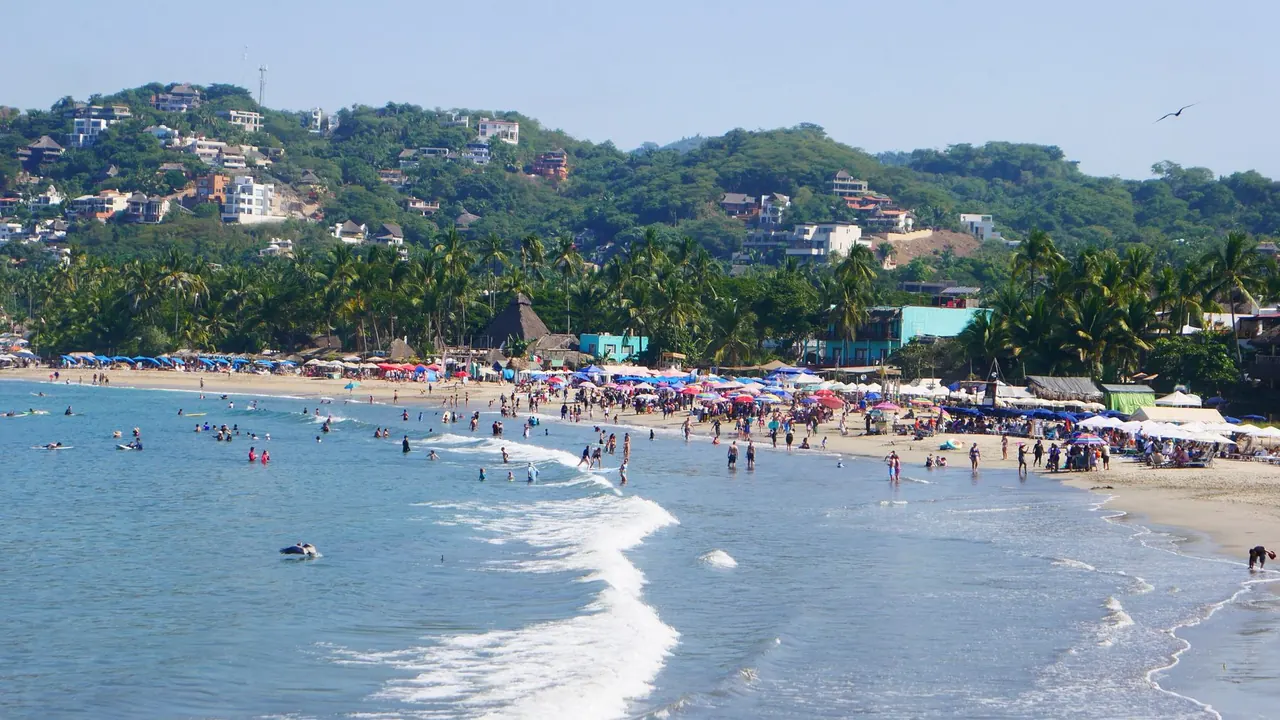
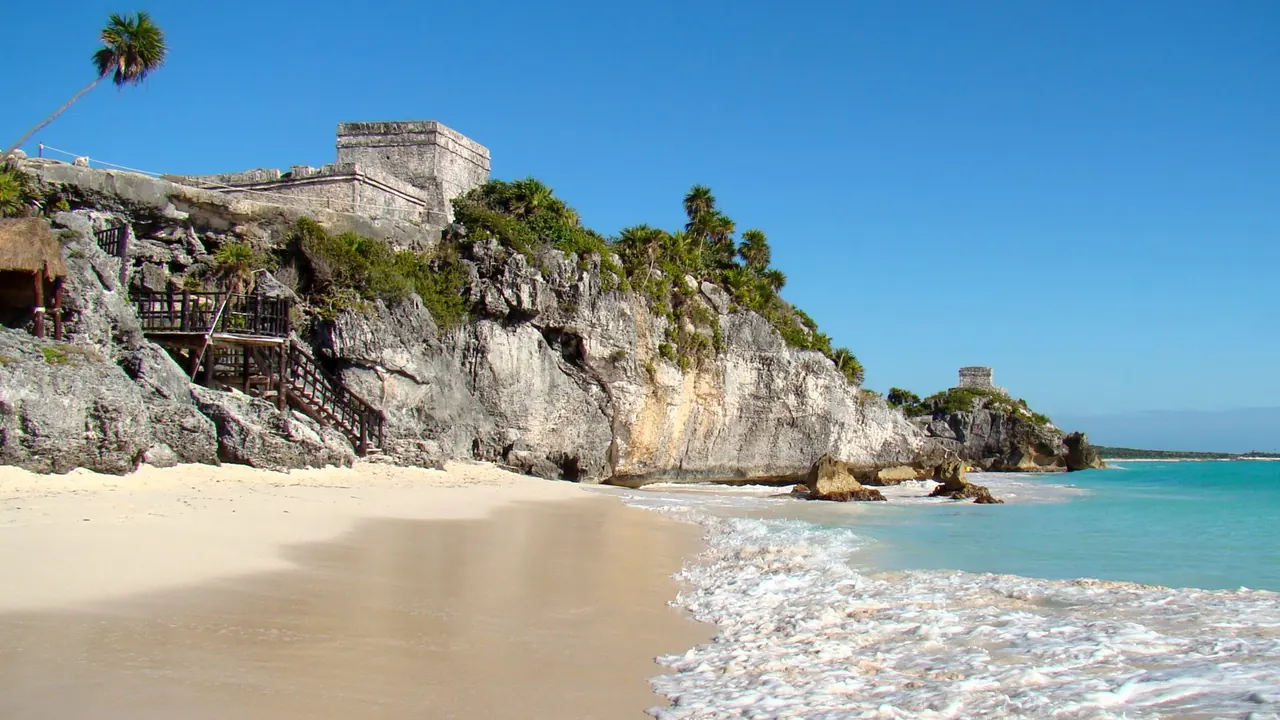
Photos: Sayulita by Luisalvaz, CC BY-SA 4.0, cropped; Tulum by Bjørn Christian Tørrissen, CC BY-SA 3.0, cropped.
Sayulita or Tulum?
Our verdict in twelve categories, each scored against the same fixed benchmark cities, and the climate month by month, so you can choose for your trip.
Choose Sayulita for
- getting around
- prices
Sayulita suits travellers who want a small Pacific surf village where the beach is at the end of the street and everything else is a short walk away. Beginners learn on its soft waves, the green hills offer headland paths and mountain biking, and in winter humpback whales come into the bay. It is also the somewhat gentler bill of the two, as long as you are happy without sights or much of a scene after dark.
Choose Tulum for
- nightlife
- wellness
- day trips
Tulum is the better choice for a trip with more in it. The Caribbean sand is finer, there is a Maya city on the cliff above the sea, Coba and Chichen Itza are within reach, and cenotes are close by. Add a far deeper wellness culture, electronic music nights and big water parks for children, and it rewards people who will hire a car and pay more for it.
Scoreboard
Twelve categories on one fixed scale from 0 to 100. The shaded stretch is the gap between the two.
Your match
Pick a travel style or drag the sliders, and both match scores follow your weighting.
Wins on getting around and prices with your weighting.
Wins on nightlife and wellness with your weighting.
What matters to you?
Category by category
What the scores mean for a trip.
Beaches & swimming
Sayulita's beach sits right in front of the village, a curved Pacific bay with rolling waves that make it a place to learn to surf rather than float. The town stretch gets crowded and the river mouth can carry runoff after rain, so calmer swimming means walking to Playa de los Muertos or along the jungle path to Carricitos.
Tulum has the better beach. Its long run of pale Caribbean sand stretches from the cliff-top ruins towards Sian Ka'an, with turquoise water and quieter, wilder stretches to the south, and Akumal's sheltered turtle bay is close by. Its drawbacks are sargassum in some warmer seasons and a bike or taxi ride from town to the sand.
Food & drink
In Sayulita the best eating is the simplest: fish tacos, aguachile made with the day's catch and al pastor from the stands around the plaza in the evening. Above that is a layer of smoothie bowls and pizza for the surf crowd, and people go to Puerto Vallarta when they want a serious dinner.
Tulum gives you a little more to explore, mainly because it has a regional cuisine to draw on. Yucatecan dishes such as sopa de lima, cochinita pibil and fish grilled with achiote turn up in the town's fondas, while the candlelit, open-fire restaurants on the beach road sell the setting as much as the plate.
Culture & sights
Sayulita offers almost nothing to tour. A small plaza, a modest church and the hillside cemetery fill an hour, and the most interesting thing to see is the beaded and yarn work of the Wixárika people in the galleries.
Tulum has one site of real weight: the walled Maya port on the cliff edge, with El Castillo standing above the sea. It takes a couple of hours, and the modern town adds little to it, but it also makes Tulum a base for the larger Maya cities inland.
Nightlife
Evenings in Sayulita begin with sunset drinks on the sand and then move to a few blocks of mezcal and cocktail bars around the plaza, with the odd DJ keeping a young surf crowd out past midnight in winter. In the wet summer it goes quiet early.
Tulum goes out on a different scale. It is known internationally for electronic music, with DJ sets in jungle clearings, beach clubs that run into the night and full-moon parties at the peak of winter. Those big nights are expensive, so go with friends and keep an eye on your drink and your ride home.
Nature & outdoors
Both places reward time outdoors, but the settings could hardly be more different. Sayulita has jungle-covered hills dropping to the Pacific, with surf breaks at Punta de Mita, headland paths, mountain biking, humpback whales from December to March and boat trips to the protected Marietas Islands.
Tulum is flat limestone jungle, and its best features are underground and offshore. Gran Cenote, Dos Ojos and many smaller pools offer some of the world's finest cavern snorkelling and cave diving, while Sian Ka'an's lagoons and mangroves can be explored by boat or on a float down Maya-built channels. There are no hills to walk, though.
Day trips
From Sayulita the main outing is Puerto Vallarta, about an hour south, for its malecón and cobbled old town. Otherwise the choice is a string of coastal villages such as San Pancho, Bucerías and Chacala, plus the colonial ruins and mangroves of San Blas on a long day.
Tulum is far better placed for day trips. Coba's forest pyramid is under an hour inland, and Chichen Itza, one of the great sites of the Americas, pairs with Valladolid or Ek Balam for a full day. Add Cozumel by ferry from Playa del Carmen and the lagoon at Bacalar, though most of these need a car, a tour or the train.
Good for families
Sayulita works best for older children who like the water. Surf schools take beginners on soft waves and Playa de los Muertos is a sheltered cove for swimming, but there is nothing built for children, and the cobbles and golf-cart traffic make pushchairs hard work.
Tulum has more to fill a family week. There are turtles in the shallows at Akumal, cenotes with wooden steps into calm pools, and the big eco-parks at Xel-Ha and Xcaret with lazy rivers and snorkelling lagoons. The catch is a beach strip aimed at couples and late parties, so a rental with a pool and a hire car is the usual answer.
Getting around
Sayulita is the easier place to be without wheels. You can cross the village on foot in ten minutes, and the beach, bars and taco stands are all within that walk, though the lanes are cobbled or dirt, have few pavements and fill with golf carts. Slow coastal buses reach Puerto Vallarta and its airport.
Tulum is spread out along a highway, with the town, the beach and the long hotel strip kilometres apart. Bicycles cover the flat ground by day, but the roads are unlit at night, taxis are expensive and colectivos only run along the highway, so seeing cenotes and ruins usually means hiring a car.
Shopping & style
Shopping is small-scale in both towns, and both have boutiques of loose linen and handmade jewellery. Sayulita adds surf shops for boards and wetsuits, and its best local buy is Huichol beadwork and yarn painting.
Tulum's boutiques along the beach road lean towards macramé, palm-fibre baskets and natural-dyed homewares at high prices. The main avenue in town is the better hunting ground for embroidered huipiles, hammocks and silver.
Affordability
Neither is a bargain by Mexican standards, but Sayulita is the cheaper of the two. Its villas and visitor restaurants are priced for North Americans and surf lessons add up, but you can walk everywhere, the taco stands and fondas are inexpensive, and a summer visit brings room prices down.
Tulum is one of the most expensive places to stay in the country. Beach-road hotels charge resort rates, while taxis, beach clubs and party tickets cost more than elsewhere, and every cenote charges its own entry. Staying in a town guesthouse and cycling to the sea is how people keep it affordable.
Live music & performing arts
Neither town has a stage of any kind, so live performance means music in bars. In Sayulita that means acoustic sets and bands on winter evenings, buskers near the plaza and the odd mariachi, with Puerto Vallarta the place for a real concert. Tulum offers bands on the main avenue, saxophone and drums over DJ sets, and ceremonial dance staged at the eco-parks.
Wellness & relaxation
Sayulita has a real yoga culture, with hillside shalas, week-long retreats in villas, massage and temazcal, and the surf, yoga and sunset rhythm suits a slow week. The centre gets noisy in high season, so for real quiet stay up on the hillsides or out towards San Pancho.
In Tulum wellness is close to the whole point of the place. The jungle and beach road are lined with retreat hotels, open-air spas, breathwork and sound baths, and the Maya temazcal is widely offered. The southern beach strip has a barefoot, hammock pace, though party nights mean choosing your spot with care.
When should you go?
Pick your month. The climate figures are measured averages, not a forecast.
Sayulita in July
Tulum in July
Daytime high, °C
Rainfall in the month, mm
Where the figures come from
Sayulita has no weather station within reach, so its figures come from a gridded climate model rather than a measured record, and read a broad area rather than the city itself.
Tulum has no weather station within reach, so its figures come from a gridded climate model rather than a measured record, and read a broad area rather than the city itself.
Temperature and rainfall are climate normals, averaged over the years shown. Sayulita: 2001-2020 normals, NASA POWER reanalysis grid, no weather station within 90 km. Tulum: 2001-2020 normals, NASA POWER reanalysis grid, no weather station within 90 km.
Sayulita has a sharp split between seasons. From November to May it is dry and pleasantly warm, with almost no rain in spring, although the sea cools to about 24°C in late winter. From June the rains build to a soaking peak in August, around 384mm, and the hot, humid summer brings early nights, so the dry winter and spring are the time to go.
Tulum is hotter and steadier all year, and the sea stays around 27°C or warmer in every month, so swimming never goes out of season. Afternoons reach about 31°C in May, which makes midday walking at the ruins hard work. The driest spell runs from February to April, and rain is heaviest in autumn, peaking near 208mm in October, but it is spread more evenly than in Sayulita's sharp summer wet season.
Which traveller are you?
On a culture and arts trip, Tulum is the clear pick. Sayulita has a plaza, a church and Huichol beadwork, while Tulum has a walled Maya city above the sea, with Coba, Chichen Itza and colonial Valladolid within a day's reach.
For a relaxing and wellness trip, Tulum offers far more. Yoga shalas, open-air spas, sound baths and temazcal sessions fill the jungle and beach road. Sayulita has a good retreat scene too, but it is smaller and has no real spa tradition.
On a trip on a tight budget, Sayulita is easier to manage. Neither place is cheap for Mexico, but Sayulita's compact village needs no car or taxis. Tulum adds entry fees at every cenote, expensive taxis and beach-club prices.
Before you go
| Measure | Sayulita | Tulum |
|---|---|---|
| Official language | Spanish, Nahuatl, Yucatec Maya | Spanish, Nahuatl, Yucatec Maya |
| Currency | Mexican Peso (MXN) | Mexican Peso (MXN) |
| Sockets | AB127 V, 60 Hz | AB127 V, 60 Hz |
| Driving side | Right | Right |
| Time zone | UTC-6 | UTC-5 |
| Emergency number | 911 | 911 |
| Elevation | 2 m | 5 m |
| Main airport | Puerto Vallarta International Airport (PVR)29 km from centre52 non-stop destinations | Felipe Carrillo Puerto International Airport Tulum (TQO)21 km from centre9 non-stop destinations |
| Public holidays this year | 9 days | 9 days |
By the numbers
| Measure | Sayulita | Tulum |
|---|---|---|
| City population | 3,390 | 33,374 |
| Museums within 10 km | 0 | 0 |
| UNESCO World Heritage sites within 50 km | 1 | 0 |
| Swim season, months above 21 °C | 12 months | 12 months |
Where else could you go?
Every comparison below shares a destination with this one, so you can follow Sayulita or Tulum somewhere new.