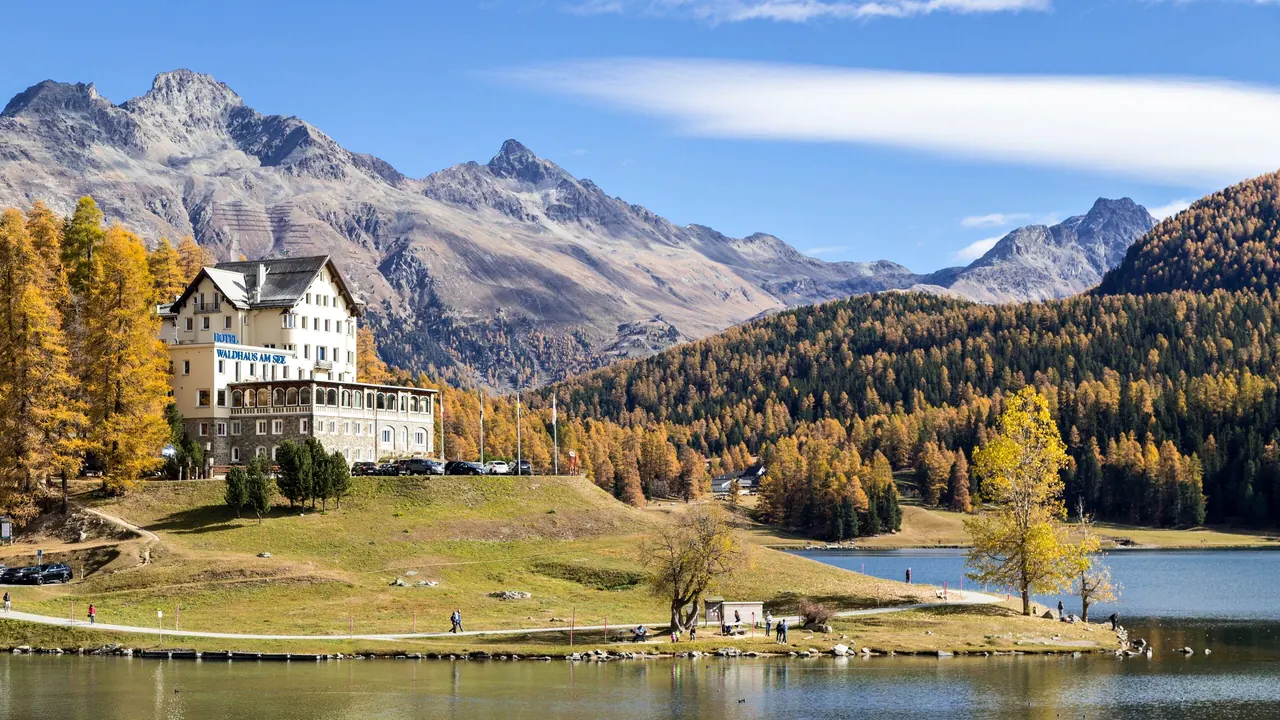
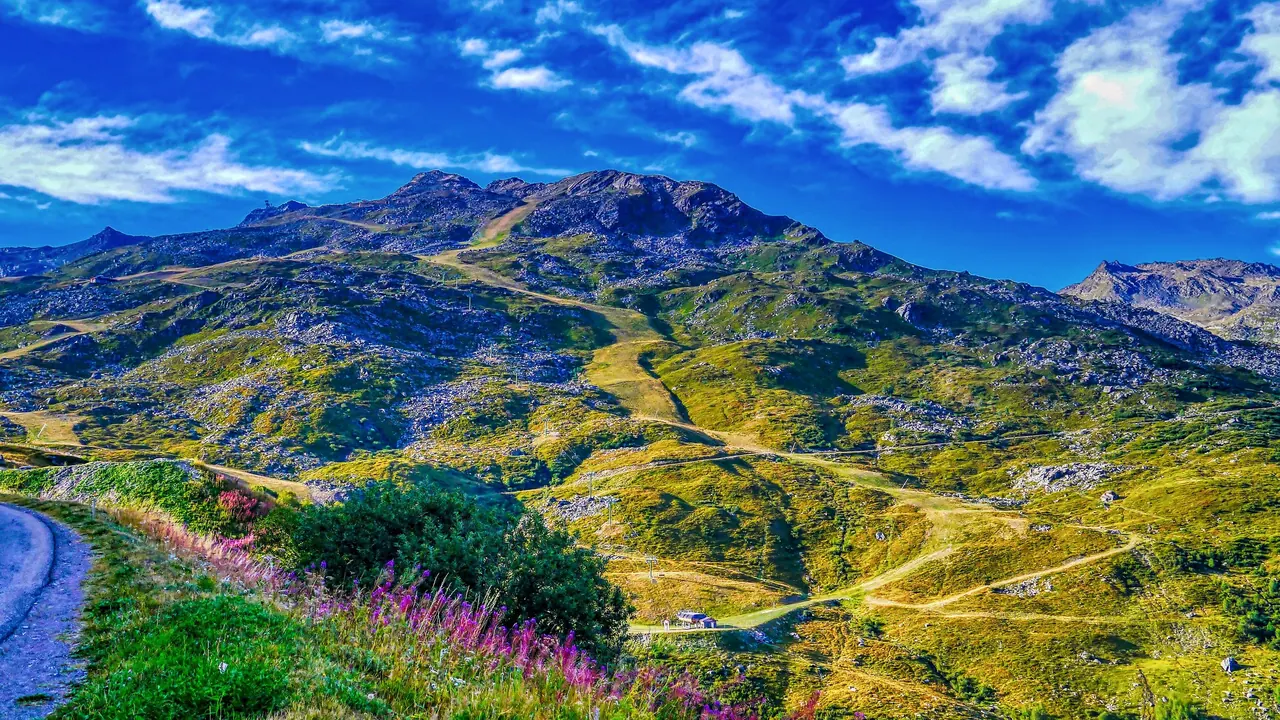
Photos: St. Moritz by JoachimKohler-HB, CC BY-SA 4.0, cropped; Val Thorens by Zairon, CC BY-SA 4.0, cropped.
St. Moritz or Val Thorens?
Our verdict in twelve categories, each scored against the same fixed benchmark cities, and the climate month by month, so you can choose for your trip.
Choose St. Moritz for
- shopping
- wellness
- day trips
St. Moritz suits travellers who want their mountains with polish: grand hotel spas, the Segantini Museum, summer jazz and chamber concerts, and a railway that reaches Italy without a car. It works in summer as well as winter, with lakes, larch forest and glacier walks. You need to be ready to pay heavily for all of it.
Choose Val Thorens for
- nightlife
- prices
Val Thorens is for skiers above all, especially groups of friends who want Europe's highest snow, the whole Three Valleys under their skis and loud après-ski afterwards. It is the cheaper of the two, particularly in a shared apartment. There is almost nothing to do off the slopes, though, and it makes little sense outside winter.
Scoreboard
Twelve categories on one fixed scale from 0 to 100. The shaded stretch is the gap between the two.
Your match
Pick a travel style or drag the sliders, and both match scores follow your weighting.
Wins on shopping and wellness with your weighting.
Wins on nightlife and prices with your weighting.
What matters to you?
Category by category
What the scores mean for a trip.
Beaches & swimming
Neither is a swimming destination, but St. Moritz at least has Lej da Staz. It is a forest lake with a lawn and a small bathing area, and for a few weeks in a warm July the water reaches about 20°C. Val Thorens lies above the treeline with only glacier lakes too cold to enter, so swimming there means the sports centre pool.
Food & drink
Both eat well at the top end for small mountain places, and both serve long lunches on sunny terraces by the slopes, but the cooking differs. St. Moritz offers Engadine fare: capuns, pizzoccheri, air-dried beef and nut tart from the old confectioners. In the evening, fine dining in the grand hotels is the main event.
Val Thorens runs on Savoyard cheese, with fondue, raclette, tartiflette and Beaufort served in wood-lined restaurants. A few ambitious hotel kitchens sit above a repetitive middle of pizza and burgers. Self-catering is more usual here, and in both places many kitchens close out of season.
Culture & sights
St. Moritz has a modest afternoon's worth of sights. There is the domed Segantini Museum with its great triptych, the painted farmhouse rooms of the Engadin Museum and the leaning tower, along with the history of two Winter Olympics and the Cresta Run. Val Thorens was built on a bare slope in the 1970s and has none of this, so anyone after Savoyard heritage must drive down to the valley.
Nightlife
Val Thorens is the place for a big night in the Alps. Après-ski begins with dancing on terrace tables as the lifts close and moves into the village pubs. It ends in clubs open into the early hours, including a well-known underground one, and the crowd is young, with many students.
St. Moritz goes out in a different style: champagne in grand hotel bars and a couple of exclusive clubs that need the right introduction. It is glamorous but subdued, and costly. In both places nightlife belongs to winter, and summer evenings are quiet.
Nature & outdoors
Both are outstanding mountain destinations, and the difference is one of kind. Val Thorens is built purely for high-altitude skiing. It is the highest resort in Europe, with snow reliable from late November into May and the vast linked Three Valleys, all set among bare rock and glaciers above the treeline.
St. Moritz has the broader landscape: a wide, sunny valley of lakes and larch forest with three big ski areas, polo on the frozen lake and some of the best cross-country trails in the Alps. In summer it adds glacier walks, kitesurfing on Lake Silvaplana and the Swiss National Park within an hour. For linked downhill terrain Val Thorens is hard to beat, but for an outdoor trip in any season St. Moritz gives more.
Day trips
St. Moritz has the better excursions, most of them by rail. The UNESCO-listed Bernina line runs over the pass to Poschiavo and Tirano in Italy, and closer by are Nietzsche's house at Sils Maria, sgraffito villages such as Guarda and, over the Maloja Pass, Soglio. These are villages rather than towns, but they are easy to reach without a car.
From Val Thorens, few people leave. Méribel and Courchevel are a ski outing rather than a trip, and Moûtiers and the medieval quarter of Conflans are modest. Annecy and Chambéry are worth seeing but take around two hours each way by car.
Good for families
Both work for skiing families, with ski schools, gentle beginner slopes and a pool for days off. Val Thorens is the more practical: the village is car-free, many apartments sit by the slopes, and it has children's clubs and a long toboggan run. Against that, its altitude brings bitter cold, lifts closed by wind and poor sleep for small children, and a party crowd sets the tone.
St. Moritz is lower and milder and adds skating on natural ice and summer walks by the lakes. Its tone is adult luxury, though, and families with young children often stay in the quieter villages nearby.
Getting around
St. Moritz is the easier place to reach and to explore. The Rhaetian Railway pulls into the lakeside station, and buses and trains cover the Upper Engadine from Maloja to Zuoz, so a car is unnecessary. The climb from Bad up to Dorf is helped by escalators and a lift.
Val Thorens is simple once you are there: compact, car-free, served by free shuttles and often ski-in, ski-out. Getting there is the hard part, an hour of hairpin bends up from the station at Moûtiers, and there is little public transport for exploring beyond the resort.
Shopping & style
St. Moritz has real shopping, though only of one kind. Via Serlas and the streets around it hold fashion, watch and jewellery boutiques, furriers and high-end ski wear, plus a few shops for Engadine linen and woodwork. Val Thorens offers ski hire, technical gear, Savoyard delicatessens and supermarkets for the apartment, and nothing to browse.
Affordability
St. Moritz is priced for the very rich, and you feel it in the small things as well as the large: a coffee or a mountain lunch costs what the grand hotels charge, and there is no cheaper layer underneath. The weeks around Christmas and in February are the dearest. Summer and the edges of the season soften the bill noticeably, and rooms often come with the lifts and the valley's buses and trains thrown in.
Val Thorens is expensive too, but its costs are those of a ski week rather than of a luxury resort: the room, the lift pass, equipment hire and lessons, at their highest in the school vacation weeks. Its crowd of students and groups of friends keeps everyday spending more down to earth than in Courchevel at the other end of the same lift system. The same week usually costs a good deal less here than in St. Moritz, though it is never cheap.
Live music & performing arts
St. Moritz has no theatre or concert hall, but its seasonal festivals are of real quality. A summer jazz festival plays in intimate rooms, the Engadin Festival holds chamber concerts in churches and hotel halls, and a classical series runs in winter. Val Thorens has only cover bands and DJs at après-ski bars, so for live music choose St. Moritz and time the trip to the festivals.
Wellness & relaxation
St. Moritz is the more restful choice, a spa town long before it was a ski resort. Bad still has a medical bath that uses the iron-rich spring water and peat, and the hotel spas are among the most elaborate in the Alps. Scuol's thermal baths are a train ride away, and only high winter feels showy rather than calm.
Val Thorens has saunas, steam rooms and massage in the better hotels and at the sports centre, and the old thermal town of Brides-les-Bains is an hour down the road. The resort itself runs on hard skiing and après-ski, so it rests tired legs more than the mind.
When should you go?
Pick your month. The climate figures are measured averages, not a forecast.
St. Moritz in July
Val Thorens in July
Daytime high, °C
Rainfall in the month, mm
Where the figures come from
St. Moritz has no rain gauge within 25 km of the centre, so its rainfall comes from a gridded climate dataset read at the destination rather than from a gauge further away.
Val Thorens has no weather station within reach, so its figures come from a gridded climate model rather than a measured record, and read a broad area rather than one spot.
Temperature and rainfall are climate normals, averaged over the years shown. St. Moritz: 2015-2025 (rainfall 1991-2020) normals, Samedan (5.5 km from centre). Val Thorens: 1991-2020 normals, TerraClimate 4 km grid at the town, no weather station within 90 km.
Both are winter places first. St. Moritz is driest from January to March, when highs hover around freezing and the sunny valley climate suits skiing and walks on the frozen lakes. June to August brings mild days near 20°C, good for hiking but never for a proper swim. Summer is also its wettest season, often over 100mm a month, much of it in afternoon showers.
Val Thorens is several degrees colder all year, with highs below freezing until March. Snowfall is heaviest from November to January, peaking near 180mm in November, and that is what keeps the season running into May. Its summer is short and cool, with highs around 15°C in July and August and weather that can turn cold at any time. For a summer mountain trip, St. Moritz is the more comfortable choice.
Which traveller are you?
On a food and nightlife trip, Val Thorens is the livelier choice in winter, with table-dancing après-ski on mountain terraces and village bars and clubs open late for a young crowd. St. Moritz dines a little better, but its evenings are glamorous and quiet.
For a relaxing and wellness trip, St. Moritz wins clearly, with a historic mineral spring, a medical bath in Bad, elaborate hotel spas facing the peaks and calm summer and autumn weeks. Val Thorens offers a sauna after skiing but little real peace.
On a trip on a tight budget, neither place is cheap, but Val Thorens costs less: groups sharing a self-catering apartment can cut costs a great deal. St. Moritz has no economical way in, and visitors watching their money usually sleep elsewhere in the valley.
Before you go
| Measure | St. Moritz | Val Thorens |
|---|---|---|
| Official language | French, German, Italian, Romansh | French |
| Currency | Swiss Franc (CHF) | Euro (EUR) |
| Sockets | CJ230 V, 50 Hz | CE230 V, 50 Hz |
| Driving side | Right | Right |
| Time zone | UTC+1, UTC+2 in summer | UTC+1, UTC+2 in summer |
| Emergency number | 112 | 112 |
| Elevation | 1,822 m | 1,710 m |
| Main airport | Zürich Airport (ZRH)145 km from centre226 non-stop destinations | Geneva International Airport (GVA)111 km from centre150 non-stop destinations |
| Public holidays this year | 9 days | 11 days |
By the numbers
| Measure | St. Moritz | Val Thorens |
|---|---|---|
| Population | 5,027 | - |
| People per km² | 175 | - |
| Museums within 10 km | 7 | 0 |
| UNESCO World Heritage sites within 50 km | 2 | 1 |
Where else could you go?
Every comparison below shares a destination with this one, so you can follow St. Moritz or Val Thorens somewhere new.
- Les Menuiresvs Val Thorens
- Méribelvs Val Thorens
- Courchevelvs Val Thorens
- La Plagnevs Val Thorens
- Val Cenisvs Val Thorens
- Tignesvs Val Thorens