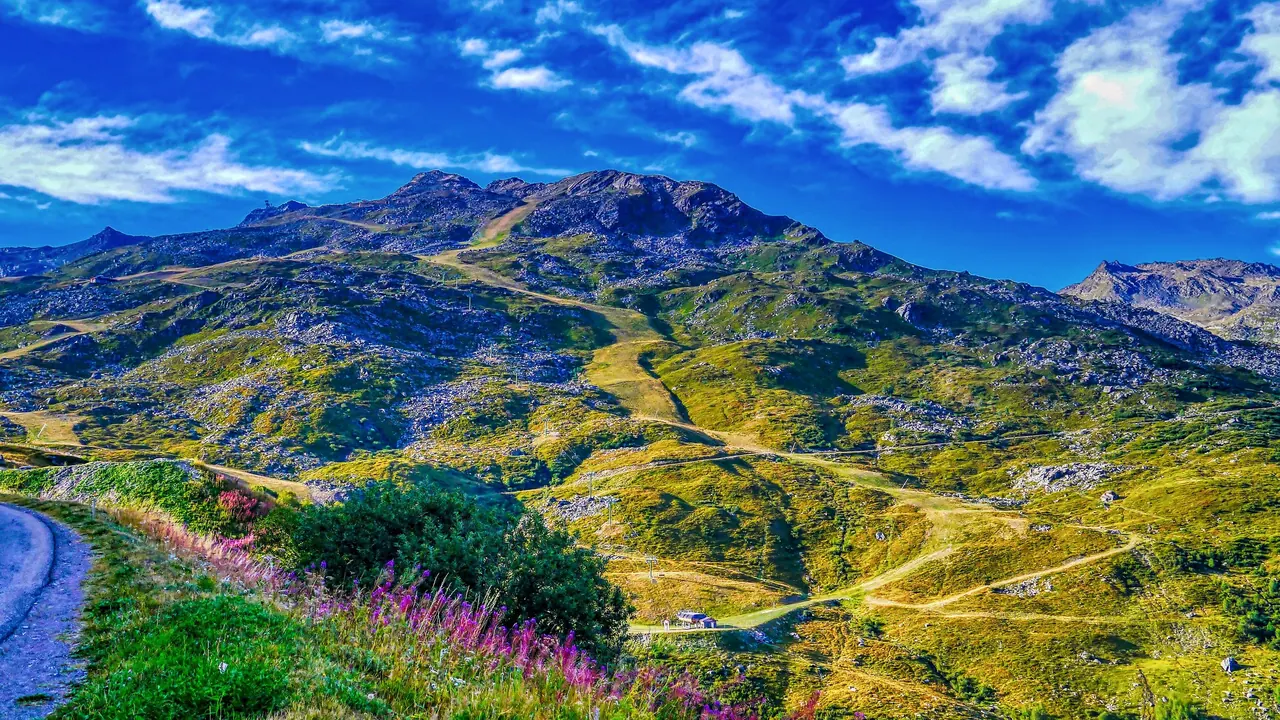
Photos: Val Thorens by Zairon, CC BY-SA 4.0, cropped.
Val Thorens or Verbier?
Our verdict in twelve categories, each scored against the same fixed benchmark cities, and the climate month by month, so you can choose for your trip.
Choose Val Thorens for
- prices
- getting around
- families
Val Thorens suits a group of friends who want the most skiing for their money and a loud week to go with it. The village is compact and car-free, you step out of the apartment onto the snow, the Three Valleys open up from the top of the lifts, and the snow at this height holds into spring. Share a self-catering flat and it is the less punishing bill of the two, though never a cheap one.
Choose Verbier for
- day trips
- live music and the arts
- shopping
Verbier is for travellers who want more from the mountain and the region around it, and can pay for it. Its freeride terrain is famous among strong skiers, the summer brings serious hiking, biking and the classical music festival, and the Rhône valley, Lake Geneva and Aosta are all close enough for a day out. Better hotel spas and thermal baths nearby make it the easier place to rest, too.
Scoreboard
Twelve categories on one fixed scale from 0 to 100. The shaded stretch is the gap between the two.
Your match
Pick a travel style or drag the sliders, and both match scores follow your weighting.
Wins on prices and getting around with your weighting.
Wins on day trips and live music and the arts with your weighting.
What matters to you?
Category by category
What the scores mean for a trip.
Beaches & swimming
Swimming plays no part in either stay. At Val Thorens the lakes are glacier-fed and icy even in summer, so a pool at the sports centre or your hotel is all there is.
Verbier is much the same, with alpine lakes such as Lac des Vaux better for looking at than bathing in. Its one advantage is that the shore of Lake Geneva is a little over an hour's drive away, so a summer day by open water is at least possible.
Food & drink
The two eat equally well, but from different cheese traditions. Val Thorens serves French Savoyard food: fondue, tartiflette, diots sausages and Beaufort, with a handful of ambitious hotel kitchens at the top end and a lot of self-catering below it.
Verbier's dish is raclette from its own Val de Bagnes, scraped from the half wheel at the table, along with rösti and croûtes au fromage. The wine lists are filled with Fendant, Petite Arvine and Cornalin from the Valais slopes below. In both places the choice soon repeats itself, cheap everyday eating is hard to find, and many kitchens close outside the main seasons.
Culture & sights
Neither resort has much to see, since both grew up around skiing. Val Thorens has the less: it was built from scratch in the 1970s as a cluster of chalet-clad blocks on a bare slope, and any Savoyard heritage means driving down the valley.
Verbier has a little more within reach. Le Châble, at the foot of the gondola, has a stone church, a small museum about life in the Bagnes valley and some old granaries in the surrounding hamlets.
Nightlife
Both are known as party resorts in winter, and Verbier comes out slightly ahead. Val Thorens is younger and rowdier, with students dancing on tables on the mountain terraces, then the village pubs and a well-known underground club. With a single small village, a week can start to feel repetitive.
Verbier's evenings centre on the packed bars around the Place Centrale and a few late clubs, where seasonal workers mix with a wealthy international crowd, which gives the scene a little more variety. Outside winter, both go quiet.
Nature & outdoors
Both are outstanding mountain destinations, but Verbier has the edge. Val Thorens's strength is altitude: it is the highest resort in Europe, so the snow holds from late November into May, and it gives skiers the whole linked Three Valleys. Its scenery is stark, all rock, snowfield and glacier with no trees.
Verbier's 4 Vallées area has a worldwide name for off-piste, freeride and ski touring. From Mont Fort the view stretches to Mont Blanc and the Matterhorn. In summer it is the richer of the two, with alpine pastures, a bike park, paragliding off the ridges and the Haute Route passing nearby, where Val Thorens has a shorter season on the edge of the Vanoise.
Day trips
Val Thorens is a hard place to leave for the day. The hairpin road down brings you to modest Moûtiers or the medieval quarter of Conflans above Albertville, and the most rewarding towns in the region, Annecy on its lake and Chambéry, are about two hours away by car. Most visitors simply stay up on the slopes.
Verbier sits where Switzerland, France and Italy meet, and the choice of day trips is far wider. Martigny, with its Roman remains and art foundation, is about half an hour away, and Sion's two hilltop castles are nearer an hour. The abbey at Saint-Maurice, Château de Chillon and the Lavaux vineyard terraces are a little over an hour away, and over the pass lie the Great St Bernard hospice and Roman Aosta.
Good for families
Families are served about equally, with different drawbacks. Val Thorens is the more practical: the village is car-free and compact, the beginner slopes are right in the centre, and there is a long toboggan run. The cold, the wind and the altitude can be hard on small children, though, and the party crowd sets much of the mood.
Verbier is lower, but it is steep and spread out, and its reputation rests on difficult terrain. Beginners do better at gentler La Tzoumaz and Savoleyres, and summer brings easy walks to mountain lakes.
Getting around
The two are almost reversed. Val Thorens is hard to reach, with a bus or taxi of about an hour up hairpin bends from Moûtiers station. Once you arrive, though, everything is close: the village is compact and car-free, and many beds are ski-in, ski-out.
Verbier is easy to reach, by train to Le Châble and then the gondola up. Getting around once there is harder, because chalets are scattered across a steep hillside and many visitors end up relying on shuttles or taxis.
Shopping & style
Val Thorens is a place to get kitted out rather than to shop. The shops cover ski hire, technical gear and resort clothing, a few delicatessens sell Savoyard cheese and charcuterie, and the small supermarkets are there to stock the apartment fridge. A wedge of Beaufort is about the only thing worth carrying home.
Verbier has more to browse, though it is still a mountain village. Its gear shops are bigger and carry more, and next to them sit a handful of smart boutiques selling clothes, jewellery and things for the chalet, so an afternoon off the slopes can include some window shopping that Val Thorens cannot offer. The souvenirs are Swiss: Bagnes cheese, Valais cured meats and a bottle or two from the vineyards below. For a proper day's shopping you still have to drive to Lausanne or Geneva.
Affordability
A group sharing a self-catering apartment in Val Thorens and cooking its own meals can bring a ski week down a long way. The resort is also less exclusive than its smartest neighbours in the Three Valleys. Lift passes, hire and school vacation weeks still make it a costly trip, though.
In Verbier the same savings go much less far. Hotels and chalet rentals in winter cost well above European norms, and a lunch on the mountain is priced for a wealthy crowd. Coming in summer or sleeping down in Le Châble helps a little, but there is no cheap way to do it.
Live music & performing arts
Verbier has something Val Thorens lacks entirely: the Verbier Festival, held each summer since 1994. For a couple of weeks, leading soloists and chamber musicians play in the festival hall and the village church, and the academy's masterclasses are open to the public. For the rest of the year there is little.
At Val Thorens, live music means cover bands and DJs in the après-ski bars, and nothing beyond that.
Wellness & relaxation
Verbier is the better place to slow down. Its upmarket hotels and luxury chalets have proper spas, the thermal baths at Saillon and Lavey-les-Bains are each within about an hour, and the quieter months bring clear air and empty terraces.
Val Thorens has hotel saunas and pools, the sports centre spa, and the old spa town of Brides-les-Bains an hour down the valley. The resort itself, though, is built around hard skiing and loud evenings, not rest.
When should you go?
Pick your month. The climate figures are measured averages, not a forecast.
Val Thorens in July
Verbier in July
Daytime high, °C
Rainfall in the month, mm
Where the figures come from
Val Thorens has no weather station within reach, so its figures come from a gridded climate model rather than a measured record, and read a broad area rather than one spot.
Verbier has no weather station within reach, so its figures come from a gridded climate model rather than a measured record, and read a broad area rather than one spot.
Temperature and rainfall are climate normals, averaged over the years shown. Val Thorens: 1991-2020 normals, TerraClimate 4 km grid at the town, no weather station within 90 km. Verbier: 1991-2020 normals, TerraClimate 4 km grid at the town, no weather station within 90 km.
Both are winter resorts first, but Val Thorens is the colder and more reliable for snow. From December to February its daytime highs stay below freezing, around -3°C in midwinter, and the snow lasts from late November into May, so late-season skiing in April is a good bet. Verbier sits lower and stays a few degrees milder, hovering around 0°C in January. That brings softer, sunnier spring days and a shorter season at village level. November and December are the wettest months in both, with Val Thorens taking about 180mm in November, most of it as snow at that height.
Summer is short and cool rather than hot. July and August reach about 16°C at Val Thorens and 18°C at Verbier, which is pleasant for walking but never warm enough to swim outdoors, and the weather can turn quickly. Verbier is drier in September and stays mild for longer into autumn, which makes it the better choice for hiking outside the peak weeks.
Which traveller are you?
On a trip on a tight budget, Val Thorens is the more realistic choice. Neither is cheap, but a shared apartment with its own kitchen brings a week here down far more than anything you can do in Verbier, one of the dearest resorts in the Alps.
For a culture and arts trip, Verbier wins easily. In summer its festival brings leading soloists and open masterclasses, and the castles of Sion, the abbey at Saint-Maurice and Château de Chillon are close enough for a day out. Val Thorens offers none of this.
On a relaxing and wellness trip, Verbier is the calmer place to unwind. Its upmarket hotels and chalets have proper spas, the thermal baths at Saillon and Lavey are near, and its quiet shoulder months suit a slow pace better than Val Thorens's après-ski.
Before you go
| Measure | Val Thorens | Verbier |
|---|---|---|
| Official language | French | French, German, Italian, Romansh |
| Currency | Euro (EUR) | Swiss Franc (CHF) |
| Sockets | CE230 V, 50 Hz | CJ230 V, 50 Hz |
| Driving side | Right | Right |
| Time zone | UTC+1, UTC+2 in summer | UTC+1, UTC+2 in summer |
| Emergency number | 112 | 112 |
| Elevation | 1,710 m | 1,490 m |
| Main airport | Geneva International Airport (GVA)111 km from centre150 non-stop destinations | Geneva International Airport (GVA)88 km from centre150 non-stop destinations |
| Public holidays this year | 11 days | 9 days |
By the numbers
| Measure | Val Thorens | Verbier |
|---|---|---|
| Museums within 10 km | 0 | 4 |
| UNESCO World Heritage sites within 50 km | 1 | 0 |
Where else could you go?
Every comparison below shares a destination with this one, so you can follow Val Thorens or Verbier somewhere new.
- Les Menuiresvs Val Thorens
- Méribelvs Val Thorens
- Courchevelvs Val Thorens
- La Plagnevs Val Thorens
- Val Cenisvs Val Thorens
- Crans-Montanavs Verbier