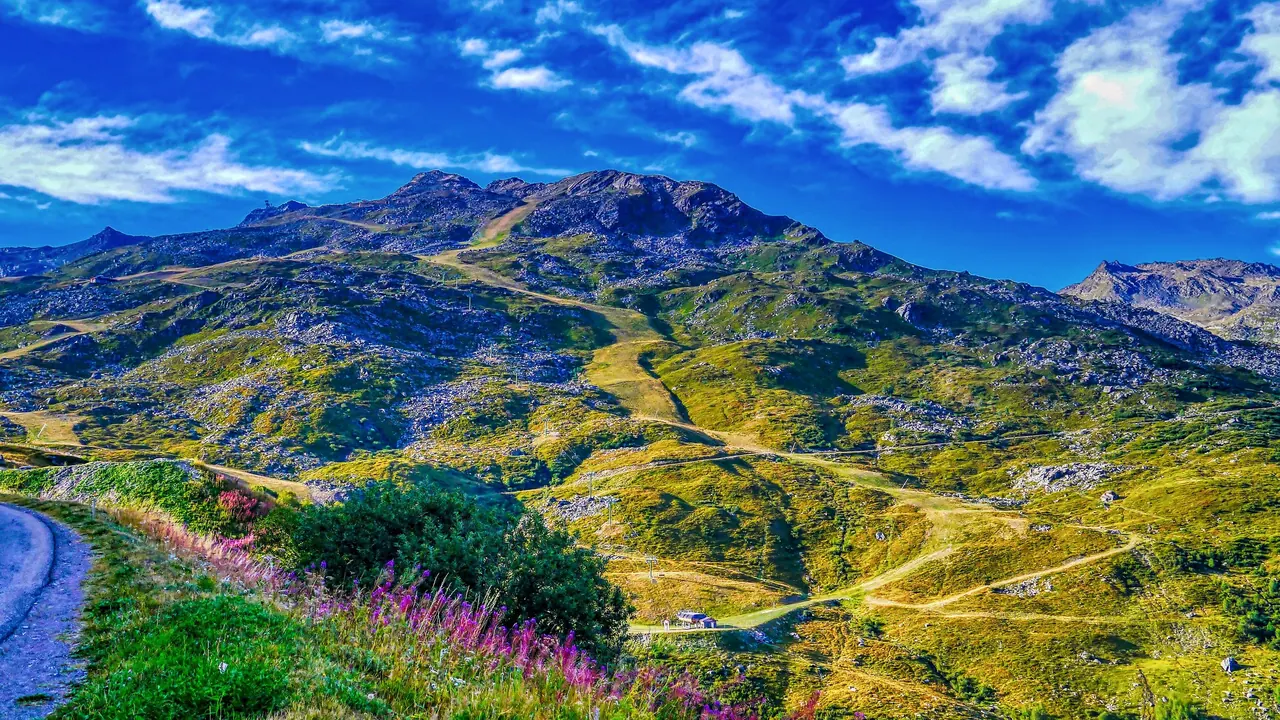
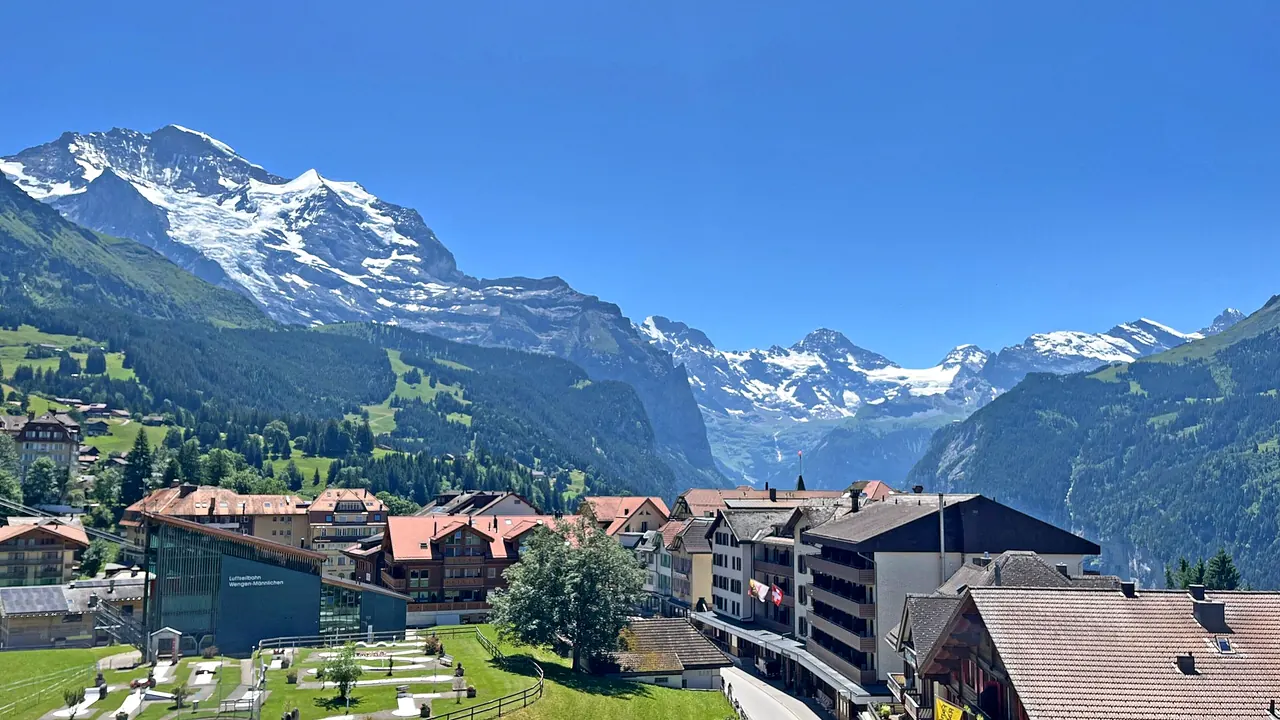
Photos: Val Thorens by Zairon, CC BY-SA 4.0, cropped; Wengen by Charles J. Sharp, CC BY-SA 4.0, cropped.
Val Thorens or Wengen?
Our verdict in twelve categories, each scored against the same fixed benchmark cities, and the climate month by month, so you can choose for your trip.
Choose Val Thorens for
- nightlife
- food and drink
- prices
Val Thorens is the pick for a ski week with friends who want the evenings to matter as much as the runs. It sits higher than any other resort in Europe, keeps reliable snow from late November into May, and opens onto the whole Three Valleys. After the lifts close there are terrace parties, pubs and clubs that run late. The food is also wider than most resorts offer, and a group sharing a self-catered apartment spends less than it would in the Swiss village.
Choose Wengen for
- day trips
- beaches
- getting around
Wengen suits travellers who come for the mountains themselves and like a quiet place to come back to. The village faces the Jungfrau across the Lauterbrunnen valley, has no cars, and works as well for summer walking as for winter skiing. It is the better base for families, for couples who want calm, and for anyone who wants to take the train down to the lakes and Bern on a free day. The price is high, and the evenings end early.
Scoreboard
Twelve categories on one fixed scale from 0 to 100. The shaded stretch is the gap between the two.
Your match
Pick a travel style or drag the sliders, and both match scores follow your weighting.
Too close to call, 1 point apart
Wins on nightlife and food and drink with your weighting.
Wins on day trips and beaches with your weighting.
What matters to you?
Category by category
What the scores mean for a trip.
Beaches & swimming
Neither village is a place for swimming, but Wengen at least has lakes within reach. In July the lidos on Lake Thun, about an hour away by train, make a pleasant warm afternoon, although glacier-fed Lake Brienz stays cooler.
Val Thorens has nothing like that. Its high lakes are meltwater and far too cold to swim in, and the coast is hours away, so swimming means the sports centre pool or a hotel pool.
Food & drink
Val Thorens eats better and with more variety. Fondue, tartiflette, diots sausages and Beaufort cheese are served in wood-panelled village restaurants and slope-side huts, and a few upmarket hotels have ambitious gastronomic kitchens. The everyday menu still gets repetitive, and much of it closes out of season.
In Wengen most meals are eaten in hotel dining rooms on half-board. The food is rösti, veal in cream sauce and hearty soups, and there are hardly any cheap or casual places. A terrace lunch facing the Jungfrau is memorable, but mainly for the view.
Culture & sights
Both are thin on sights, so culture is not a reason to choose either. Val Thorens is a ski station built in the 1970s on an empty slope, with no old buildings at all. Wengen at least has some character from its past: wooden chalets, Belle Époque hotels from its days as an English resort, a small church and a long history of ski racing. That makes it a more pleasant place for an evening stroll.
Nightlife
Val Thorens is one of the liveliest resorts in the Alps. People dance on tables at the mountain terraces as the lifts close, the village pubs fill up afterwards, and a few clubs, including a well-known underground one, stay open until the early hours. The crowd is young and full of students, although a week in one small village can start to feel repetitive.
Wengen offers a few busy bars after skiing and a hotel bar that stays open later. The village only really parties on the weekend of the Lauberhorn downhill in January. In summer, walkers are in bed early.
Nature & outdoors
Both villages are in superb mountain country, and Wengen comes out ahead for its setting and for the range of what you can do there. It looks straight across the Lauterbrunnen valley, with its sheer walls and waterfalls, to the Jungfrau, Eiger and Mönch. Trails from the village lead through meadows, along the Männlichen ridge to Kleine Scheidegg and beneath the Eiger north face, and the railway continues up to the Jungfraujoch glacier.
Val Thorens offers bigger, higher skiing: lifts above 3,200m, glacier and off-piste terrain, and the linked runs of Méribel and Courchevel. Its landscape is bare rock and snow with no trees. Its summer is short, with walks to high lakes and the edge of the Vanoise.
Day trips
From Wengen, the rack railway opens up a full programme of days out, though every trip starts with the slow ride down. You can go to Thun's castle and old town, take a steamer to Spiez and Oberhofen, visit the woodcarvers of Brienz and the Ballenberg open-air museum, or make a long day of Bern's arcaded medieval centre.
Val Thorens is poorly placed for this. Below the hairpin road there is little more than modest Moûtiers and the medieval quarter of Conflans. Annecy and Chambéry are worth seeing, but at around two hours by car each way they make for a tiring day.
Good for families
Altitude is what counts against Val Thorens with small children. At about 2,300m it is often bitterly cold and windy, bad weather can shut the lifts, and young children may sleep poorly. The practical side is good, with a mostly car-free village, beginner areas in the centre, a long toboggan run and a pool at the sports centre, but the young après-ski crowd sets the tone.
Wengen, a thousand metres lower, is the gentler base. With no cars at all, children can wander the lanes safely, the nursery slopes sit beside the hotels, and in summer the rack railway and cable car turn the high viewpoints into short outings. There is little to fill a rainy day, the steep paths are hard work with a buggy, and feeding a family costs a great deal.
Getting around
Wengen is easier, mainly because you never need a car. Trains bring you to Lauterbrunnen, the rack railway takes you up, and electric carts carry your luggage from the station. The same line runs on to Kleine Scheidegg and the Jungfraujoch, so the high mountains are part of the transport network.
Within Val Thorens, getting about is just as simple, with free shuttles and many ski-in, ski-out apartments. Arriving is harder: it takes about an hour by road from Moûtiers station up hairpin bends, cars stay in car parks at the edge of the resort, and there is little public transport for exploring once you are there.
Shopping & style
Neither is a place to go shopping. In both, the shops cover ski hire, outdoor gear and groceries. What differs is the local food. Val Thorens has delicatessens selling Savoyard cheese and charcuterie and supermarkets suited to self-catering. Wengen's short main street has chocolate and souvenir counters, and for real choice you go down to Interlaken or Bern.
Affordability
In Val Thorens most of the money goes on skiing: a lift pass for the Three Valleys, equipment hire, ski school for anyone learning, and long lunches in the huts beside the slopes. Most beds are in apartment residences with kitchens, so a raclette at home can stand in for a restaurant meal on some nights. School vacation weeks still cost the most, but the resort lacks the exclusive feel of Courchevel at the far end of the Three Valleys.
Wengen costs more almost everywhere you spend. The biggest bills are for getting about the mountain: the rack railway, the cable car to the Männlichen and the long ride up to the Jungfraujoch are paid for trip by trip, in summer as well as in winter, although a regional rail pass softens them a little. Many visitors book half-board because the village has so few cheap places to eat, and a drink on a terrace facing the Eiger is priced with the view in mind. The trails are free to walk, but little else is.
Live music & performing arts
Neither has a stage or a concert hall, and the little there is differs in kind. Val Thorens means cover bands and DJs at après-ski bars, with the occasional event on the slopes. Wengen offers traditional evenings instead: an alphorn or yodelling night in a hotel, occasional summer concerts and a brass band at village festivals. Anyone who wants proper theatre should head to Bern.
Wellness & relaxation
For rest, Wengen has the advantage of quiet. With no traffic, you hear cowbells, the cog railway and the waterfalls, and a slow afternoon on a balcony facing the Jungfrau is the main draw. Its spas are mostly saunas and treatment rooms in the larger hotels.
Val Thorens has more facilities, with hotel pools and steam rooms and a public spa at the sports centre. Brides-les-Bains, an old thermal town with a real spa tradition, is about an hour down the valley. The resort itself is built around hard skiing and loud evenings, so it is not a place to slow down.
When should you go?
Pick your month. The climate figures are measured averages, not a forecast.
Val Thorens in July
Wengen in July
Daytime high, °C
Rainfall in the month, mm
Where the figures come from
Val Thorens has no weather station within reach, so its figures come from a gridded climate model rather than a measured record, and read a broad area rather than one spot.
Wengen has no weather station within reach, so its figures come from a gridded climate model rather than a measured record, and read a broad area rather than one spot.
Temperature and rainfall are climate normals, averaged over the years shown. Val Thorens: 1991-2020 normals, TerraClimate 4 km grid at the town, no weather station within 90 km. Wengen: 1991-2020 normals, TerraClimate 4 km grid at the town, no weather station within 90 km.
Val Thorens is a winter place first. Daytime highs stay below freezing from December to February, around -3°C at their coldest, and the heavy precipitation of late autumn and winter, peaking near 180mm in November, falls as snow and keeps the ski season going into May. The summer window is short and cool, with highs of about 16°C in August, which is fine for high trails but never warm, and cold snaps can arrive at any time.
Wengen is lower and a little milder throughout, with January highs around 0°C and a summer that reaches about the same 16°C. Its wettest stretch is the hiking season, with roughly 110mm a month from June to August, so summer walks will bring showers and spells of cloud. Late spring brings wildflowers and full waterfalls, and the clearer days of September and October are often the most rewarding time for walking. Winter suits both places. Summer favours Wengen, where walking is the main reason to visit, while much of Val Thorens closes.
Which traveller are you?
For a food and nightlife trip, Val Thorens is the clear choice. Afternoon après-ski on the mountain terraces moves into village bars and late clubs, and Savoyard cheese dishes sit alongside a few serious hotel kitchens. Wengen's evenings mostly end after a half-board dinner.
On a family trip with children, Wengen works better. The car-free lanes are safe, the nursery slopes are near the hotels and the atmosphere is calm. Val Thorens is also car-free, but its altitude, its cold and its party crowd make it harder going with young children.
For a trip on a tight budget, neither place is cheap, but Val Thorens is easier to manage. Groups sharing an apartment and cooking for themselves can cut the cost a good deal. In Wengen, Swiss prices and the fares on every mountain railway add up quickly.
Before you go
| Measure | Val Thorens | Wengen |
|---|---|---|
| Official language | French | French, German, Italian, Romansh |
| Currency | Euro (EUR) | Swiss Franc (CHF) |
| Sockets | CE230 V, 50 Hz | CJ230 V, 50 Hz |
| Driving side | Right | Right |
| Time zone | UTC+1, UTC+2 in summer | UTC+1, UTC+2 in summer |
| Emergency number | 112 | 112 |
| Elevation | 1,710 m | 1,274 m |
| Main airport | Geneva International Airport (GVA)111 km from centre150 non-stop destinations | Zürich Airport (ZRH)106 km from centre226 non-stop destinations |
| Public holidays this year | 11 days | 10 days |
By the numbers
| Measure | Val Thorens | Wengen |
|---|---|---|
| Population | - | 1,116 |
| People per km² | - | 31 |
| Museums within 10 km | 0 | 2 |
| UNESCO World Heritage sites within 50 km | 1 | 1 |
Where else could you go?
Every comparison below shares a destination with this one, so you can follow Val Thorens or Wengen somewhere new.
- Les Menuiresvs Val Thorens
- Mürrenvs Wengen
- Grindelwaldvs Wengen
- Méribelvs Val Thorens
- Courchevelvs Val Thorens
- La Plagnevs Val Thorens