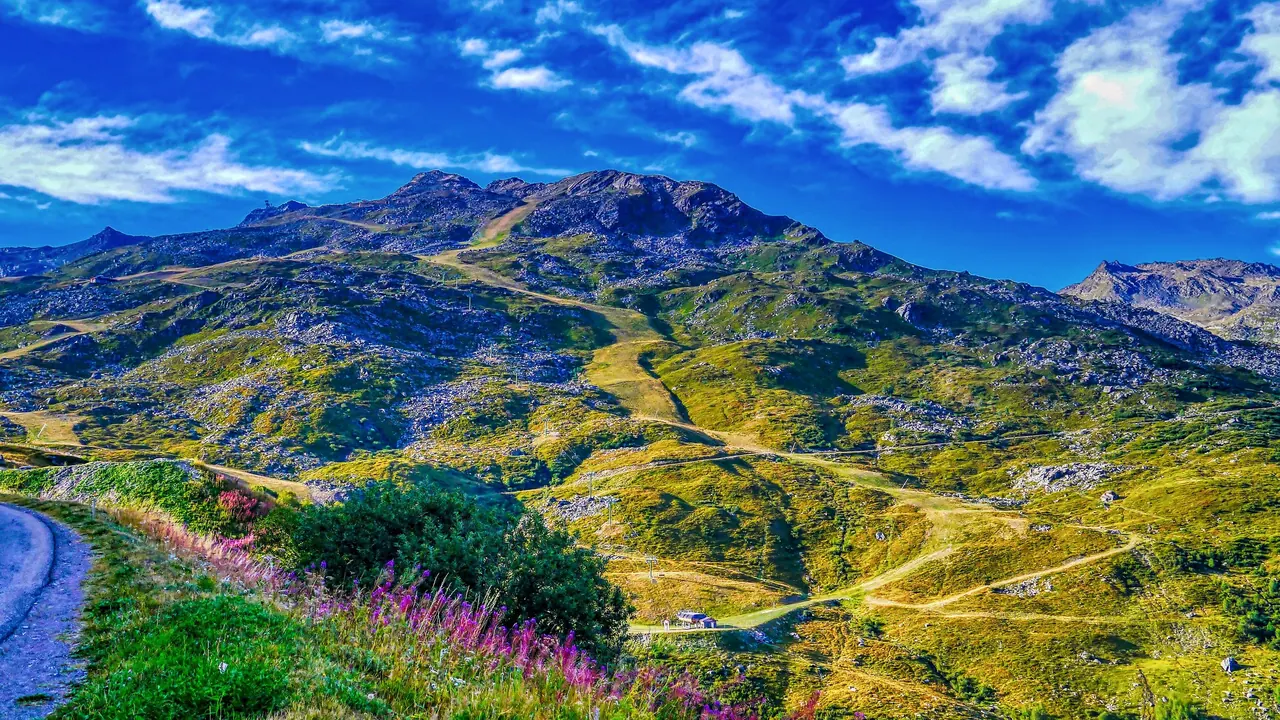
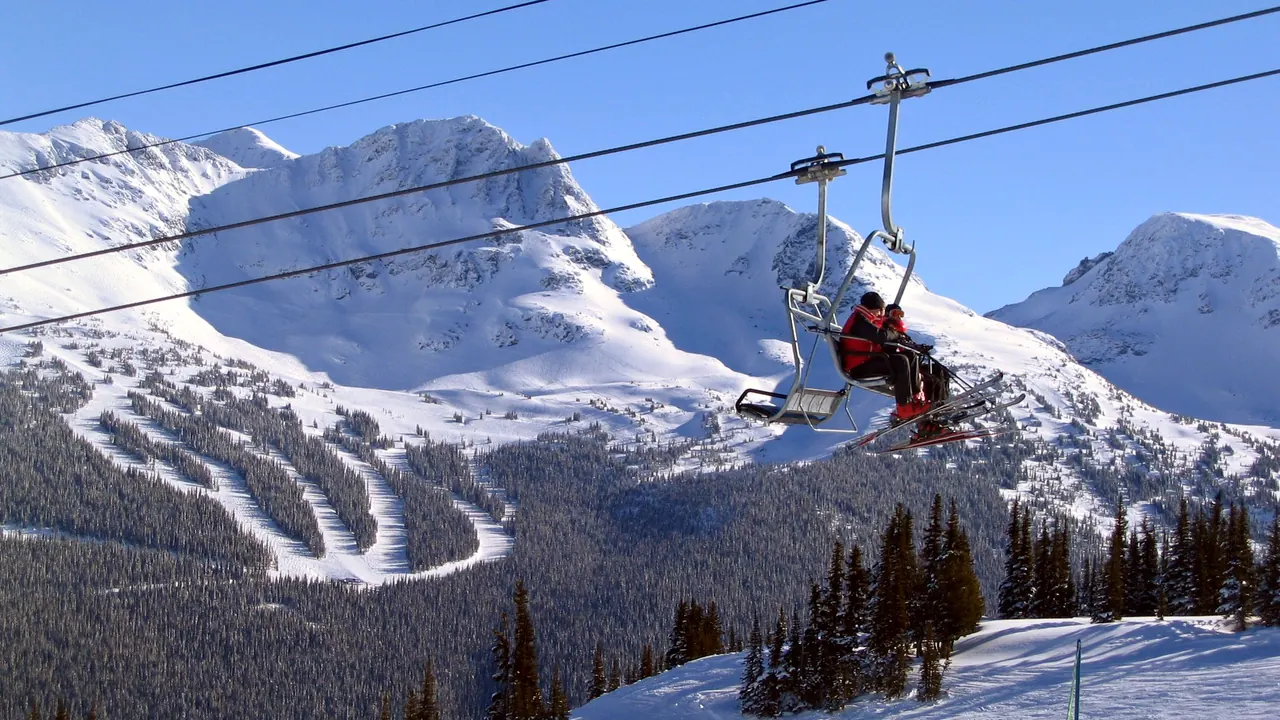
Photos: Val Thorens by Zairon, CC BY-SA 4.0, cropped; Whistler by Ruth Hartnup, CC BY 2.0, cropped.
Val Thorens or Whistler?
Our verdict in twelve categories, each scored against the same fixed benchmark cities, and the climate month by month, so you can choose for your trip.
Choose Val Thorens for
- nightlife
- prices
Val Thorens is the pick for a group of friends who want a hard-skiing winter week high in the French Alps. Its altitude keeps the snow reliable late into spring, the lifts open onto the whole Three Valleys without taking skis off, and the après-ski, from table-dancing on mountain terraces to clubs running into the small hours, is built for a young crowd. Travellers coming from Europe can also arrive by train as far as Moûtiers. Expect a bare, treeless village with little to do beyond skiing and partying.
Choose Whistler for
- beaches
- wellness
- families
Whistler suits almost everyone else, and works in summer as well as winter. The two mountains have forest as well as alpine bowls, the bike park and Garibaldi trails fill the warmer months, and the lakes, Nordic spa and Audain Art Museum give rest days real substance. Families, couples who want calm evenings and anyone hoping to add a few days in Vancouver will find it the more rounded base.
Scoreboard
Twelve categories on one fixed scale from 0 to 100. The shaded stretch is the gap between the two.
Your match
Pick a travel style or drag the sliders, and both match scores follow your weighting.
Wins on nightlife and prices with your weighting.
Wins on beaches and wellness with your weighting.
What matters to you?
Category by category
What the scores mean for a trip.
Beaches & swimming
Neither place has a coast, but only Whistler offers any swimming outdoors. In July and August, Lost Lake's sandy shore and the grassy parks, rafts and jetties of Alta and Alpha lakes make good afternoons after a hike or bike ride, with the shallower water warming to around 20°C in a warm spell.
At Val Thorens the high lakes are glacier-fed and far too cold for bathing even in midsummer, so swimming means the pool at the sports centre or your hotel.
Food & drink
The eating is about as good in both, but very different in flavour. Val Thorens means Savoyard cheese cooking, fondue, raclette and tartiflette in wood-lined rooms and long lunches at slope-side huts, plus a few ambitious hotel kitchens; outside the seasons much of the village shuts.
Whistler cooks Pacific Northwest produce such as BC salmon and spot prawns, pairs it with deep British Columbia wine lists, and adds ramen and sushi counters and breakfast spots. Its signature ritual is nachos and craft beer on the gondola-base patios rather than a mountain-hut lunch.
Culture & sights
Whistler has a little to see; Val Thorens has nothing. The Audain Art Museum, with its Emily Carr paintings and Northwest Coast First Nations masks, and the Squamish Lil'wat Cultural Centre are both worth a few hours, and the 2010 Olympic venues add interest.
Val Thorens was built on a bare slope in the 1970s, with no old town or museum, so anyone curious about Savoyard heritage has to drive down to the valley towns.
Nightlife
Both are known as party resorts and both deliver a young, loud winter scene, but the setting differs. In Val Thorens the party starts up the mountain, with dancing on tables at terrace bars as the lifts close, then moves to village pubs and a handful of clubs, one of them underground, full of students.
Whistler's après happens on packed patios at the foot of the gondolas, and its late bars fill with seasonal workers and Australians on working visas. Whistler keeps some life in summer around its big bike festivals, whereas Val Thorens' nightlife all but vanishes once the snow goes.
Nature & outdoors
Both are first-rate mountain destinations, but Whistler is the more complete one. Whistler and Blackcomb, linked by the Peak 2 Peak Gondola, have more than 200 runs, alpine bowls and deep Coast Mountains snow, with forest below, and in summer they become a famous downhill bike park, with Garibaldi's turquoise lakes, valley paddling and black bears on the slopes.
Val Thorens' strengths are altitude and scale. As Europe's highest resort it keeps snow into May, and the Three Valleys give an enormous linked ski area across Méribel and Courchevel. Its landscape is stark rock, snowfield and glacier with no trees, and its summer is short and often cold.
Day trips
From either resort, the best outing is about two hours away by car. From Val Thorens that means lakeside Annecy or Chambéry, a long day after the hairpin road down to the valley. Nearer by, the choice is modest: an afternoon in the medieval quarter of Conflans above Albertville, or Méribel and Courchevel, which are really ski outings rather than trips.
Whistler's two-hour journey brings a bigger reward. Vancouver lies at the end of the scenic Sea to Sky Highway, and as a whole city it is worth a night rather than a rushed day. On the way down are Squamish with its gondola and the old Britannia copper mine, which is now a mining museum.
Good for families
Whistler is clearly the stronger family resort. Its ski schools are big and well run, tubing and sledding fill the gaps between lessons, and in summer there are lake beaches, mini-golf, an adventure park and gondola rides to spot marmots and bears.
Val Thorens handles the basics well, with a mostly car-free village, central beginner slopes, children's clubs and a long toboggan run. The altitude works against it, though: bitter wind, lifts closed by weather, small children sleeping badly, and a party crowd setting the tone.
Getting around
Once you arrive, both are easy: car-free villages, free shuttles and lifts from the doorstep. Val Thorens has more ski-in, ski-out lodging and a lift network spanning the Three Valleys, while Whistler adds the paved Valley Trail for walking and cycling between lakes.
The journeys there differ. Val Thorens has a train station at Moûtiers, then about an hour of hairpin road, whereas Whistler has no passenger railway and most people come by airport coach from Vancouver along a highway that needs winter tyres in heavy snow.
Shopping & style
Whistler gives a little more to browse. Beyond its excellent ski, board and bike shops, the pedestrian village has art galleries selling Indigenous prints and carvings, a few boutiques and a summer farmers' market in the Upper Village. Val Thorens stops at gear hire, resort clothing and a few delicatessens with Beaufort cheese and Savoyard charcuterie to take home.
Affordability
Both are expensive, and there is little to choose between them. Val Thorens is less exclusive than Courchevel next door, and groups sharing a self-catering apartment can cut costs considerably, though school vacation weeks are dear.
Whistler's lift passes are among the costliest anywhere and Christmas is steep, but staying further down the valley, using the free shuttles and coming in spring or autumn all help.
Live music & performing arts
Whistler has a modest edge. It has free summer concerts on Olympic Plaza, buskers in the village and a small community arts centre with local theatre, and Vancouver's stages are a long drive away. In Val Thorens live music means cover bands, DJs and the odd on-slope event, and nothing more.
Wellness & relaxation
Whistler is far better for unwinding. Its large Nordic-style outdoor spa beside the river, where guests soak in silence among cedars, often under falling snow, is an experience in itself, and quiet shoulder seasons make a slow week easy.
In Val Thorens relaxation means a hotel sauna or the sports centre spa after skiing. For a real spa tradition you need to go down to the thermal town of Brides-les-Bains, about an hour away.
When should you go?
Pick your month. The climate figures are measured averages, not a forecast.
Val Thorens in July
Whistler in July
Daytime high, °C
Rainfall in the month, mm
Where the figures come from
Val Thorens has no weather station within reach, so its figures come from a gridded climate model rather than a measured record, and read a broad area rather than one spot.
Whistler has no rain gauge within 25 km of the centre, so its rainfall comes from a gridded climate dataset read at the destination rather than from a gauge further away.
Temperature and rainfall are climate normals, averaged over the years shown. Val Thorens: 1991-2020 normals, TerraClimate 4 km grid at the town, no weather station within 90 km. Whistler: 1991-2020 normals, Whistler - Nesters (1.1 km from centre).
Val Thorens stays wintry for most of the year. Daytime highs sit below freezing from December to February, around -3°C in the coldest months, which gives cold, dependable snow for skiing into May. The short summer brings highs of only about 16°C in August, cool enough for hiking but never warm, and rain or snow falls steadily all year, heaviest in November and December.
Whistler's village is milder in winter, hovering around freezing, but November and January are very wet, near 196mm in November, and that falls as snow on the mountains. Its summer is a real one: July and August reach about 25°C with only around 46mm of rain, warm enough for the lakes and long days on bike trails. The difference is sharpest from June to September, when Whistler is a full summer resort and Val Thorens stays cool and high-mountain.
Which traveller are you?
On a family trip with children, Whistler is the easier choice. Its milder valley, large ski schools, tubing, summer lake beaches and adventure park suit young children better than Val Thorens, where the altitude, wind and party crowd can wear families down.
For a relaxing and wellness trip, Whistler wins clearly. Soaking in silence in the forest Nordic spa, walking the Valley Trail between lakes and taking long dinners make a slow week easy, while Val Thorens offers hotel saunas inside a resort built around skiing hard.
On a food and nightlife trip in winter, Val Thorens has the edge for partying, with terrace après-ski, pubs and a famous underground club full of students. Whistler eats more broadly, with Pacific Northwest seafood and serious BC wine cellars.
Before you go
| Measure | Val Thorens | Whistler |
|---|---|---|
| Official language | French | French, English |
| Currency | Euro (EUR) | Canadian Dollar (CAD) |
| Sockets | CE230 V, 50 Hz | AB120 V, 60 Hz |
| Driving side | Right | Right |
| Time zone | UTC+1, UTC+2 in summer | UTC-8, UTC-7 in summer |
| Emergency number | 112 | 911 |
| Elevation | 1,710 m | 670 m |
| Main airport | Geneva International Airport (GVA)111 km from centre150 non-stop destinations | Vancouver International Airport (YVR)104 km from centre109 non-stop destinations |
| Public holidays this year | 11 days | 11 days |
By the numbers
| Measure | Val Thorens | Whistler |
|---|---|---|
| Population | - | 13,982 |
| People per km² | - | 58 |
| Museums within 10 km | 0 | 1 |
| UNESCO World Heritage sites within 50 km | 1 | 0 |
Where else could you go?
Every comparison below shares a destination with this one, so you can follow Val Thorens or Whistler somewhere new.
- Les Menuiresvs Val Thorens
- Méribelvs Val Thorens
- Courchevelvs Val Thorens
- La Plagnevs Val Thorens
- Val Cenisvs Val Thorens
- Tignesvs Val Thorens