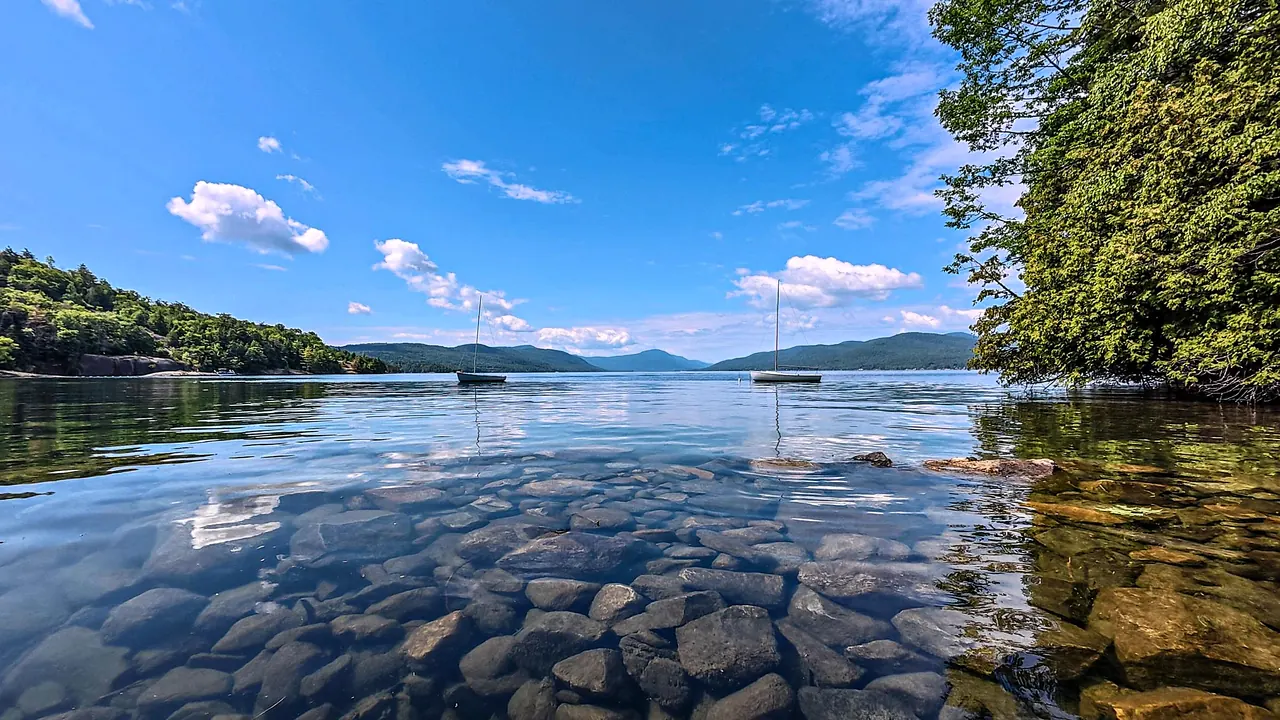
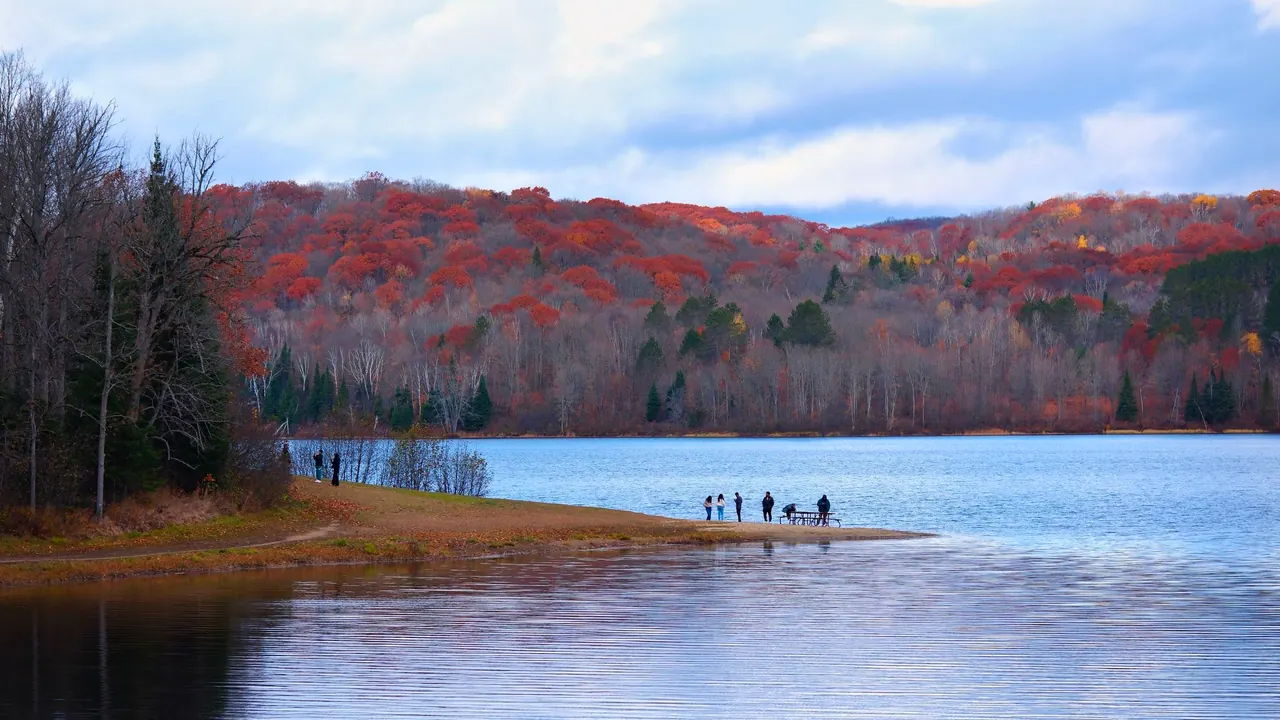
Photos: Adirondacks by Internetjessy, CC0; Muskoka by Surja Raj, Pexels License.
Adirondacks or Muskoka?
Our verdict in twelve categories, each scored against the same fixed benchmark cities, and the climate month by month, so you can choose for your trip.
Choose Adirondacks for
- culture and sights
- day trips
- prices
Pick the Adirondacks if you want variety on top of the woods and water. The High Peaks give real mountain hiking, and the region carries more history: colonial forts on Lake Champlain and Lake George, the Olympic venues at Lake Placid, the Gilded Age Great Camps. Saratoga Springs, Vermont and even Montreal are close enough for a day out, and the quieter central lakes keep costs a little lower. It suits a vacation that mixes summits, sights and a few days at the lake.
Choose Muskoka for
- beaches
- wellness
- food and drink
Muskoka is the simpler choice and does one thing very well: a week at a cottage by the water. The big lakes come right up to the dock, a canoe is never far away, and Algonquin Park's moose and loons are a short drive north. There is less to see and it costs more in summer. If what you want is to swim, paddle and sit on the granite until evening, it serves that slow lake life better.
Scoreboard
Twelve categories on one fixed scale from 0 to 100. The shaded stretch is the gap between the two.
Your match
Pick a travel style or drag the sliders, and both match scores follow your weighting.
Wins on culture and sights and day trips with your weighting.
Wins on beaches and wellness with your weighting.
What matters to you?
Category by category
What the scores mean for a trip.
Beaches & swimming
Lake swimming is the whole story in both places, and the water warms to the same low twenties in July and August. Muskoka builds a vacation around it more completely. The large lakes and hundreds of smaller ones come right up to the cottage, so a swim off the dock or a granite slab is part of every day rather than an outing.
The Adirondacks have more classic sandy beaches, notably Lake George's public strands and the small town beaches on Mirror Lake and the Fulton Chain. Swimming there is still one activity among hiking and sightseeing, often with a drive in between.
Food & drink
Neither region is a reason to travel for food, and they are much alike: casual, hearty and seasonal. The Adirondacks lean towards diner breakfasts with maple syrup, lodge dinners of steak and trout, and Champlain Valley cider and cheese in autumn, with Lake Placid and Saranac Lake offering the most choice.
Muskoka's own flavours are butter tarts, lake pickerel, Bala cranberries and craft beer from Bracebridge and Huntsville. Its best cooking is in the lake resorts, and many visitors simply cook at the cottage.
Culture & sights
The Adirondacks have clearly more history to visit. The forts at Ticonderoga and Lake George tell the story of the colonial wars, Lake Placid keeps the arenas and ski jumps of two Winter Olympics, and the Great Camps and the Adirondack Experience museum show how the region's guides, loggers and wealthy families lived. They are spread out, but together they fill several days.
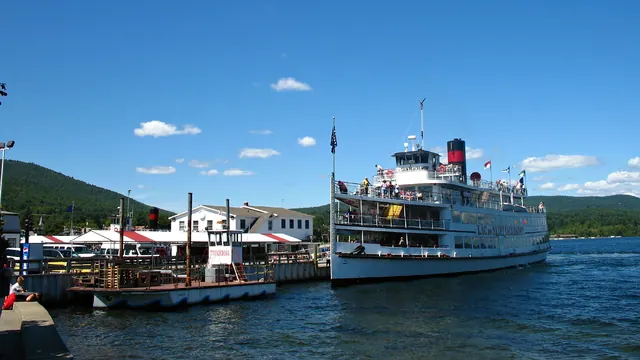
Muskoka's heritage comes down to the lakes themselves: the steamships and boat museum at Gravenhurst, Bethune Memorial House and a pioneer village in Huntsville. That is an afternoon or two, best combined with a cruise past the old boathouses.
Nightlife
Both regions go quiet early, and evenings mostly mean a fire or a porch. The difference is that the Adirondacks have one real exception: Lake George village in summer, with waterfront bars and party boats busy with young weekenders, plus a few lively pubs on Lake Placid's Main Street. Muskoka has no equivalent and no clubs. A brewpub patio in Huntsville or Bracebridge, or a band at a resort lounge, is as late as it gets.
Nature & outdoors
Both are excellent wild country, and they differ in shape more than quality. The Adirondacks have mountains: forty-six High Peaks, Mount Marcy rising above the treeline, and downhill skiing and ice climbing in winter, alongside the canoe routes of the St Regis and Saranac Lakes.
Muskoka is low, rolling Canadian Shield, with pink granite, white pine and lakes linked by portages. Paddling is the main activity, Algonquin Park's wildlife is less than an hour from Huntsville, and the Torrance Barrens add dark-sky stargazing. Blackflies make late spring trying in both.
Day trips
The Adirondacks have more within reach of the region. Saratoga Springs and Albany are an easy run from Lake George, ferries cross Lake Champlain to Burlington and Vermont's farm villages, and Montreal works as a long day from the northern lakes.
Muskoka's outings are more modest: Orillia's lakeside main street, the reconstructed Jesuit mission and shrine at Midland, and island cruises from Parry Sound or Midland on Georgian Bay. Toronto is too far, and too slow in summer traffic, to be worth it as a day trip.
Good for families
Both regions have a long tradition of family summers by the lake, but they offer different kinds of days. The Adirondacks lay on more organised fun: the theme park and water park near Lake George, Old Forge's water park, the treetop walkway at the Wild Center and bobsled rides at Lake Placid, though reaching them means long drives.
Muskoka keeps things simpler: shallow bays, a canoe at the cottage, nature programmes in the provincial parks, and the steamships at Gravenhurst. Each region has its own long-established Christmas-themed park for young children.
Getting around
You need a car in either region, and neither has public transport that reaches the lakes or trails. Distances inside the Adirondacks are longer: winding forest roads put Lake George more than an hour and a half from Lake Placid, though a daily train does run along Lake Champlain.
In Muskoka the Highway 11 towns are close to one another, so the driving within the region is easier. The difficulty is getting there and back, with slow Friday and Sunday traffic to and from Toronto, and some island cottages are reachable only by boat.
Shopping & style
Shopping is a sideline in both, and the best buys are crafts. In the Adirondacks that means twig and bentwood furniture, pack baskets and balsam pillows, with outdoor-gear shops on Lake Placid's Main Street and an outlet strip near Lake George. Muskoka's version is the Muskoka chair, cottage décor and pottery bought from artists' studios in the main-street towns, enough to fill a rainy afternoon.
Affordability
Neither is cheap in summer, but the Adirondacks give you more ways to keep costs down. Lake Placid and Lake George charge resort prices, while the central and western lakes have family motels and state campgrounds, and the hiking and swimming that most people come for are free.
Muskoka's main season is pricier. Lakefront cottages are booked by the week, the big resorts are premium, and restaurant meals cost much what they do in Toronto. The savings lie in park campgrounds, older highway motels, self-catering, or coming in June or after Thanksgiving.
Live music & performing arts
Orchestra and ballet in the open-air amphitheatre at Saratoga Springs are the biggest nights out within reach of the Adirondacks, an evening's drive from the southern lakes. Closer in, chamber concerts fill lakeside churches around Lake George, young singers train in a summer opera programme near Schroon Lake, and Lake Placid's arts centre hosts touring shows.
Muskoka's stages are smaller: theatre in the historic Gravenhurst Opera House, concerts in Huntsville and Bracebridge, and free bandstand evenings in the town parks. For chamber music, Parry Sound's Festival of the Sound is just to the west. Both regions save their programme for July and August, and little runs outside it.
Wellness & relaxation
Both regions are made for slowing down, and Muskoka has only a modest edge, mainly for pampering. In the Adirondacks, rest is mostly the landscape itself: a porch above a still lake, a canoe at dawn, and the mountain air that Saranac Lake was once built around as a place of rest. Spa treatments are limited to a few grand resorts on Lake George and lodges in Lake Placid, though Saratoga Springs' historic mineral baths lie just south of the park.
Muskoka adds more comfort to the same kind of quiet. The big resorts on Lake Rosseau, Lake Joseph and Peninsula Lake run full spas with lake-view treatment rooms and outdoor hot tubs, and many rental cottages have a wood-fired sauna by the shore, so a sauna and a lake dip can be part of an ordinary day.
When should you go?
Pick your month. The climate figures are measured averages, not a forecast.
Adirondacks in July
Muskoka in July
Daytime high, °C
Rainfall in the month, mm
Where the figures come from
Adirondacks has no rain gauge within 25 km of the centre, so its rainfall comes from a gridded climate dataset read at the destination rather than from a gauge further away.
Temperature and rainfall are climate normals, averaged over the years shown. Adirondacks: 2006-2020 (rainfall 1991-2020) normals, Harrietstown (20.1 km from centre). Muskoka: 1991-2020 normals, Muskoka Airport (7.8 km from centre).
The two regions share almost the same calendar. Both are cold, snowy winter places, with daytime highs below freezing from December to February. Both warm quickly through May, and July is the warmest month in each at about 25°C. The lakes are only comfortable for swimming in July and August. June water is bracing, and by mid to late September most people only paddle. September stays pleasant for hiking and canoeing, and the autumn colour in late September and early October is the other high point in both.
The rain falls differently. In the Adirondacks it is wettest in high summer, with June to August each bringing over 100mm, often as showers on warm afternoons. Muskoka's summer is a little drier, with July the only month above 100mm, while its autumn and early winter are wetter, with November the wettest month at 107mm. For a dry summer week at the lake Muskoka has a slight edge. For a crisp, settled spell of autumn hiking the Adirondacks do.
Which traveller are you?
For a beach and sun trip, Muskoka is the better choice. In summer the water is the centre of every day: swimming off docks and warm granite into Lake Rosseau, Lake Joseph or Lake Muskoka, with canoes and paddleboards at hand, and no driving needed to reach a beach.
On a culture and arts trip, the Adirondacks offer more. Fort Ticonderoga, Fort William Henry, the Olympic sites at Lake Placid and the Great Camps give you several afternoons of history, and Saratoga Springs' summer orchestra and ballet season is within reach of the southern lakes.
On a tight budget, the Adirondacks go further. Motels and state campgrounds around the central and western lakes cost less than Muskoka's weekly cottages and lake resorts, and the trails, summits and lakes that draw most visitors are free to use.
Before you go
| Measure | Adirondacks | Muskoka |
|---|---|---|
| Official language | - | French, English |
| Currency | US Dollar (USD) | Canadian Dollar (CAD) |
| Sockets | AB120 V, 60 Hz | AB120 V, 60 Hz |
| Driving side | Right | Right |
| Time zone | UTC-5, UTC-4 in summer | UTC-5, UTC-4 in summer |
| Emergency number | 911 | 911 |
| Main airport | Albany International Airport (ALB)26 non-stop destinations | Toronto Pearson International Airport (YYZ)190 non-stop destinations |
| Public holidays this year | 13 days | 11 days |
Where else could you go?
Every comparison below shares a destination with this one, so you can follow Adirondacks or Muskoka somewhere new.
- Catskillsvs Adirondacks
- Hudson Valleyvs Adirondacks
- Finger Lakesvs Adirondacks
- Finger Lakesvs Muskoka
- Poconosvs Adirondacks
- The Hamptonsvs Adirondacks