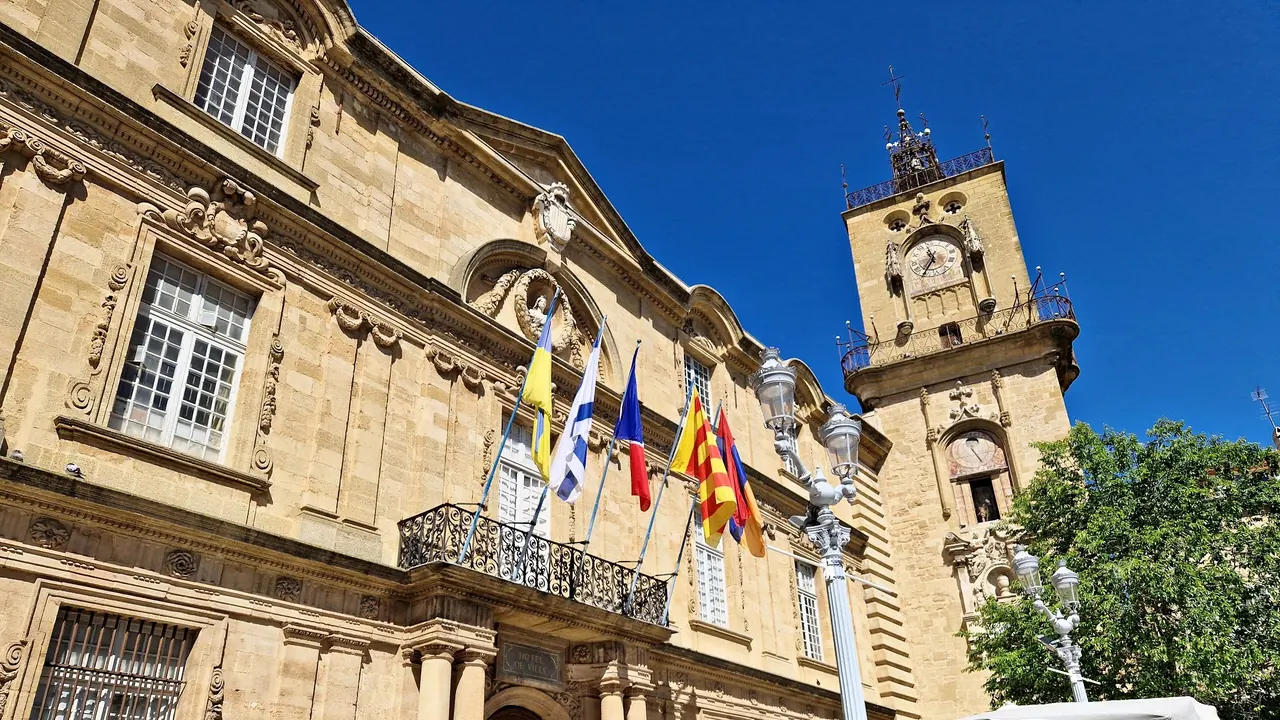
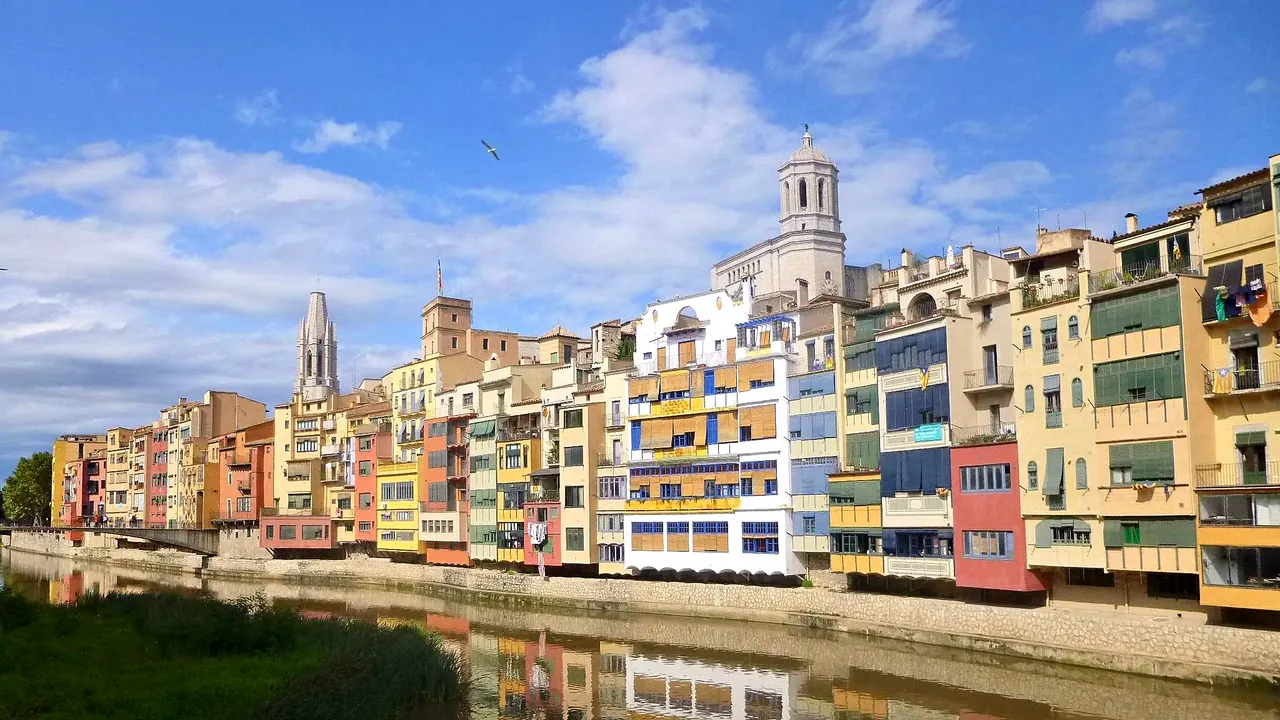
Photos: Aix-en-Provence by Hanay, CC BY-SA 4.0, cropped; Girona by Zarateman, CC0.
Aix-en-Provence or Girona?
Our verdict in twelve categories, each scored against the same fixed benchmark cities, and the climate month by month, so you can choose for your trip.
Choose Aix-en-Provence for
- live music and the arts
- shopping
- wellness
Aix-en-Provence suits the traveller who wants elegance and a cultural calendar. Its July opera festival, the home stage of a leading contemporary dance company and a real spa on the site of the Roman baths give it more to fill an evening or an afternoon. The boutique-lined lanes and Provençal markets make it the better town for shopping, as long as you accept higher bills and have a car for the Luberon and the Calanques.
Choose Girona for
- prices
- beaches
- food and drink
Girona is the better pick for a lower budget and for anyone drawn to the sea or a bike. The Costa Brava's sandy bays and clear coves are closer to a proper beach day than the rocky inlets near Marseille, and the cycling and greenways start at the edge of town. Barcelona is near enough for a day out, and you come back each night to a quieter, cheaper medieval city.
Scoreboard
Twelve categories on one fixed scale from 0 to 100. The shaded stretch is the gap between the two.
Your match
Pick a travel style or drag the sliders, and both match scores follow your weighting.
Too close to call, 2 points apart
Wins on live music and the arts and shopping with your weighting.
Wins on prices and beaches with your weighting.
What matters to you?
Category by category
What the scores mean for a trip.
Beaches & swimming
Neither town has a beach of its own, but Girona's coast gives the better swimming. The Costa Brava mixes long sandy bays with pine-backed coves, and the water around Begur and L'Escala is among the clearest on this stretch of the Mediterranean.
From Aix you reach the small city beaches of Marseille, the Côte Bleue and the calanques near Cassis. These are mostly pebbly or rocky inlets that fill up fast in August, and the mistral can chill the water. Many visitors to Aix end up swimming in a hotel or villa pool.
Food & drink
The two eat about equally well, in different ways. Aix is built around its morning markets and the long lunch on a terrace, with tapenade, daube, chilled Coteaux d'Aix rosé and calissons from the old confectioners.
Girona leans on Catalan home cooking, such as botifarra with beans and mar i muntanya dishes, and it also has a reputation for serious tasting-menu restaurants that Aix doesn't match. It has Empordà wine, vermouth before lunch and xuixos from the pastry shops. In both towns the cooking rarely goes beyond the local cuisine, and the most scenic terraces are not the best places to eat.
Culture & sights
The two are level, but the pleasures differ. Aix is a classical town of plane trees, mossy fountains and the honey-coloured mansions of the Mazarin quarter. Its link to Cézanne, through his studio at Les Lauves, the family house at the Jas de Bouffan and the Bibémus quarries, makes it a real artistic pilgrimage, and the Musée Granet and the fine interiors of the Hôtel de Caumont fill two or three days at a gentle pace.
Girona is more medieval and more dramatic. The walled Barri Vell climbs from the river to a cathedral with one of the widest Gothic naves in the world, past the Romanesque cloister of Sant Pere de Galligants, the Arab Baths and the Call, one of Europe's best-preserved Jewish quarters. Walking the walls, with views towards the Pyrenees, is a highlight in itself. Its museums are smaller, so a day or two of unhurried walking covers the essentials, slightly less time than Aix asks for.
Nightlife
Aix has a little more going on after dark. Its large student population keeps the bars around Place des Cardeurs busy, and there are cocktail and wine bars and a few small clubs, though it all ends long before dawn.
Girona is quieter still. Its evenings mean a late dinner and then drinks around Plaça de la Independència, with a few music bars open late at weekends. In both towns the student crowd thins out in the term breaks, and for a proper club night Aix sends you to Marseille and Girona to Barcelona.
Nature & outdoors
Both are excellent bases for the outdoors, but for different activities. Aix is walking country. Montagne Sainte-Victoire rises at the edge of town, the Calanques offer cliff paths and sea kayaking, and the Gorges du Verdon is within reach. In midsummer, though, fire-risk closures can shut the massifs.
Girona is the place for cyclists, with quiet lanes to the climbs of Rocacorba and Els Àngels and flat greenways on old railway lines towards Olot and the coast. It also has the volcanic beech woods of the Garrotxa, the coastal trail of the Costa Brava and, unlike Aix, skiing in the Pyrenees in winter.
Day trips
For day trips the two are matched, so the question is which region appeals to you more. From Aix you reach Marseille, papal Avignon, Roman Arles, Nîmes and the Pont du Gard, and the hill villages of the Luberon and Alpilles, from Gordes to Les Baux.
Girona's big draw is Barcelona, under 40 minutes away by fast train. Add the Dalí triangle of Figueres, Púbol and Cadaqués, medieval Besalú and Peratallada, the ruins of Empúries and an easy hop over the border to Perpignan or Collioure. In both regions the villages are much easier to reach with a car.
Good for families
Neither town is built for children, and families in both usually stay somewhere with a pool or near the coast. Aix is easier on foot with young ones. Its centre is flat and pedestrian, the fountains give natural stopping points, and the zoo at La Barben makes a day out.
Girona's Barri Vell is all stairs and cobbles, which is hard work with a pushchair, but the Devesa park has shade and play areas and most children love walking the walls. Girona's sandy beaches are also a simpler family day out than the rocky coves near Marseille.
Getting around
Both are compact towns where you walk everywhere, with a slight edge to Aix, whose centre is small, flat and mostly pedestrian. Its weak point is the TGV station, out on the plateau and reached by shuttle bus.
Girona's old quarter is steep, but its train station sits at the edge of the centre, with fast trains to Barcelona and Figueres. Bikes are a natural way to get around locally. In both places the countryside, villages and wineries really need a hired car.
Shopping & style
Aix is the better place to shop. Rue d'Italie, Rue Fabrot and Rue Espariat hold French fashion, shoe and homeware boutiques, the Allées Provençales add the chains, and the markets bring produce, textiles, bric-a-brac and flowers. Calissons, santons, Marseille soap and Provençal fabrics are classic things to take home.
Girona's shopping is limited to the Rambla's independent shops and bookshops, Empordà cheese and oil from the Mercat del Lleó, and a lot of cycling kit. For anything bigger, people go to Barcelona.
Affordability
Girona is the noticeably cheaper of the two. Prices are middling for Western Europe, the weekday set lunch is a real bargain and everyday cafés and taverns charge fairly. The pressure on rooms comes in summer, at the spring flower festival and in the cycling season.
Aix is one of the dearer towns in southern France. It has few hotels in the centre, much of its accommodation is in boutique hotels and country houses, and rates peak in July with the opera festival. Market picnics and back-street lunch menus soften the cost, and in both places hiring a car adds to the bill.
Live music & performing arts
Aix is on a different level here. In July its opera festival puts new productions on in the courtyard of the Archbishop's Palace. Through the year the Grand Théâtre de Provence hosts touring orchestras and opera, Ballet Preljocaj performs at the Pavillon Noir, and plays and concerts fill the old Théâtre du Jeu de Paume.
Girona has a decent programme for its size, with concerts at the Auditori and Catalan-language drama at the Teatre Municipal, and its autumn Temporada Alta festival of international theatre and dance is worth timing a trip around. Outside that season the programme is thin, and there is no resident opera or orchestra.
Wellness & relaxation
Aix has the stronger bathing tradition. The Romans founded it for its warm springs, some fountains still run warm, and the Thermes Sextius spa offers thermal pools on the site of the ancient baths, right in town.
Girona's Arab Baths are a monument to look at, not a place to bathe. For thermal pools you go about 20 minutes south to the spring hotels of Caldes de Malavella. As for slowing down, the two are much alike: market mornings in one, river walks in the other, and long lunches in both.
When should you go?
Pick your month. The climate figures are measured averages, not a forecast.
Aix-en-Provence in July
Girona in July
Daytime high, °C
Rainfall in the month, mm
Temperature and rainfall are climate normals, averaged over the years shown. Aix-en-Provence: 1991-2020 normals, Marseille / Marignane (19.2 km from centre). Girona: 1991-2020 normals, Gerona / Costa Brava (10.1 km from centre).
Both towns have hot summers, with afternoons reaching about 31°C in July and August. That is too hot for long walks in the middle of the day, so spring and early autumn suit sightseeing and the hills best. Aix has the drier, sunnier summer. July brings only about 11mm of rain, and the long sunny days keep going into September. Girona gets showers through most of the year, and its sunniest months are noticeably less bright than those in Provence.
For swimming, June to September works on both coasts, but the Costa Brava is a little warmer, at about 24°C in August against about 22°C off Marseille. Autumn is when the rain arrives in both places. Aix turns wet from September to November, and Girona's wettest month is October at about 86mm. In winter Girona is a couple of degrees milder, but neither town is warm enough then for more than walking around in a coat.
Which traveller are you?
On a culture and arts trip, Aix pulls ahead. Both towns have handsome old centres, but Aix adds Cézanne's studio, the Musée Granet, a world-class opera festival every July and Ballet Preljocaj all year. Girona's stage life is thinner, and many plays are in Catalan.
For a shopping trip, Aix is clearly the better choice. Its old-town lanes are full of French fashion, shoe and homeware boutiques, chain stores sit at its foot and markets run every day. In Girona the shopping is small, and anyone who is serious about it takes the train to Barcelona.
On a tight budget, Girona makes more sense. Prices are middling rather than high, a weekday set lunch is good value and the beaches are near enough to reach by bus. Aix has few hotels in town and they charge high rates, so the same week costs noticeably more.
Before you go
| Measure | Aix-en-Provence | Girona |
|---|---|---|
| Official language | French | Spanish |
| Currency | Euro (EUR) | Euro (EUR) |
| Sockets | CE230 V, 50 Hz | CF230 V, 50 Hz |
| Driving side | Right | Right |
| Time zone | UTC+1, UTC+2 in summer | UTC+1, UTC+2 in summer |
| Emergency number | 112 | 112 |
| Elevation | 73 m | 70 m |
| Main airport | Marseille Provence Airport (MRS)21 km from centre126 non-stop destinations | Girona-Costa Brava Airport (GRO)10 km from centre18 non-stop destinations |
| Public holidays this year | 11 days | 14 days |
By the numbers
| Measure | Aix-en-Provence | Girona |
|---|---|---|
| City population | 149,695 | 108,666 |
| People per km² | 804 | 2,779 |
| Museums within 10 km | 8 | 9 |
| UNESCO World Heritage sites within 50 km | 1 | 0 |
| Swim season, months above 21 °C | 2 months | 3 months |
Where else could you go?
Every comparison below shares a destination with this one, so you can follow Aix-en-Provence or Girona somewhere new.
- Marseillevs Aix-en-Provence
- Avignonvs Aix-en-Provence
- Barcelonavs Girona
- Saint-Tropezvs Aix-en-Provence
- Montpelliervs Aix-en-Provence
- Cannesvs Aix-en-Provence