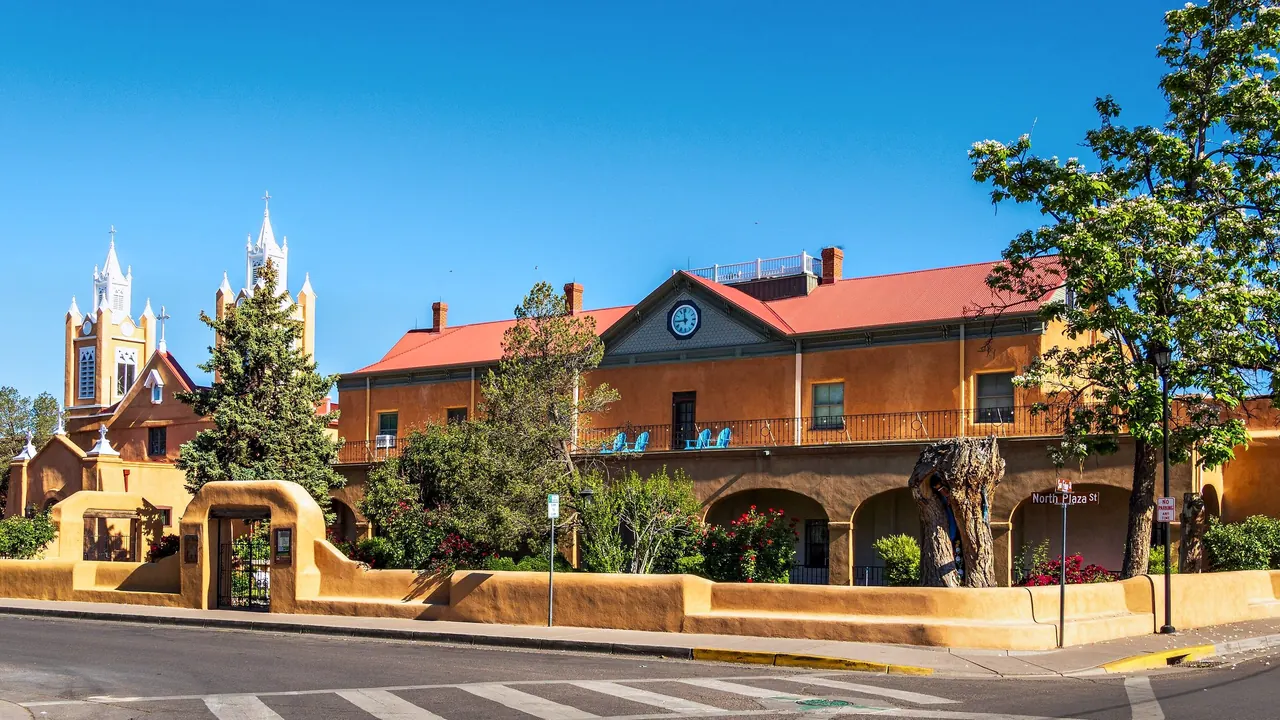
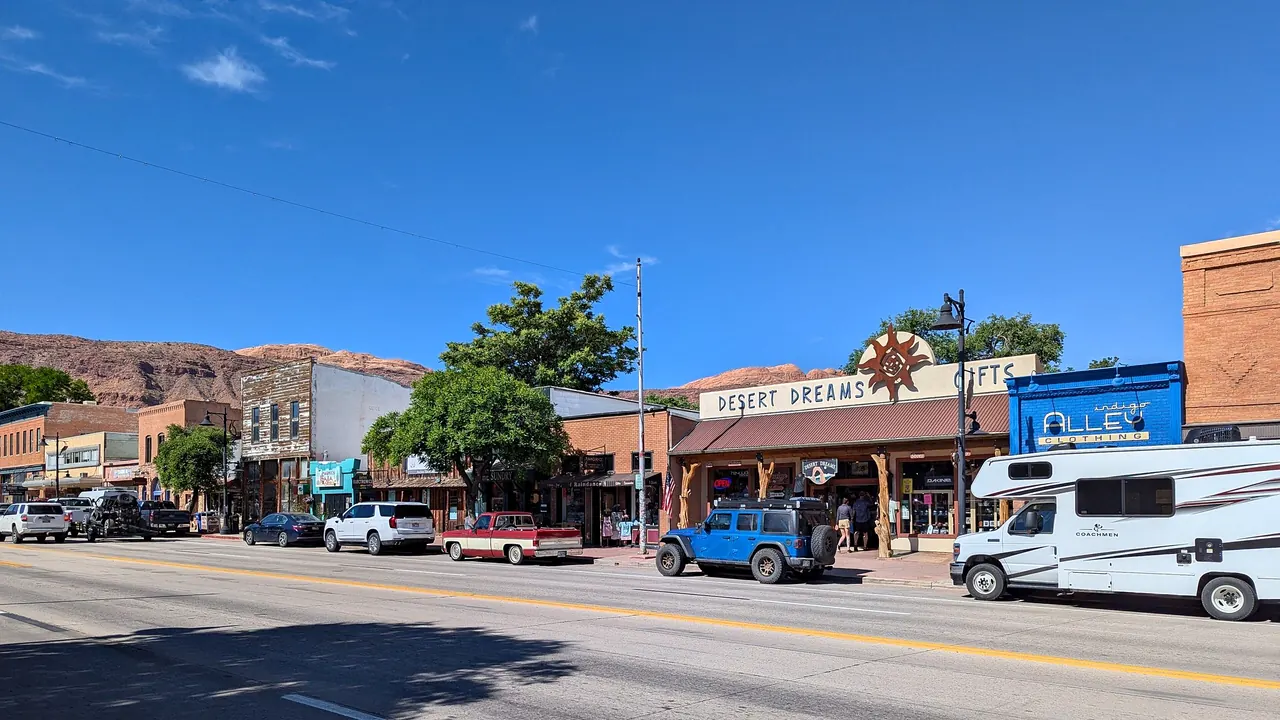
Photos: Albuquerque by dconvertini, CC BY-SA 2.0, cropped; Moab by G. Edward Johnson, CC BY 4.0, cropped.
Albuquerque or Moab?
Our verdict in twelve categories, each scored against the same fixed benchmark cities, and the climate month by month, so you can choose for your trip.
Choose Albuquerque for
- day trips
- food and drink
- culture and sights
Albuquerque is the better choice for a rounded trip to the Southwest. It has a real regional cuisine built on New Mexican chile, Native and Hispanic heritage at the Indian Pueblo Cultural Center and the National Hispanic Cultural Center, and Santa Fe an hour up the road. It suits travellers who want food, history and craft as much as scenery, and families who want a zoo, a science centre and the Balloon Fiesta to go with the mountain views.
Choose Moab for
- nature and the outdoors
- beaches
Moab asks for one thing and gives it back in full: days spent outdoors. Arches begins at the edge of town, Canyonlands is under an hour away, and the slickrock trails, river trips and canyoneering are among the best anywhere. Choose it if you want to hike, ride or raft from dawn and be asleep by eleven, and you won't miss museums, varied restaurants or nights out.
Scoreboard
Twelve categories on one fixed scale from 0 to 100. The shaded stretch is the gap between the two.
Your match
Pick a travel style or drag the sliders, and both match scores follow your weighting.
Wins on day trips and food and drink with your weighting.
Wins on nature and the outdoors and beaches with your weighting.
What matters to you?
Category by category
What the scores mean for a trip.
Beaches & swimming
Neither town is a place for a beach vacation, as both lie deep in the desert, far from any coast. Albuquerque's summer swimming is in pools or out at Cochiti Lake, a drive away.
Moab has a little more natural water close to town, with Mill Creek's shallow pools, Ken's Lake and sandbars on the Colorado. The river is cold and fast, though, so for most visitors swimming means a pool after a hike.
Food & drink
Albuquerque is a place to travel for its food. New Mexican cooking, with its question of red or green chile, blue corn enchiladas, posole and sopaipillas, is a cuisine you can't find in the same form elsewhere. It is best in old family places in the South and North Valleys and along Route 66, and in late summer the whole city smells of roasting chile.
Moab has no local cooking of its own. Main Street serves burgers, tacos and pizza to hungry hikers, with a few more ambitious dinner spots. Utah's alcohol rules and the queues on busy evenings make dinner less relaxed than in New Mexico.
Culture & sights
Albuquerque gives a couple of rewarding days. You can see the 18th-century San Felipe de Neri church on the Old Town plaza and get a grounding in Pueblo cultures at the centre the nineteen Pueblos run themselves. Add the nuclear science museum, the neon of Route 66 and the carved rocks of Petroglyph National Monument.
Moab's town holds a morning at most, with the small Museum of Moab and a few uranium-boom buildings. Its real heritage is outdoors, in the Ancestral Puebloan and Fremont rock art along Potash Road and Kane Creek, and in dinosaur trackways.
Nightlife
Albuquerque at least offers a choice. Downtown has bars and a few dance clubs that fill and get loud at weekends, while Nob Hill offers cocktail bars and taprooms at a gentler pace. Brewery patios carry much of the evening social life.
Moab's evenings consist of a couple of brewpubs full of bikers and rafters, with no clubs, and the town is mostly asleep by eleven. Its night-time draw is the very dark, star-filled sky.
Nature & outdoors
Albuquerque has fine outdoor country. The tramway climbs the Sandia Mountains to pine forest above 3,000m, the bosque along the Rio Grande has shaded paths and wintering cranes, and volcanic cones rise west of the river.
Moab is in another league, a base people cross continents for. Arches starts minutes from town, Canyonlands and Dead Horse Point look over a maze of canyons, and the Slickrock Trail, the Whole Enchilada descent, rafting, climbing and jeep tracks mean you could stay a fortnight without repeating a day.
Day trips
From Albuquerque, the day out to Santa Fe is one of the best in the region, with its plaza, the Palace of the Governors and the galleries of Canyon Road an hour away by car or train. Acoma's Sky City, the cliff dwellings of Bandelier, Chimayo and the Turquoise Trail villages give a week of varied outings.
Moab's day trips are mostly into more landscape. The towns within reach, such as Green River, Monticello and Bluff, are small, and the most rewarding cultural outing, to Edge of the Cedars and Hovenweep, takes a long day on the road.
Good for families
Albuquerque has more for children of every age. The BioPark combines a zoo, an aquarium and gardens, Explora and the natural history museum's dinosaur halls are in Old Town, and the Sandia tramway is a treat. The October Balloon Fiesta, with hundreds of balloons rising at dawn, is a reason to plan the whole trip around it.
Moab works well for active school-age children, who will enjoy the short arch walks, Junior Ranger programmes and gentle raft floats. Unfenced drops, midday heat and the lack of anything built for small children make it harder with toddlers.
Getting around
You need a car in both towns. Albuquerque does have a bus along Central Avenue linking Old Town, downtown, the university and Nob Hill, plus the train to Santa Fe, so a few days without driving are possible.
In Moab, Main Street is walkable and a paved cycle path runs north to the Arches entrance, but that is where the options end. Without a vehicle you depend on outfitters' shuttles and tours, and much of the backcountry needs high clearance.
Shopping & style
Both towns sell Native and Southwestern craft, but Albuquerque is where buying it becomes a real pursuit. The Indian Pueblo Cultural Center is run by the Pueblos themselves, and between its shop and the stores around the Old Town plaza you can compare silverwork, pottery and weaving side by side, and often buy from the artist who made the piece. Nob Hill adds a few independent boutiques and vintage shops, though neither town has a fashion street.
Moab has a few galleries with Navajo jewellery and weavings, so a good piece is possible, but there is far less to choose from and compare. Its own speciality is the rock shops, where geodes, fossils and minerals make souvenirs that suit the canyon country. Next to them are well-stocked bike, climbing and camping stores for anyone who needs to replace gear between rides.
Affordability
Costs run lower in Albuquerque for most of the year. Hotels are plentiful and fairly priced, a chile plate in a family restaurant is generous, and Old Town and the foothills trails cost next to nothing. The exception is Balloon Fiesta week in October, when rooms are scarce and rates climb steeply.
Moab's small supply of rooms meets heavy demand in spring and autumn, so simple motels charge resort rates, and rafting or jeep tours add up fast. Campers do better, since public and dispersed camping is cheap, one park pass lasts a week, and winter is far kinder to the wallet.
Live music & performing arts
Albuquerque has a steady programme. Touring musicals and the philharmonic play at Popejoy Hall, the Pueblo Deco KiMo stages film and concerts, and the city's flamenco tradition brings dancers from Spain. Weekend Native dances at the Pueblo centre are a rare thing to witness.
Moab's highlight comes once a year, when the Moab Music Festival takes chamber music into canyon grottoes reached by boat. Outside that season there is little more than a band in a brewpub.
Wellness & relaxation
Albuquerque does better for rest because it is close to hot springs. Jemez Springs' mineral pools are a little over an hour away, there are bathhouses around Santa Fe, and resort spas on nearby Pueblo lands look out on the mountains.
Moab is a place of early starts and tired legs, with massage studios rather than spas and no springs worth the drive. What it offers instead is quiet: still evenings, cliffs glowing at sunset and a cabin in the La Sals for anyone who wants to slow down.
When should you go?
Pick your month. The climate figures are measured averages, not a forecast.
Albuquerque in July
Moab in July
Daytime high, °C
Rainfall in the month, mm
Where the figures come from
Moab's temperatures are measured 27 km from the centre, at Moab / Crescent Junction.
Moab's station stands 162 m above the city centre, so the centre is likely a little warmer than the figures say.
Moab has no rain gauge within 25 km of the centre, so its rainfall comes from a gridded climate dataset read at the city rather than from a gauge further away.
Temperature and rainfall are climate normals, averaged over the years shown. Albuquerque: 1991-2020 normals, Albuquerque International Airport (7.3 km from centre). Moab: 2006-2020 (rainfall 1991-2020) normals, Moab / Crescent Junction (27 km from centre).
Both towns are high desert with hot summers and cold winters, so spring and autumn are the best seasons in each. Albuquerque is the milder of the two in winter, with January afternoons around 9°C and plenty of sun, which makes Old Town and the museums pleasant even in the coldest months. Moab's winter is properly cold, with January highs near 2°C, so its trails are quiet and need warm layers.
From June to August both are too hot for long walks in the middle of the day. Moab peaks around 35°C in July and stays very dry, while in Albuquerque July is also its wettest month, as afternoon storms build over the mountains. April, May, September and October are the months to go: warm, clear days in Albuquerque, and in Moab the conditions that make long hikes and rides comfortable.
Which traveller are you?
For an outdoors trip, Moab is the clear pick. Arches and Canyonlands are minutes away, and the Slickrock Trail, rafting on the Colorado and canyoneering fill a week. Albuquerque's Sandia trails and the bosque are good, but they are a side dish here.
On a culture and arts trip, Albuquerque has far more to offer. It has the adobe plaza of Old Town, the Pueblo and Hispanic cultural centres, flamenco and the KiMo Theatre, with Santa Fe's museums and galleries an easy day out. Moab offers rock art and little else.
For a food and nightlife trip, Albuquerque wins easily. Red and green chile, carne adovada and family kitchens in the valleys give it a cuisine of its own, and Central Avenue has bars, taprooms and a few clubs. Moab eats to refuel and goes to bed early.
Before you go
| Measure | Albuquerque | Moab |
|---|---|---|
| Currency | US Dollar (USD) | US Dollar (USD) |
| Sockets | AB120 V, 60 Hz | AB120 V, 60 Hz |
| Driving side | Right | Right |
| Time zone | UTC-7, UTC-6 in summer | UTC-7, UTC-6 in summer |
| Emergency number | 911 | 911 |
| Elevation | 1,619 m | 1,227 m |
| Main airport | Albuquerque International Sunport (ABQ)6 km from centre27 non-stop destinations | Canyonlands Regional Airport (CNY)27 km from centre2 non-stop destinations |
| Public holidays this year | 13 days | 12 days |
By the numbers
| Measure | Albuquerque | Moab |
|---|---|---|
| City population | 564,559 | 5,366 |
| People per km² | 1,150 | 501 |
| Museums within 10 km | 10 | 1 |
| UNESCO World Heritage sites within 50 km | 0 | 0 |
Where else could you go?
Every comparison below shares a destination with this one, so you can follow Albuquerque or Moab somewhere new.
- Santa Fevs Albuquerque
- Telluridevs Moab
- Taosvs Albuquerque
- Durango, Coloradovs Moab
- Aspenvs Moab
- Page, Arizonavs Moab