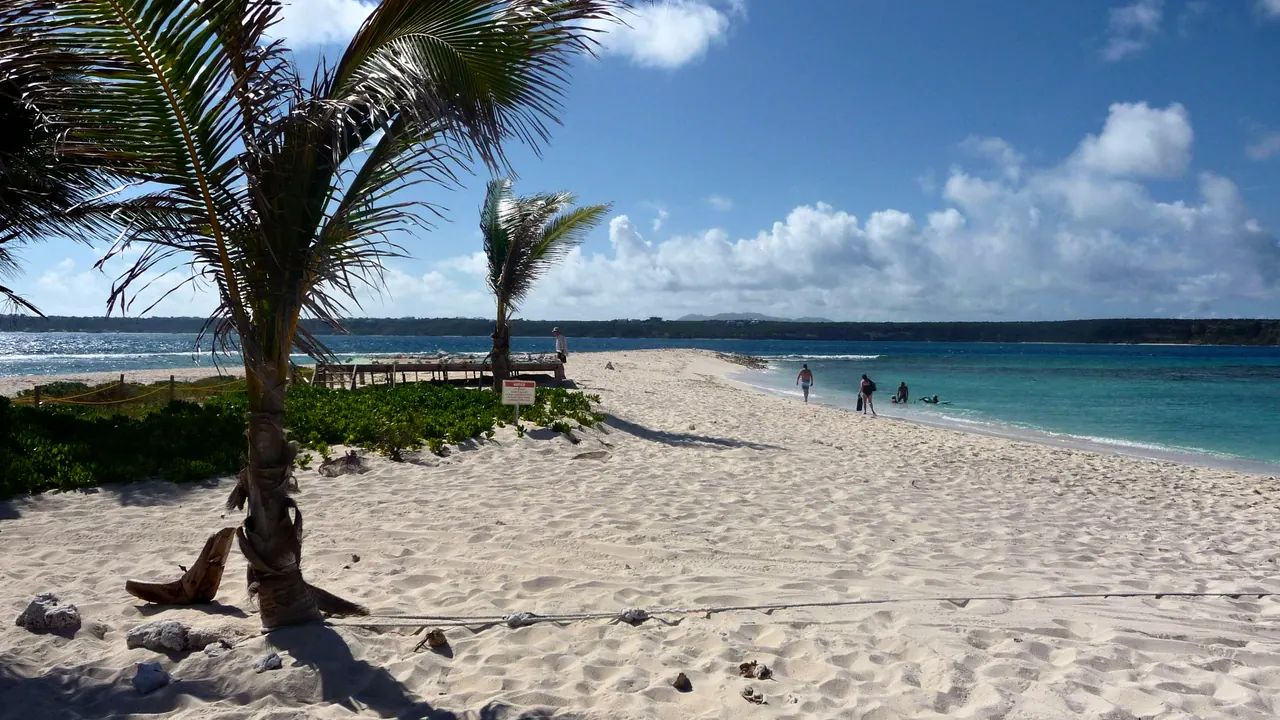
Photos: Anguilla by alljengi, CC BY-SA 2.0, cropped.
Anguilla or Martinique?
Our verdict in twelve categories, each scored against the same fixed benchmark cities, and the climate month by month, so you can choose for your trip.
Choose Anguilla for
- getting around
- beaches
- wellness
Anguilla is the choice when the beach is the whole point. Its coral sand is finer, the water calmer and the shoreline quieter than almost anywhere in the region, with no high-rises and no cruise ships. The days come down to swimming, a long seafood dinner and an early night. It suits couples and anyone with a generous budget who wants rest rather than a programme, and who won't miss museums, mountains or a lively town.
Choose Martinique for
- nature and the outdoors
- culture and sights
- prices
Martinique gives you a bigger, more varied island, and you need a car to make the most of it. You can climb a volcano in the morning, swim with turtles off a southern cove in the afternoon and finish with a ti-punch made from rum distilled down the road. It has a living Creole culture, the ruins of Saint-Pierre and French bakeries. The beaches are very good if not quite Anguilla's equal, it costs somewhat less, and it suits travellers who want to explore as well as lie on the sand.
Scoreboard
Twelve categories on one fixed scale from 0 to 100. The shaded stretch is the gap between the two.
Your match
Pick a travel style or drag the sliders, and both match scores follow your weighting.
Wins on getting around and beaches with your weighting.
Wins on nature and the outdoors and culture and sights with your weighting.
What matters to you?
Category by category
What the scores mean for a trip.
Beaches & swimming
Anguilla has the stronger beaches. More than thirty strands of fine white coral sand ring a flat island, from long Shoal Bay East to the sheltered curve of Maundays Bay, with calm, clear water and none of them crowded. In winter the south and west sides stay calm even when the north picks up swell, and a boat trip to Sandy Island adds a day on a near-empty sandbar.
Martinique's best sand is on the Caribbean side and around the southern tip, at Grande Anse des Salines and the bays of Les Anses-d'Arlet. There you get variety rather than perfection, with gold and black sand side by side and turtles grazing close to shore. Most of the Atlantic coast is too rough for swimming, and some coves fill with local families at weekends.
Food & drink
Martinique has the edge at the table, mostly because of what it produces itself. There is Creole cooking with French technique: accras, colombo, blaff of fresh fish and grilled conch at beach shacks. Add proper bakeries, a covered market in Fort-de-France and, above all, its own rhum agricole, tasted at the cane estates where it is made.
Anguilla puts its effort into dinner. Polished beachfront restaurants along the west end and Sandy Ground serve crayfish and grilled snapper, and roadside lolos grill ribs at weekends. With no real markets and almost everything imported, it is a place for long seafood evenings by the sea rather than for exploring a food culture.
Culture & sights
Martinique has much more to see. The ruins of Saint-Pierre, the old capital wiped out by Mount Pelée in 1902, make a powerful visit. Fort-de-France adds the ornate Schoelcher Library and a cast-iron cathedral, and around the island you will find sugar estates, Joséphine's birthplace and the Anse Cafard slavery memorial, all bound up with Creole history.
On Anguilla, the 18th-century Wallblake House, a small heritage museum in East End and the Amerindian carvings in Fountain Cavern are about all there is. That makes a pleasant morning, not a reason to choose the island.
Nightlife
Neither island is a place for big nights out, though Martinique has a little more going on. On Anguilla the late action is concentrated in Sandy Ground, where a few beach bars have rum and dancing on the sand, and Sunday afternoon sessions run into the evening. There are no clubs.
Martinique has zouk and kompa clubs around Fort-de-France that fill late at weekends with a local crowd, and its pre-Lent Carnival takes over the towns for days. The scene is spread out, though, so going out usually means driving.
Nature & outdoors
This is where the islands are furthest apart. Martinique's volcanic north has Mount Pelée at about 1,400m, rainforest on the Pitons du Carbet, waterfalls, canyoning gorges and UNESCO-listed forest. Below that come the mangrove and cliff trails of the Caravelle peninsula, a coastal path around the south, and diving at Diamond Rock and on the Saint-Pierre wrecks.
Anguilla is low, dry and covered in scrub, so its outdoor life is almost entirely on the water: snorkelling, reef and wreck diving in the marine parks, and sailing or kitesurfing in the trade winds. On land you get cliff walks and birdwatching at the salt ponds, but no real hiking.
Day trips
Martinique gives you more days out. You can drive through the rum country, linking distilleries around Sainte-Marie and Le Robert the way you would tour a wine region, or follow the north coast road to Grand-Rivière. Fast ferries from Fort-de-France also reach Dominica and St Lucia for a long day abroad.
Anguilla's one real outing is the short ferry ride to Saint Martin, for the French harbour town of Marigot and the restaurants of Grand Case. A chartered boat to St Barths is an occasional extra.
Good for families
Martinique suits families somewhat better. Its southern bays have calm, shallow water where children can snorkel with turtles, French supermarkets and healthcare make daily life easy, and there are a few extras such as the small zoo at Le Carbet and glass-bottom boats. Its winding roads and traffic tire small children, though.
Anguilla is calmer and easier for very young children, with gently shelving sand at Rendezvous Bay and Meads Bay and almost no traffic. Beyond the beach there is nothing built for children, and older ones may get restless after a few days.
Getting around
Anguilla is the simpler island to get around. It is about 26km long and traffic is light, so any beach is a short drive away in a hire car, though there are hardly any buses and getting there means flying to Sint Maarten and catching a ferry.
On Martinique, a car is close to essential and the driving is harder. Northern roads are steep and winding, and traffic around Fort-de-France and Le Lamentin jams at rush hour. The passenger ferries across the bay to Les Trois-Îlets help, and staying in the south with occasional trips north keeps it manageable.
Shopping & style
Neither island is a shopping destination, but Martinique gives you more to bring home. You can buy aged rhum agricole at the estates, spices and vanilla at the Fort-de-France market, madras cotton and village crafts.
On Anguilla, shopping means a few galleries, resort boutiques, sea salt and hot sauce. Most visitors who want more cross to the duty-free streets of Saint Martin.
Affordability
Both islands are expensive, but Anguilla is in a class of its own. Accommodation is mostly high-end resorts and villas, and meals, drinks and even groceries are priced for an island that imports nearly everything. The roadside lolos are the only real way to save.
Martinique charges French prices with an island premium, but you have more ways to spend less. A self-catering gîte, fish and fruit from markets and roadside stalls, beach snack bars, free hiking and cheap rum tastings all keep costs down.
Live music & performing arts
Martinique has a real performance tradition. Bèlè drum-and-dance evenings in northern and central villages welcome visitors into the circle, and Fort-de-France has a national arts centre with theatre and dance, though most of it is in French.
Anguilla's music is mostly reggae, soca and string bands at weekend beach bars, plus its March reggae festival and the August Summer Festival. There is no theatre or concert hall.
Wellness & relaxation
Anguilla is slightly better for pure rest. The large luxury resorts have extensive spas with treatment rooms open to the breeze, and the island's quiet, with no high-rises and no cruise crowds, makes doing very little easy.
Martinique has hotel spas and beach yoga around Les Trois-Îlets and Sainte-Anne, plus warm volcanic springs in the northern forest for a dip. Its slow pace is mainly a feature of the southern coast rather than the whole island.
When should you go?
Pick your month. The climate figures are measured averages, not a forecast.
Anguilla in July
Martinique in July
Daytime high, °C
Rainfall in the month, mm
Temperature and rainfall are climate normals, averaged over the years shown. Anguilla: 1991-2020 normals, Juliana Airport, Saint Maarten (14.5 km from centre). Martinique: 1991-2020 normals, Le Lamentin (7.7 km from centre).
Both islands are hot all year, with daytime highs close to 30°C and the sea at 26°C or warmer in every month, so swimming is never out of season. The real difference is rain. On Anguilla, February and March are the driest months, at about 50mm, and it stays fairly dry into early summer before the wettest stretch arrives in October and November. Anguilla is also the sunnier of the two in every month. In late summer, when the heat peaks, the humidity makes walking at midday hard work on both islands.
Martinique is much the wetter island. Its driest window is February and March, which is also the best time to climb Mount Pelée or walk the rainforest. From April the rain builds steadily, and August, October and November each bring more than 260mm, with September only a little drier. If your trip depends on hiking and driving, the dry season matters far more on Martinique than on Anguilla.
Which traveller are you?
On a beach and sun trip, Anguilla is the better pick. Its powdery white beaches outshine Martinique's coves, there are no cruise crowds, and you can reach Shoal Bay, Meads Bay or a sandbar on Prickly Pear Cays with little effort.
For an outdoors trip, choose Martinique without hesitation. It has Mount Pelée's cloud-forest summit, rainforest waterfalls on the Route de la Trace, canyoning, the Caravelle trails and wreck dives off Saint-Pierre, while flat, scrubby Anguilla offers little beyond the water.
On a culture and arts trip, Martinique has much more to show. You can see the ruins of Saint-Pierre, the Schoelcher Library, old sugar estates and the Anse Cafard memorial, and join bèlè drum evenings in the villages. Anguilla's handful of sights fill a morning or two.
Before you go
| Measure | Anguilla | Martinique |
|---|---|---|
| Official language | English | - |
| Currency | East Caribbean Dollar (XCD) | Euro (EUR) |
| Sockets | A110 V, 60 Hz | CE220 V, 50 Hz |
| Driving side | Left | Right |
| Time zone | UTC-4 | UTC-4 |
| Emergency number | 911 | 112 |
| Main airport | Clayton J. Lloyd International Airport (AXA)15 non-stop destinations | Martinique Aimé Césaire International Airport (FDF)17 non-stop destinations |
| Public holidays this year | 14 days | 13 days |
By the numbers
| Measure | Anguilla | Martinique |
|---|---|---|
| Population | 16,293 | 360,630 |
| People per km² | 167 | 320 |
| Swim season, months above 21 °C | 12 months | 12 months |
Where else could you go?
Every comparison below shares a destination with this one, so you can follow Anguilla or Martinique somewhere new.
- Saint-Martinvs Anguilla
- Sint Maartenvs Anguilla
- St Bartsvs Anguilla
- British Virgin Islandsvs Anguilla
- St Croixvs Anguilla
- St Johnvs Anguilla