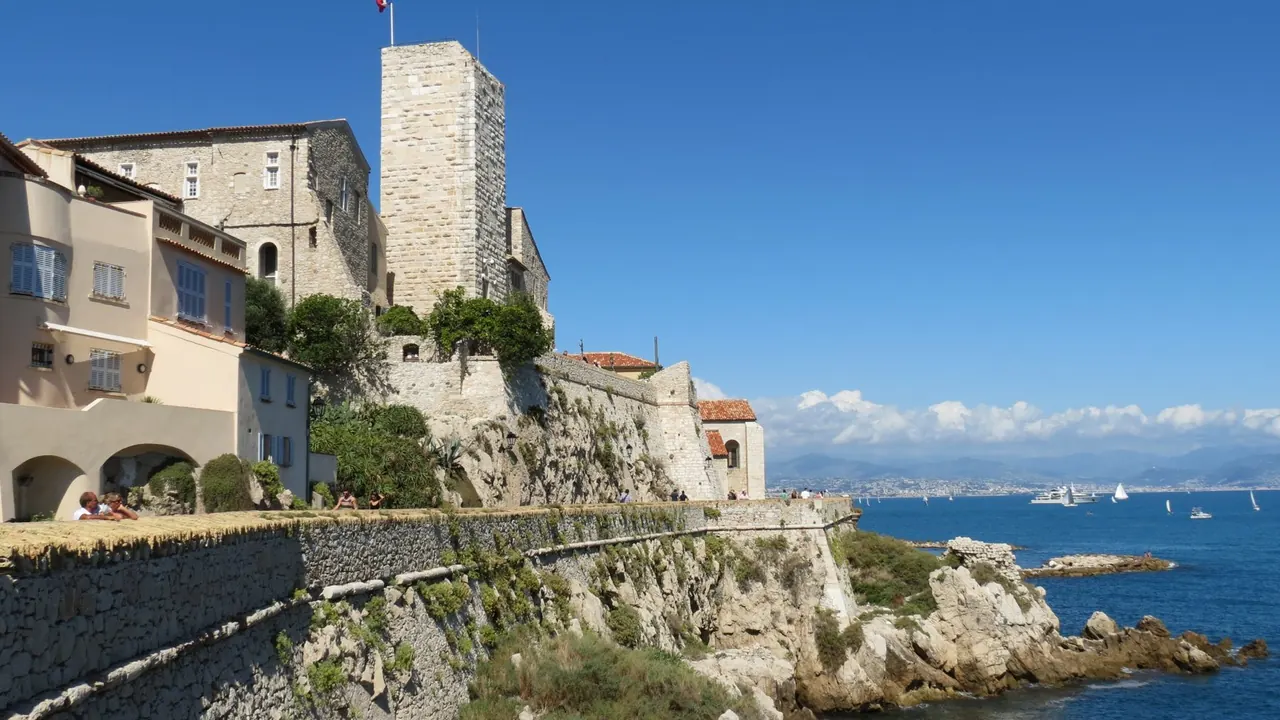
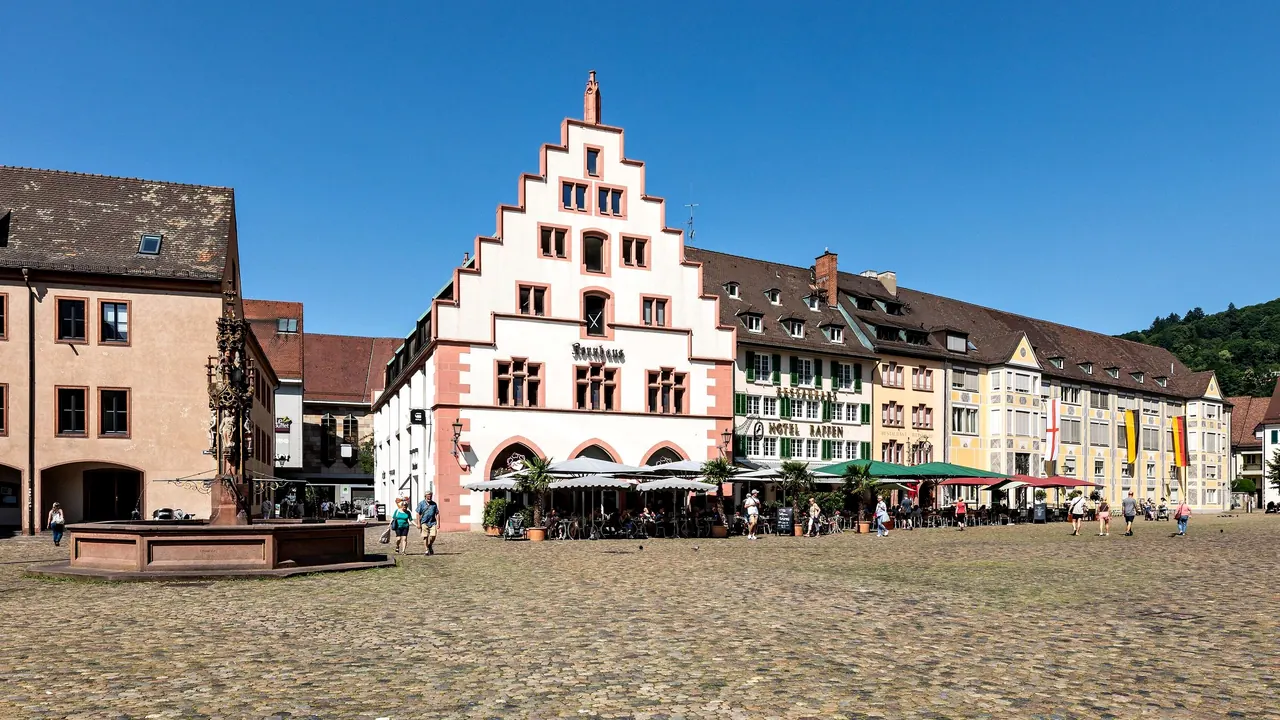
Photos: Antibes by Johan Allard, CC BY-SA 4.0, cropped; Freiburg by Dietmar Rabich, CC BY-SA 4.0, cropped.
Antibes or Freiburg?
Our verdict in twelve categories, each scored against the same fixed benchmark cities, and the climate month by month, so you can choose for your trip.
Choose Antibes for
- beaches
- day trips
Antibes is the pick for a summer by the sea. It has real sandy beaches at Juan-les-Pins and La Salis and clear coves around the cape, and the whole Riviera lies along one railway line, from Cannes to Monaco and Menton, with hill villages behind. It suits couples and friends who want to swim in the morning and see a different town or village in the afternoon, and who can live with high-season prices and full beaches.
Choose Freiburg for
- wellness
- families
- getting around
Choose Freiburg if you would rather walk, cycle and soak in thermal water than lie on sand. The Black Forest starts at the edge of town and spa towns lie a short ride south. The compact, car-free centre, with trams and bike lanes, makes it easy with children. Baden cooking, the Münster and a year-round stage give the evenings more substance, and staying there costs somewhat less.
Scoreboard
Twelve categories on one fixed scale from 0 to 100. The shaded stretch is the gap between the two.
Your match
Pick a travel style or drag the sliders, and both match scores follow your weighting.
Wins on beaches and day trips with your weighting.
Wins on wellness and families with your weighting.
What matters to you?
Category by category
What the scores mean for a trip.
Beaches & swimming
There is no contest here. Antibes has some of the only sand on this part of the Riviera, with gently shelving beaches at Juan-les-Pins and La Salis, and clear coves and flat rocks for swimming around Cap d'Antibes. Private clubs take much of the sand at Juan-les-Pins, and the free stretches fill early in high summer.
Freiburg is a long way from any coast. On a hot day you cycle out to the gravel-pit lakes on the Rhine plain, which have grassy banks, or take a cool swim in Titisee or Schluchsee in the Black Forest. It's a refreshing dip, not a beach vacation.
Food & drink
Freiburg eats somewhat better. Baden cooking takes a lead from France next door: Flammkuchen, Schäufele, Black Forest ham and mountain trout, with Kaiserstuhl Pinot to drink. The region around it has notable fine dining, and the sausage stalls at the Münster market are a daily ritual.
Antibes is pleasant to eat in rather than memorable. Think of the Provençal market on Cours Masséna, socca and pissaladière, and grilled fish with rosé outdoors. A few bistros in the old town and serious tables on the cape are worth seeking out, but the streets by the port lean on tourist menus. Neither place offers much range beyond its regional cooking.
Culture & sights
Neither is a big museum town, but Freiburg gives you more to see. The red sandstone Münster with its climbable lace tower, the Historisches Kaufhaus, the medieval gates and the Bächle channels give the old town a strong character, even though much of it was rebuilt after the war. The Augustinermuseum holds fine medieval art.
Antibes has one standout sight, the Picasso Museum in the Château Grimaldi on the sea wall. Around it are the ramparts, Fort Carré above Port Vauban and the Villa Eilenroc on the cape. Each town is covered in a day or two.
Nightlife
Evenings are about equally lively in both, but on a different calendar. Antibes depends on the season. In July and August, Juan-les-Pins has beach bars and a few clubs open late, and yacht crews fill the pubs near Port Vauban. Out of season, much of it shuts early or closes altogether.
Freiburg runs on its students rather than the summer. There are pubs, wine bars and beer gardens around the Martinstor, people gather by the Dreisam, and a few clubs play techno and indie. It's busiest in term-time.
Nature & outdoors
Freiburg has the mountains on its doorstep. The Schlossberg rises behind the old town, and the Schauinsland cable car climbs to ridge trails at about 1,280m. The Feldberg offers hiking in summer and snow in winter, and the Kaiserstuhl vineyards and the bike paths of the Rhine plain suit gentler days.
In Antibes the outdoors means the sea and the shore: the coastal path over the limestone of the cape, then snorkelling, diving, sailing and paddleboarding in clear water. For real hiking you drive to the red cliffs of the Esterel or the pre-Alps above Grasse, because the land around town is flat and built up.
Day trips
Both are excellent bases, and Antibes has the edge because so much is packed so close. Cannes and Nice are minutes away by train, and the same line runs on to Villefranche, Monaco and Menton. Boats cross to the Lérins Islands, and Saint-Paul-de-Vence, Eze, Grasse, Biot and Vallauris sit in the hills behind.
Freiburg's places are more spread out, but they span three countries. Basel is under an hour by train, Colmar and the Alsace wine villages are about an hour by car, and Strasbourg is a little further. Staufen, Breisach and Baden-Baden are closer to home.
Good for families
Freiburg makes an easy family week. It is flat, green and safe, and children can sail toy boats down the Bächle. Add swimming lakes in summer, gentle forest walks and the Steinwasen park with its suspension bridge. Rainy days are the weak point.
Antibes has one strong card, its gently shelving sand, which suits toddlers better than the pebble beaches elsewhere on the coast. Beyond the beach there are the ramparts, the boats in Port Vauban and the trip out to the Lérins Islands, and the August heat calls for early starts.
Getting around
Both towns have centres you can walk, but Freiburg takes you much further without a car. Its old town is car-free, trams are frequent, there are bike lanes everywhere, and regional trains climb the Höllental and run along the Rhine. Many hotels give guests a card for local buses and trains.
In Antibes, the old town, the market and the port are close together, and the coastal railway makes Nice, Cannes and Monaco simple. Off that line, buses to the cape and the hill villages are slow, and summer traffic and parking on the coast road are hard work.
Shopping & style
Neither is a shopping destination, and for anything serious people leave town: from Antibes they go to Cannes or Nice, and from Freiburg to Basel. What differs is what you bring home.
Antibes means Provençal goods: olive oil, soaps and linens from the covered market and the boutiques in the old town, with Biot glass and Vallauris pottery close by. Freiburg has chain and department stores on Kaiser-Joseph-Strasse, independent shops in the Gerberau, and wine, schnapps, ham and cuckoo clocks.
Affordability
Freiburg costs less overall. Rooms are scarce and dearer than you would expect for its size, especially during trade fairs, but day-to-day spending is gentle. Market snacks, wine taverns and restaurants in the student quarter are reasonably priced, and the sights cost little or nothing.
Antibes in July and August is priced like a luxury resort, from rooms on the cape to loungers at Juan-les-Pins. Hotel rates drop sharply in spring and autumn, the coastal trains are good value, and self-catering from the market saves a good deal.
Live music & performing arts
Freiburg has the steadier programme through the year. Theater Freiburg stages opera, drama and dance, the Freiburger Barockorchester plays at the Konzerthaus, students keep small jazz clubs going, and the Zelt-Musik-Festival fills a tent village each summer.
Antibes has one famous festival, Jazz à Juan, held each July since 1960 under the pines by the sea, where Ray Charles and Miles Davis once played. Beyond that there is the Anthéa theatre, and for opera you go to Nice.
Wellness & relaxation
Freiburg sits in spa country. There is a mineral thermal bath on the city's eastern edge, warm outdoor pools and saunas at Bad Krozingen twenty minutes south, and a Roman ruin beside the modern baths at Badenweiler. The town itself moves at an easy pace, with café terraces and riverside paths.
Antibes has no bathing tradition. Wellness there means a thalassotherapy centre and the grand hotel spas on the cape. It's restful in May, June and September, but in July and August the crowds work against it.
When should you go?
Pick your month. The climate figures are measured averages, not a forecast.
Antibes in July
Freiburg in July
Daytime high, °C
Rainfall in the month, mm
Temperature and rainfall are climate normals, averaged over the years shown. Antibes: 1991-2020 normals, Nice (9.9 km from centre). Freiburg: 1991-2020 normals, Freiburg (0.6 km from centre).
Antibes is at its best from June to September. June to August are hot, sunny and dry, with July bringing almost no rain. The sea warms to 25°C in August and stays warm enough for swimming into early October. Rain returns in September and builds through autumn, and November is the wettest month at 138mm. Winter is mild and fairly bright, good weather for walking the cape path with the Alps in view, though too cool for the beach.
Freiburg has an inland climate, and the gap between the two is widest in winter. January highs are near 6°C, with much less sunshine than on the coast, though the higher slopes get snow. Summer is almost as warm as on the Riviera, around 27°C in July, but late spring and summer are the wettest part of the year. May is the peak at 103mm, and June to August stay showery. April and September suit walking and cycling best, and in high summer the lakes are warm enough for a dip.
Which traveller are you?
For a beach and sun trip, Antibes is the clear winner. It has real sand at Juan-les-Pins and La Salis, rocky coves with clear water around the cape, and sea warm enough to swim in from June into October. Freiburg offers only lakes and open-air pools.
On a family trip with children, Freiburg is easier to manage. It has the flat, car-free centre, the Bächle channels, the free Mundenhof animal park, the Schauinsland cable car and Europa-Park nearby. Antibes has gentle sandy beaches but little else for children.
For a relaxing and wellness trip, Freiburg has the depth. There are thermal baths on its edge and in Bad Krozingen and Badenweiler, Baden-Baden is an hour away, and the town keeps a slow pace all year. Antibes has thalassotherapy and hotel spas, but summer crowds undo the calm.
Before you go
| Measure | Antibes | Freiburg |
|---|---|---|
| Official language | French | German |
| Currency | Euro (EUR) | Euro (EUR) |
| Sockets | CE230 V, 50 Hz | CF230 V, 50 Hz |
| Driving side | Right | Right |
| Time zone | UTC+1, UTC+2 in summer | UTC+1, UTC+2 in summer |
| Emergency number | 112 | 112 |
| Elevation | 0 m | 278 m |
| Main airport | Nice-Côte d'Azur Airport (NCE)11 km from centre130 non-stop destinations | EuroAirport Basel–Mulhouse–Freiburg (BSL)50 km from centre112 non-stop destinations |
| Public holidays this year | 11 days | 12 days |
By the numbers
| Measure | Antibes | Freiburg |
|---|---|---|
| City population | 77,637 | 238,299 |
| People per km² | 2,930 | 1,558 |
| Museums within 10 km | 14 | 13 |
| UNESCO World Heritage sites within 50 km | 2 | 2 |
| Swim season, months above 21 °C | 4 months | - |
Where else could you go?
Every comparison below shares a destination with this one, so you can follow Antibes or Freiburg somewhere new.
- Cannesvs Antibes
- Nicevs Antibes
- Monacovs Antibes
- Colmarvs Freiburg
- Saint-Tropezvs Antibes
- Baselvs Freiburg