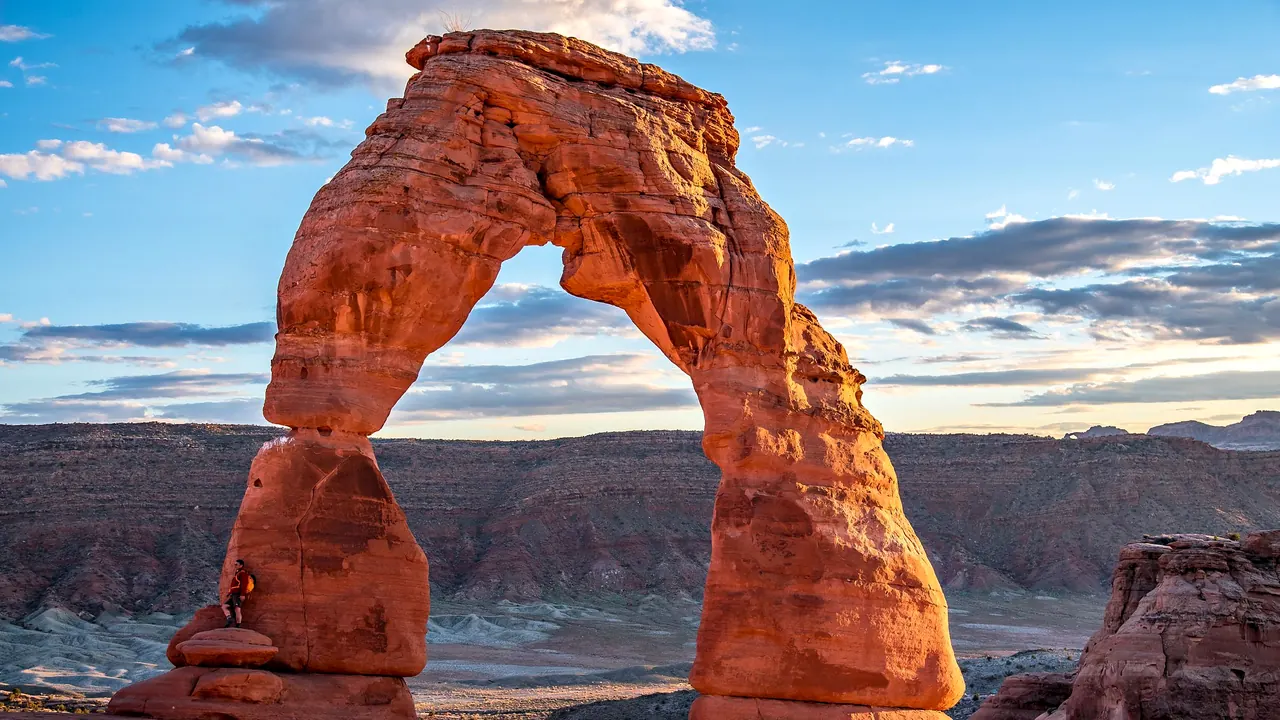
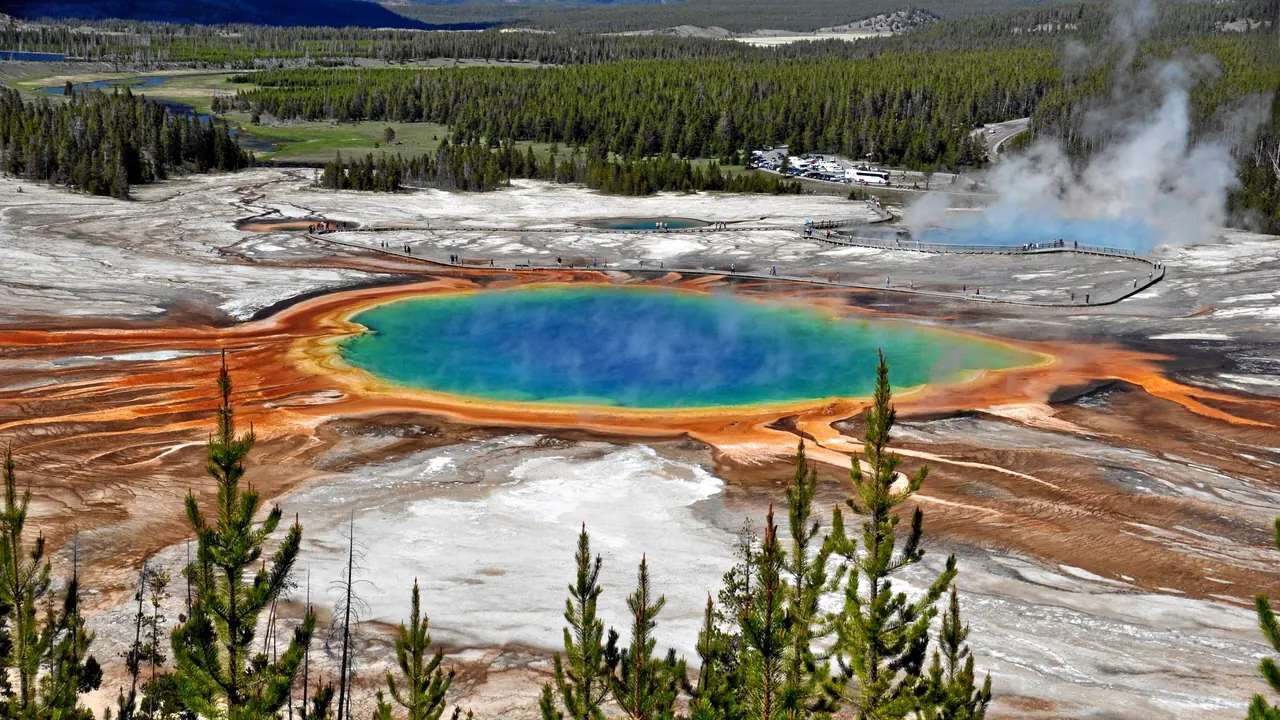
Photos: Arches by Jan Tang, Pexels License; Yellowstone by James St. John from Newark, Ohio, CC BY 2.0, cropped.
Arches or Yellowstone?
Our verdict in twelve categories, each scored against the same fixed benchmark cities, and the climate month by month, so you can choose for your trip.
Choose Arches for
- getting around
- prices
- food and drink
Arches suits travellers who want red rock country in a compact package. Moab sits minutes from the park gate, so you can sleep in town, be at a trailhead before sunrise and still get back for a long lunch, then add Canyonlands, the Colorado and the slickrock bike trails without long drives. It is the better pick for an active couple or group of friends, for anyone watching costs who is happy to camp, and for a spring or autumn trip when the desert is at its kindest.
Choose Yellowstone for
- families
- day trips
- culture and sights
Yellowstone is the bigger, slower undertaking, and it pays back with variety: geysers, a great canyon, a huge lake and roadside bison, elk and wolves. It works better for families, since erupting geysers and flat boardwalks hold children's attention better than desert scrambles. It also has more park history in its lodges and forts, and better outings to towns like Cody and Jackson. Expect hours behind the wheel each day and a much shorter summer season.
Scoreboard
Twelve categories on one fixed scale from 0 to 100. The shaded stretch is the gap between the two.
Your match
Pick a travel style or drag the sliders, and both match scores follow your weighting.
Too close to call, 1 point apart
Wins on getting around and prices with your weighting.
Wins on families and day trips with your weighting.
What matters to you?
Category by category
What the scores mean for a trip.
Beaches & swimming
Neither is a place to swim, and both leave most visitors in a motel or hotel pool. Around Moab the Colorado is cold, silty and fast and is for rafting, with only a small hill reservoir or a creek pool after a hike for a dip. At Yellowstone the lake stays bitterly cold even in August, so the real choice is a summer plunge in the Firehole canyon or a soak in the commercial hot-spring pools outside the park.
Food & drink
Both feed you well enough after a long day outdoors, and neither is a reason to go. Moab has the easier setup: brewpubs, diners and green-chile Southwestern and Mexican cooking all sit together on and around Main Street, a short drive from the park. Utah's liquor rules make wine with dinner a little more awkward.
Yellowstone has more regional flavour, with bison burgers, trout and huckleberry pie, and the historic lodge dining rooms are an experience in themselves. The catch is logistics: kitchens close early, meals are far apart, and the better cooking in Jackson and Bozeman is a long way from the geyser basins.
Culture & sights
Yellowstone has more to offer. As the first national park, it has real built heritage: the log-and-stone Old Faithful Inn, the Roosevelt Arch and the old army buildings of Fort Yellowstone at Mammoth. An hour beyond the east gate, the Buffalo Bill Center of the West in Cody makes a serious museum day.
At Arches, the human story is older and quieter. It survives mainly in petroglyph panels at Courthouse Wash, Wolfe Ranch and along Potash Road, plus a pioneer cabin and Moab's small museum. These are worth a few hours between hikes, not a day of their own.
Nightlife
Both go to bed early, but for different reasons. Moab has a few brewpubs where climbers and bikers swap stories, and the best night out is a walk under the dark sky among the fins. In Yellowstone, evenings mean a lodge lounge drink or a ranger talk, because the wildlife watching starts at dawn.
Nature & outdoors
Both are among the finest wild landscapes in the world, so this comes down to what you want to see. Arches is a world of stone: thousands of sandstone arches and fins, the canyon views from Island in the Sky and Dead Horse Point, and the La Sal Mountains behind. Its great strength is adventure sport, with slickrock biking, rafting, canyoneering and tower climbing all near Moab.
Yellowstone is alive in a way the desert is not. Geysers erupt, Grand Prismatic Spring steams in rings of colour, and herds of bison move through Hayden Valley while wolves and grizzlies are watched at dawn in Lamar Valley. It suits wildlife watchers and walkers more than climbers.
Day trips
Yellowstone has the better outings, though each is a long day. Jackson has its town square and the National Museum of Wildlife Art, Cody has Buffalo Bill's Western town, and there are the gold-rush settlements of Virginia City and the high Beartooth Highway to Red Lodge.
Around Moab, almost everything within reach is more wilderness. Green River's river-exploration museum and the rock art near Bluff are the main exceptions, and Mesa Verde and Monument Valley are really overnight trips.
Good for families
Yellowstone is the easier sell to children. Scheduled eruptions, belching mud pots and bison by the roadside keep interest high, the geyser boardwalks are flat and short, and the wildlife centre in West Yellowstone shows bears and wolves up close. The cost is long car days and constant supervision around hot ground and animals.
Arches works mainly for children old enough to scramble and carry water. The sandy slot to Sand Dune Arch, dinosaur tracks near Moab and gentle river floats are real highlights. Summer heat and unfenced drops make it hard going with toddlers.
Getting around
Both need a car, but Arches is far less work. Moab is about five minutes from the entrance, the park road runs only 30km, Canyonlands is under an hour away, and a paved bike path links town to the park. The main hassle is trailhead car parks filling by mid-morning.
Yellowstone spreads its sights around the 230km Grand Loop Road, with low speed limits and bison jams, so moving between basins and valleys takes hours. The airports are one to two hours from the gates, and most roads close to cars from November to April.
Shopping & style
Moab's Main Street sells the desert, with outfitters and bike shops stocking serious gear and rock shops full of geodes and polished stone. Cody and Jackson sell the Old West: cowboy boots, hats and galleries of wildlife painting and bronze. Beyond that, Moab adds Southwestern photography and some Native American jewellery and pottery, while Yellowstone's gateway towns mostly have fly-fishing and outdoor shops, and either way a single afternoon covers it.
Affordability
Arches is the cheaper of the two, though neither is cheap. Moab charges gateway-town prices in spring and autumn, but the park is small enough to see from one base, the hiking is free, and campgrounds along the river and in the desert cost little. The money goes on guided rafting and jeep tours.
Yellowstone's summer demand pushes lodge and motel rooms high, Jackson is famously expensive, and long daily distances add fuel to the hire car. Camping, picnic lunches, the smaller gateway towns and a shoulder-season visit are the ways to bring it down.
Live music & performing arts
Neither has much of a stage, and each has one standout. Moab's late-summer chamber music festival holds concerts in unusual places, including a sandstone grotto reached by boat. Around Yellowstone, summer brings the nightly rodeo in Cody and the classical season of the Grand Teton Music Festival near Jackson, plus family musicals in West Yellowstone.
Wellness & relaxation
Yellowstone has the edge for unwinding, because you can actually soak. The springs inside the park are off limits, but the open-air hot-spring pools near Gardiner and in Paradise Valley make a slow evening after a day of driving, and lake shores and backcountry trails are calm in September and October.
Around Arches there are no hot springs, only a few massage studios and the occasional river resort. The rest comes from silence: a quiet campsite, red cliffs at dusk and a sky full of stars.
When should you go?
Pick your month. The climate figures are measured averages, not a forecast.
Arches in July
Yellowstone in July
Daytime high, °C
Rainfall in the month, mm
Where the figures come from
Arches has no rain gauge within 25 km of the centre, so its rainfall comes from a gridded climate dataset read at the destination rather than from a gauge further away.
Yellowstone has no weather station within reach, so its figures come from a gridded climate model rather than a measured record, and read a broad area rather than one spot.
Temperature and rainfall are climate normals, averaged over the years shown. Arches: 2006-2020 (rainfall 1991-2020) normals, Moab / Crescent Junction (19.4 km from centre). Yellowstone: 2001-2020 normals, NASA POWER reanalysis grid, no weather station within 90 km.
Around Moab, Arches is at its best in spring and autumn. April and October are mild and May and September warm, all good for long hikes, though October is the wettest month of the year at about 25mm, so a shower is more likely then than in spring. June to August climbs to around 35°C, which pushes any walking into the early morning. Winter is cold, with highs only a little above freezing in December and January, but it is quiet. Rain and snow are light in every season, and the winter months get about as much as April.
On the Yellowstone plateau the pattern runs almost the other way. July and August are the only properly mild months, with highs around 25°C and the least rain, while June and September are cool but still fine for walking. From December to February daytime highs stay below freezing, down to about -6°C in January. March and November hover around zero, and April and October are only a little warmer. Precipitation is heavy from autumn to spring, reaching 86mm in December and falling largely as snow in the coldest months. The two pair well, because Yellowstone is at its best just when Arches is too hot.
Which traveller are you?
On a family trip with children, Yellowstone is the easier choice. Old Faithful erupts on schedule, mud pots bubble and bison wander beside the road, and short boardwalks suit small legs. Arches mostly suits older children who can handle heat and unfenced drops.
For a trip on a tight budget, Arches goes further. The park is small enough to explore from one cheap base, hiking costs nothing, and public-land campgrounds along the river keep nights inexpensive. Yellowstone's concentrated summer demand and long daily drives make it the costlier trip.
For a mountain biking or climbing trip, Arches is the place, with Moab's slickrock trails, canyoneering routes and desert towers at Fisher Towers and Castle Valley all close to town. Yellowstone's outdoors is about geysers, wildlife and hiking, not technical rock or bike trails.
Before you go
| Measure | Arches | Yellowstone |
|---|---|---|
| Currency | US Dollar (USD) | US Dollar (USD) |
| Sockets | AB120 V, 60 Hz | AB120 V, 60 Hz |
| Driving side | Right | Right |
| Time zone | UTC-7, UTC-6 in summer | UTC-7, UTC-6 in summer |
| Emergency number | 911 | 911 |
| Main airport | Canyonlands Regional Airport (CNY)2 non-stop destinations | Bozeman Yellowstone International Airport (BZN)27 non-stop destinations |
| Public holidays this year | 12 days | 11 days |
Where else could you go?
Every comparison below shares a destination with this one, so you can follow Arches or Yellowstone somewhere new.
- Canyonlandsvs Arches
- Grand Tetonvs Yellowstone
- Bryce Canyonvs Arches
- Zionvs Arches
- Grand Canyonvs Arches
- Rocky Mountain National Parkvs Arches