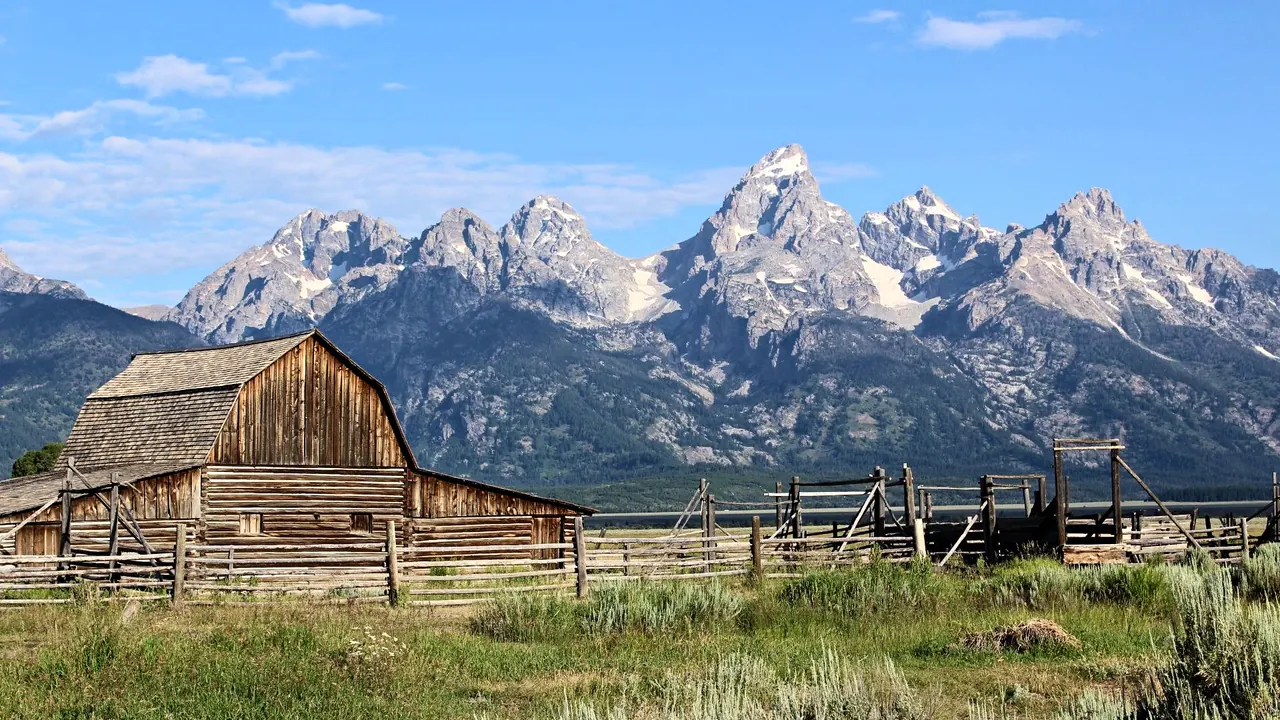
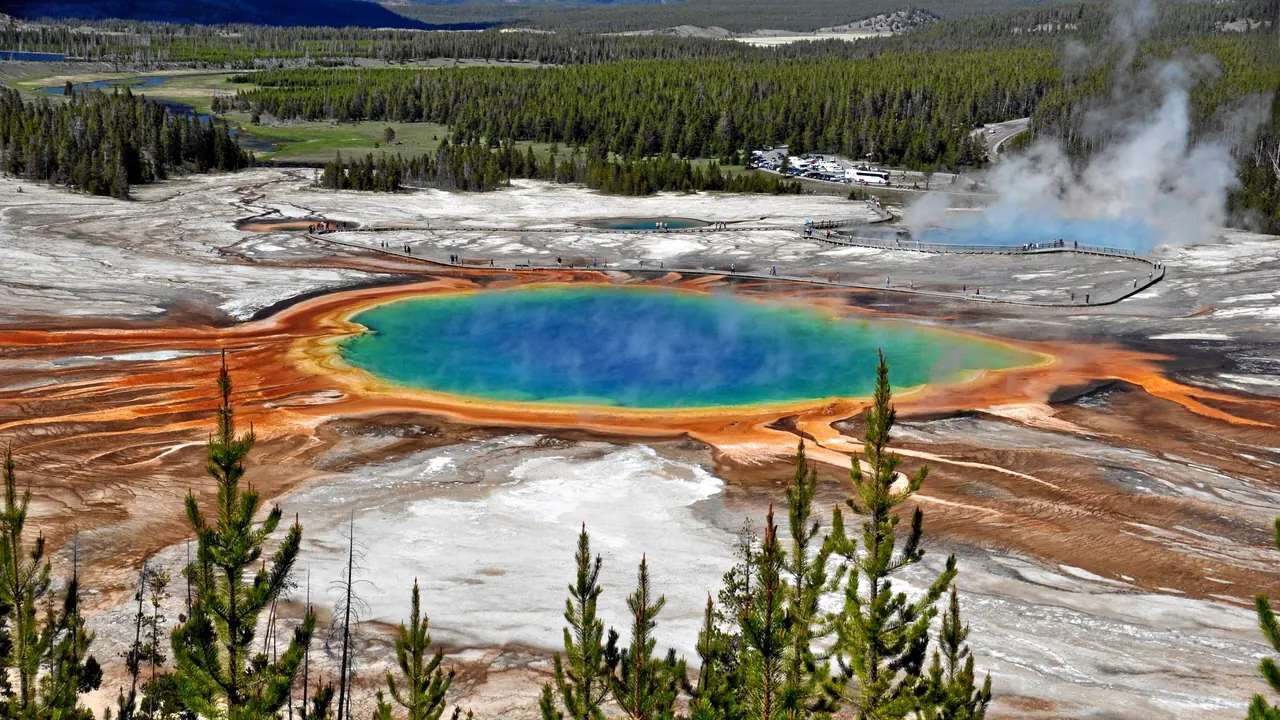
Photos: Grand Teton by Z3lvs, CC0; Yellowstone by James St. John from Newark, Ohio, CC BY 2.0, cropped.
Grand Teton or Yellowstone?
Our verdict in twelve categories, each scored against the same fixed benchmark cities, and the climate month by month, so you can choose for your trip.
Choose Grand Teton for
- getting around
- shopping
- food and drink
Grand Teton suits travellers who want serious mountain walking from a comfortable base. The peaks rise straight off the valley floor, trailheads are a short drive from Jackson, and evenings bring proper restaurants, western saloons and, in summer, orchestral concerts at Teton Village. It is the easier place to spend a week without long drives, and in winter it becomes a ski destination in its own right.
Choose Yellowstone for
- prices
- day trips
- culture and sights
Choose Yellowstone for a landscape found almost nowhere else: erupting geysers, boiling pools and the ochre canyon of the Yellowstone River, with wolves and bison herds in the northern valleys. Families with younger children tend to get more from it, and it is the slightly less costly of the two. In return you spend long hours on the Grand Loop Road, and evenings end early with little to eat or do after dark.
Scoreboard
Twelve categories on one fixed scale from 0 to 100. The shaded stretch is the gap between the two.
Your match
Pick a travel style or drag the sliders, and both match scores follow your weighting.
Wins on getting around and shopping with your weighting.
Wins on prices and day trips with your weighting.
What matters to you?
Category by category
What the scores mean for a trip.
Beaches & swimming
Neither is a place to swim, but Grand Teton at least offers a pleasant dip. String Lake is shallow, sandy at the edges and warm enough on late-summer afternoons, and families paddle off the gravel shores at Colter Bay.
Yellowstone's water is colder and more dangerous. The lake stays near 10°C even in August and the thermal pools are off limits. That leaves a quick plunge in the Firehole River canyon or a commercial hot-spring pool outside the park.
Food & drink
Grand Teton eats far better, thanks to Jackson on its doorstep. This small town has upscale dining rooms around the square, good bakeries and coffee roasters, and craft distilleries close by. The lodges and Colter Bay cafeterias inside the park are basic, but a good dinner is never far away.
In Yellowstone, meals are a practical stop between geyser basins: lodge dining rooms, general-store counters and gateway-town steakhouses, with huckleberry pie as the local treat. Kitchens close early and the serious cooking is in Jackson or Bozeman, both a long drive from the sights, so most visitors rely on packed lunches.
Culture & sights
Grand Teton's human story fits into a day. It covers the weathered barns of Mormon Row, the log Chapel of the Transfiguration with the peaks framed in its window, Menor's Ferry and the National Museum of Wildlife Art above Jackson. These sights are good to photograph but quick to see.
Yellowstone has more to show. As the world's first national park, founded in 1872, it has the Old Faithful Inn, the finest rustic lodge of its kind, along with the Roosevelt Arch and the old army buildings of Fort Yellowstone. The Buffalo Bill Center of the West in Cody adds a major museum of Plains Indian cultures and Western art.
Nightlife
Grand Teton has what little nightlife there is between the two, and it is all in Jackson. There are western saloons on the town square with country dancing, a few brewpubs and cocktail bars, and loud après-ski at Teton Village in winter. Nights end fairly early, but they have character.
Yellowstone has almost nothing after dark beyond a lodge lounge, a ranger talk or a gateway-town saloon that empties early.
Nature & outdoors
Both rank among the great wild places on earth, but they look nothing alike. Grand Teton is a mountain range, with granite peaks over 4,000m rising straight from the sage flats and glacial lakes at their feet. Trails lead into Cascade Canyon and along the Teton Crest, there is real alpine climbing, and in winter there is deep-powder skiing at Jackson Hole.
Yellowstone is a volcanic plateau whose wonders come from underground: Old Faithful, Grand Prismatic Spring, the terraces at Mammoth and the yellow canyon at Lower Falls. Both have superb wildlife. Grand Teton is best known for moose in the willows at Oxbow Bend, while Yellowstone adds wolves and grizzlies in Lamar Valley and big bison herds in Hayden Valley.
Day trips
Neither is a base for touring other towns, since most days are spent inside the parks. From Grand Teton the one big outing is Yellowstone itself, about an hour north of Jackson Lake. Driggs and Victor over Teton Pass make a quiet half day.
Yellowstone's gateways lead in more directions: Jackson's galleries to the south, Buffalo Bill's Cody to the east, Bozeman to the north, the gold-rush towns of Virginia City and Nevada City to the west, and the Beartooth Highway over to Red Lodge. Each is a long day, but there is more to choose from.
Good for families
Both suit children who love animals, and both run the Junior Ranger programme. Grand Teton works best for active families with school-age children. The boat across Jenny Lake leads to the walk up to Hidden Falls, there are flat lakeside trails at String Lake and gentle Snake River floats, and Jackson has a summer rodeo.
Yellowstone appeals more to younger children because its sights put on a show: Old Faithful erupting on schedule, mud pots bubbling and belching, short boardwalks, and bears and wolves at the wildlife centre in West Yellowstone. The trade-off is more hours in the car and constant supervision near boiling water and bison.
Getting around
Both need a car, but Grand Teton is far easier to cover. The airport lies inside the park, Jenny Lake is about forty minutes from Jackson and a full loop through the valley fits into a day. Jackson's compact centre is easy to walk, and a bus runs out to Teton Village.
Yellowstone's Grand Loop Road runs about 230km at low speeds, so moving between the geyser basins, the canyon and Lamar Valley takes hours. The nearest airports are one to two hours from the entrances. Both lose roads to winter closures, but Yellowstone's interior can then be reached only by snowcoach or snowmobile.
Shopping & style
Grand Teton has the better shopping because Jackson's town square brings it together. You find galleries of wildlife painting and bronzes, western boots and hats, Native American jewellery and well-stocked climbing and ski shops in a few walkable blocks. Yellowstone has lodge gift shops, general stores and fly-fishing outfitters in the gateway towns, and anyone after western wear or art ends up in Cody or Jackson.
Affordability
Both are expensive in summer, but Grand Teton costs more. Jackson is among the country's wealthiest resort towns, and its rooms, restaurants and guided rafting or climbing add up fast. Camping, or staying over the pass in Idaho's Teton Valley, keeps costs down.
Yellowstone is somewhat cheaper. Its lodges and motels charge more than their comfort justifies, yet the sights cost nothing beyond park entry. Campgrounds and the smaller gateway towns help, and spring and autumn are noticeably cheaper than high summer.
Live music & performing arts
Grand Teton has the stronger summer programme. The Grand Teton Music Festival, held at Teton Village since the 1960s, brings a professional orchestra for weekly symphonic and chamber concerts in July and August. Jackson adds a performing arts centre, a small theatre and country bands in the saloons.
Yellowstone itself offers campfire ranger talks, with a nightly summer rodeo in Cody and family musicals in West Yellowstone. Visitors who want the orchestra drive south to the same festival.
Wellness & relaxation
Grand Teton is the easier place to unwind. Upscale hotels in Jackson and Teton Village run full spas, and Granite Hot Springs offers a forest soak about an hour south. The still lakes and dark skies bring calm without any planning.
Yellowstone's springs are too hot and fragile to bathe in, so soaking means the developed pools near Gardiner or in Paradise Valley, and there are few spas. Quiet also depends on timing. The main loop is busy in July and August, and the calm comes early in the morning or in September and October.
When should you go?
Pick your month. The climate figures are measured averages, not a forecast.
Grand Teton in July
Yellowstone in July
Daytime high, °C
Rainfall in the month, mm
Where the figures come from
Grand Teton's temperatures are measured 33 km from the centre, at Jackson Hole / Moose.
Grand Teton has no rain gauge within 25 km of the centre, so its rainfall comes from a gridded climate dataset read at the destination rather than from a gauge further away.
Yellowstone has no weather station within reach, so its figures come from a gridded climate model rather than a measured record, and read a broad area rather than one spot.
Temperature and rainfall are climate normals, averaged over the years shown. Grand Teton: 1991-2020 normals, Jackson Hole / Moose (32.7 km from centre). Yellowstone: 2001-2020 normals, NASA POWER reanalysis grid, no weather station within 90 km.
Both are summer destinations, and the weather makes that plain. Around Grand Teton the valley warms quickly from June, and July and August reach about 32°C by day. That is hot for a midday climb but good for an afternoon dip in String Lake. July is also the driest month, at about 24mm. September stays pleasant for hiking. From December to February highs sit around freezing and the trip turns to skiing.
Yellowstone sits higher and is cooler all year. Its July highs of about 25°C make long days on foot more comfortable, but the warm season is shorter. June and September are mild rather than warm, and October is already cool. From November to March daytime highs stay at or below freezing, falling to -6°C in midwinter. It is also the wetter of the two, with steady rain or snow in every month outside July and August and the most in December.
Which traveller are you?
On a family trip with younger children, Grand Teton asks for more walking than small legs can manage, so Yellowstone is the better pick. Its sights hold short attention spans, and most are only a few minutes from the car.
For a food and nightlife trip, choose Grand Teton and stay in Jackson itself, so dinner and a late drink are a short walk away rather than a drive. Yellowstone only works for this traveller as a day out from there.
On a tight budget, Grand Teton is the harder place to make the money last. Base yourself around Yellowstone instead, where a week of sightseeing adds little to the bill, and see the Tetons on a long day out.
Before you go
| Measure | Grand Teton | Yellowstone |
|---|---|---|
| Currency | US Dollar (USD) | US Dollar (USD) |
| Sockets | AB120 V, 60 Hz | AB120 V, 60 Hz |
| Driving side | Right | Right |
| Time zone | UTC-7, UTC-6 in summer | UTC-7, UTC-6 in summer |
| Emergency number | 911 | 911 |
| Main airport | Jackson Hole Airport (JAC)16 non-stop destinations | Bozeman Yellowstone International Airport (BZN)27 non-stop destinations |
| Public holidays this year | 11 days | 11 days |
Where else could you go?
Every comparison below shares a destination with this one, so you can follow Grand Teton or Yellowstone somewhere new.
- Glacier National Parkvs Yellowstone
- Rocky Mountain National Parkvs Grand Teton
- Glacier National Parkvs Grand Teton
- Archesvs Grand Teton
- Canyonlandsvs Grand Teton
- Rocky Mountain National Parkvs Yellowstone