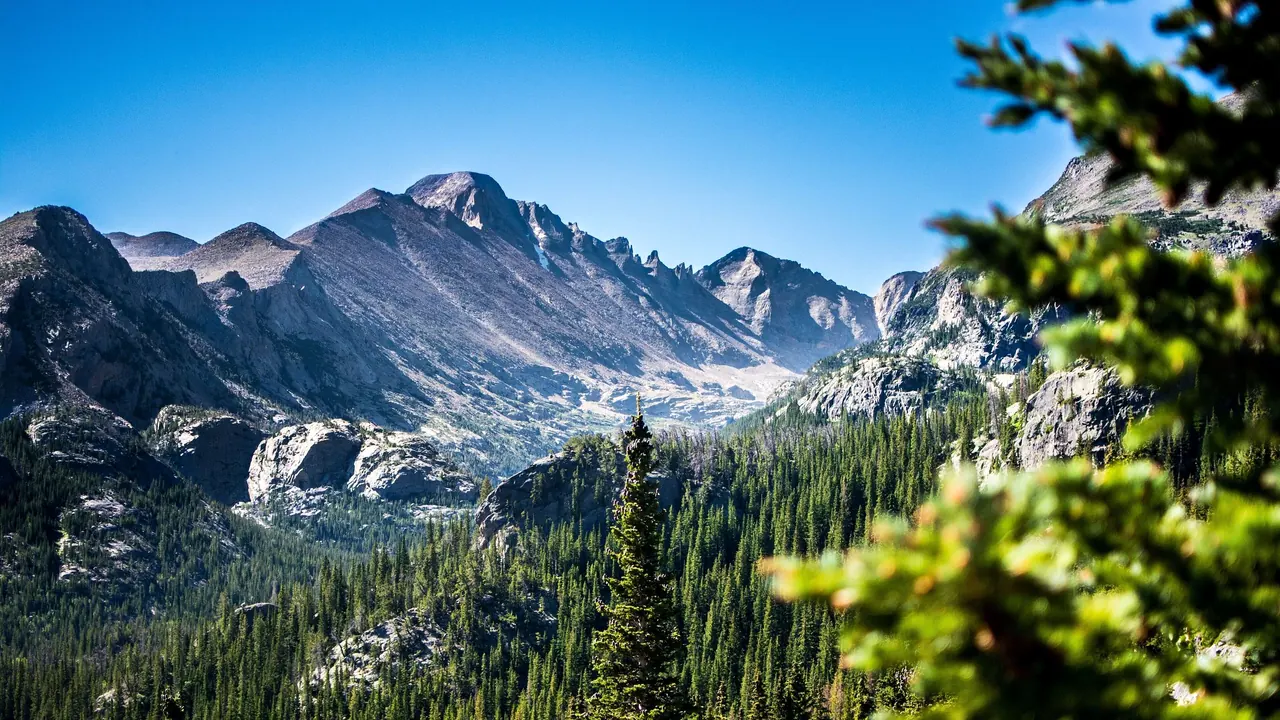
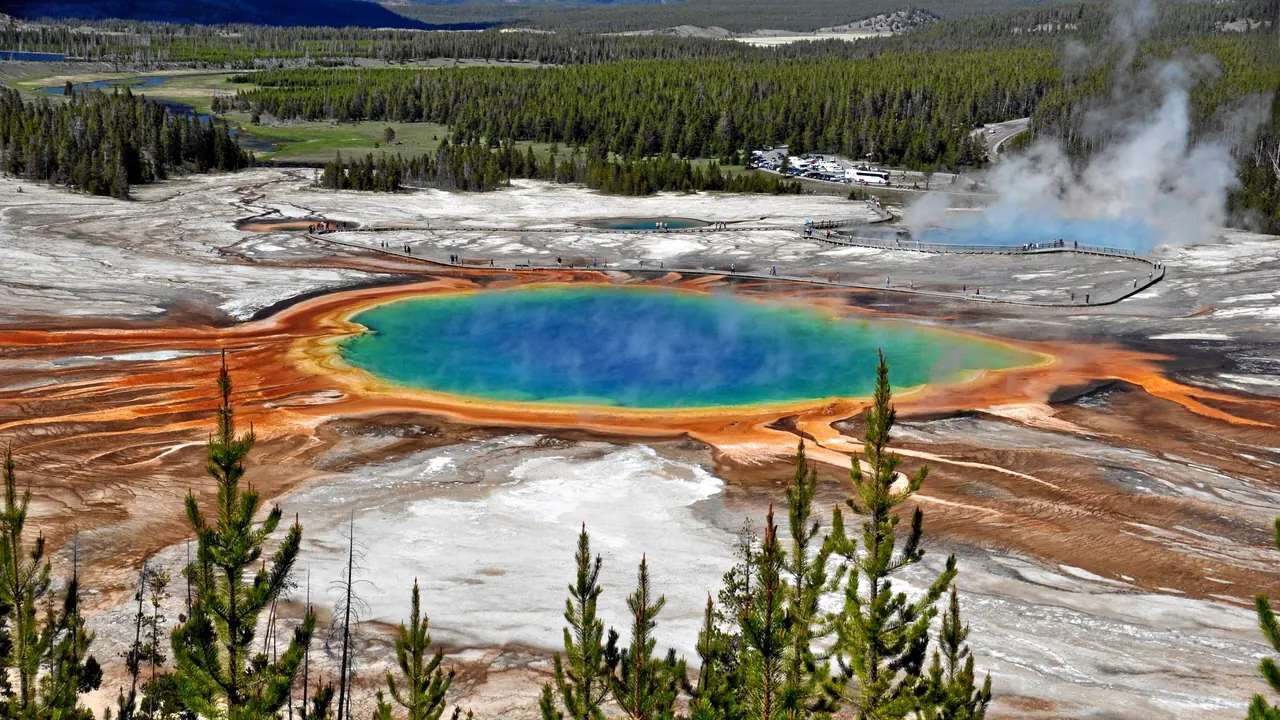
Photos: Rocky Mountain National Park by Peter Pryharski epicpeter, CC0; Yellowstone by James St. John from Newark, Ohio, CC BY 2.0, cropped.
Rocky Mountain National Park or Yellowstone?
Our verdict in twelve categories, each scored against the same fixed benchmark cities, and the climate month by month, so you can choose for your trip.
Choose Rocky Mountain National Park for
- getting around
- day trips
- wellness
Rocky Mountain National Park suits the traveller who wants high alpine country without a long expedition to reach it. Denver's airport is a drive of about two hours, a summer shuttle takes the strain off the busiest trailheads, and the Front Range towns of Boulder and Fort Collins are close enough for a rest day. It is the better pick for hikers drawn to lakes, peaks and tundra, and for anyone who wants a riverside cabin to come back to at night.
Choose Yellowstone for
- culture and sights
- nature and the outdoors
- families
Yellowstone is for the traveller who wants a landscape found almost nowhere else: geyser basins, steaming terraces and wildlife on a scale that turns every drive into a safari. It also has more history to show, from the Old Faithful Inn to Fort Yellowstone. In return you accept long hours on the Grand Loop Road, distant airports and a shorter, cooler summer, so it rewards a longer stay planned around dawn starts.
Scoreboard
Twelve categories on one fixed scale from 0 to 100. The shaded stretch is the gap between the two.
Your match
Pick a travel style or drag the sliders, and both match scores follow your weighting.
Too close to call, 2 points apart
Wins on getting around and day trips with your weighting.
Wins on culture and sights and nature and the outdoors with your weighting.
What matters to you?
Category by category
What the scores mean for a trip.
Beaches & swimming
Neither is a place to swim, and they disappoint in different ways. Rocky Mountain's best water is Grand Lake on the western side, where a small shore suits paddleboards, boats and a brave, brief plunge. Yellowstone's cold lake is dangerous rather than refreshing, its thermal pools are off limits, and the one recognised dip is a summer plunge in a canyon stretch of the Firehole River. In either park, a hotel pool is the realistic answer.
Food & drink
The food is equally modest, but it is shaped differently. Rocky Mountain's meals centre on Estes Park, a single compact town with breakfast diners, steakhouses, a few breweries and distilleries, and taffy shops on Elkhorn Avenue, with Boulder's restaurants an hour away.
Yellowstone feeds you in the dining rooms of historic lodges and at general-store counters, with more regional character in bison burgers, trout and huckleberry pie. Its gateway towns are spread far apart and park kitchens close early, so you plan meals around the driving.
Culture & sights
Yellowstone has the richer heritage, because it is the world's first national park and its buildings show it. The Old Faithful Inn is a landmark of rustic architecture, Fort Yellowstone recalls the years when the army guarded the park, and Cody's Buffalo Bill Center of the West adds a serious museum of Plains Indian cultures and Western art.
Rocky Mountain's sights fill an afternoon. They include the Holzwarth dude ranch cabins in the Kawuneeche Valley, the Moraine Park Discovery Center and the Stanley Hotel above Estes Park, with its ghost tours.
Nightlife
Both parks go to bed early, since the wildlife is best at dawn. Estes Park has slightly more to offer after dark, with brewpubs, taprooms and saloons gathered along Elkhorn Avenue. Yellowstone's evenings are more likely to mean a lodge lounge or a ranger talk, with scattered gateway-town saloons that empty early. In both, the dark sky is the best thing about the night.
Nature & outdoors
Both are outstanding, but Yellowstone edges ahead because nothing elsewhere matches it. Most of the world's active geysers lie on its volcanic plateau, alongside Grand Prismatic Spring, the Mammoth terraces and a canyon of yellow rock. Its wildlife is the fullest roll call in the lower states, with wolves and grizzlies in Lamar Valley and bison herds in Hayden Valley.
Rocky Mountain's strength is height. It has more than sixty peaks above 3,600m, Trail Ridge Road crossing open alpine tundra, and glacial lakes such as Sky Pond and Chasm Lake. Elk bugle in Moraine Park in September, and for hikers and climbers it can feel more intimate and easier to explore on foot.
Day trips
Rocky Mountain has better outings close at hand. Boulder, with its Flatirons and pedestrian street, is about an hour from Estes Park, Fort Collins and Lyons are nearby, and Denver's museums are within a long morning's reach.
Yellowstone's outings are each a long day for a single stop. You can visit Jackson's square and wildlife art museum, Buffalo Bill's Cody, Bozeman, or the gold-rush settlements of Virginia City. The Beartooth Highway to Red Lodge is a splendid drive, but most visitors find the park itself fills every day.
Good for families
Both parks suit families who like being outdoors, and both offer Junior Ranger badges and animals grazing beside the road. Yellowstone has more drama for children, with Old Faithful erupting on schedule, belching mud pots and short, flat boardwalks. The cost is hours in the car and constant watching near scalding water and bison.
Rocky Mountain is gentler. There are easy lake loops at Bear Lake and Sprague Lake, and Estes Park adds a tramway, mini-golf and horse riding. The altitude is the main thing to plan for, so take the first day slowly.
Getting around
Rocky Mountain is far simpler to reach and to manage. Denver's airport is about two hours away on good roads, a free summer shuttle runs up Bear Lake Road, and Estes Park is small enough to walk. The catch is that only Trail Ridge Road links the two sides, and it closes for much of the year, so most visitors base themselves on one side.
Yellowstone has no public transport at all. Its sights are spread along the 230km Grand Loop Road, where bison and full car parks slow summer traffic, and the airports are one to two hours from the gates. From November to April the interior is reached only by snowcoach or snowmobile.
Shopping & style
Shopping is an afterthought in both. Elkhorn Avenue in Estes Park gives the most concentrated browsing, with outdoor gear, Western wear, galleries and taffy in one walkable street. Yellowstone's version is spread between lodge gift shops and the gateway towns, though Jackson and Cody are the places to find cowboy boots, hats and wildlife bronzes.
Affordability
Both are expensive in summer, for the same reason: demand crowds into a short season and a car is unavoidable. Yellowstone's in-park lodges book out and are priced above their comfort, and a base near Jackson costs more still. Rocky Mountain's pinch comes in summer and during the September elk season. In both parks, campgrounds, picnic lunches and the shoulder months bring costs down considerably.
Live music & performing arts
Neither has much of a stage, and what each has is distinctive. Rocky Mountain's surprise is the repertory theatre in Grand Lake, staging Broadway-style musicals all summer, along with chamber concerts and bluegrass evenings around Estes Park. Yellowstone's signature is the nightly summer rodeo in Cody, with the Grand Teton Music Festival's orchestra further off at Teton Village.
Wellness & relaxation
Rocky Mountain is the easier place to unwind. Lodge and resort spas in Estes Park, riverside cabins along the Big Thompson and the quiet Kawuneeche Valley all lie close to a base, and Hot Sulphur Springs is about forty minutes from Grand Lake.
Yellowstone teases you with steaming ground you cannot touch. Soaking means a drive to the pools near Gardiner or into Paradise Valley, spas are few, and real calm comes from timing it right: an early morning by the lake or the quieter weeks of September and October.
When should you go?
Pick your month. The climate figures are measured averages, not a forecast.
Rocky Mountain National Park in July
Yellowstone in July
Daytime high, °C
Rainfall in the month, mm
Where the figures come from
Rocky Mountain National Park's temperatures are measured 77 km from the centre, at Kremmling.
Rocky Mountain National Park has no rain gauge within 25 km of the centre, so its rainfall comes from a gridded climate dataset read at the destination rather than from a gauge further away.
Yellowstone has no weather station within reach, so its figures come from a gridded climate model rather than a measured record, and read a broad area rather than one spot.
Temperature and rainfall are climate normals, averaged over the years shown. Rocky Mountain National Park: 2006-2025 (rainfall 1991-2020) normals, Kremmling (77 km from centre). Yellowstone: 2001-2020 normals, NASA POWER reanalysis grid, no weather station within 90 km.
Measured where most visitors stay, Rocky Mountain National Park has the longer and drier walking season. May is mild, June to September are warm, with July reaching about 29°C, and October is still pleasant for a stroll through Estes Park. Rain stays light all year. The wettest month is July, at around 50mm, and it falls mostly as afternoon thunderstorms, so high hikes are best started early. Winters are cold but fairly dry.
Yellowstone is cooler and wetter, with a much shorter summer. July and August are the only warm months, at around 25°C, and they are also the driest. June and September are cool, and April, May and October are cold and damp. From November to March the plateau sits at or below freezing. December is the wettest month of the year at about 86mm, and in that cold nearly all of it falls as snow. If you want a relaxed summer trip, Rocky Mountain gives you more weeks to choose from. Yellowstone means aiming for high summer, or coming equipped for real winter.
Which traveller are you?
On an outdoors trip, Yellowstone gives you the bigger week. Each day can bring different ground, from thermal basins to deep backcountry. The jagged Tetons lie just to the south for more hiking, and in winter snowcoach and ski trips cross the frozen, steaming basins.
For a relaxing and wellness trip, Rocky Mountain National Park asks less of you. Shorter drives leave more of the day free for doing nothing, nights are dark and quiet enough for stargazing from the high meadows, and late spring brings a noticeably calmer park.
On a trip on a tight budget, Rocky Mountain National Park makes the money go a little further. Fewer hours at the wheel mean less fuel, the free summer shuttle saves the hunt for a parking space, and the small, walkable town lets you leave the car in the evening.
Before you go
| Measure | Rocky Mountain National Park | Yellowstone |
|---|---|---|
| Currency | US Dollar (USD) | US Dollar (USD) |
| Sockets | AB120 V, 60 Hz | AB120 V, 60 Hz |
| Driving side | Right | Right |
| Time zone | UTC-7, UTC-6 in summer | UTC-7, UTC-6 in summer |
| Emergency number | 911 | 911 |
| Main airport | Denver International Airport (DEN)231 non-stop destinations | Bozeman Yellowstone International Airport (BZN)27 non-stop destinations |
| Public holidays this year | 12 days | 11 days |
Where else could you go?
Every comparison below shares a destination with this one, so you can follow Rocky Mountain National Park or Yellowstone somewhere new.
- Grand Tetonvs Yellowstone
- Archesvs Rocky Mountain National Park
- Canyonlandsvs Rocky Mountain National Park
- Glacier National Parkvs Yellowstone
- Grand Tetonvs Rocky Mountain National Park
- Bryce Canyonvs Rocky Mountain National Park