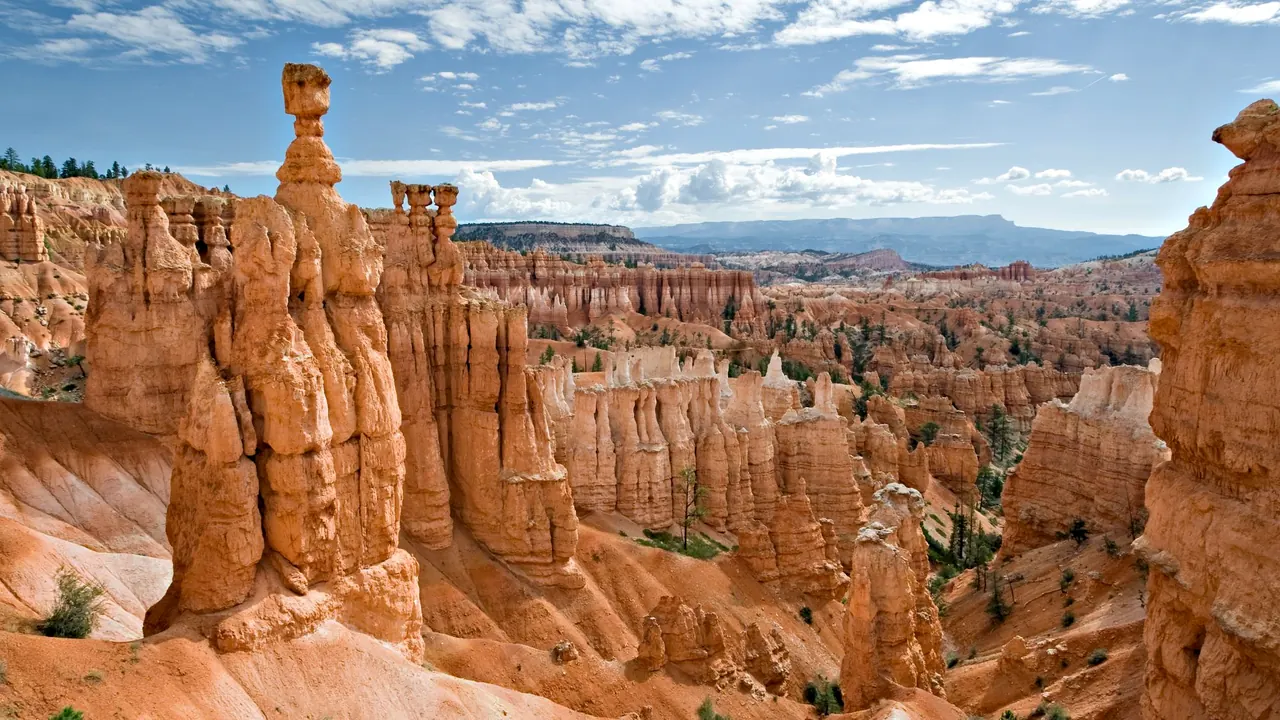
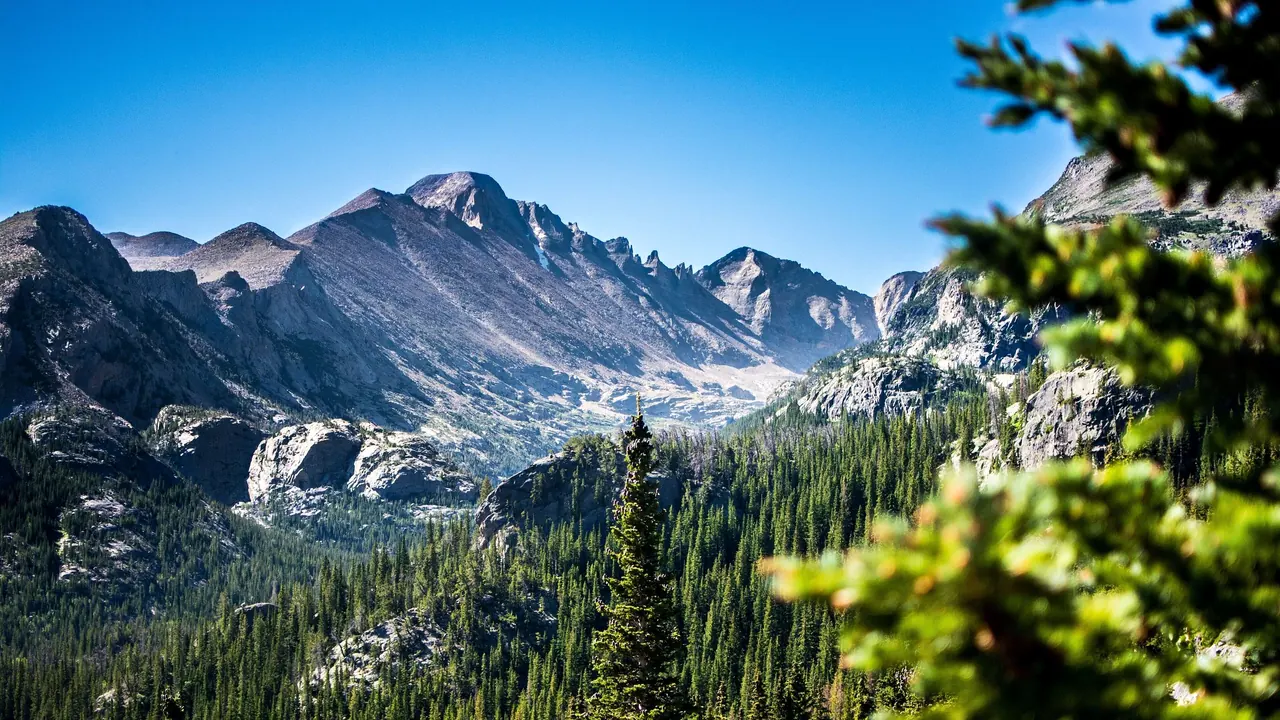
Photos: Bryce Canyon by Luca Galuzzi (Lucag), CC BY-SA 2.5, cropped; Rocky Mountain National Park by Peter Pryharski epicpeter, CC0.
Bryce Canyon or Rocky Mountain National Park?
Our verdict in twelve categories, each scored against the same fixed benchmark cities, and the climate month by month, so you can choose for your trip.
Choose Bryce Canyon for
- prices
- getting around
Bryce Canyon suits travellers who want one extraordinary landscape and are happy to give their days to it. The hoodoo amphitheatre, the slot canyons of Grand Staircase-Escalante and Scenic Byway 12 make a desert road trip. The towns are small and quiet and offer little beyond a bed and a meal. It works best for walkers, photographers and stargazers who don't mind early nights and simple food.
Choose Rocky Mountain National Park for
- day trips
- wellness
- families
Rocky Mountain National Park is the better choice for a mixed party or a longer stay. High peaks, alpine tundra and elk in the meadows match Bryce for scenery. On top of that, Estes Park has more to eat and do, the activities for children are better, there are spas and hot springs for rest days, and Boulder, Fort Collins and Denver are close enough for a day out.
Scoreboard
Twelve categories on one fixed scale from 0 to 100. The shaded stretch is the gap between the two.
Your match
Pick a travel style or drag the sliders, and both match scores follow your weighting.
Wins on prices and getting around with your weighting.
Wins on day trips and wellness with your weighting.
What matters to you?
Category by category
What the scores mean for a trip.
Beaches & swimming
Neither is a swimming destination, and a motel or hotel pool is the honest answer in both. The difference is in the water nearby. Around Bryce, Tropic Reservoir and Panguitch Lake are cold reservoirs for fishing and paddling. Grand Lake, on the western side of Rocky Mountain, is a natural lake with a small shoreline where people sunbathe briefly or take a quick cold plunge, though a paddleboard suits it better.
Food & drink
Rocky Mountain eats a little better, mainly because Estes Park is larger than any Bryce gateway town. Its breakfast diners, steakhouses, craft breweries, distilleries and taffy shops on Elkhorn Avenue give some choice, and Boulder's kitchens are an hour's drive away.
Around Bryce, the diners of Bryce Canyon City, Tropic and Panguitch serve ranch-style plates and pie, choice thins after dark, and Utah's rules limit alcohol. The one reason to drive for dinner is the handful of kitchens cooking with local produce in Escalante and Boulder along Highway 12. In both parks the picnic lunch on the trail is the usual midday meal.
Culture & sights
Both offer an afternoon of modest heritage around a vacation spent outdoors, and they tell different stories. Bryce has the 1920s timber-and-stone lodge, the Paiute stories of the hoodoos, Panguitch's red-brick pioneer centre and the ancestral Puebloan village at the Anasazi State Park Museum. Rocky Mountain looks back on homesteaders and early tourists, with the dude-ranch cabins of the Holzwarth Historic Site and the Stanley Hotel above Estes Park with its ghost tours.
Nightlife
Evenings are quiet in both, and in both the night sky is the real attraction. The small difference is a drink. Bryce's largely Mormon gateway towns have hardly a bar between them. Estes Park has brewpubs, taprooms and old-style saloons, and Grand Lake has a couple of boardwalk bars, though nothing stays open late in either park.
Nature & outdoors
These are two of the great American landscapes, and they could hardly be more different. Bryce is about rock. You see the orange and pink hoodoos of the amphitheatre from the Rim Trail, go down among the spires on the Navajo Loop and Queen's Garden, and have the Fairyland and Peekaboo loops almost to yourself. Beyond the park are Red Canyon, Kodachrome Basin and the slot canyons of Grand Staircase-Escalante, and the dark skies add ranger-led astronomy evenings.
Rocky Mountain is about height and wildlife. Trail Ridge Road crosses open alpine tundra, trails climb to Sky Pond, Chasm Lake and the summit of Longs Peak at 4,346m, and elk, bighorn sheep and moose are easy to see. Lumpy Ridge has rock climbing and the Big Thompson and Colorado rivers have fly fishing, neither of which Bryce can match. In winter, both parks are for snowshoes and skis.
Day trips
Rocky Mountain has far more for a day away from the trails. The Front Range is down the canyon roads, with Boulder's pedestrian street and the Flatirons about an hour away, the old town and breweries of Fort Collins, and Denver's museums within a couple of hours.
From Bryce, the outings are Panguitch's pioneer main street, the Puebloan museum at Boulder, Kanab's Hollywood Western past and the college town of Cedar City. Each is pleasant enough, but none fills a day, and most of the driving goes to more landscape rather than towns.
Good for families
Rocky Mountain is the more rewarding park for families. The flat walks around Bear Lake, Sprague Lake and Lily Lake suit small legs, and Estes Park adds the Prospect Mountain tramway, mini-golf, go-karts and stables. Elk by the roadside are a highlight for children, though they need to be kept at a distance during the rut.
Bryce has the paved rim between Sunrise and Sunset Points and a Junior Ranger programme of its own, and the hoodoos fascinate children. Even so, the climb back out of the canyon is steep, the drop-offs are unfenced, and outside the park there is little for children, so it suits school-age walkers rather than toddlers.
Getting around
Both are car trips with a free summer shuttle for the busiest stretch, and both are about equally easy to drive. Bryce's difficulty is distance. The nearest large airports are several hours away and the outings along Highway 12 are long, but the single scenic drive to Rainbow Point is simple to follow.
Rocky Mountain is closer to an airport, with Denver about two hours from Estes Park. Its difficulty is the layout. The two sides are joined only by Trail Ridge Road, which closes for much of the year, so most visitors base themselves on one side and stay there.
Shopping & style
Nobody travels to either park to shop. Around Bryce, shopping means a large general store with camping supplies and Western wear, the park bookshops, and roadside rock shops selling fossils, geodes and polished stone, which make a fitting souvenir of the area's geology.
Estes Park has a little more to browse. Elkhorn Avenue has outdoor gear, Western wear, jewellery and a few art galleries, and Grand Lake's boardwalk has a smaller version of the same.
Affordability
Expect similar costs at both, high in summer when there are too few beds for the crowds and cheaper for anyone who camps and packs lunches. At Bryce, the older motels of Panguitch are the main way to save, and winter is much cheaper, though many places close or reduce their service.
At Rocky Mountain, the elk season keeps prices high into early autumn, and Estes Park's resort-town restaurants add a tip to every bill. Late spring and late autumn are the easier times for a budget. Park entry is a smaller cost than lodging in both, though a road trip that takes in several Utah parks adds up.
Live music & performing arts
Both have a summer stage and little else, so it comes down to what you want to see. From Bryce, the serious option is the Utah Shakespeare Festival in Cedar City, an hour and a half's drive away and worth planning one evening around. Close to the park there is only a cowboy dinner show. Rocky Mountain's offer is closer to hand: Broadway-style musicals at Grand Lake's repertory theatre, chamber concerts from the summer music school and bluegrass evenings in Estes Park.
Wellness & relaxation
Rocky Mountain offers more real rest. Estes Park has lodges with spas, riverside cabins along the Fall River and Big Thompson are made for slow mornings, and the hot spring pools at Hot Sulphur Springs are a short drive from Grand Lake. The quiet Kawuneeche Valley is an escape from the busier eastern side.
Bryce offers calm rather than treatments. A hotel hot tub, empty roads and a dark sky from a lodge porch are about as far as it goes, and most days there are spent hiking in and out of the canyon.
When should you go?
Pick your month. The climate figures are measured averages, not a forecast.
Bryce Canyon in July
Rocky Mountain National Park in July
Daytime high, °C
Rainfall in the month, mm
Where the figures come from
Bryce Canyon has no rain gauge within 25 km of the centre, so its rainfall comes from a gridded climate dataset read at the destination rather than from a gauge further away.
Rocky Mountain National Park's temperatures are measured 77 km from the centre, at Kremmling.
Rocky Mountain National Park has no rain gauge within 25 km of the centre, so its rainfall comes from a gridded climate dataset read at the destination rather than from a gauge further away.
Temperature and rainfall are climate normals, averaged over the years shown. Bryce Canyon: 2004-2020 (rainfall 1991-2020) normals, Bryce Canyon / Bryce Canyon City (3.9 km from centre). Rocky Mountain National Park: 2006-2025 (rainfall 1991-2020) normals, Kremmling (77 km from centre).
The figures are measured where most visitors stay, and both are high-altitude summer parks. At Bryce, June is the driest month and July the warmest, at about 27°C, which is good for long days on the trails. Rain comes with the late-summer storms and peaks at about 42mm in August. September stays warm, and May and October are cool but pleasant for walking. Rocky Mountain gets a little warmer, about 29°C in July, but it is wetter right through from May to August, with about 50mm in July, which is why high hikes there start early.
Winter is cold in both. At Bryce, highs are only just above freezing from December to February. November and March are chilly rather than freezing, and snow can lie on the hoodoos until April, when the rim is open for snowshoeing. Midwinter is harder at Rocky Mountain, around -4°C in January, and Trail Ridge Road is closed from mid-autumn to late spring, so in the cold months you only see one side of the park.
Which traveller are you?
On a family trip with children, Rocky Mountain National Park is the safer choice, especially with younger ones. Its easy walks don't end in a steep climb back out, and Estes Park keeps children busy on stormy afternoons. Bryce rewards older children who already enjoy a hard hike.
For a relaxing and wellness trip, Rocky Mountain National Park lets you take proper rest days between hikes, with treatments on the eastern side and a warm soak near the western one. Bryce is genuinely calm, but nearly every day there still means climbing at altitude.
For an outdoors trip, both parks are superb, so choose by the kind of days you want. Bryce gives short loops with a huge payoff and fits into a desert road trip, with Zion two hours away. Rocky Mountain suits long days above the tree line and wildlife watching at dawn.
Before you go
| Measure | Bryce Canyon | Rocky Mountain National Park |
|---|---|---|
| Currency | US Dollar (USD) | US Dollar (USD) |
| Sockets | AB120 V, 60 Hz | AB120 V, 60 Hz |
| Driving side | Right | Right |
| Time zone | UTC-7, UTC-6 in summer | UTC-7, UTC-6 in summer |
| Emergency number | 911 | 911 |
| Main airport | Harry Reid International Airport (LAS)160 non-stop destinations | Denver International Airport (DEN)231 non-stop destinations |
| Public holidays this year | 12 days | 12 days |
Where else could you go?
Every comparison below shares a destination with this one, so you can follow Bryce Canyon or Rocky Mountain National Park somewhere new.
- Zionvs Bryce Canyon
- Grand Canyonvs Bryce Canyon
- Canyonlandsvs Bryce Canyon
- Archesvs Bryce Canyon
- Archesvs Rocky Mountain National Park
- Canyonlandsvs Rocky Mountain National Park