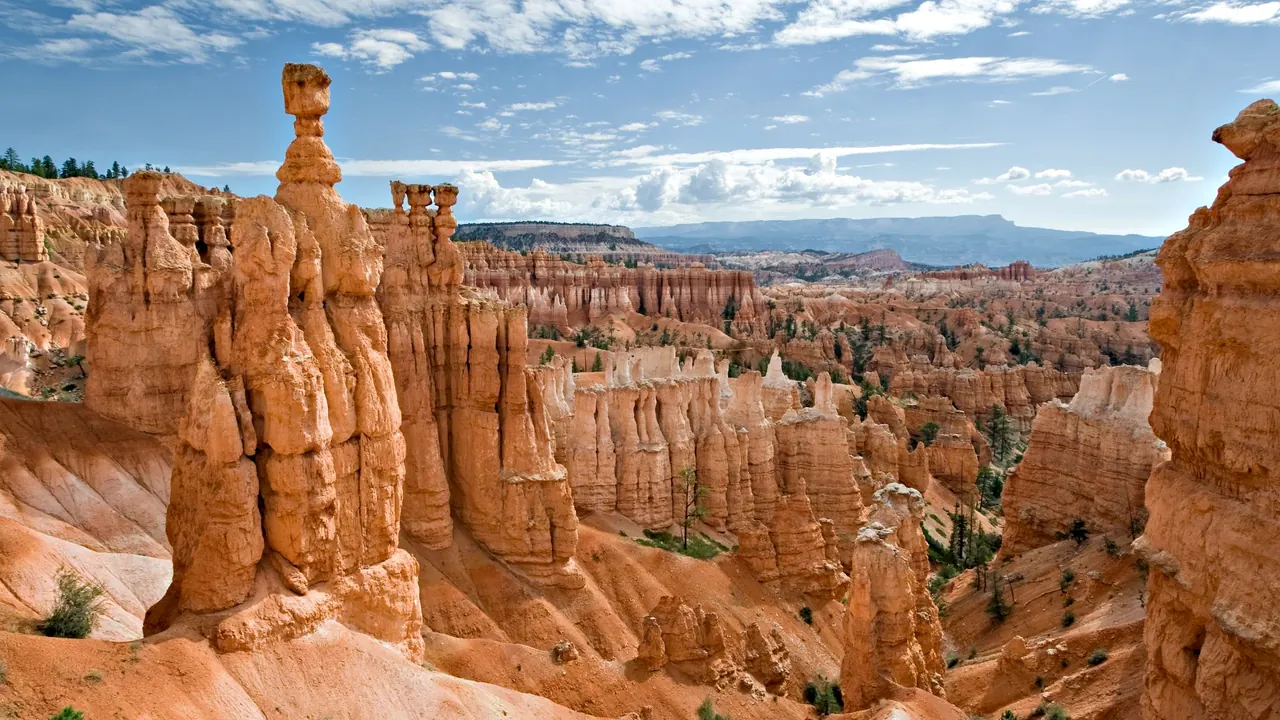
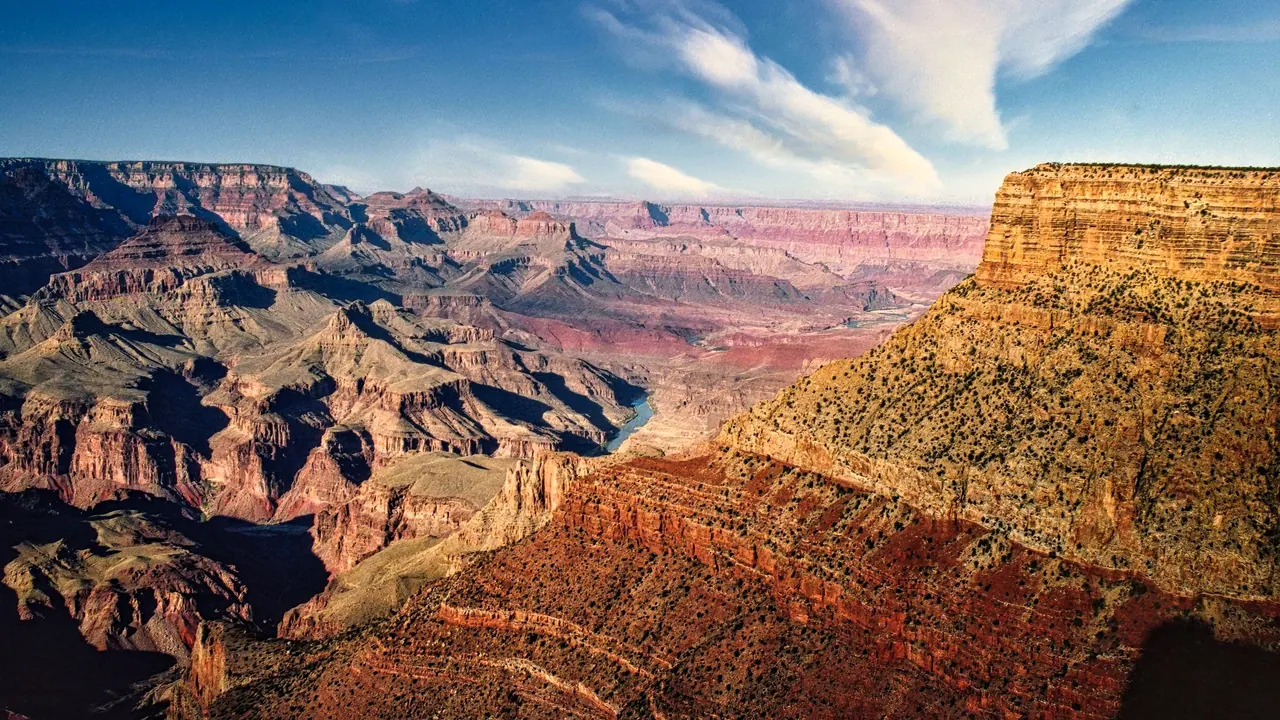
Photos: Bryce Canyon by Luca Galuzzi (Lucag), CC BY-SA 2.5, cropped; Grand Canyon by Tom Fisk, Pexels License.
Bryce Canyon or Grand Canyon?
Our verdict in twelve categories, each scored against the same fixed benchmark cities, and the climate month by month, so you can choose for your trip.
Choose Bryce Canyon for
- prices
Bryce Canyon suits walkers who want to be inside the landscape rather than above it. The amphitheatre is compact, the trails drop straight down among the hoodoos, and a few days covers it well. It is also the cooler of the two in high summer, and in winter it offers snowshoeing and cross-country skiing on the rim. The towns around it, though, offer little beyond beds, diners and the night sky.
Choose Grand Canyon for
- day trips
- culture and sights
- shopping
For a longer trip with more variety, the Grand Canyon is the stronger choice. The gorge is on a far larger scale, with rafting on the Colorado, mule rides and rim-to-rim hiking, and the South Rim has more heritage to see. Flagstaff, Williams and Sedona are within reach and add museums, Native American craft, better meals and a few evenings out, none of which Bryce can match.
Scoreboard
Twelve categories on one fixed scale from 0 to 100. The shaded stretch is the gap between the two.
Your match
Pick a travel style or drag the sliders, and both match scores follow your weighting.
Wins on prices with your weighting.
Wins on day trips and culture and sights with your weighting.
What matters to you?
Category by category
What the scores mean for a trip.
Beaches & swimming
Neither is a place to swim, but the Grand Canyon at least has some options. Lake Powell at Page warms up in summer and has sandy coves, and the pools below Havasu Falls reward a long hike that needs a permit. Bryce has only cold reservoirs such as Tropic Reservoir and Panguitch Lake, which are used for fishing and paddling, so a motel pool is the only real place for a dip.
Food & drink
At both canyons food is practical, so the real difference is how far you drive for a good dinner. From the Grand Canyon, Flagstaff's old downtown has craft breweries, green chile, frybread and a few serious kitchens, and on the rim itself the El Tovar dining room has the most atmosphere.
Bryce's towns serve steaks, burgers, Navajo tacos and pie, and early closing and Utah's alcohol rules narrow the choice further. Its best meals are along Scenic Byway 12 in Escalante and Boulder, and most days end up built around a picnic packed for the trail.
Culture & sights
The Grand Canyon has the richer heritage, centred on the railway-era buildings of Grand Canyon Village: El Tovar, Hopi House, the Kolb Studio and Mary Colter's Desert View Watchtower with its Hopi murals. Flagstaff's Museum of Northern Arizona and Lowell Observatory are enough for a couple of good mornings.
At Bryce, an afternoon is enough for the 1920s lodge, the visitor centre's Paiute stories of the hoodoos and the red-brick pioneer houses of Panguitch. The Anasazi State Park Museum is further out along Highway 12.
Nightlife
Neither offers a real night out near the trails. The Grand Canyon has a little more, with a couple of lounges on the rim and Flagstaff's brewpubs and student bars, although Flagstaff is too far away if you want to be up for sunrise. Bryce's small Mormon gateway towns have almost nothing open late, and the evening is spent looking at the stars.
Nature & outdoors
Both are among the great landscapes of the American West, and the difference is one of scale and approach. The Grand Canyon is a mile-deep gorge that you mostly look down into before going in on steep trails, by mule or on a raft. It rewards ambitious visitors with the rim-to-rim crossing, days on the Colorado and condors circling along the rim.
Bryce is compact and close up. The Navajo Loop and Queen's Garden take you among the hoodoos quickly, and Red Canyon, Kodachrome Basin and the slot canyons of Grand Staircase-Escalante are nearby. Its high plateau also gives it a snowy winter of snowshoeing and cross-country skiing.
Day trips
From the Grand Canyon there is far more within reach. Sedona's red rock and galleries, the hillside mining town of Jerome, the cliff dwellings at Walnut Canyon and Montezuma Castle and the pueblos at Wupatki all make full days out from Flagstaff, and so does the drive east towards Antelope Canyon.
Bryce's outings are mostly more scenery. Panguitch's pioneer main street, Kanab with its past as a Western film location and the college town of Cedar City are pleasant stops, but none of them fills a day.
Good for families
Both parks win children over with Junior Ranger programmes and short paved stretches of the Rim Trail, and both need the same care, with thin air, unfenced edges and tiring climbs back out. The Grand Canyon has more around it, such as the vintage train from Williams into the village and the drive-through wildlife park with bears and bison.
Bryce has horse rides, stargazing evenings and Queen's Garden, which makes a manageable first walk down among the spires. Outside the park, though, there is little for children apart from motel pools.
Getting around
Both need a car, and inside each park free shuttles in the main season spare you the crowded car parks. The bigger difference is distance. At Bryce, everything lies along one scenic drive of about 30km, while the Grand Canyon's North and South Rims are hours apart by road and Hermit Road is open only to shuttles for much of the year.
You can also reach the South Rim on the historic train from Williams. Bryce has no public transport at all, and snow can close the southern end of its park road in winter.
Shopping & style
The Grand Canyon has one real reason to shop: Native American craft. Hopi House and the old trading posts at Cameron sell Navajo rugs, silver jewellery, kachina carvings and pottery, and the staff know the makers. Bryce has a general store with Western wear and camping supplies and roadside rock shops selling fossils and geodes.
Affordability
Costs are similar, and at both the main expense is a summer room near the rim, while the trails, shuttles and ranger programmes are covered by the entrance fee. The Grand Canyon has cheaper motels in Williams and Flagstaff as a fallback, but it also offers some of the costliest extras in the West, from helicopter flights to multi-day rafting.
Bryce has fewer of these costly extras, and the older motels in Panguitch, camping and a much cheaper winter keep the bill down. The small number of restaurants does keep meal prices firm.
Live music & performing arts
Neither is a place for regular performances, and what each offers is different. Around the Grand Canyon there is a late-summer chamber music festival on the South Rim, occasional Native American dancing at Desert View, and Flagstaff's small symphony and its historic theatre with touring bands. From Bryce, the one serious draw is the Utah Shakespeare Festival in Cedar City, which is worth planning an evening around, while the gateway town has a summer cowboy dinner show.
Wellness & relaxation
Neither has spas worth the name, so at both, relaxing means stillness and dark skies. The Grand Canyon has the edge with its slower, forested North Rim and with Sedona, about two hours south, for treatments, retreats and yoga. Bryce has quiet towns and lodge porches under some of the darkest skies in the country, but days spent climbing at altitude leave little energy for rest.
When should you go?
Pick your month. The climate figures are measured averages, not a forecast.
Bryce Canyon in July
Grand Canyon in July
Daytime high, °C
Rainfall in the month, mm
Where the figures come from
Bryce Canyon has no rain gauge within 25 km of the centre, so its rainfall comes from a gridded climate dataset read at the destination rather than from a gauge further away.
Temperature and rainfall are climate normals, averaged over the years shown. Bryce Canyon: 2004-2020 (rainfall 1991-2020) normals, Bryce Canyon / Bryce Canyon City (3.9 km from centre). Grand Canyon: 1991-2020 normals, Grand Canyon Park (1 km from centre).
Neither has a beach season, so the question is when the trails are pleasant. Bryce's high plateau is a summer destination. July highs reach only about 27°C, warm but comfortable for hiking, and June is the driest of the warm months. Afternoon rain builds from July and peaks in August at around 42mm, with September still fairly wet. April, May and October are cool but fine for walking, while from December to February days barely rise above freezing and the hoodoos often carry snow.
The Grand Canyon figures run warmer all year, and the two follow almost opposite calendars. Highs climb to 36°C in July, and from June to August the heat makes walking at midday hard work and the trails into the canyon dangerous. April and October are the sweet spots at around 21°C, with May and September also good for serious hiking. Winter days are cool rather than freezing. June is almost rainless, and October and August are the wettest months. In short, Bryce is better in high summer, and the Grand Canyon in spring and autumn.
Which traveller are you?
For a culture and arts trip, the Grand Canyon is the better of the two, although neither is really a cultural destination. Mary Colter's buildings on the South Rim, the Tusayan ruin and Flagstaff's Museum of Northern Arizona and Lowell Observatory offer more than Bryce's lodge and pioneer towns.
On a family trip with children, the Grand Canyon has more to keep them busy, with the vintage train from Williams, the drive-through wildlife park and ranger talks. Both parks have unfenced edges and thin air, so both suit school-age walkers better than toddlers.
For an outdoors trip in high summer, Bryce Canyon is the easier choice. Its plateau stays comfortable for the Navajo Loop and Fairyland trails, while the Grand Canyon's inner trails become dangerously hot. In spring and autumn the Grand Canyon is better, with rafting and the rim-to-rim crossing.
Before you go
| Measure | Bryce Canyon | Grand Canyon |
|---|---|---|
| Currency | US Dollar (USD) | US Dollar (USD) |
| Sockets | AB120 V, 60 Hz | AB120 V, 60 Hz |
| Driving side | Right | Right |
| Time zone | UTC-7, UTC-6 in summer | UTC-7 |
| Emergency number | 911 | 911 |
| Main airport | Harry Reid International Airport (LAS)160 non-stop destinations | Phoenix Sky Harbor International Airport (PHX)149 non-stop destinations |
| Public holidays this year | 12 days | 12 days |
Where else could you go?
Every comparison below shares a destination with this one, so you can follow Bryce Canyon or Grand Canyon somewhere new.
- Zionvs Bryce Canyon
- Sedonavs Grand Canyon
- Zionvs Grand Canyon
- Canyonlandsvs Bryce Canyon
- Archesvs Bryce Canyon
- Canyonlandsvs Grand Canyon