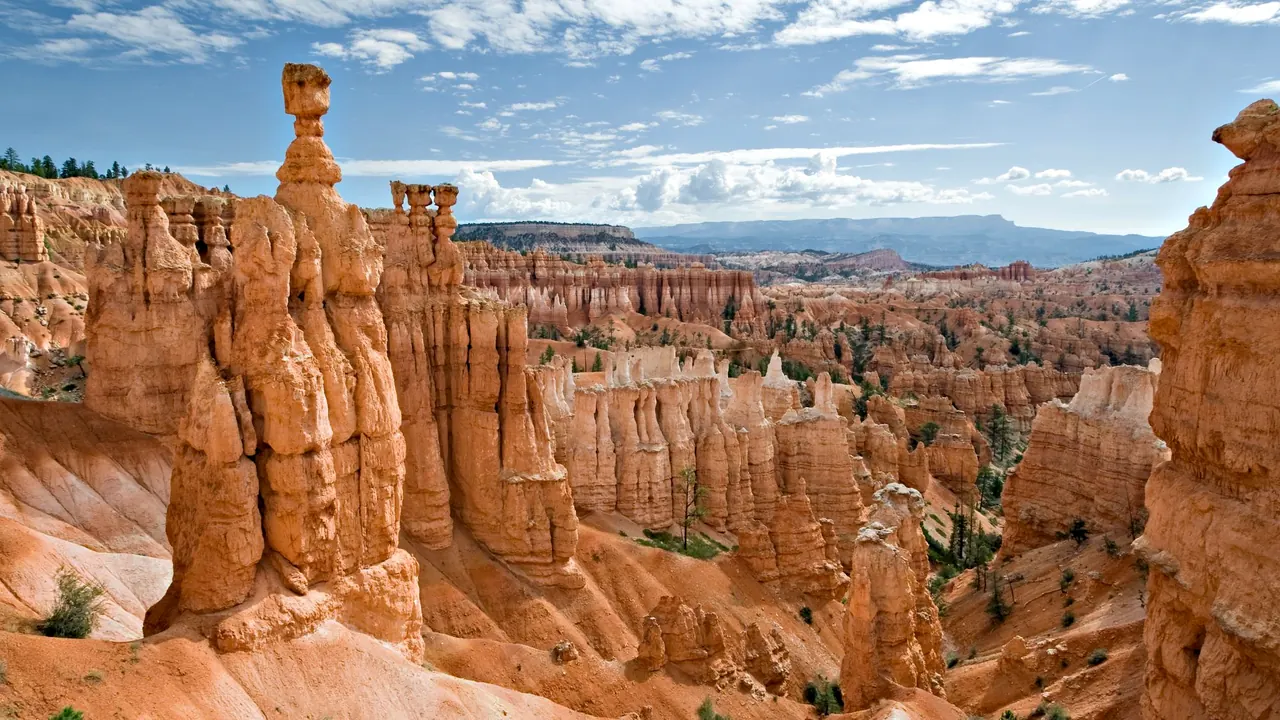
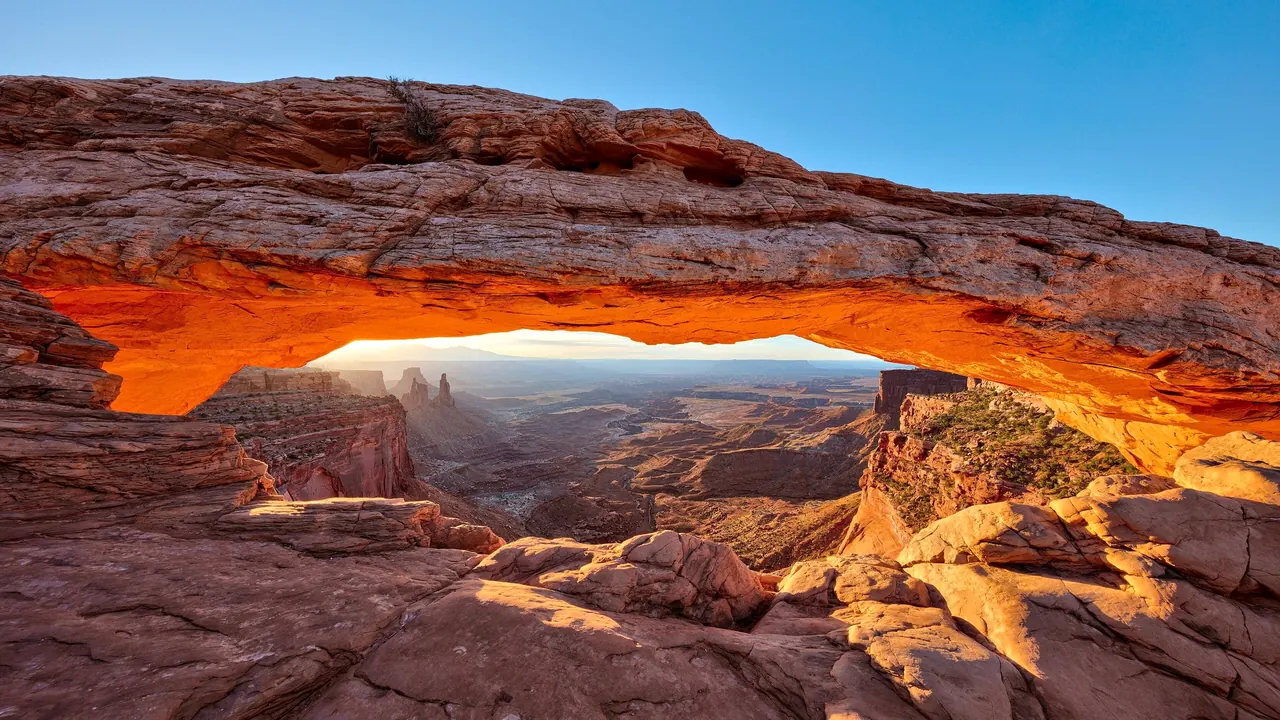
Photos: Bryce Canyon by Luca Galuzzi (Lucag), CC BY-SA 2.5, cropped; Canyonlands by Thomas Wolf, www.foto-tw.de, CC BY-SA 3.0, cropped.
Bryce Canyon or Canyonlands?
Our verdict in twelve categories, each scored against the same fixed benchmark cities, and the climate month by month, so you can choose for your trip.
Choose Bryce Canyon for
- prices
- live music and the arts
Bryce Canyon suits a walker who wants one extraordinary landscape seen closely and at a gentle pace. The hoodoo amphitheatre is compact, the Rim Trail ties the viewpoints together, and the trails down among the spires fill two or three days without much driving. Because it sits so high, summer stays pleasant when the lower desert is baking, and in winter the snow-covered hoodoos make it a different trip altogether. Expect quiet evenings in small towns and very little else.
Choose Canyonlands for
- culture and sights
- day trips
- food and drink
Canyonlands is the better choice for an active trip with a town base. From Moab you can reach Arches, Island in the Sky and Dead Horse Point, then add mountain biking on slickrock, rafting on the Colorado, climbing or four-wheel-drive tracks. The region also has more to find between the hikes: rock art panels, a few brewpubs, trading posts and a wider choice of places to eat. The price is summer heat at midday and longer distances to cover.
Scoreboard
Twelve categories on one fixed scale from 0 to 100. The shaded stretch is the gap between the two.
Your match
Pick a travel style or drag the sliders, and both match scores follow your weighting.
Wins on prices and live music and the arts with your weighting.
Wins on culture and sights and day trips with your weighting.
What matters to you?
Category by category
What the scores mean for a trip.
Beaches & swimming
Neither destination is for swimming. Bryce Canyon's nearby water is cold mountain reservoirs such as Tropic Reservoir and Panguitch Lake, which people use for fishing and paddling. In canyon country the Colorado and Green rivers are for rafting, and on a hot day you can paddle in a calm eddy or a small hill reservoir above Moab. In both, the motel pool is the realistic option.
Food & drink
Canyonlands eats a little better, almost entirely because of Moab. The town has more restaurants than its size suggests, plus Tex-Mex and Southwestern plates, craft-beer taprooms, food trucks and early breakfast spots for hikers before dawn.
Around Bryce Canyon the meals are ranch breakfasts, steaks, Navajo tacos and pie in Tropic and Panguitch, and choice thins quickly after dark. The best cooking is a drive away along Scenic Byway 12, in Escalante and Boulder. In both places Utah's liquor rules limit the drinking and picnics do a lot of the work.
Culture & sights
Canyonlands has more heritage, and you find it on the rock rather than in buildings. Fremont and Ancestral Puebloan petroglyphs line Potash Road and Courthouse Wash, Newspaper Rock is on the way to the Needles, and the life-size painted figures of the Great Gallery repay the long drive and hike.
Bryce Canyon's list is shorter and done in an afternoon. It has the 1920s timber-and-stone lodge, the Paiute stories told at the visitor centre, the red-brick pioneer houses of Panguitch and the Puebloan village at Boulder's state park museum.
Nightlife
Neither has much of an evening. The difference is that Moab has a few bars and brewpubs where rafting guides and mountain bikers gather, and on a spring weekend they get lively. The Mormon gateway towns near Bryce Canyon have almost nothing open late, and most visitors go to bed early to catch sunrise on the rim. In both places, the stars are the real reason to stay up.
Nature & outdoors
Both are world-class, but in different ways. Bryce Canyon is one concentrated spectacle: orange and pink hoodoos packed into bowls at the edge of a plateau, seen from the Rim Trail and explored on the Navajo Loop, Queen's Garden and Fairyland trails. Red Canyon, Kodachrome Basin and the slot canyons of Grand Staircase-Escalante are close by, and winter brings snowshoeing and cross-country skiing on the rim.
Canyonlands covers far more ground and offers more to do in it. Arches is next to Moab, and the Island in the Sky overlooks, Dead Horse Point, the Needles and the remote Maze are all within reach. It adds slickrock biking, whitewater through Cataract Canyon, climbing at Indian Creek, the White Rim Road and the alpine La Sal Mountains above the desert.
Day trips
Day trips from both mostly lead to more scenery, but Canyonlands has a few more towns and sites worth a visit as places. Bluff has pioneer stone houses, Blanding's Edge of the Cedars museum has fine Puebloan pottery beside a ruin, and the Hovenweep towers and the orchards of Palisade are within reach.
From Bryce Canyon the options are thinner: Panguitch's main street, Kanab with its Hollywood Western past and the college town of Cedar City. None of them fills a day on its own.
Good for families
Both work for families who enjoy walking, and both demand care near the unfenced drops. Bryce Canyon is easier in summer because the altitude keeps it cool, and the paved rim between Sunrise and Sunset Points makes a gentle start. The thin air and the steep climb out are what tire children there.
Canyonlands has more variety for children, with short walks to Double Arch and the Windows, dinosaur tracks near Moab and half-day float trips on calm water. Against that, summer afternoons are dangerously hot and the sights are far apart.
Getting around
You need a car in both places, and they are equally easy once you have one, but the layouts differ. Bryce Canyon is a single scenic road of about 30km along the plateau, with a summer shuttle to the busiest overlooks and the Rim Trail linking the viewpoints on foot. Getting there is the hard part, because the airports are hours away.
Canyonlands spreads out from Moab, which you can walk around and which has a riverside bike path towards Arches. The longer drives run to the Needles, there are queues at the Arches gate in high season, and the Maze or the White Rim need a high-clearance vehicle.
Shopping & style
Canyonlands has the better things to take home. The trading posts around Bluff and Blanding sell Navajo rugs, silver jewellery and pottery, and Moab's Main Street has bike, climbing and outdoor gear as well as galleries. Bryce Canyon offers a general store with Western wear and camping supplies, a few roadside rock shops and the park's books and maps.
Affordability
Both are costly for what you get in high season, because there are too few beds for the visitors. They differ in where you can save. Near Bryce Canyon you save by staying in the older motels of Panguitch or camping in the national forest, and the shuttle and ranger programmes cost nothing extra.
In Canyonlands, a single park pass covers several parks and the public land offers free dispersed camping. Guided rafting, jeep and canyoneering trips quickly add to the bill. In both, winter is cheaper but much of the area closes or slows down.
Live music & performing arts
Neither is a place for regular performances, and each has a single festival worth planning around. Bryce Canyon's is a drive away: the long-established Utah Shakespeare Festival in Cedar City, with a repertory of plays from early summer into autumn. Canyonlands has the Moab Music Festival, where chamber music is played in sandstone grottoes reached by jet boat and on riverside ranches in late summer and early autumn.
Wellness & relaxation
Neither has a bathing tradition, and both offer quiet more than pampering. Moab has a few day spas and massage studios for sore cyclists, plus some resort lodges along the river. Around Bryce Canyon, the cool mountain air and an evening on a lodge porch under the dark sky do most of the restoring, with only the odd hotel hot tub.
When should you go?
Pick your month. The climate figures are measured averages, not a forecast.
Bryce Canyon in July
Canyonlands in July
Daytime high, °C
Rainfall in the month, mm
Where the figures come from
Bryce Canyon has no rain gauge within 25 km of the centre, so its rainfall comes from a gridded climate dataset read at the destination rather than from a gauge further away.
Canyonlands has no weather station within reach, so its figures come from a gridded climate model rather than a measured record, and read a broad area rather than one spot.
Temperature and rainfall are climate normals, averaged over the years shown. Bryce Canyon: 2004-2020 (rainfall 1991-2020) normals, Bryce Canyon / Bryce Canyon City (3.9 km from centre). Canyonlands: 2001-2020 normals, NASA POWER reanalysis grid, no weather station within 90 km.
The two lie close on the map but far apart in height, and that shapes the year. Bryce Canyon, measured up on the plateau rim, is at its best from June to September, when July peaks around 27°C and the air stays cool enough to hike all day. August is the wettest month, at about 42mm, mostly in afternoon storms. From December to February highs sit just above freezing, March and November are still cold, and the hoodoos can hold snow from November into April. That is lovely for snowshoeing but chilly for ordinary sightseeing.
Canyonlands, measured around Moab in the lower desert, runs far hotter. July highs reach about 36°C, so summer hiking means a dawn start and a long rest at midday. Spring and autumn are the best seasons. April and May warm from about 19°C into the mid-twenties, and September and October are similar on the way down. Those autumn months bring a few more showers, but rain stays light all year. Winter days are cool but fine for walking. Neither destination has a beach season.
Which traveller are you?
On an outdoors trip, both are superb, so the question is the type of activity. Bryce Canyon is for hikers who want trails down among the hoodoos and snowshoeing in winter. Canyonlands adds slickrock biking, rafting, canyoneering and climbing across several parks.
For a culture and arts trip, Canyonlands gives more to seek out, even though neither destination is a cultural one. Its Fremont and Ancestral Puebloan rock art, above all the Great Gallery, beats Bryce Canyon's historic lodge and pioneer towns. Bryce is close only on the stage, thanks to the Shakespeare festival in Cedar City.
On a family trip with children, both suit walkers better than toddlers. Bryce Canyon keeps summer days cool and has a flat paved stretch of rim. Canyonlands has more variety, with short arch walks, dinosaur tracks and calm float trips, but its afternoons are dangerously hot.
Before you go
| Measure | Bryce Canyon | Canyonlands |
|---|---|---|
| Currency | US Dollar (USD) | US Dollar (USD) |
| Sockets | AB120 V, 60 Hz | AB120 V, 60 Hz |
| Driving side | Right | Right |
| Time zone | UTC-7, UTC-6 in summer | UTC-7, UTC-6 in summer |
| Emergency number | 911 | 911 |
| Main airport | Harry Reid International Airport (LAS)160 non-stop destinations | Canyonlands Regional Airport (CNY)2 non-stop destinations |
| Public holidays this year | 12 days | 12 days |
Where else could you go?
Every comparison below shares a destination with this one, so you can follow Bryce Canyon or Canyonlands somewhere new.
- Archesvs Canyonlands
- Zionvs Bryce Canyon
- Grand Canyonvs Bryce Canyon
- Archesvs Bryce Canyon
- Zionvs Canyonlands
- Grand Canyonvs Canyonlands