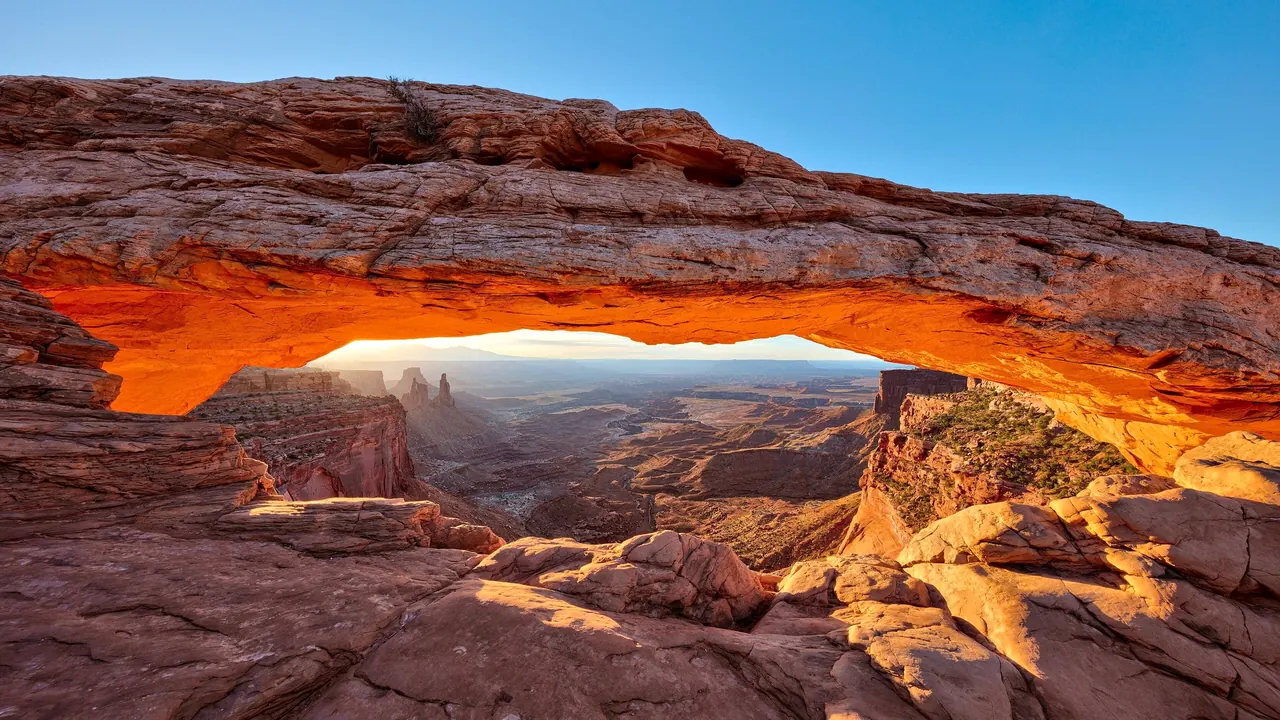
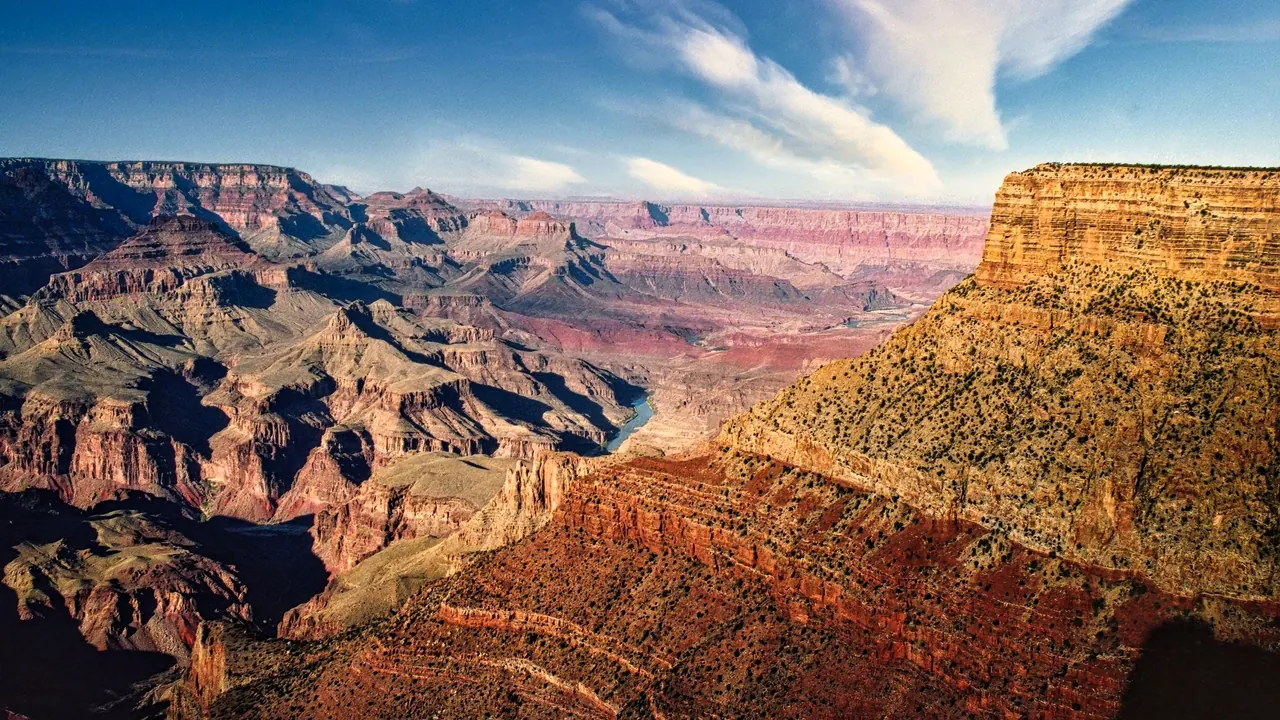
Photos: Canyonlands by Thomas Wolf, www.foto-tw.de, CC BY-SA 3.0, cropped; Grand Canyon by Tom Fisk, Pexels License.
Canyonlands or Grand Canyon?
Our verdict in twelve categories, each scored against the same fixed benchmark cities, and the climate month by month, so you can choose for your trip.
Choose Canyonlands for
- prices
- food and drink
Canyonlands is the pick for travellers who want to be busy outdoors from dawn onwards. Arches starts at the edge of Moab, and Island in the Sky, Dead Horse Point and the Needles are all within a drive. The region is built for doing things: slickrock mountain biking, rafting Cataract Canyon, climbing at Indian Creek and jeeping the White Rim. Expect a gear-shop town, early nights and very little to do away from the rock.
Choose Grand Canyon for
- day trips
- shopping
- culture and sights
The Grand Canyon is for people who want one overwhelming view and a little more around it. The South Rim has railway-era lodges, Mary Colter's watchtower and shuttle buses between the viewpoints. Flagstaff and Sedona add museums, Native American craft, pueblo ruins and spas, which makes it the easier choice for a mixed group or anyone who wants some days off the trail.
Scoreboard
Twelve categories on one fixed scale from 0 to 100. The shaded stretch is the gap between the two.
Your match
Pick a travel style or drag the sliders, and both match scores follow your weighting.
Wins on prices and food and drink with your weighting.
Wins on day trips and shopping with your weighting.
What matters to you?
Category by category
What the scores mean for a trip.
Beaches & swimming
Neither region is a swimming destination, but the Grand Canyon at least offers a real option. From Page on its eastern edge, Lake Powell warms to the mid-20s in summer and has sandy coves. There are also the turquoise pools below Havasu Falls, for those willing to hike in with a permit.
Around Moab, the Colorado and Green rivers are too cold, silty and fast for swimming. Cooling off there means a small hill reservoir, a quiet eddy or the motel pool. Lake Powell is a long drive away.
Food & drink
You will eat about as well in either region, which means fuel rather than a highlight. Moab is the one food town in Canyonlands, a trailhead place of burgers, Tex-Mex, taprooms, food trucks and pre-dawn breakfasts. Utah's liquor laws shape what you can drink.
The Grand Canyon splits its eating between historic lodge dining rooms on the rim, with El Tovar the grandest, and Flagstaff's old downtown. Flagstaff has breweries, green chile and Navajo frybread, but it is an hour and a half's drive from the rim.
Culture & sights
The Grand Canyon has more to see beyond the landscape. The South Rim has early twentieth-century buildings in log and stone, Mary Colter's Desert View Watchtower and the Tusayan pueblo ruin. Flagstaff adds a serious museum of Hopi, Navajo and Zuni art and the observatory where Pluto was found.
Canyonlands has almost no built heritage. Its culture is on the rock: Newspaper Rock, the panels on Potash Road and the Great Gallery in Horseshoe Canyon, one of the finest rock-art sites in North America. Reaching the Great Gallery takes a long dirt drive and a hike.
Nightlife
Both regions go to bed early, so the real difference is where any nightlife is found. In Moab it is in town, a few brewpubs full of rafting guides and bikers that can be lively on a spring weekend.
At the Grand Canyon, the rim has just a lodge lounge or two. Flagstaff has dive bars and student venues, but they are too far from the rim to combine with a sunrise start. In both regions, the best thing to do after dark is look at the stars.
Nature & outdoors
Both are among the great landscapes of the world, and they differ in shape and in how you use them. Canyonlands is many places in one: the arches outside Moab, the mesa-top overlooks of Island in the Sky, the spires of the Needles, the remote Maze and the alpine La Sals. Its playground is wide, for biking, climbing, canyoneering and four-wheel driving.
The Grand Canyon is one mile-deep gorge, read in layers of nearly two billion years of rock. It is explored on foot or by mule down Bright Angel and South Kaibab, or along the easy Rim Trail, with rafting and condors along the way. The cool, forested North Rim gives it a second, gentler side.
Day trips
The Grand Canyon offers more varied outings. Sedona's red rocks and galleries, hillside Jerome and the pueblos of Wupatki, Walnut Canyon and Montezuma Castle are all within a drive. So are Route 66 at Williams and Antelope Canyon near Page.
From Canyonlands, most excursions lead to more landscape. The handful of places worth visiting are small: Bluff's stone houses, the pottery museum at Blanding, the Hovenweep towers and the orchards of Palisade across the Colorado line.
Good for families
For families, the two regions come out about even, and both carry the same warnings about unfenced drops, summer heat and long drives. Canyonlands works better for younger children. They can manage the short walks to the arches, see dinosaur tracks near Moab and take gentle half-day floats on the Colorado.
The Grand Canyon suits school-age children who walk well. Its draws are the first look over the rim, ranger talks, the vintage train from Williams and a drive-through park with bears and bison. The altitude and steep trails make it harder with toddlers.
Getting around
You need a car in both regions, and the difference is what happens once you arrive. At the Grand Canyon, you can park and use free shuttles along the village and Hermit Road, or walk the Rim Trail between viewpoints. You can also arrive by the historic train. The North Rim, though, is a four-and-a-half-hour drive around the gorge.
In Canyonlands the driving never really stops, although the paved roads from Moab are short and easy, and a bike path runs to the Arches gate. For the Maze, Horseshoe Canyon or the White Rim, you need high clearance or a guide.
Shopping & style
In either region, Native American craft is the thing worth taking home, and the difference is how easy it is to find. In Canyonlands, the trading posts selling Navajo rugs, silver jewellery and pottery are around Bluff and Blanding, far south of Moab. Moab's Main Street is mostly bike and climbing gear, rock shops and T-shirts.
At the Grand Canyon, the same crafts are sold on the rim itself at Hopi House and at the old trading post in Cameron. Hopi kachina carvings add to the range, and staff can explain the makers and their styles. Flagstaff covers outdoor gear.
Affordability
Both are costly to stay in and cheap to explore, and the savings come in different ways. In Canyonlands, Moab's ordinary motels are overpriced in the main seasons, but public land around the parks allows free dispersed camping. Self-catering campers can see the best of the region for very little.
At the Grand Canyon, the rim lodges and Tusayan hotels are the expensive way to stay. Motels in Williams or Flagstaff and the park campgrounds cost much less, and the shuttles and ranger talks are included in the entry fee. The big costs are mule rides, helicopter flights and rafting trips.
Live music & performing arts
Both regions are quiet on stage, and each has a late-summer chamber music festival to plan around. Moab's festival is the more memorable setting, with concerts in sandstone grottoes reached by jet boat down the Colorado and on riverside ranches.
The Grand Canyon's festival plays on the South Rim. In the warm months, Native American dancers sometimes perform at Desert View, and Flagstaff's symphony and historic theatre fill in the rest of the year.
Wellness & relaxation
Neither region has hot springs or a bathing tradition, so rest here mostly means quiet. In Canyonlands, the quiet comes at either end of an active day: sunrise from a canyon rim, a desert silence that few places can match and night skies dark enough to show the Milky Way. Its few day spas and riverside lodges are there for tired legs, not for retreats.
The Grand Canyon gives stillness more room. You can sit at a quiet viewpoint at dawn, spend slow days among the aspen and spruce of the North Rim and watch some of the darkest skies in the country, all of which makes for a gentler stay. Anyone who wants treatments can reach Sedona's within a day.
When should you go?
Pick your month. The climate figures are measured averages, not a forecast.
Canyonlands in July
Grand Canyon in July
Daytime high, °C
Rainfall in the month, mm
Where the figures come from
Canyonlands has no weather station within reach, so its figures come from a gridded climate model rather than a measured record, and read a broad area rather than one spot.
Temperature and rainfall are climate normals, averaged over the years shown. Canyonlands: 2001-2020 normals, NASA POWER reanalysis grid, no weather station within 90 km. Grand Canyon: 1991-2020 normals, Grand Canyon Park (1 km from centre).
Both regions follow the same desert calendar, and spring and autumn are the times to go. Around Moab, April and October reach about 19°C, which is ideal for hiking and biking. May and September are warmer but still fine with an early start. From June to August the days reach the low to mid 30s, peaking at 36°C in July, which is too hot for midday on the slickrock. Winter days are cold, only a few degrees above freezing. Rain is light all year and a little heavier from late summer into autumn.
The Grand Canyon figures run about two degrees warmer through spring, autumn and winter. Good walking weather there starts a little earlier in spring and lasts a little later into autumn, while high summer is just as hot in both regions. Late spring is noticeably drier at the Grand Canyon: June has barely any rain, about 3mm against 10mm around Moab. Late-summer storms reach both. The North Rim opens only from mid-May to mid-October, so a cooler visit among its forests has to fall within that window.
Which traveller are you?
On a culture and arts trip, the Grand Canyon is the better choice. Grand Canyon Village has its historic rim buildings and Hopi House, Desert View Watchtower has Hopi murals inside, and Flagstaff adds the Museum of Northern Arizona and Lowell Observatory. Canyonlands offers superb rock art, but little else.
For a relaxing and wellness trip, lean towards the Grand Canyon. The canyon itself has only stillness and dark skies to offer, but Sedona, a couple of hours south, has a whole town of spas, retreats and yoga. Canyonlands has a handful of massage studios for sore cyclists.
For mountain bikers, Canyonlands is the clear choice. Moab's slickrock trails are world-famous, the White Rim Road makes a classic multi-day ride, and the town's shops supply and repair bikes. At the Grand Canyon, the trails are made for walking and mules, not wheels.
Before you go
| Measure | Canyonlands | Grand Canyon |
|---|---|---|
| Currency | US Dollar (USD) | US Dollar (USD) |
| Sockets | AB120 V, 60 Hz | AB120 V, 60 Hz |
| Driving side | Right | Right |
| Time zone | UTC-7, UTC-6 in summer | UTC-7 |
| Emergency number | 911 | 911 |
| Main airport | Canyonlands Regional Airport (CNY)2 non-stop destinations | Phoenix Sky Harbor International Airport (PHX)149 non-stop destinations |
| Public holidays this year | 12 days | 12 days |
Where else could you go?
Every comparison below shares a destination with this one, so you can follow Canyonlands or Grand Canyon somewhere new.
- Archesvs Canyonlands
- Sedonavs Grand Canyon
- Zionvs Grand Canyon
- Bryce Canyonvs Grand Canyon
- Bryce Canyonvs Canyonlands
- Zionvs Canyonlands