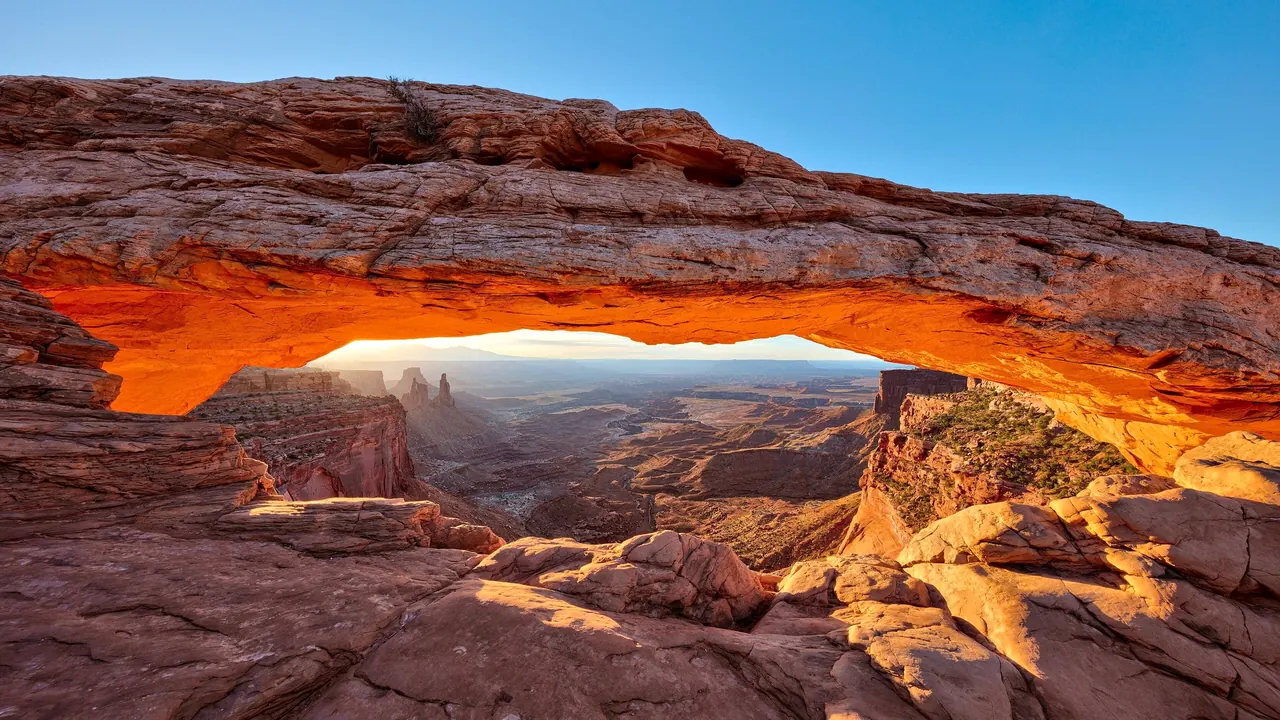
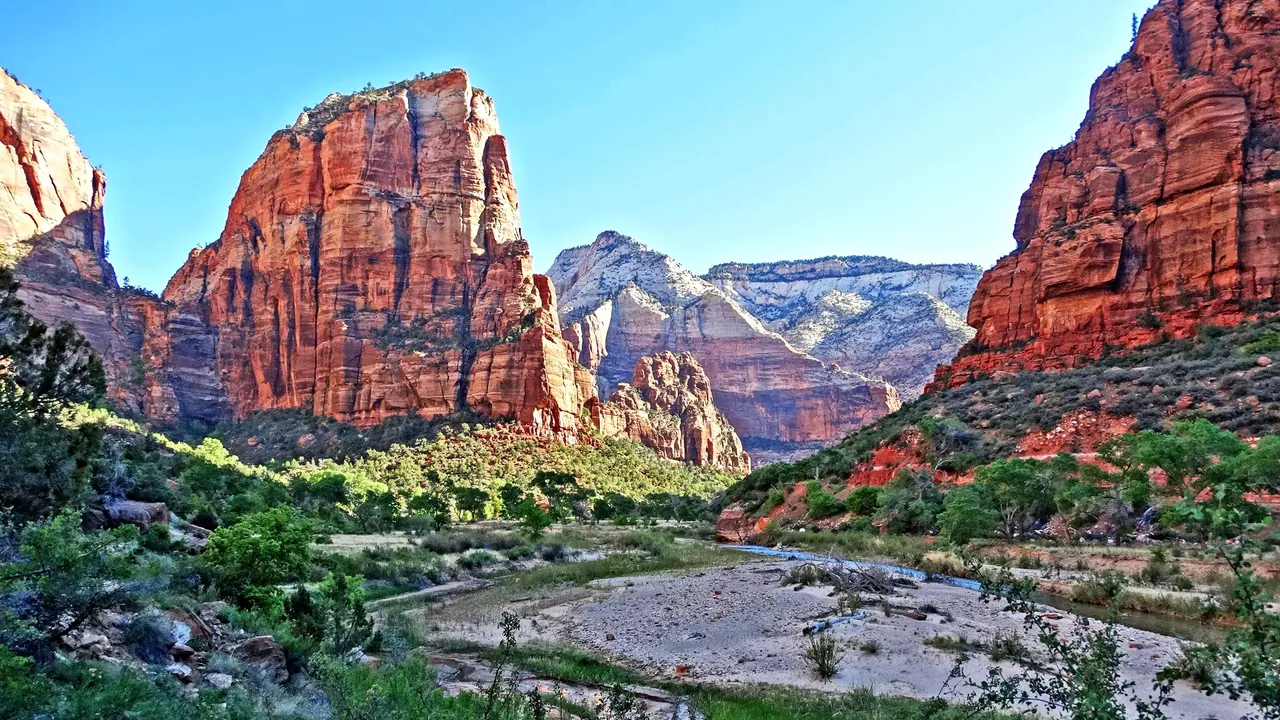
Photos: Canyonlands by Thomas Wolf, www.foto-tw.de, CC BY-SA 3.0, cropped; Zion by inkknife_2000 (7.5 million views +), CC BY-SA 2.0, cropped.
Canyonlands or Zion?
Our verdict in twelve categories, each scored against the same fixed benchmark cities, and the climate month by month, so you can choose for your trip.
Choose Canyonlands for
- culture and sights
- nightlife
- day trips
Canyonlands suits the traveller who wants room to move and a range of ways to use it. From a base in Moab you get Arches on the doorstep, the mesa-top overlooks of Island in the Sky, the spires of the Needles and the empty Maze, and the region rewards anyone who rides slickrock on a mountain bike, runs a river canyon on a raft or drives a four-wheel-drive track. It is a trip for people who are happy to spend hours in the car and keep their evenings simple, with a campsite and the stars to end the day.
Choose Zion for
- live music and the arts
- wellness
- beaches
Zion puts its drama into one tight canyon, and that makes it the easier trip. A free shuttle runs up the scenic drive past every trailhead, the classic hikes from the Narrows to Angels Landing start a few minutes apart, and the gentler walks work well for families. Beyond the park, the region also has more for the hours away from the trail: a warm reservoir to swim in, spa resorts near St. George, and summer theatre in Cedar City and at Tuacahn. Choose it if you want a smoother stay and don't mind sharing the trails with more people.
Scoreboard
Twelve categories on one fixed scale from 0 to 100. The shaded stretch is the gap between the two.
Your match
Pick a travel style or drag the sliders, and both match scores follow your weighting.
Wins on culture and sights and nightlife with your weighting.
Wins on live music and the arts and wellness with your weighting.
What matters to you?
Category by category
What the scores mean for a trip.
Beaches & swimming
Neither region is a swimming destination, but Zion at least has somewhere to swim. Sand Hollow, half an hour away near Hurricane, has red-sand shores and water that is warm through the summer months. Canyonlands has only a small reservoir in the hills above Moab and a few calm river eddies. Its silty, fast rivers are for rafting, not swimming, so on a hot afternoon most visitors end up in the motel pool.
Food & drink
The food is much the same in both: burgers, pizza, Southwestern plates and early breakfasts for people heading to the trailhead, all under Utah's strict liquor rules. Moab has a little more character, with craft-beer taprooms and food trucks. Springdale has one or two more ambitious dining rooms with canyon views, while nearby St. George mostly offers chains. In both regions many visitors cook for themselves.
Culture & sights
There is little human heritage to see in either, and what there is differs in kind. In Canyonlands it is painted and carved on the rock: Newspaper Rock, the panels along Potash Road and, above all, the life-size figures of the Great Gallery in Horseshoe Canyon, which you reach only by a long dirt drive and a hike.
Zion's heritage is more about pioneers and engineering. It includes the Human History Museum, the 1930 tunnel cut through the cliff, the adobe ghost town of Grafton and the Mormon temple and tabernacle in St. George. Zion's sights are easier to reach, while Canyonlands offers the more remarkable single experience.
Nightlife
There is no real nightlife in either region. Moab's bars and brewpubs fill with rafting guides and mountain bikers and can be lively on a spring weekend, which is a little more than Springdale's couple of patios offer. In both places the early starts end the night soon after dinner, and the best thing to do after dark is to look at the stars.
Nature & outdoors
Both are world-class desert landscapes, but they work in different ways. Canyonlands is vast and spread out. It covers Arches, the overlooks of Island in the Sky and Dead Horse Point, the Needles and the remote Maze, plus the alpine La Sal Mountains, and its range of activities is wider: slickrock biking, whitewater rafting, climbing at Indian Creek and the White Rim Road.
Zion is concentrated in a single canyon with walls up to 600m high, and its fame rests on walking. You can wade the Narrows, climb the chains to Angels Landing or explore slot canyons on a canyoneering trip. Kolob Canyons offers emptier country, and Bryce lies about two hours away.
Day trips
In both regions, a day out usually means more scenery rather than another town. From Canyonlands, the trips with the most historical interest head south: Bluff's pioneer stone houses, the Puebloan pottery at Edge of the Cedars in Blanding and the Hovenweep towers. Grand Junction and the Palisade orchards make an easy outing across the Colorado line.
Zion's outings are more about the Mormon and Wild West past. Kanab has its film-set heritage, Pipe Spring is a preserved ranch fort, and St. George and Cedar City have pioneer and frontier museums. Las Vegas is about two and a half hours away, too far for a comfortable day trip.
Good for families
Zion is the easier of the two with children. The shuttle, the cycle path along the Pa'rus Trail and the paddling spot at the end of the Riverside Walk make a day in the canyon simple to manage. The reservoirs near Hurricane give families a place to swim.
Canyonlands has real highlights for children too: the short walks to Sand Dune Arch and Double Arch, dinosaur tracks near Moab and calm float trips on the Colorado. But the distances between sights mean long hours in the car, and many of the overlooks have sheer drops with no fences.
Getting around
Zion is the easier region to get around. In the busy months a free shuttle runs the length of the main canyon, and another connects Springdale's hotels to the park gate, so you can leave the car parked for days. You only need to drive for Kolob Canyons, the east side or Bryce.
In Canyonlands you need a car the whole time. The paved roads are good and Arches starts just outside Moab, but the Needles is an hour and a half away. The Maze, Horseshoe Canyon and the White Rim need a high-clearance vehicle or a guided tour, and in the busy seasons long queues of cars build up at the Arches gate.
Shopping & style
Neither region is a place to shop, and both offer much the same practical outfitters and souvenir shops. What differs is the best thing to take home. Around Canyonlands it comes from the trading posts near Bluff and Blanding, which sell Navajo rugs and silver. In Zion it means the landscape photography and Native American jewellery sold in Springdale's galleries, and St. George adds ordinary malls and outlet stores.
Affordability
Zion is the cheaper trip if you are not camping, because the towns of Hurricane and St. George offer cheaper motels and supermarkets within an hour of the park. Once you are there, the free shuttles and the hiking cost nothing.
Moab has no such fallback. In season its plain motels charge more than they are worth, and guided rafting and jeep trips add up quickly. The way to save in Canyonlands is to camp: the public land around the parks has plenty of campgrounds and free dispersed camping.
Live music & performing arts
Zion is clearly ahead for live performance. In summer, Tuacahn stages full Broadway musicals in an open-air amphitheatre against red cliffs, and the Utah Shakespeare Festival in Cedar City runs a respected repertory season into autumn. Both make a good evening after a day on the trails.
Canyonlands has one event, but a distinctive one. The Moab Music Festival, held from late summer into early autumn, takes chamber music into sandstone grottoes reached by jet boat. Outside the festival there is little to see on stage.
Wellness & relaxation
Zion offers far more for a restful stay. The destination spa resorts around Ivins combine treatments, yoga and guided hikes among the red rock, and several Springdale lodges have spas and pools facing the canyon walls. Canyonlands has only a few day spas in Moab, aimed at sore cyclists and hikers. Its own kind of rest is the silence at sunrise on a canyon rim, which is easier to find there than in Zion's crowded main canyon.
When should you go?
Pick your month. The climate figures are measured averages, not a forecast.
Canyonlands in July
Zion in July
Daytime high, °C
Rainfall in the month, mm
Where the figures come from
Canyonlands has no weather station within reach, so its figures come from a gridded climate model rather than a measured record, and read a broad area rather than one spot.
Zion's temperatures are measured 26 km from the centre, at Colorado City / Centennial Park.
Zion's station stands 298 m above the place it is measured for, so that place is likely a little warmer than the figures say.
Zion has no rain gauge within 25 km of the centre, so its rainfall comes from a gridded climate dataset read at the destination rather than from a gauge further away.
Temperature and rainfall are climate normals, averaged over the years shown. Canyonlands: 2001-2020 normals, NASA POWER reanalysis grid, no weather station within 90 km. Zion: 2014-2025 (rainfall 1991-2020) normals, Colorado City / Centennial Park (25.5 km from centre).
Both regions are at their best in spring and autumn, and both are too hot for daytime hiking in midsummer, when July reaches about 36°C in each and people walk at dawn. Around Moab the comfortable seasons are April to May and September to October. Winters there are cold, with January highs near 5°C, but they stay dry. Late summer and early autumn bring a little more rain to Canyonlands, mostly in short storms.
Zion is warmer at both ends of the year, with January highs around 10°C and October still pleasant at about 24°C, so its walking season runs from March into November. In return its winters are much wetter than Canyonlands', with up to 44mm in February, and the canyon can see snow. Summer storms over Zion matter more, because they can send flash floods down the Narrows. In the heat of June to September, the reservoirs near Hurricane are warm enough for a proper swim.
Which traveller are you?
On a family trip with children, Canyonlands is the harder one to manage, with long hours in the car between sights and cliff edges that need constant watching. It suits older children. Zion keeps most of a family's day inside one canyon, so outings stay short and the hard routes are easy to skip.
For a relaxing and wellness trip, Canyonlands offers deep silence, but its days revolve around physical effort and there is little laid on for rest. In Zion you can book a proper spa stay outside the park, with treatments and gentle activity arranged, and go into the canyon when you want to.
For mountain bikers and river runners, Canyonlands is the obvious choice. Moab is one of the world's great riding towns, and its rivers carry multi-day trips through deep canyons. Zion's one cold, narrow river is for wading, and its trails are built for people on foot.
Before you go
| Measure | Canyonlands | Zion |
|---|---|---|
| Currency | US Dollar (USD) | US Dollar (USD) |
| Sockets | AB120 V, 60 Hz | AB120 V, 60 Hz |
| Driving side | Right | Right |
| Time zone | UTC-7, UTC-6 in summer | UTC-7, UTC-6 in summer |
| Emergency number | 911 | 911 |
| Main airport | Canyonlands Regional Airport (CNY)2 non-stop destinations | Harry Reid International Airport (LAS)160 non-stop destinations |
| Public holidays this year | 12 days | 12 days |
Where else could you go?
Every comparison below shares a destination with this one, so you can follow Canyonlands or Zion somewhere new.
- Archesvs Canyonlands
- Bryce Canyonvs Zion
- Grand Canyonvs Zion
- Bryce Canyonvs Canyonlands
- Archesvs Zion
- Grand Canyonvs Canyonlands