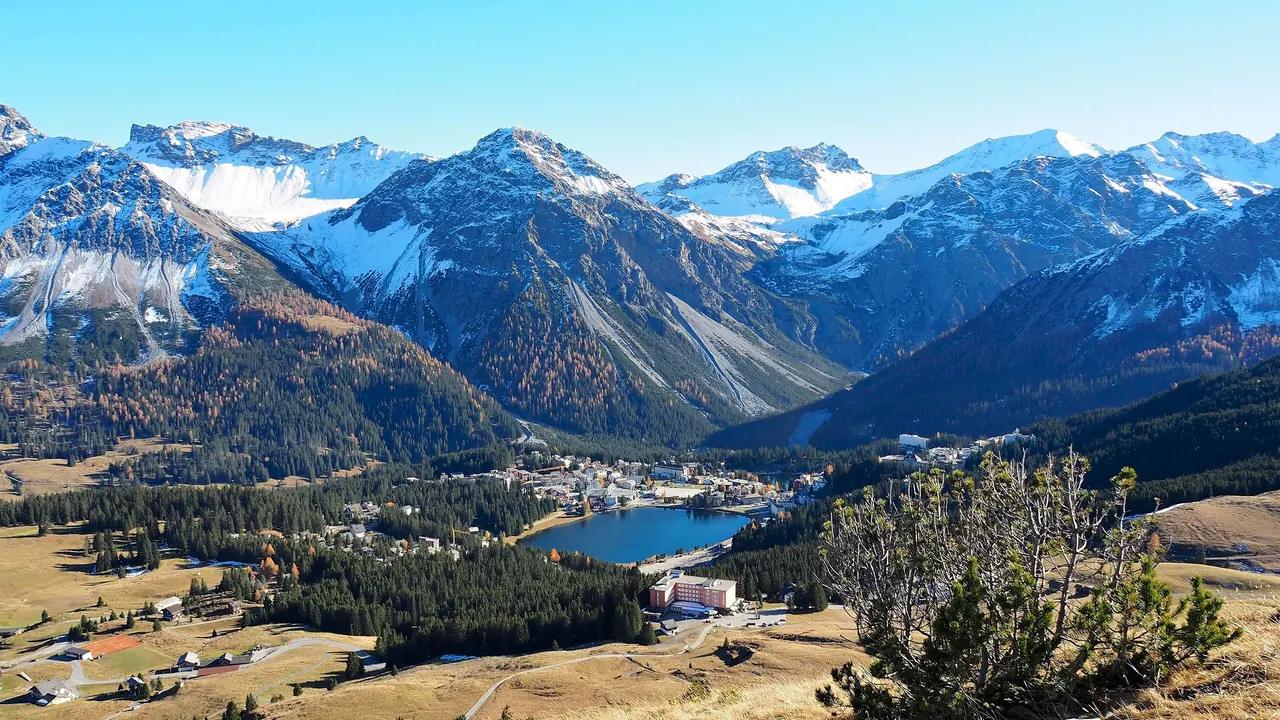
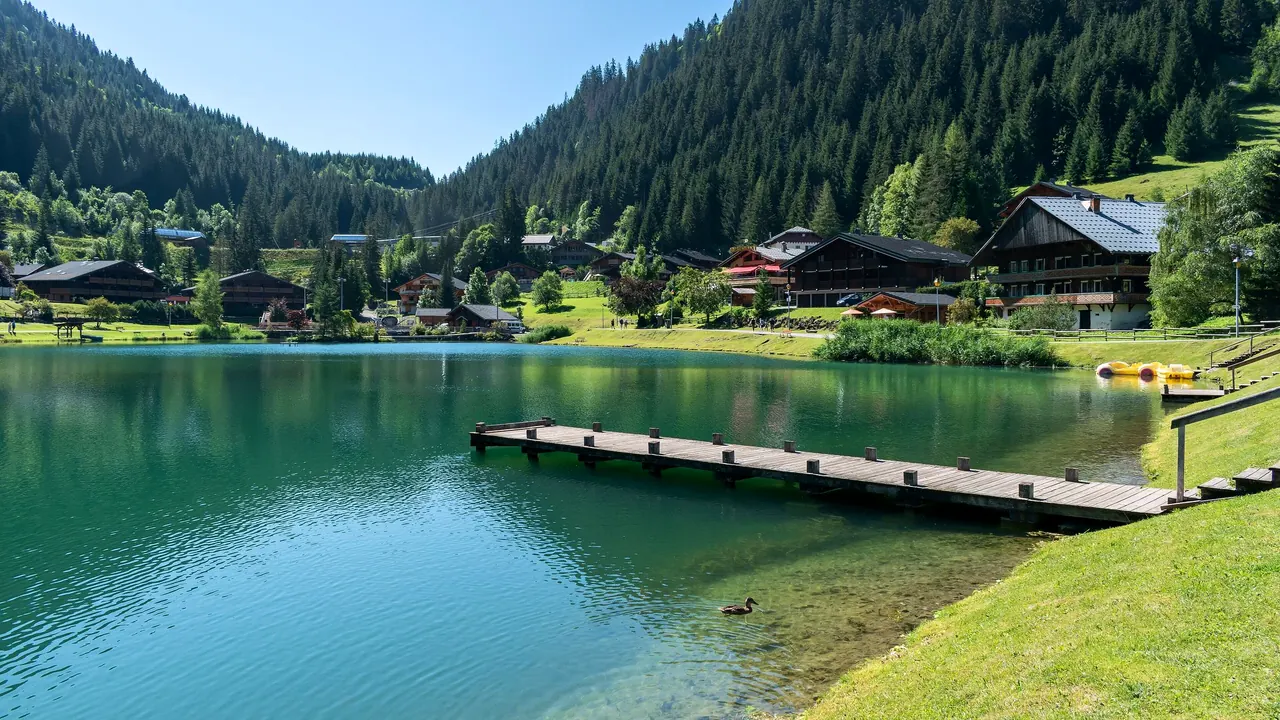
Photos: Arosa by Andres Passwirth, CC BY-SA 4.0, cropped; Châtel by Krzysztof Golik, CC BY-SA 4.0, cropped.
Arosa or Châtel?
Our verdict in twelve categories, each scored against the same fixed benchmark cities, and the climate month by month, so you can choose for your trip.
Choose Arosa for
- getting around
- live music and the arts
- wellness
Arosa suits travellers who want a calm, polished mountain stay without a car. The train climbs right into the village, and free buses and lifts do the rest. The hotel spas, the December comedy festival and the summer chamber concerts give it a more refined rhythm. It is for people whose budget can absorb Swiss resort prices.
Choose Châtel for
- prices
- day trips
- families
For families, skiers watching their budget and anyone happy to drive, Châtel is the better pick. It costs far less and keeps children busier. It also opens onto the vast Portes du Soleil and puts Lake Geneva, its old towns and the ferry to Lausanne within reach for days off the mountain.
Scoreboard
Twelve categories on one fixed scale from 0 to 100. The shaded stretch is the gap between the two.
Your match
Pick a travel style or drag the sliders, and both match scores follow your weighting.
Too close to call, level with your weighting
Wins on getting around and live music and the arts with your weighting.
Wins on prices and day trips with your weighting.
What matters to you?
Category by category
What the scores mean for a trip.
Beaches & swimming
Neither village is a swimming destination, so the difference is in where you get wet. Arosa's water is in the village itself: the Untersee lido with its lawn and jetty, and colder dips in the Obersee and Schwellisee for a few weeks in high summer.
Châtel's Lac de Vonnes is for paddleboards rather than bathing. Swimming there means the aquatic centre's indoor and outdoor pools, or a drive of under an hour to the pebbly lidos and grassy shores of Lake Geneva, which gets a little warmer than Arosa's alpine lakes.
Food & drink
Both kitchens run on melted cheese and mountain comfort food, and both thin out when the seasons end. Arosa cooks the food of Graubünden: capuns, barley soup and air-dried meat on hut terraces, with a small fine-dining tier in the luxury hotels for a special evening.
Châtel cooks Savoyard, with tartiflette and croziflette alongside the fondue. What it adds is local cheese: this is the home of Abondance cheese, which you can buy straight from the farms and dairies around the village.
Culture & sights
Arosa's past is that of a health resort, while Châtel's is that of a border village, and each takes an afternoon at most. In Arosa you have the shingled Bergkirchli standing alone on its meadow, the valley museum's account of farmers and sanatorium days, and the grand old hotels left from that era.
Châtel tells its story at La Vieille Douane, the old customs post, through the officers stationed there and the smugglers who carried salt and cheese over the passes. Around the parish church, old farmhouses with deep overhanging roofs still stand.
Nightlife
In both villages evenings end early, built around après-ski and quiet outside winter. Arosa's nights out are smarter, with hotel bars and a couple of small weekend clubs, and its liveliest week is the long-running gay ski week in January.
Châtel stays more casual and family-minded, with a few pubs open late in the season. Anyone wanting a bigger night has to head to the party resorts elsewhere in the Portes du Soleil.
Nature & outdoors
Both are first-rate mountain bases, and the choice comes down to what you want to do there. Arosa sits higher, at 1,800m, so its snow is reliable, and its lifts link to Lenzerheide. Its summer draws are lake circuits, high routes over the passes toward Davos, marmots and the bear sanctuary.
Châtel, lower at about 1,200m, is part of the far larger Portes du Soleil, with ski days that cross into Switzerland. In summer it is the stronger pick for downhill and enduro riders, with its bike park and long linked trails, plus paragliding and climbing.
Day trips
Châtel has much more to offer beyond the village, provided you drive. The cloister of Abondance Abbey is close by, and Évian, Thonon and medieval Yvoire sit on Lake Geneva. The ferry crosses to Lausanne, and Montreux and the Château de Chillon lie over the pass.
Arosa's outings all start with the hour-long rail line down to Chur, a scenic ride in itself. Chur's old town and cathedral make a fine day out, but Maienfeld, Vaduz or the Albula line toward St. Moritz take two hours or more, so the choice runs out quickly. On the other hand, none of it needs a car.
Good for families
Both suit children, but Châtel is the more complete family resort. Beyond the ski schools and sledging it has a long zip line over the valley, an aquatic centre, pony rides, paddleboarding and easy bike trails, and its lifts let mixed-ability families ski together.
Arosa covers the basics well, with gentle children's areas, lakes, walks to farm restaurants and the bears, and the free buses and light traffic make it easy with children. Rainy days are harder to fill, though, and meals out cost a family more.
Getting around
Arosa is the clear choice without a car. The Rhaetian Railway climbs up from Chur, free buses link the station, the lake and the lift stations, and cable cars do the rest. On foot, the hillside village means plenty of slopes and stairs.
Châtel is strung out along the valley road and has no railway. Its compact centre is easy to walk and seasonal shuttles reach the lifts, but anything further is a job for a car, and the drive up can need chains in winter.
Shopping & style
The real difference is what goes home in your suitcase, since both main streets sell mostly ski gear, rentals and souvenirs. From Arosa that means Swiss chocolate or something from the boutiques that serve hotel guests. For a wider choice, the nearest place is Chur's old town, an hour down the line.
Châtel's best buys are edible: Abondance cheese, Savoyard sausage, honey and liqueurs from the farms and dairies around the village. For anything beyond that, go to the lake towns or Geneva.
Affordability
Châtel is much easier on the wallet. It is a village resort rather than a glitzy one, with self-catering chalets and apartments, supermarkets and farm shops, and summer passes that bundle lifts and attractions. The ski weeks during school vacations still add up.
Arosa is very expensive at any time of year, with upscale hotels, Swiss prices for lift passes and rental, and costly meals out. The guest card and free buses help, and summer is cheaper, but a self-catered apartment is the only real way to keep costs down.
Live music & performing arts
Arosa has the more interesting calendar for a village of its size. A long-established comedy festival fills December, with some stages out in the snow, and summer brings chamber concerts to its churches, the Bergkirchli among them.
Châtel has après-ski bands, the odd summer concert and folk celebrations such as the cows' return from the high pastures. For a proper concert you drive down to the lake or to Montreux.
Wellness & relaxation
Arosa was built on rest. Its larger hotels have extensive spas with pools and saunas facing the peaks, the village has a public indoor pool, and outside the busiest weeks its days are slow and its nights early.
Châtel's spas in the chalet hotels and the wellness area at the aquatic centre are smaller affairs, and its calm is the calm of the pastures, with cowbells and long evenings. For real thermal bathing you drive down to the old baths at Évian or Thonon.
When should you go?
Pick your month. The climate figures are measured averages, not a forecast.
Arosa in July
Châtel in July
Daytime high, °C
Rainfall in the month, mm
Where the figures come from
Arosa's temperatures are measured 31 km from the centre, at Samedan.
Arosa has no rain gauge within 25 km of the centre, so its rainfall comes from a gridded climate dataset read at the destination rather than from a gauge further away.
Châtel's temperatures are measured 72 km from the centre, at Bourg-St-Maurice.
Châtel's station stands 188 m below the city centre, so the centre is likely a little cooler than the figures say.
Châtel has no rain gauge within 25 km of the centre, so its rainfall comes from a gridded climate dataset read at the destination rather than from a gauge further away.
Temperature and rainfall are climate normals, averaged over the years shown. Arosa: 2015-2025 (rainfall 1991-2020) normals, Samedan (31.2 km from centre). Châtel: 1999-2020 (rainfall 1991-2020) normals, Bourg-St-Maurice (72.3 km from centre).
Arosa is the colder of the two all year. Daytime highs hover around freezing from December to February, which keeps the snow reliable, and only July and August, at about 20°C, are warm enough for a dip in the lakes. Most of its rain falls in summer, with June to August the wettest stretch, so summer hikers should pack waterproofs. Late winter is its driest time, which suits skiers.
Châtel is warmer, with winter highs of about 5°C and a July peak of 27°C. That makes June to August warm enough for the outdoor pools and an afternoon on Lake Geneva. Its rain is spread more evenly through the year but is heaviest in winter, with December the wettest month at 167mm. September is its driest month and still mild at 22°C, which makes it the most comfortable time for walking.
Which traveller are you?
On a trip on a tight budget, Châtel wins easily. It is a French village resort rather than a Swiss one, so a stay costs far less. Arosa stays expensive even in its cheapest season, and every meal and outing there comes at Swiss prices.
On a family trip with children, Châtel is the safer bet. It has built itself around families for a long time, so the days fill easily in both seasons. Its lower costs also count for more when there are several people to feed. In Arosa, wet days drag.
For a relaxing and wellness trip, Arosa is the better fit. You arrive by train, never need a car, and spend your days between a hotel spa and a sun terrace. In Châtel the best bathing means a drive down to the lake.
Before you go
| Measure | Arosa | Châtel |
|---|---|---|
| Official language | French, German, Italian, Romansh | French |
| Currency | Swiss Franc (CHF) | Euro (EUR) |
| Sockets | CJ230 V, 50 Hz | CE230 V, 50 Hz |
| Driving side | Right | Right |
| Time zone | UTC+1, UTC+2 in summer | UTC+1, UTC+2 in summer |
| Emergency number | 112 | 112 |
| Elevation | 1,775 m | 1,053 m |
| Main airport | Zürich Airport (ZRH)114 km from centre226 non-stop destinations | Geneva International Airport (GVA)56 km from centre150 non-stop destinations |
| Public holidays this year | 9 days | 11 days |
By the numbers
| Measure | Arosa | Châtel |
|---|---|---|
| Population | 3,185 | 1,174 |
| People per km² | 21 | 36 |
| Museums within 10 km | 1 | 0 |
| UNESCO World Heritage sites within 50 km | 2 | 3 |
Where else could you go?
Every comparison below shares a destination with this one, so you can follow Arosa or Châtel somewhere new.