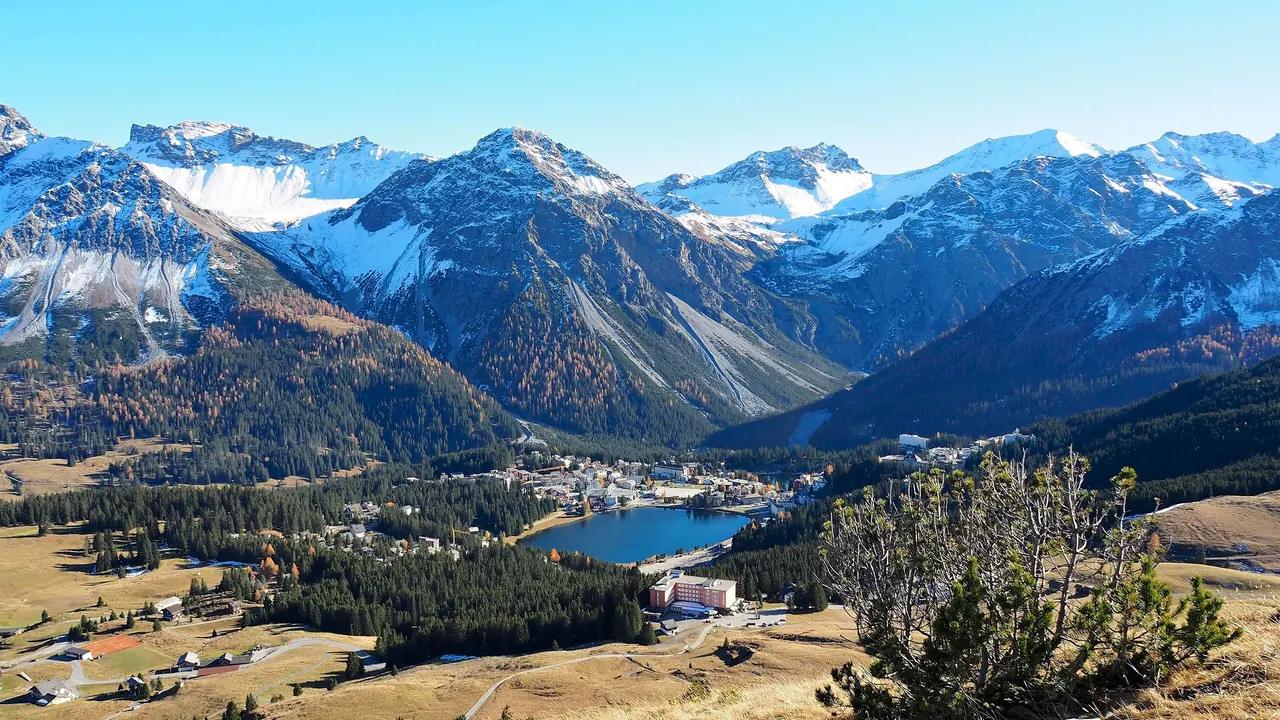
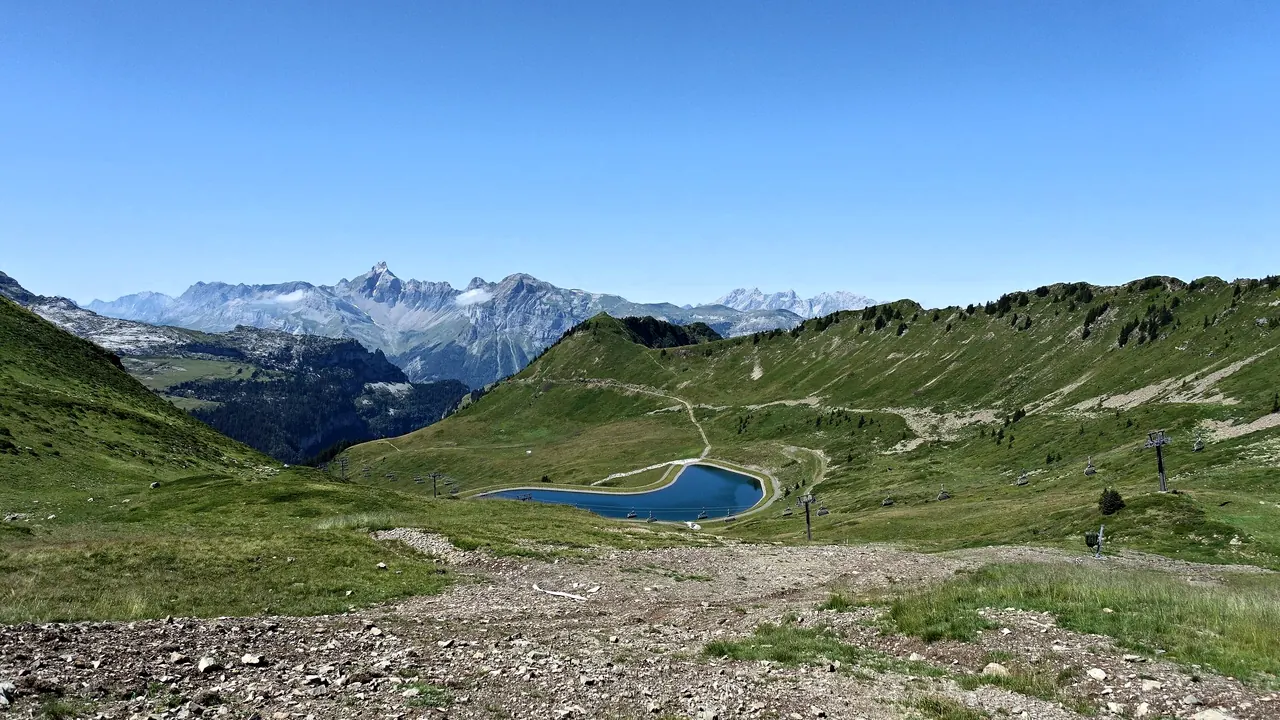
Photos: Arosa by Andres Passwirth, CC BY-SA 4.0, cropped; Flaine by Guilhem Vellut, CC BY 2.0, cropped.
Arosa or Flaine?
Our verdict in twelve categories, each scored against the same fixed benchmark cities, and the climate month by month, so you can choose for your trip.
Choose Arosa for
- wellness
- getting around
- live music and the arts
Arosa suits travellers who want a calm, polished Swiss mountain stay without a car. The train climbs up from Chur, free buses and lifts handle everything once you arrive, and the hotel spas, lakeside walks and slow pace go back to the village's history as a place to recover. It also works in summer as well as winter, with lake swims, a December comedy festival and summer chamber concerts. Choose it if comfort matters more than cost.
Choose Flaine for
- prices
- day trips
- culture and sights
Flaine is the better pick for a ski week where the budget counts. Its self-catering apartments sit right on the snow in a car-free modernist resort, and the Grand Massif gives skiers a huge linked area with Mont Blanc on the horizon. With a car, Annecy, Geneva and Chamonix are all within a day's reach. Evenings are quieter and pampering is limited, but it costs noticeably less.
Scoreboard
Twelve categories on one fixed scale from 0 to 100. The shaded stretch is the gap between the two.
Your match
Pick a travel style or drag the sliders, and both match scores follow your weighting.
Wins on wellness and getting around with your weighting.
Wins on prices and day trips with your weighting.
What matters to you?
Category by category
What the scores mean for a trip.
Beaches & swimming
Neither resort is a place for swimming, but Arosa at least has water you can get into. The lido on the Untersee, with its lawn and jetty, and the colder Obersee and Schwellisee higher up give a few weeks of bracing lake swims in July and August.
Flaine's little lake is for walks and picnics, not bathing. A swim there means a residence pool or a day's drive down to Lake Annecy or Lake Geneva.
Food & drink
Both run on Alpine comfort food, and Arosa offers a little more choice. Its huts serve Graubünden dishes such as capuns, barley soup and air-dried meat on terraces above the valley, and the luxury hotels add a small fine-dining tier for a special evening.
Flaine's cooking is Savoyard: tartiflette, croziflette, Reblochon and Abondance. Because most guests stay in apartments, a lot of the eating happens at home with shopping from the resort's cheese counters. In both places much of the choice closes outside the main seasons.
Culture & sights
For anyone interested in architecture and art, Flaine has more to see. Arosa's sights are older and fewer: the shingled late-15th-century Bergkirchli standing alone on its meadow above Innerarosa, the Schanfigg valley museum, and a few grand hotels left from the years when the sanatoriums were here.
In Flaine the resort is the attraction. Marcel Breuer designed it in the 1960s as one modernist whole, with a building cantilevered out over the cliff, and you can walk between monumental works by Picasso, Dubuffet and Vasarely. An hour or two covers it, but design lovers will find it more rewarding than anything in Arosa.
Nightlife
After dark Arosa runs on après-ski in the slope-side bars, then hotel bars and a couple of small clubs that stay open late at weekends. The January gay ski week brings its liveliest nights. The mood is smart rather than wild, and in summer the village goes to bed early.
Flaine is quieter still. A few bars around the Forum fill up when the lifts close, one or two keep a weekend DJ going later, and the crowd of families and committed skiers is mostly home soon after dinner.
Nature & outdoors
Both are first-class mountain bases, and the difference lies in the kind of terrain. Flaine's north-facing limestone bowl opens onto the Grand Massif, with long runs down to Samoëns and Sixt, views of Mont Blanc and good off-piste and touring. In summer the fissured karst of the Désert de Platé, via ferratas and paragliding take over, but the lifts run for only a short season.
Arosa is softer and greener: a basin of larches and lakes under the Weisshorn, linked to Lenzerheide for skiing. In summer there are high routes over the passes to Davos, marmots on the meadows and the bear sanctuary, so it suits a summer stay rather better.
Day trips
Flaine is the better base for day trips, as long as you have a car. Annecy's canals, Geneva and Chamonix are each a drive of about an hour or so after the winding road down. Samoëns and the lakeside village of Yvoire are within reach as well.
From Arosa every outing starts with the scenic train ride down to Chur, which makes a fine day out in itself. Beyond Chur, though, Maienfeld, Vaduz and the Albula line take two hours or more each way.
Good for families
Both work equally well for a mountain vacation with children, but in different seasons. Flaine is made for the ski week: there are no cars in the centre, and the nursery slopes and snow gardens sit right outside the apartments. In summer it has much less to offer.
Arosa keeps children busy in both seasons, with lake days, the bear sanctuary and cable cars to the viewpoints in summer, and free buses for tired legs. Neither has zoos or children's museums, and in both a run of rainy days is hard to fill.
Getting around
Arosa is the easier place to manage without a car. The Rhaetian Railway brings you up from Chur, and free buses link the station, the lake and the lifts. The only drawback is a village of slopes and stairs.
Flaine is just as simple once you arrive, being compact and car-free with much of the accommodation ski-in ski-out. Getting there is harder: the nearest station is down at Cluses, and you either drive the long mountain road or book a transfer from Geneva.
Shopping & style
Neither is a place to shop, and both send you down the valley for any real range. Arosa's main street adds a few boutiques for hotel guests and Swiss chocolate to the ski shops, with Chur's old town an hour away by train. In Flaine the best take-home is a Savoyard cheese or a local wine, and serious shopping means Annecy or Geneva.
Affordability
Flaine is much the cheaper of the two. Its apartments are modest by the standards of upmarket French resorts, cooking for yourself keeps the bills down, and outside the French school vacation weeks prices drop noticeably. The lift pass and ski hire remain the main expenses.
Arosa charges Swiss mountain prices for its upscale hotels, meals, passes and rental. Summer is noticeably cheaper than the ski season, and a vacation apartment where you cook for yourself helps a good deal more, but even then Arosa is never a budget trip.
Live music & performing arts
Arosa has a small but real calendar, which Flaine lacks almost entirely. Its long-established December comedy festival puts stand-up and cabaret on stages around the village, some of them outdoors in the snow. Summer chamber concerts fill the churches, including the Bergkirchli.
In Flaine live performance comes down to the odd show and some après-ski music. An evening of theatre or concerts means a trip to Annecy or Geneva.
Wellness & relaxation
Arosa is the better place to rest. It began as a health resort for its dry, sunny air, and that unhurried pace has lasted. Some of its large hotel spas are extensive, with pools and saunas facing the peaks, and the village also has a public indoor pool.
Flaine's saunas and pools in the residences are welcome after skiing but not a reason to come. Its calm comes from having no cars and quiet evenings, and a proper thermal bath means driving down to the Chablais spa towns.
When should you go?
Pick your month. The climate figures are measured averages, not a forecast.
Arosa in July
Flaine in July
Daytime high, °C
Rainfall in the month, mm
Where the figures come from
Arosa's temperatures are measured 31 km from the centre, at Samedan.
Arosa has no rain gauge within 25 km of the centre, so its rainfall comes from a gridded climate dataset read at the destination rather than from a gauge further away.
Flaine has no weather station within reach, so its figures come from a gridded climate model rather than a measured record, and read a broad area rather than one spot.
Temperature and rainfall are climate normals, averaged over the years shown. Arosa: 2015-2025 (rainfall 1991-2020) normals, Samedan (31.2 km from centre). Flaine: 2001-2020 normals, NASA POWER reanalysis grid, no weather station within 90 km.
Both resorts are at their best in two seasons, deep winter for snow and high summer for walking. Flaine is the colder of the two in winter, with daytime highs below freezing from December to February, while Arosa climbs a few degrees above zero by February and March. Arosa's winters are also the drier ones. Its wettest months come in summer, at around 150mm a month from June to August, so afternoon showers are part of a hiking day there. Flaine has no real dry season, and rain and snow fall fairly evenly through the year, with late spring slightly wetter than the rest.
July and August are the warmest months in both and the best for high walks. Arosa reaches about 20°C and Flaine a little less. Only in those weeks are Arosa's small lakes warm enough for a quick swim. April, May and November fall between the two seasons in both places, too mild for reliable snow and too cool and damp for comfortable walking up high.
Which traveller are you?
On a trip on a tight budget, Flaine is the clear choice. Its modest self-catering apartments, supermarkets and cheese counters let you cook for yourself, and January, late March or summer avoid the dearer school vacation weeks. Arosa stays expensive whatever the season.
For a relaxing and wellness trip, Arosa wins. It was built as a high-altitude health resort, its larger hotels have extensive spas with pools and saunas looking out on the peaks, and the quiet lakeside walks make a slow stay easy. Flaine offers calm but little pampering.
On a culture and arts trip, Flaine has more to look at. Marcel Breuer's modernist resort and the Picasso and Dubuffet sculptures are on the doorstep, and Annecy and Geneva are within a day's drive. Arosa has its concerts and comedy festival but few sights.
Before you go
| Measure | Arosa | Flaine |
|---|---|---|
| Official language | French, German, Italian, Romansh | French |
| Currency | Swiss Franc (CHF) | Euro (EUR) |
| Sockets | CJ230 V, 50 Hz | CE230 V, 50 Hz |
| Driving side | Right | Right |
| Time zone | UTC+1, UTC+2 in summer | UTC+1, UTC+2 in summer |
| Emergency number | 112 | 112 |
| Elevation | 1,775 m | 1,600 m |
| Main airport | Zürich Airport (ZRH)114 km from centre226 non-stop destinations | Geneva International Airport (GVA)52 km from centre150 non-stop destinations |
| Public holidays this year | 9 days | 11 days |
By the numbers
| Measure | Arosa | Flaine |
|---|---|---|
| Population | 3,185 | - |
| People per km² | 21 | - |
| Museums within 10 km | 1 | 0 |
| UNESCO World Heritage sites within 50 km | 2 | 2 |
Where else could you go?
Every comparison below shares a destination with this one, so you can follow Arosa or Flaine somewhere new.
- Samoënsvs Flaine
- Lenzerheidevs Arosa
- Davosvs Arosa
- Saint-Gervais-les-Bainsvs Flaine
- Chamonixvs Flaine
- Les Getsvs Flaine