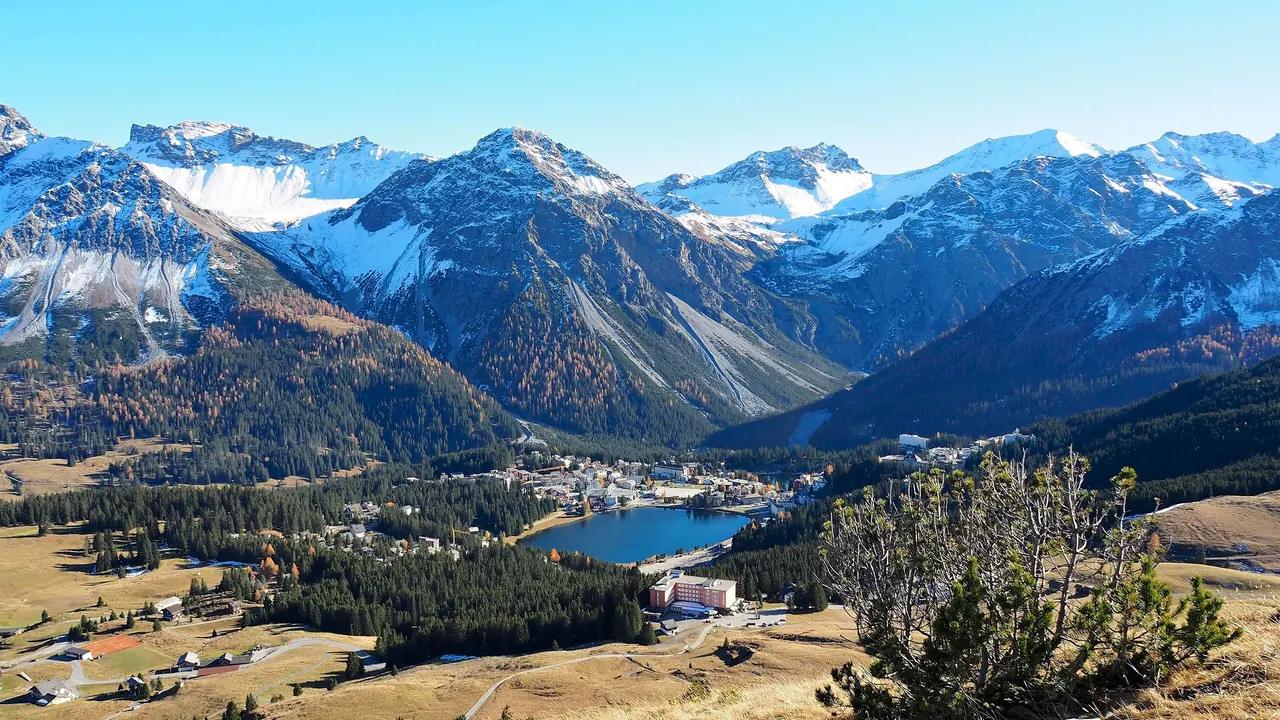
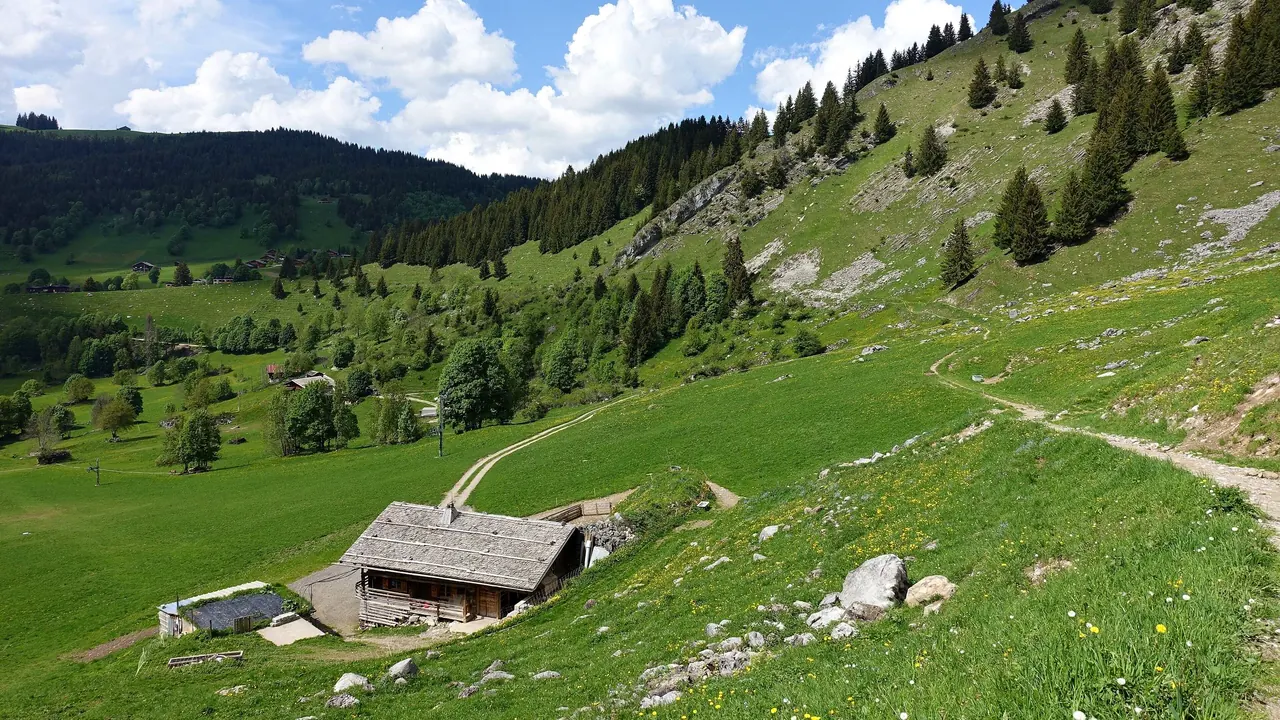
Photos: Arosa by Andres Passwirth, CC BY-SA 4.0, cropped; La Clusaz by Guilhem Vellut, CC BY 2.0, cropped.
Arosa or La Clusaz?
Our verdict in twelve categories, each scored against the same fixed benchmark cities, and the climate month by month, so you can choose for your trip.
Choose Arosa for
- getting around
- wellness
- live music and the arts
Arosa suits travellers who want the mountain to be the whole vacation. You arrive by train, leave the car at home and spend your days on the lifts, the lake paths and the hotel spa. It has kept the calm of its sanatorium past, and its winter comedy festival and summer chamber concerts give the calendar a little more shape. The catch is the cost: this is one of the dearer corners of the Swiss Alps, and once you are up there, everything else is a long ride down the valley.
Choose La Clusaz for
- day trips
- prices
- beaches
La Clusaz is the better pick if you want the Alps as a base for a wider trip and are happy to drive. Annecy and its lake, Geneva, Megève and Chamonix are all within a day's reach, summers are warm enough for lake swimming, and the self-catering chalets and apartments keep a family week more affordable than in Arosa. In exchange the snow is less certain, and you will spend more time on mountain roads.
Scoreboard
Twelve categories on one fixed scale from 0 to 100. The shaded stretch is the gap between the two.
Your match
Pick a travel style or drag the sliders, and both match scores follow your weighting.
Too close to call, 1 point apart
Wins on getting around and wellness with your weighting.
Wins on day trips and prices with your weighting.
What matters to you?
Category by category
What the scores mean for a trip.
Beaches & swimming
Arosa keeps its swimming inside the village basin. There is the lido on the Untersee with its lawn and jetty, and the higher Obersee and Schwellisee for hardy swimmers. The water rarely gets much above 20°C, and the season lasts only a few weeks of high summer.
La Clusaz has the better option, though you have to drive for it. Lake Annecy is well under an hour down the valley, and its clear water is noticeably warmer than Arosa's alpine lakes. The free lakeside beaches at Annecy, Talloires and Saint-Jorioz make it easy to fit a lake day or two into a hot summer week.
Food & drink
Both kitchens come down to hearty mountain cooking with a narrow range, but the regional flavours differ. Arosa's terrace huts serve the Graubünden repertoire of capuns, barley soup, rösti and air-dried meat, and its luxury hotels add a small fine-dining option for a special evening.
La Clusaz is Reblochon country, so expect tartiflette, croziflette and fondue. It also offers something Arosa lacks: you can buy cheese straight from farm cellars and local produce at the weekly market in Thônes. In both places many restaurants close between seasons.
Culture & sights
Neither is a place for sightseeing, though Arosa has a little more of a story to tell. Its 15th-century Bergkirchli stands alone on a meadow above Innerarosa, and the Schanfigg museum and the grand old hotels recall the era when tuberculosis patients came for the dry air. In La Clusaz the heritage is the setting itself: the onion-domed church tower and the wooden farm buildings in the hamlets. For museums, people drive down to Annecy.
Nightlife
Arosa's evenings are the smarter of the two. After après-ski, people move on to hotel bars and a couple of small clubs that open late at weekends, and the January gay ski week brings the liveliest nights of the year.
La Clusaz puts its energy into the hour when the lifts close, with mulled wine and music in the bars around the village square. It is a family resort, so instead of a club scene there is the odd dance floor in school vacations. Outside winter, both villages are quiet well before midnight.
Nature & outdoors
Both are first-rate mountain bases, but they feel different. Arosa sits higher, at 1,800m, in an enclosed basin of larches and small lakes below the Weisshorn. Its altitude makes the snow reliable, and the lift link to Lenzerheide opens up one of the larger ski areas in Graubünden. In summer there are marmots on the upper meadows and the bear sanctuary on the hillside.
La Clusaz lies lower, beneath the jagged limestone ridges of the Aravis, and its five interlinked massifs give it plenty of terrain, but the snow is less certain early and late in the season. Its summers offer more variety: paragliding, via ferrata, lift-served biking and the walk up to the Col des Aravis with views of Mont Blanc.
Day trips
Arosa sits at the end of the line, so every outing begins with the hour-long train ride over the Schanfigg viaducts to Chur. Chur's old town, Romanesque cathedral and art museum make a good day out, and the vineyards at Maienfeld are a short hop further, about an hour and a half from Arosa. Vaduz, Davos and the Albula line toward St. Moritz each take two hours or more.
La Clusaz has far more within easy reach. Annecy's canal-lined old town and lake are under an hour away, with Talloires and the castle at Menthon-Saint-Bernard close by. Geneva is about an hour by road, and Megève and Chamonix lie over the Col des Aravis. Nearly all of this is easiest by car.
Good for families
Arosa makes the mountain easy for small children without a car. Cable cars carry them up to high viewpoints, free buses handle the tired trip home, and the bear sanctuary is a guaranteed hit. The drawback is the cost of eating out, which adds up quickly for a family.
La Clusaz is better set up for doing things your own way. Self-catering chalets keep mealtimes simple, beginner slopes sit close to the village, and summer brings pony rides, rope parks and farm visits to watch cheese being made. Its winding roads can upset children prone to car sickness. On a wet day, neither has much to offer beyond the pool.
Getting around
Arosa is much easier to reach and to get around without a car. The Rhaetian Railway climbs up from Chur in about an hour, free buses connect the station, the lake, Innerarosa and the lift stations, and the lifts take over on the mountain. The only effort is the walking, which involves plenty of slopes and stairs.
La Clusaz is compact once you are there, and free shuttles run in winter. The nearest station, though, is Annecy, an hour away by regional bus, and for lake days, trailheads and day trips a car is close to essential.
Shopping & style
From Arosa the souvenir is Swiss chocolate from the main street. In La Clusaz it is a Reblochon bought straight from a farm cellar. Otherwise the two villages sell much the same things: ski hire, outdoor gear and a handful of boutiques.
For proper shopping, Arosa sends you down the line to Chur's old town. La Clusaz has the wider choice, with Annecy or Geneva within a day's reach.
Affordability
La Clusaz is noticeably cheaper, though winter is still expensive, with lift passes, ski school and school-vacation rentals all adding up. It costs less than the fashionable high-altitude resorts, and self-catering makes a real difference.
Arosa is expensive at every level, with upscale hotels, Swiss restaurant prices and peak-week ski costs. The summer guest card and simple guesthouses help a little. In both places summer is the cheaper season.
Live music & performing arts
Arosa has more to offer, thanks to two fixed points in its year. A long-established December comedy festival puts stand-up and cabaret on stages around the village, some of them out in the snow. In summer, chamber concerts fill the churches, the Bergkirchli among them. La Clusaz has only outdoor summer concerts and the occasional festival weekend, so anyone wanting a real performance has to go to Annecy or Geneva.
Wellness & relaxation
Arosa is the more restful choice. The village began as a place to recover in the dry mountain air and has kept that slow pace. Its larger hotels have extensive spas with peak views, and there is a public indoor pool in the village.
La Clusaz offers saunas and hot tubs in some hotels and chalets, plus the village pool complex. Its one advantage is the historic thermal baths at Saint-Gervais-les-Bains, about an hour away over the Aravis, which give it a real bathing tradition within reach, something Arosa lacks.
When should you go?
Pick your month. The climate figures are measured averages, not a forecast.
Arosa in July
La Clusaz in July
Daytime high, °C
Rainfall in the month, mm
Where the figures come from
Arosa's temperatures are measured 31 km from the centre, at Samedan.
Arosa has no rain gauge within 25 km of the centre, so its rainfall comes from a gridded climate dataset read at the destination rather than from a gauge further away.
La Clusaz's temperatures are measured 42 km from the centre, at Bourg-St-Maurice.
La Clusaz has no rain gauge within 25 km of the centre, so its rainfall comes from a gridded climate dataset read at the destination rather than from a gauge further away.
Temperature and rainfall are climate normals, averaged over the years shown. Arosa: 2015-2025 (rainfall 1991-2020) normals, Samedan (31.2 km from centre). La Clusaz: 1999-2020 (rainfall 1991-2020) normals, Bourg-St-Maurice (41.6 km from centre).
Arosa is the colder of the two all year. Daytime highs stay below freezing in December and January, which keeps the snow reliable from early winter into March, and even in July the warmest afternoons reach only about 20°C. That makes high summer pleasant for hiking but too cool for lazing by the water. Its wettest stretch is also the summer, with around 150mm a month from June to August, so plan walks for the mornings and expect showers later in the day.
La Clusaz runs much warmer. July afternoons reach around 27°C, which is lake-beach weather at Annecy, and late spring and September are comfortable for long walks. Its rain falls the other way round: the summer is the drier half, and the wettest month is December at about 150mm. Winter highs of around 5°C in January explain why its snow is less dependable than Arosa's.
Which traveller are you?
For a relaxing and wellness trip, Arosa is the clear choice. The village was built for convalescence, the larger hotels have extensive spas looking out on the peaks, and outside the busiest ski weeks the evenings are quiet and early.
On a trip on a tight budget, La Clusaz goes further. Neither resort is cheap, but its self-catering chalets, free summer hiking and quieter January weeks cost much less than Arosa, where upscale hotels and Swiss prices are hard to avoid.
For a beach and sun trip, La Clusaz is the only real contender. July is properly warm, and Lake Annecy's free beaches at Talloires and Saint-Jorioz are a short drive away. Arosa's alpine lakes stay chilly and its summer afternoons are cool.
Before you go
| Measure | Arosa | La Clusaz |
|---|---|---|
| Official language | French, German, Italian, Romansh | French |
| Currency | Swiss Franc (CHF) | Euro (EUR) |
| Sockets | CJ230 V, 50 Hz | CE230 V, 50 Hz |
| Driving side | Right | Right |
| Time zone | UTC+1, UTC+2 in summer | UTC+1, UTC+2 in summer |
| Emergency number | 112 | 112 |
| Elevation | 1,775 m | 995 m |
| Main airport | Zürich Airport (ZRH)114 km from centre226 non-stop destinations | Geneva International Airport (GVA)44 km from centre150 non-stop destinations |
| Public holidays this year | 9 days | 11 days |
By the numbers
| Measure | Arosa | La Clusaz |
|---|---|---|
| Population | 3,185 | 1,623 |
| People per km² | 21 | 40 |
| Museums within 10 km | 1 | 1 |
| UNESCO World Heritage sites within 50 km | 2 | 2 |
Where else could you go?
Every comparison below shares a destination with this one, so you can follow Arosa or La Clusaz somewhere new.
- Le Grand-Bornandvs La Clusaz
- Lenzerheidevs Arosa
- Davosvs Arosa
- Megèvevs La Clusaz
- Klostersvs Arosa
- Saint-Gervais-les-Bainsvs La Clusaz