
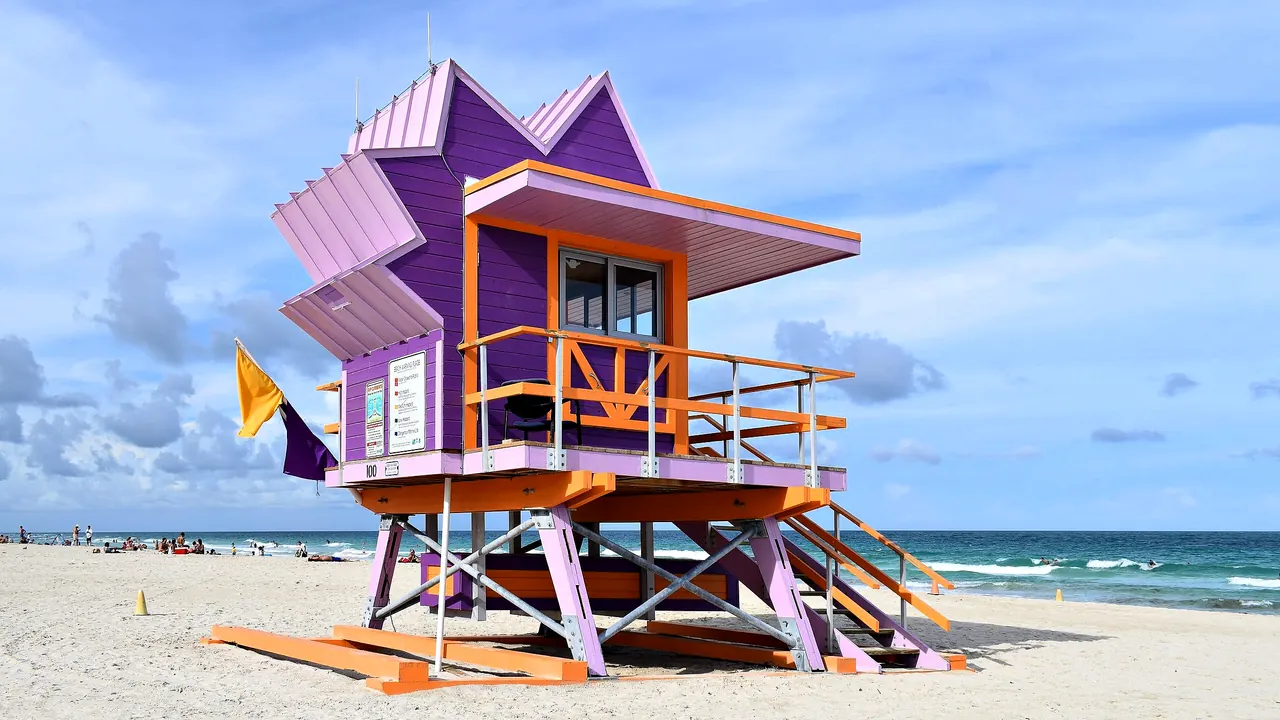
Photos: Asheville by Warren LeMay, CC0; Miami Beach by Radomianin, CC BY-SA 4.0, cropped.
Asheville or Miami Beach?
Our verdict in twelve categories, each scored against the same fixed benchmark cities, and the climate month by month, so you can choose for your trip.
Choose Asheville for
- nature and the outdoors
- prices
- wellness
Asheville is the choice for travellers who want mountains, walking and a slower pace. Its strength is the land around it: the Blue Ridge Parkway, Pisgah National Forest and the Great Smoky Mountains are all close, and evenings are spent in brewery taprooms or at a bluegrass jam. It suits hikers, cyclists, autumn leaf-watchers and anyone happy to drive a hire car between trailheads, waterfalls and the Biltmore Estate. It is also the easier of the two on the wallet.
Choose Miami Beach for
- beaches
- nightlife
- getting around
Miami Beach suits people who want warm sea, sand and a late night out. The Atlantic is swimmable all year, the Art Deco district is a short walk from the beach, and South Beach's clubs run until dawn. Without a car you can still spend whole days on the sand, by the pool and on the beachwalk. It costs more, and there are no hills or hiking, but for a beach and party trip Asheville has nothing to compare.
Scoreboard
Twelve categories on one fixed scale from 0 to 100. The shaded stretch is the gap between the two.
Your match
Pick a travel style or drag the sliders, and both match scores follow your weighting.
Wins on nature and the outdoors and prices with your weighting.
Wins on beaches and nightlife with your weighting.
What matters to you?
Category by category
What the scores mean for a trip.
Beaches & swimming
Here the two are as far apart as they can be. Miami Beach is built along its beach, a continuous stretch of pale sand on the Atlantic, with a calm, warm sea and a choice of mood from crowded South Beach to quieter North Beach. You can swim there in any month.
Asheville is hours from the coast. Its summer swimming happens at Sliding Rock, in waterfall pools, on tubes down the French Broad or at the small beach on Lake Lure, and the water stays cold even in July. It makes a pleasant half-day, but it is no substitute for a beach vacation.
Food & drink
The two eat about equally well, but the food is very different. Asheville cooks from its Appalachian farms, with trout, heirloom beans, ramps and barbecue, and its many breweries, cider makers and farmers' markets are as much a reason to visit as the restaurants. Look beyond Southern and modern American cooking, though, and the choice soon runs thin.
Miami Beach leans Latin and upscale: Cuban sandwiches and cafecito from takeaway windows, stone crabs in winter, ceviche and arepas, and polished hotel dining rooms. On Ocean Drive the food is mostly for tourists, so it pays to eat on the side streets or cross the causeway to Little Havana.
Culture & sights
Both cities have a short list of sights led by striking interwar architecture. Asheville has two main draws, the Biltmore Estate, which fills a whole day, and a downtown of 1920s Art Deco and Beaux-Arts buildings such as City Hall and the Grove Arcade. The Folk Art Center adds the region's craft history.
Miami Beach's Art Deco Historic District is the larger set of buildings and the easier walk, a pastel strip of 1930s hotels along Ocean Drive and Collins Avenue. The Wolfsonian and the Holocaust Memorial complete the list, and the bigger museums are on the mainland.
Nightlife
Miami Beach is the place for a big night out. South Beach has clubs with guest DJs that run until dawn, afternoon pool parties and lobby bars made for being seen, though it comes with dress codes, door policies and high bills.
Asheville's evenings are smaller and friendlier: taprooms on the South Slope, dive bars on Haywood Road in West Asheville and the summer drum circle in Pritchard Park. There are hardly any dance clubs, and most places are quiet by midnight.
Nature & outdoors
Asheville is clearly ahead for the outdoors. It sits among the oldest mountains in the east, with the Blue Ridge Parkway, Mount Mitchell and the Great Smokies within about an hour. The hiking, mountain biking and whitewater rafting are good, and the late-spring blooms and autumn colour change the landscape through the year.
Miami Beach has no hills or trails worth the name. Its outdoor life is paddleboarding on the bay, snorkelling on offshore reefs and wrecks, and trips out to the Everglades and Biscayne National Park. These are good for a morning, but they cannot match a mountain range on the doorstep.
Day trips
There is about as much to do on excursions from either city, but the trips are very different. From Asheville they go into the mountains: Brevard's waterfall country, the Carl Sandburg Home at Flat Rock, and Cherokee's museum and Oconaluftee village, with Greenville's riverside downtown about an hour away.
From Miami Beach most trips head for cities and the coast. Mainland Miami gives you Vizcaya, Little Havana and Coral Gables, Palm Beach is to the north and Key Largo to the south. Both need a car, and Miami's traffic can make the trips feel longer than the map suggests.
Good for families
Both cities suit families, but different kinds. Asheville is for active children: animal encounters at the Western North Carolina Nature Center, tubing, Sliding Rock, zip lines and the Biltmore farmyard, with plenty of driving in between.
In Miami Beach, children spend most of their time on the sand, in gentle water watched by lifeguards. Families should stay in Mid-Beach or North Beach rather than in party-heavy South Beach, and the zoo and science museum mean a trip to the mainland.
Getting around
Miami Beach is the easier place to manage without a car. South Beach is flat and compact, free trolleys run up Collins Avenue, and the beachwalk is good for cycling. Leaving the island means causeway traffic or a hire car.
In Asheville only the hilly downtown and the South Slope are comfortable on foot. The Biltmore Estate, the Parkway and every trailhead lie at the end of slow, winding mountain roads that the thin bus network does not reach, so nearly everyone drives.
Shopping & style
Miami Beach is the stronger shopping trip, mainly because of Bal Harbour, where the major European fashion and jewellery houses share an open-air mall. Lincoln Road is better for an evening stroll than for finding anything you could not buy at home.
Asheville offers the opposite. It has no luxury labels or department stores. Instead, potters, weavers and glassmakers sell from studios in the River Arts District and galleries downtown, so it is the better place for something handmade in the region.
Affordability
Neither is cheap, but Asheville is the gentler of the two. Its hotels are expensive on autumn weekends and most visitors pay for a car and Biltmore tickets. Still, the trails, waterfalls and Parkway cost nothing, and a midweek or winter stay brings real savings.
Miami Beach costs more at almost every turn. Oceanfront rooms in winter, resort fees, parking and South Beach cocktails all add up quickly. North Beach hotels, Cuban takeaway windows and the cheap summer season help, and the sand is free.
Live music & performing arts
The two are level here, with very different programmes. Asheville's strength is Appalachian music: bluegrass and old-time jams, buskers downtown, free summer fiddle and clogging evenings at Shindig on the Green, and a folk festival that dates back to 1928.
Miami Beach is the more formal of the two. It has the New World Symphony in its Gehry hall, sometimes projected onto the outside wall for audiences on the lawn, and it is home to Miami City Ballet. Its club music is mostly DJs rather than bands.
Wellness & relaxation
Asheville is slightly better for a restful trip. Its history as a mountain health retreat shows in its many yoga studios and therapists, the spas of its hillside resort hotels, and the riverside mineral tubs at Hot Springs. Cool evenings and quiet inn porches do the rest.
Miami Beach offers resort spas with hydrotherapy circuits and sunrise yoga on the sand, but no bathing tradition. A calm stay depends on choosing Mid-Beach or the stretch towards Surfside over loud South Beach.
When should you go?
Pick your month. The climate figures are measured averages, not a forecast.
Asheville in July
Miami Beach in July
Daytime high, °C
Rainfall in the month, mm
Where the figures come from
Asheville's temperatures are measured 50 km from the centre, at Asheville Regional Airport.
Asheville has no rain gauge within 25 km of the centre, so its rainfall comes from a gridded climate dataset read at the city rather than from a gauge further away.
Temperature and rainfall are climate normals, averaged over the years shown. Asheville: 1991-2020 (sunshine 1981-2010) normals, Asheville Regional Airport (50.3 km from centre). Miami Beach: 1991-2020 (sunshine 1981-2010) normals, Miami International Airport (18.8 km from centre).
Asheville is a four-season mountain city. Winters are cold, with daytime highs around 9°C in January, and summers reach about 29°C with humidity and afternoon storms. Rain falls steadily all year rather than in a set season. The best months for walking and hiking are May and June, when the rhododendrons bloom, and September and October, when the air cools and the leaves turn. October is also the driest month.
Miami Beach is warm all year, so the question is rain and heat rather than cold. December to April is the easy season: dry, sunny, warm enough for the beach every day, and the sea never drops below about 25°C. From May the wet season sets in, with heavy afternoon storms peaking at around 267mm in June, and highs of 33°C in July and August make walking the streets at midday hard work. The sea is at its warmest then. In winter Miami is warm while Asheville is cold. In early summer and autumn Asheville is the more comfortable place to walk.
Which traveller are you?
On a beach and sun trip, Miami Beach is the obvious pick. It has kilometres of wide sand, lifeguards along the whole shore and warm sea all year, while Asheville's swimming is limited to cold river pools and a small lake beach.
For an outdoors trip, Asheville wins easily. Ridge hikes over grassy balds, waterfall walks, mountain biking in Pisgah and rafting on the French Broad all start close to town. Miami Beach is flat and built up, and its outdoor life is mostly on the water.
On a food and nightlife trip, Miami Beach has the edge, mostly because of the nights. South Beach's clubs, rooftop pools and late dinners run until dawn. Asheville eats just as well, from Appalachian farm cooking to dozens of breweries, but most places quieten around midnight.
Before you go
| Measure | Asheville | Miami Beach |
|---|---|---|
| Currency | US Dollar (USD) | US Dollar (USD) |
| Sockets | AB120 V, 60 Hz | AB120 V, 60 Hz |
| Driving side | Right | Right |
| Time zone | UTC-5, UTC-4 in summer | UTC-5, UTC-4 in summer |
| Emergency number | 911 | 911 |
| Elevation | 650 m | 1 m |
| Main airport | Asheville Regional Airport (AVL)18 km from centre27 non-stop destinations | Miami International Airport (MIA)16 km from centre198 non-stop destinations |
| Public holidays this year | 14 days | 11 days |
By the numbers
| Measure | Asheville | Miami Beach |
|---|---|---|
| City population | 94,589 | 82,890 |
| People per km² | 796 | 2,109 |
| Museums within 10 km | 4 | 14 |
| UNESCO World Heritage sites within 50 km | 0 | 0 |
| Swim season, months above 21 °C | - | 12 months |
Where else could you go?
Every comparison below shares a destination with this one, so you can follow Asheville or Miami Beach somewhere new.
- Miamivs Miami Beach
- Fort Lauderdalevs Miami Beach
- Boca Ratonvs Miami Beach
- Gatlinburgvs Asheville
- Pigeon Forgevs Asheville
- Palm Beachvs Miami Beach