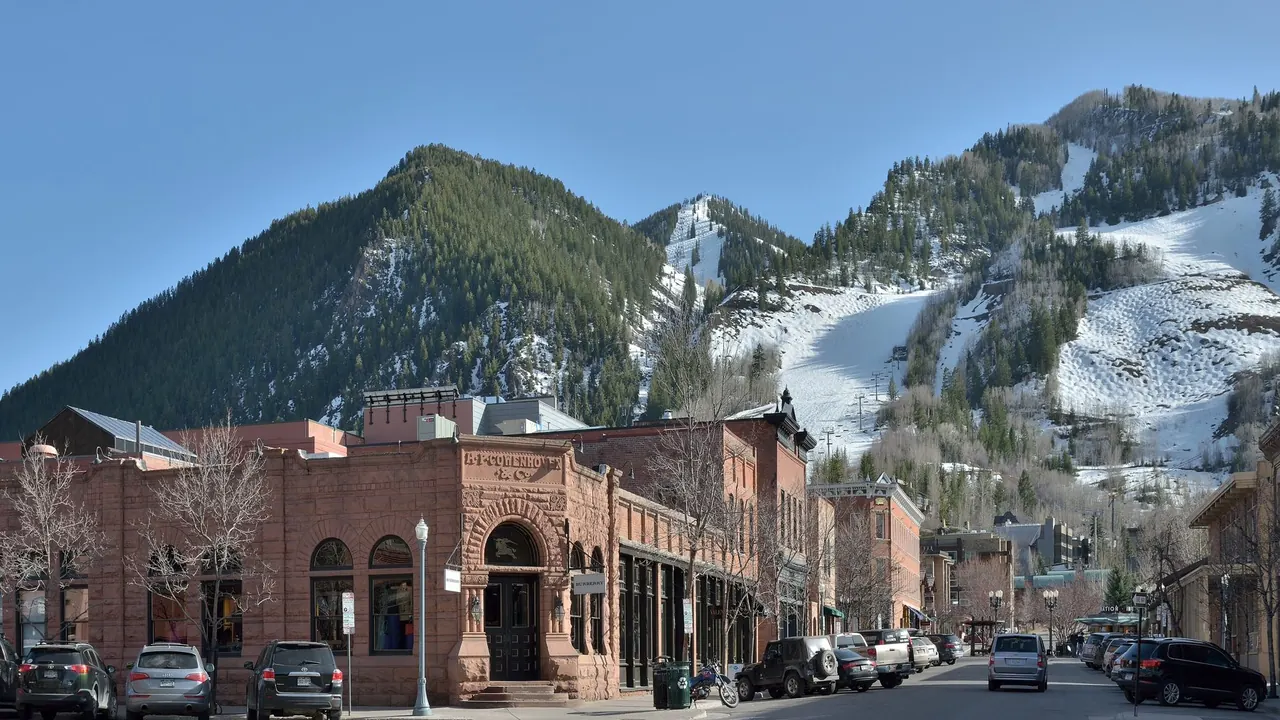
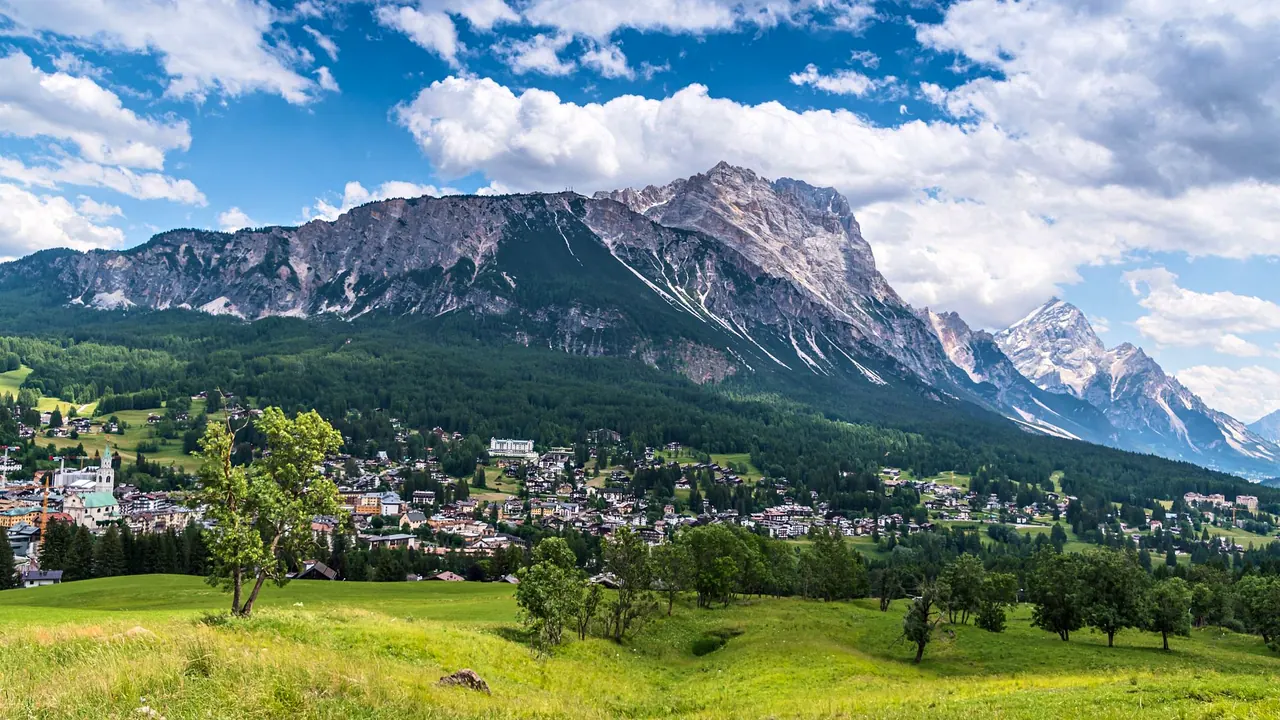
Photos: Aspen by Moroder, CC BY-SA 3.0, cropped; Cortina d'Ampezzo by Andreas Neubauer, Pexels License.
Aspen or Cortina d'Ampezzo?
Our verdict in twelve categories, each scored against the same fixed benchmark cities, and the climate month by month, so you can choose for your trip.
Choose Aspen for
- live music and the arts
- getting around
- nightlife
Aspen suits travellers who want a mountain resort with a bit of town life around it. Its free buses link four ski mountains and run down the valley, so you can manage without a car. Après-ski goes on into downtown bars, and in summer a major classical music festival gives the evenings a purpose. Its summers are also warmer and drier, which makes long days on the trails easier to plan.
Choose Cortina d'Ampezzo for
- day trips
- prices
- nature and the outdoors
Cortina is the pick if the mountains themselves matter most and you want them with an Italian accent. The pale Dolomite towers, the via ferrata routes and the hut terraces serving casunziei and polenta give it a character Aspen cannot copy. South Tyrol and even Venice are within a day's reach. Expect quiet nights, a car for exploring and plenty of summer rain.
Scoreboard
Twelve categories on one fixed scale from 0 to 100. The shaded stretch is the gap between the two.
Your match
Pick a travel style or drag the sliders, and both match scores follow your weighting.
Wins on live music and the arts and getting around with your weighting.
Wins on day trips and prices with your weighting.
What matters to you?
Category by category
What the scores mean for a trip.
Beaches & swimming
Neither town is a place to swim, and both send you to a hotel pool. What differs is the summer water. Aspen's best option is floating or rafting the Roaring Fork River. In Cortina, the snowmelt lakes of Ghedina and Pianozes are better for a walk around the shore than for a dip.
Distance to the sea differs too. Aspen is about two days' drive from any coast. From Cortina the Adriatic is a little over two hours away, so mountains and coast can share one Italian trip.
Food & drink
The two eat at much the same level. Both cook well for wealthy visitors, and both are thin on cheap food. In Aspen the cooking is international: steak and sushi counters, Italian dining rooms and chef-led menus with deep wine lists. Its big food moments are après-ski on the terraces at the base of Aspen Mountain and the Food & Wine Classic in June.
Cortina has what Aspen lacks, a cuisine of its own. Look for beetroot casunziei with poppy seeds, barley soup and polenta with game, ideally eaten on a rifugio terrace high above the valley. In the valley, the wines come from the Veneto and South Tyrol.
Culture & sights
Neither town has major sights, and either fills an afternoon rather than a trip. Aspen's interest is its silver-boom past. You can see it in the red-brick Victorian downtown around the Wheeler Opera House and in the painted miners' cottages of the West End, with Herbert Bayer's modernist Aspen Institute campus as an unexpected extra.
Cortina gives you a bell-towered basilica, the ice stadium from the 1956 Winter Games and the Rimoldi collection of Italian art. Its most powerful history is out of town, in the First World War tunnels and trenches on Lagazuoi and the Cinque Torri. That turns history into a mountain day.
Nightlife
Aspen is clearly the livelier of the two at night. In ski season, après-ski moves from the slopeside decks to downtown bars and lounges. Around Christmas, New Year and the X Games, hotel bars and a few small clubs keep going late. Even summer has drinks on the patios.
In Cortina, the evening ritual is the stroll along the Corso Italia and then a long dinner. A club or two opens in peak winter weeks, but for most of the year the town is asleep by late evening.
Nature & outdoors
Both are among the finest mountain settings anywhere, but the landscapes are very different. Aspen's Elk Mountains give you four separate ski areas linked by free shuttles: steep Highlands, gentle Buttermilk, huge Snowmass and a gondola rising straight from downtown. In summer the Maroon Bells and wilderness routes to summits above 4,000m are close at hand.
Cortina is ringed by the pale, jagged towers of the Dolomites. It also plugs into the vast Dolomiti Superski network, so you can ski the Sella Ronda circuit rather than staying on one resort's runs. In summer it leans towards climbing, with historic via ferrata routes, the Tre Cime and long hut-to-hut walking.
Day trips
Cortina has the better choice of outings. Within an hour or two you reach South Tyrol: San Candido, Brunico's castle and the Messner Mountain Museum, and Bolzano, where the Iceman lies in the archaeology museum. Austria's Lienz is in range, and Venice is a long but possible day.
Aspen's list is mostly small mountain towns. Choose from Glenwood Springs down the valley, Carbondale, Redstone and Marble, or Leadville over Independence Pass. In winter the pass closes and the options shrink further.
Good for families
Both work for families who ski or hike, and neither has a zoo, aquarium or theme park. Aspen's strengths are gentle Buttermilk with its kids' areas and lift-served summer extras like alpine coasters and ropes courses. Free buses make moving between mountains with children easy. The 2,400m altitude can knock young ones back for a day or two.
Cortina offers beginner slopes at Socrepes, public skating in the Olympic ice stadium, a forest rope park and meadows beside the huts. Wet summer days with little ones are harder to fill.
Getting around
Aspen is far easier to manage without a car. Free buses link the town to all four ski areas and run down the valley to Glenwood Springs. A summer shuttle reaches the Maroon Bells, and the local airport is minutes from downtown.
Cortina's centre is just as walkable, but the town has had no railway since 1964. Arriving usually means a coach from Venice. Buses to Misurina and the passes are infrequent, so most visitors end up hiring a car to explore the Dolomites.
Shopping & style
Aspen offers more for serious shoppers. Its few downtown blocks hold international luxury labels you would not expect in a mountain town, plus commercial art galleries and Western-style leather goods.
Cortina's offer is one street, the Corso Italia, with fashion, furriers and ski wear. It does have something Aspen lacks: the Cooperativa di Cortina, trading since 1893, and shops selling local wood carving and filigree. That gives it more to take home that actually comes from the place.
Affordability
Neither is a place for a tight budget, but Aspen is the harder of the two on your wallet. Its ski-season rooms, lift tickets and meals are priced well above big-city norms, and even staying in Glenwood Springs only softens the bill.
Cortina is still expensive in the winter peak and in August. Lunch at a rifugio is good value for the setting, though, and early summer and late September ease the rates a little.
Live music & performing arts
This is one of the widest gaps between the two. Aspen's summer belongs to the Aspen Music Festival and School, with orchestral, chamber and opera performances in the Benedict Music Tent, plus jazz and the Aspen Santa Fe Ballet. The Wheeler Opera House keeps concerts, comedy and film going all year.
Cortina has no theatre season and no regular venue. Its music is limited to summer chamber concerts in churches and the odd performance at New Year.
Wellness & relaxation
Both are calm outside the peak weeks, and both rely mainly on hotel spas. Aspen's advantage is natural hot water within reach. The big mineral pools and cave vapour baths of Glenwood Springs are an hour away, and Conundrum Hot Springs rewards a long hike.
Cortina has no springs, but its hotel spas follow Alpine tradition, with hay baths, saunas and steam rooms. A slow afternoon on a hut terrace in June or September is as restful as either town gets.
When should you go?
Pick your month. The climate figures are measured averages, not a forecast.
Aspen in July
Cortina d'Ampezzo in July
Daytime high, °C
Rainfall in the month, mm
Where the figures come from
Aspen has no rain gauge within 25 km of the centre, so its rainfall comes from a gridded climate dataset read at the city rather than from a gauge further away.
Temperature and rainfall are climate normals, averaged over the years shown. Aspen: 2006-2020 (rainfall 1991-2020) normals, Aspen / Woody Creek (5.2 km from centre). Cortina d'Ampezzo: 1991-2020 normals, Dobbiaco (22.5 km from centre).
Both towns sit near freezing from December to February, with highs around 0°C, and both are ski destinations through those months and into March. Neither has any beach weather. The big difference comes in summer. Aspen warms to about 27°C in July and stays dry all year, with no month much above 40mm of rain. June to September is an easy run of trail and town weather, and late September adds the gold of the aspen groves.
Cortina's summer is cooler, peaking around 22°C, which is pleasant for hiking. It is also its wettest season, with about 130mm in July and heavy totals either side, so mountain days need a flexible plan. June and September are a little drier than high summer and still mild. Midwinter is Cortina's driest stretch, which helps on the slopes.
Which traveller are you?
On a culture and arts trip, Aspen wins if you go in summer. The Aspen Music Festival fills the season with orchestral, chamber and opera concerts, and Cortina has nothing comparable. By day, neither town offers more than an afternoon's sightseeing.
For a food and nightlife trip, choose Aspen if the night matters more than the menu. In ski season, dinner leads on to bars and late clubs. Cortina's evenings end at the table, though its cooking is far more local.
For via ferrata climbers and hut-to-hut hikers, Cortina has no real rival. Some of the oldest protected climbing routes in the Alps start from its lifts. The Alta Via 1 links rifugi serving hot meals high among the Dolomite towers.
Before you go
| Measure | Aspen | Cortina d'Ampezzo |
|---|---|---|
| Official language | - | Italian |
| Currency | US Dollar (USD) | Euro (EUR) |
| Sockets | AB120 V, 60 Hz | CFL230 V, 50 Hz |
| Driving side | Right | Right |
| Time zone | UTC-7, UTC-6 in summer | UTC+1, UTC+2 in summer |
| Emergency number | 911 | 112 |
| Elevation | 2,405 m | 1,224 m |
| Main airport | Aspen-Pitkin County Airport (Sardy Field) (ASE)5 km from centre11 non-stop destinations | Venice Marco Polo Airport (VCE)116 km from centre103 non-stop destinations |
| Public holidays this year | 12 days | 13 days |
By the numbers
| Measure | Aspen | Cortina d'Ampezzo |
|---|---|---|
| City population | 7,004 | 5,546 |
| People per km² | 700 | 22 |
| Museums within 10 km | 2 | 3 |
| UNESCO World Heritage sites within 50 km | 0 | 1 |
Where else could you go?
Every comparison below shares a destination with this one, so you can follow Aspen or Cortina d'Ampezzo somewhere new.
- Beaver Creekvs Aspen
- Vailvs Aspen
- Copper Mountainvs Aspen
- Breckenridgevs Aspen
- Keystonevs Aspen
- Innsbruckvs Cortina d'Ampezzo