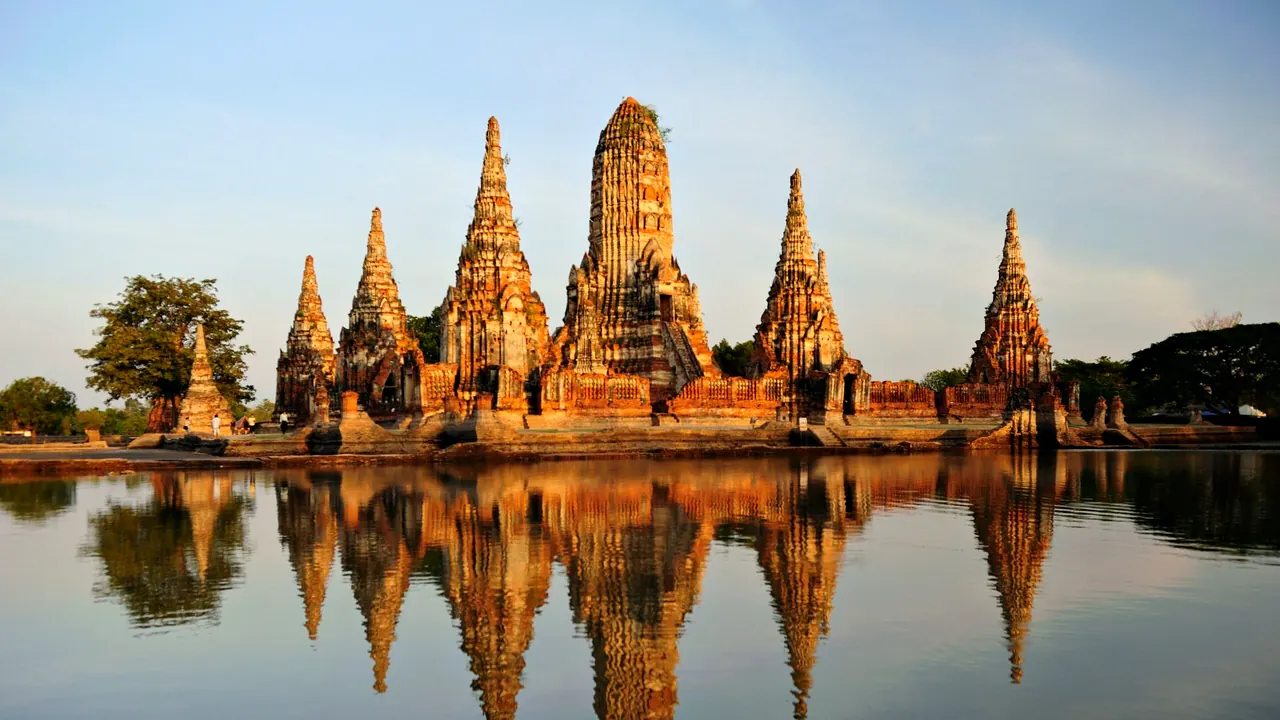
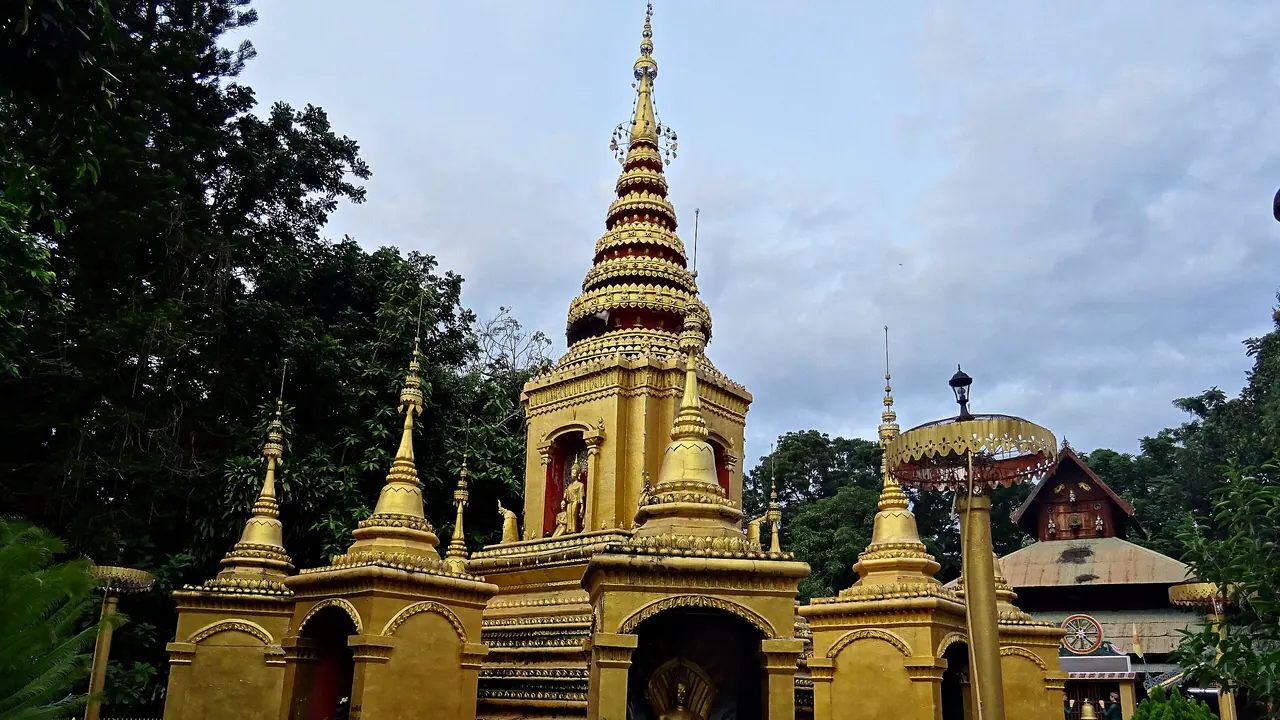
Photos: Ayutthaya by เกริกชัย อินทร์ปอ, CC BY-SA 3.0, cropped; Pai by Christophe95, CC BY-SA 4.0, cropped.
Ayutthaya or Pai?
Our verdict in twelve categories, each scored against the same fixed benchmark cities, and the climate month by month, so you can choose for your trip.
Choose Ayutthaya for
- culture and sights
- day trips
- getting around
Ayutthaya is for travellers who want history they can stand inside. The ruined capital of Siam fills the island with temples, prangs and museum gold, Bangkok and the Bang Pa-In palace are easy day trips, and the flat lanes make a bicycle all you need. It suits a focused stay of a few days, especially as a stop on the way to or from Bangkok, but evenings are early and quiet.
Choose Pai for
- nature and the outdoors
- wellness
- nightlife
Pai rewards people who come for the landscape and the slow pace. It is a valley of rice fields, canyon ridges, waterfalls and hot springs, with yoga retreats, massage shops and a sociable backpacker bar scene in the evenings. There is little to see in town itself and it is hard to get to, so it works best for a longer, unhurried stay by travellers who are happy on a scooter.
Scoreboard
Twelve categories on one fixed scale from 0 to 100. The shaded stretch is the gap between the two.
Your match
Pick a travel style or drag the sliders, and both match scores follow your weighting.
Wins on culture and sights and day trips with your weighting.
Wins on nature and the outdoors and wellness with your weighting.
What matters to you?
Category by category
What the scores mean for a trip.
Beaches & swimming
Neither town is anywhere near the sea, so the beach part of a Thai trip has to happen somewhere else. The difference is what you can do with the water nearby. In Ayutthaya the rivers are working waterways, so swimming means the hotel pool.
In Pai you can float down the river on an inner tube in the hot season or splash under Mo Paeng waterfall. It is modest swimming, but it is outdoors.
Food & drink
Ayutthaya has the stronger local cooking. It has its own dishes: boat noodles eaten several bowls at a time, giant river prawns grilled beside the water, and roti sai mai pancakes from the old Muslim quarter. On top of that come the island's night markets and the Chao Phrom market.
Pai's walking street has good khao soi and Shan dishes, and Santichon adds Yunnanese noodles. Much of the rest, though, is smoothie bowls, pizza and vegan plates aimed at long-staying travellers. It is easy eating rather than a taste of the region.
Culture & sights
This is where the two differ most. Ayutthaya was the capital of Siam for four centuries, and its ruins are some of the great sights of Southeast Asia: the three chedis of Wat Phra Si Sanphet, the Buddha head held in tree roots at Wat Mahathat, Wat Chaiwatthanaram at sunset, and the crypt gold in the national museum.
Pai has the white Buddha of Wat Phra That Mae Yen, a few Shan-style temples, the wartime iron bridge and the mud-brick village of Santichon. That adds up to a pleasant half day, not a reason to make the journey.
Nightlife
Pai has the livelier evenings by some distance. Reggae bars, fairy-lit garden bars and the odd party out of town fill with backpackers after the night market. It is still a small-town scene, though, with no clubs, and the centre is mostly finished soon after midnight.
Ayutthaya's evenings are a short strip of guesthouse bars and a drink at a riverside restaurant, looking across at the floodlit temples. Most people are in bed early.
Nature & outdoors
Pai is the place for landscape. It is a green valley ringed by forested hills, with the narrow ridges of Pai Canyon, the waterfalls, morning mist at Yun Lai, hill-tribe treks and the river cave of Tham Lod about an hour away.
Ayutthaya sits on a flat river plain. Its pleasures are a bike ride under shady trees, a long-tail boat around the island and egrets over the paddies. For forest you have to go to Khao Yai, about two hours away.
Day trips
Ayutthaya makes a much better base for day trips. Bangkok is about an hour and a half away by train, the mixed Thai and European summer palace at Bang Pa-In is about twenty minutes, and Lopburi has Khmer temples and its famous macaques.
Pai is tucked away in the mountains. Apart from the Lahu and Lisu villages around Soppong, the nearby towns are three hours away on very twisty roads. Most people treat Pai as one stop on a northern loop rather than a base.
Good for families
The two towns suit different children rather than one suiting them better. Ayutthaya is the easier short stop. A morning at the ruins, the Buddha head in the tree roots and a boat around the island will hold most children's interest, and the town is relaxed with families. The open sites have little shade, though, and the midday heat is hard on small ones.
Pai is better for older children who like being outdoors, with waterfalls, hot springs, farm visits and gentle tubing on the river. The catch is getting there and getting about. The winding road in makes many people carsick, most outings need a scooter or a driver, and the evenings centre on backpackers.
Getting around
Ayutthaya is the easier town to get around. The island is flat and a few kilometres across, so a hired bicycle or a tuk-tuk circuit reaches most of the ruins, and small ferries cross to the far banks. Bangkok is a short train ride away.
In Pai you can walk the centre in minutes, but the sights are spread across the valley and no public transport reaches them. That leaves a scooter on hill roads, which is risky for beginners, or a hired songthaew. Getting there at all means a long minibus ride up from Chiang Mai.
Shopping & style
Ayutthaya's stalls sell for temple visitors, and Pai's are aimed at travellers who stay a while. Ayutthaya's browsing is mostly amulets, clothes and souvenirs outside the ruins, and its one real speciality is the woven crafts at Bang Sai, downriver.
Pai's evening walking street is more enjoyable to wander, with hill-tribe textiles, handmade jewellery and small art prints, much of it made locally. Neither town has much range, though. In Pai the same stock turns up from stall to stall, and for anything more you need Chiang Mai.
Affordability
Both are very cheap, and a modest budget goes a long way in either. Your money goes on different things. In Ayutthaya the main costs are the separate entrance fees at each ruin and a tuk-tuk for the day. In Pai the sights are mostly free, but scooter hire adds up, prices in the tourist centre run above those of ordinary northern towns, and they climb around the new year.
Live music & performing arts
Pai has more live music, though it is informal. Most nights a few bars host acoustic, blues or reggae jams by musicians passing through, and you come across them over a drink.
Ayutthaya has almost nothing on most evenings. The exception is its annual World Heritage fair, when light-and-sound shows and traditional dance are staged among the ruins.
Wellness & relaxation
Pai is built for unwinding. You can soak in the hot springs at Tha Pai in the cool morning, sign up for a yoga, meditation or detox retreat, find an inexpensive massage on every street, or spend long afternoons in a hammock looking over the rice fields. The spring haze takes some of the shine off.
Ayutthaya's rest is simpler. A shophouse foot massage after a day of cycling and a quiet evening on a riverside terrace once the tour buses have left are pleasant, but there are no springs or retreats.
When should you go?
Pick your month. The climate figures are measured averages, not a forecast.
Ayutthaya in July
Pai in July
Daytime high, °C
Rainfall in the month, mm
Where the figures come from
Ayutthaya's temperatures are measured 49 km from the centre, at Suphan Buri.
Ayutthaya has no rain gauge within 25 km of the centre, so its rainfall comes from a gridded climate dataset read at the city rather than from a gauge further away.
Ayutthaya's sunshine is measured 70 km from the centre, at Bangkok.
Pai's temperatures are measured 64 km from the centre, at Mae Hong Son.
Pai's station stands 242 m below the city centre, so the centre is likely a little cooler than the figures say.
Pai has no rain gauge within 25 km of the centre, so its rainfall comes from a gridded climate dataset read at the city rather than from a gauge further away.
Pai's sunshine is measured 86 km from the centre, at Chiang Mai.
Temperature and rainfall are climate normals, averaged over the years shown. Ayutthaya: 1961-1990 (sunshine 1991-2020, rainfall 1991-2020) normals, Suphan Buri (49.2 km from centre). Pai: 1971-2000 (sunshine 1991-2020, rainfall 1991-2020) normals, Mae Hong Son (63.7 km from centre).
For both towns the dry, sunny months from November to February are the time to go. Ayutthaya peaks at around 30°C in December, but even then the ruins are best seen early or late in the day. From December to February Pai is a degree or two cooler, which makes the climb to the viewpoints and a morning soak in the hot springs easier. March and April are the hardest months in both towns, with highs of 37°C to 38°C. Pai is slightly the hotter of the two then, and smoke from field burning hides its hills.
Ayutthaya's rain builds through the summer and is heaviest late in the season, at 234mm in September, before it dries out in November. Pai's wet season comes earlier and brings more rain overall. It peaks in July and August, the valley's least sunny months, when the rice fields are at their greenest but the tracks turn to mud.
Which traveller are you?
For a culture and arts trip, Ayutthaya is the clear choice. Its UNESCO-listed ruins, the Chao Sam Phraya National Museum and the old foreign quarters make several full days of sightseeing. Pai offers one hilltop Buddha and a few small temples.
On an outdoors trip, Pai wins easily. You can ride a scooter to Pai Canyon, the waterfalls and the misty viewpoints, trek to hill-tribe villages, raft in the wet season or visit Tham Lod cave. Around Ayutthaya there are only flat paddies and gentle cycling between the ruins.
For a relaxing and wellness trip, Pai is the better fit. It has natural hot springs, yoga and meditation retreats, cheap massage everywhere, and hammocks overlooking the rice fields. Ayutthaya also has good massage and calm riverside evenings, but no springs and no retreats.
Before you go
| Measure | Ayutthaya | Pai |
|---|---|---|
| Official language | Thai | Thai |
| Currency | Baht (THB) | Baht (THB) |
| Sockets | ABCF220 V, 50 Hz | ABCF220 V, 50 Hz |
| Driving side | Left | Left |
| Time zone | UTC+7 | UTC+7 |
| Emergency number | Police 191, ambulance 1669, fire 199 | Police 191, ambulance 1669, fire 199 |
| Elevation | 7 m | 509 m |
| Main airport | Suvarnabhumi Airport (BKK)78 km from centre150 non-stop destinations | Chiang Mai International Airport (CNX)86 km from centre28 non-stop destinations |
By the numbers
| Measure | Ayutthaya | Pai |
|---|---|---|
| City population | 52,940 | 3,598 |
| People per km² | 3,577 | - |
| Museums within 10 km | 3 | 0 |
| UNESCO World Heritage sites within 50 km | 1 | 0 |
Where else could you go?
Every comparison below shares a destination with this one, so you can follow Ayutthaya or Pai somewhere new.
- Bangkokvs Ayutthaya
- Chiang Maivs Pai
- Kanchanaburivs Ayutthaya
- Chiang Raivs Pai
- Pattayavs Ayutthaya
- Hua Hinvs Ayutthaya