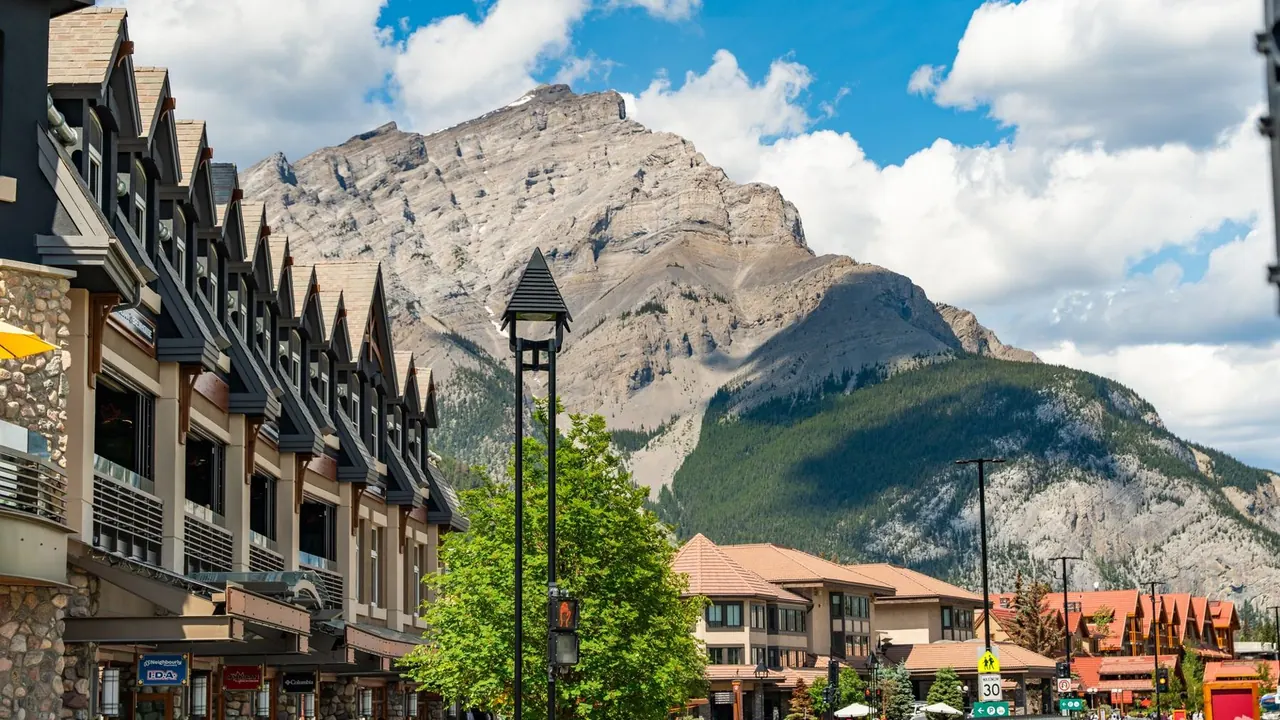
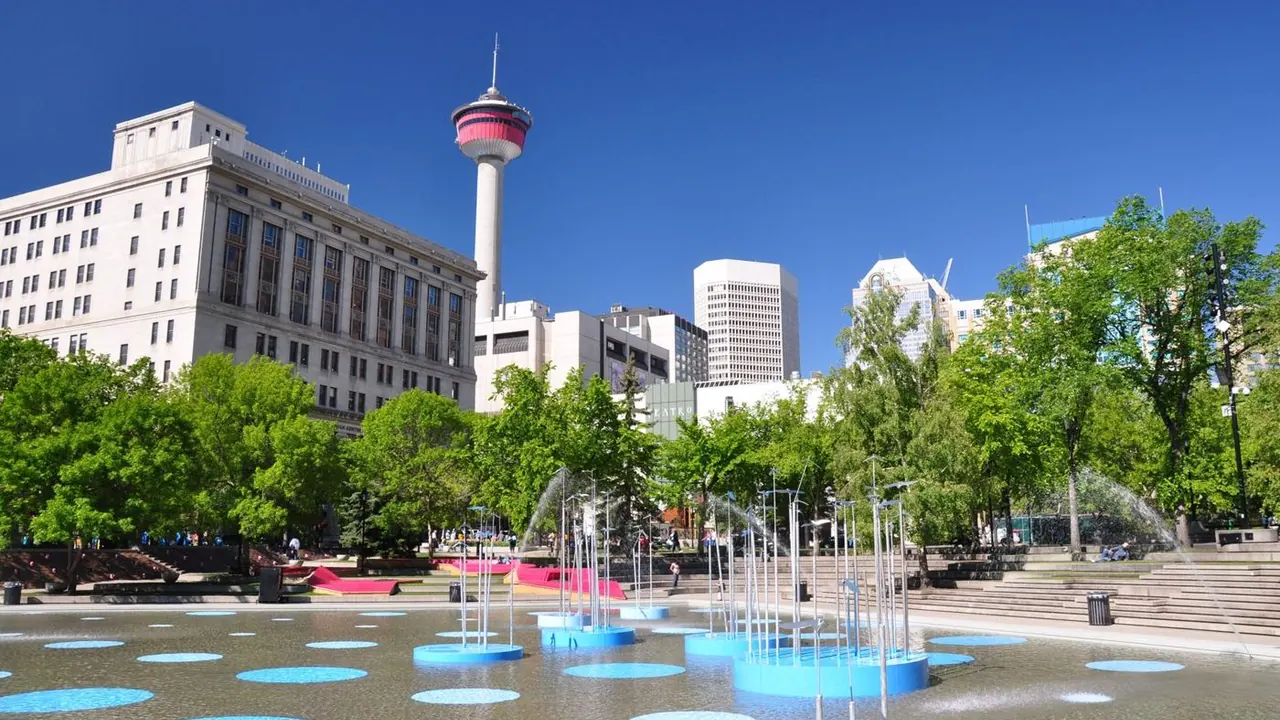
Photos: Banff by bryan pascual, Pexels License; Calgary by abdallahh, CC BY 2.0, cropped.
Banff or Calgary?
Our verdict in twelve categories, each scored against the same fixed benchmark cities, and the climate month by month, so you can choose for your trip.
Choose Banff for
- getting around
- wellness
- nature and the outdoors
Banff is the choice when the mountains are the whole point of the trip. You wake up inside the national park, with elk on the lawns and trailheads, lakes and the gondola minutes from your door. Evenings end in a hot spring or a pub on Banff Avenue rather than at a concert. It suits hikers, skiers and couples who will pay more for a room to be there already when the light comes up on Cascade Mountain.
Choose Calgary for
- day trips
- prices
- shopping
Calgary makes more sense for travellers who want the Rockies as one part of a broader Alberta trip. A car takes you into Kananaskis, out to the dinosaur fossils at Drumheller and down to Head-Smashed-In Buffalo Jump, and you come back to better restaurants, a symphony and theatre season, and a zoo and science centre for the children. Rooms cost less, and in July the Stampede gives the city a character the mountain town cannot match.
Scoreboard
Twelve categories on one fixed scale from 0 to 100. The shaded stretch is the gap between the two.
Your match
Pick a travel style or drag the sliders, and both match scores follow your weighting.
Wins on getting around and wellness with your weighting.
Wins on day trips and prices with your weighting.
What matters to you?
Category by category
What the scores mean for a trip.
Beaches & swimming
Neither place is for a swimming vacation, and the difference lies in what you swim in. In Banff it means a brief, cold dip at shallow Johnson Lake on an August afternoon, or a warm soak in the hot springs. Calgary's warm-day pleasures are more about floating, either drifting down the Bow River on a tube or swimming at Sikome Lake in Fish Creek Park or at Chestermere Lake.
Food & drink
Calgary eats better, though beef is the main event in both. Banff's dining is mostly steaks, game, fondue and pub plates along Banff Avenue, with a few more ambitious hotel dining rooms, and the range is narrow for a town with so many visitors.
Calgary adds variety. You can order ginger beef in Chinatown, find Vietnamese, Filipino and Lebanese cooking in the suburbs, visit the breweries around Manchester and Ramsay, and have brunch in Inglewood or Kensington. Its farmers' markets offer the prairie produce that Banff lacks.
Culture & sights
Calgary has more to see, though neither is a heritage destination. Banff's sights all tell one story, the founding of the park, from the Cave and Basin spring to the Banff Springs Hotel and the Whyte Museum, and a single day covers them.
Calgary needs about two days. The Glenbow covers western Canadian art, Studio Bell holds the national music collection, Heritage Park brings prairie settlement to life, and Stephen Avenue keeps its sandstone buildings from the 1880s. It also gives you easier access to the region's fossils and Indigenous sites.
Nightlife
A night out in Banff means one street. Seasonal workers and the ski crowd keep a handful of pubs and dance bars on and around Banff Avenue loud until late, with après-ski filling the early evening, and you can walk between them in minutes. It is cheerful for a few nights, then repetitive, and it thins out in the quiet weeks of spring and autumn.
Calgary's evenings are spread across several districts and offer real variety. There are cocktail bars and patios along 17th Avenue SW, bars in the East Village, a few clubs, and country bars with line dancing and a mechanical bull. Midweek is quiet, but in Stampede week the whole city stays out late for ten days.
Nature & outdoors
Both are built around the Rockies. The difference is that in Banff you are inside them, and from Calgary you visit them. In Banff, Cascade Mountain fills the end of the main street, elk graze in town, and Lake Minnewanka, Johnston Canyon and the gondola are minutes away, with Moraine Lake and the Icefields Parkway further along.
Calgary gives you Kananaskis about an hour away, quieter than the national park, and Banff in about ninety minutes. Within the city, there are the river pathways, Fish Creek and the open grassland of Nose Hill. That is still excellent, but every mountain day starts with a drive.
Day trips
Calgary is the far better base for varied outings. Drumheller's badlands and the Royal Tyrrell Museum's dinosaur collection lie to the north-east. To the south you reach the UNESCO-listed Head-Smashed-In Buffalo Jump and the ranching history of the Bar U, and Banff and Canmore make the mountain day.
From Banff almost every excursion goes deeper into the mountains, so towns are few. Canmore and the small stops at Field and Golden are pleasant but minor, and the main change of scene is a long drive back east to Calgary.
Good for families
Calgary has far more built for children. There is the zoo with its life-size dinosaurs, the hands-on TELUS Spark science centre, steam trains at Heritage Park, Calaway Park's rides and the summer coaster at Canada Olympic Park. Drumheller's fossils make a strong day out for older children.
Banff relies on the outdoors to keep children happy. They can spot bighorn sheep from the car, ride the gondola, walk the Johnston Canyon boardwalk and toboggan in winter. That works well for active families, but on a wet day there is little made for them.
Getting around
Banff is easier day to day. You can cross the flat town on foot in about twenty minutes, and Roam Transit buses reach the gondola, the hot springs, Lake Minnewanka and Lake Louise. You only need a car for the Icefields Parkway and remoter trailheads.
Calgary's downtown grid, Plus 15 skywalks and two CTrain lines cover the centre well, but the city sprawls and buses are slow. Its main outings are realistically reached only by car, so most visitors hire one at the airport.
Shopping & style
What you take home is what sets the two apart: a piece of Indigenous art or a mountain painting from Banff, or a pair of hand-made cowboy boots from Calgary. Beyond its galleries, Banff's shopping is limited to Banff Avenue and a few side streets. It is mostly outdoor outfitters for anyone who arrived without proper boots, plus fudge and moose-and-maple souvenirs, and it fills a rainy afternoon.
Calgary can fill a proper shopping day. Its long-established western outfitters sell felt hats, belt buckles and saddlery as well as boots. CORE and Chinook Centre carry the major chains, and Kensington, Inglewood and 17th Avenue add independent boutiques, record shops and antique dealers.
Affordability
Calgary is clearly the cheaper stay. Hotels cost less outside Stampede week, and suburban restaurants keep meals reasonable, although a hire car and park fees still add up once you head west.
Building limits inside the national park keep Banff's rooms scarce and dear, especially in summer and over Christmas, and restaurants charge resort prices. The trails and lakes cost nothing beyond the park pass. That is why many budget travellers sleep in Canmore or at a campground instead.
Live music & performing arts
Calgary has a regular season. The Calgary Philharmonic plays the Jack Singer Concert Hall, Theatre Calgary performs at the Werklund Centre, and Calgary Opera stages a short season. In July there is the Folk Music Festival on Prince's Island and the Stampede grandstand show.
Banff's arts life revolves around one institution, the Banff Centre on Tunnel Mountain, with concerts and dance mostly in summer. In autumn comes the Mountain Film and Book Festival, which is a real draw for adventure fans. Otherwise it is bands in pubs.
Wellness & relaxation
Banff is the more restful stay, simply because the springs are on your doorstep. You can soak in the open-air pool of the 1930s Upper Hot Springs bathhouse as snow falls after a day's skiing, the grand hotels have mineral pools and full spas, and evenings are quiet.
Calgary has hotel spas and yoga studios, but no bathing tradition of its own. Its best relaxation means driving an hour to the Nordic spa in Kananaskis, or out to Banff itself.
When should you go?
Pick your month. The climate figures are measured averages, not a forecast.
Banff in July
Calgary in July
Daytime high, °C
Rainfall in the month, mm
Temperature and rainfall are climate normals, averaged over the years shown. Banff: 1991-2020 normals, Banff (2 km from centre). Calgary: 1991-2020 normals, Calgary Int'l CS (8.2 km from centre).
Both places follow the same pattern through the year: a short, warm summer and a long, cold winter. Banff sits higher and stays a couple of degrees cooler all year round. Its July afternoons reach about 23°C, against 25°C in Calgary. From December to February Banff's days stay below freezing, which suits skiing but makes walking the streets a chilly business, while Calgary stays nearer zero. Neither gets warm enough for a beach day, even in high summer.
The rain comes at different times. Banff spreads its rain fairly evenly from June to September, with June the wettest, so every summer month carries much the same chance of a damp afternoon on the trails. In September it is cooler and as wet as August, but that is when the larches turn gold. Calgary has most of its rain in early summer, when June brings about 106mm, often in heavy storms, and then dries out, so late July to September is the more dependable window there. Both are fairly dry from late autumn through winter.
Which traveller are you?
On an outdoors trip, Banff is the stronger base. Trails, canoe launches, the Sulphur Mountain gondola and three ski areas are right on hand, and Lake Louise and the Icefields Parkway are close, while from Calgary every mountain day starts with a long drive.
For a trip on a tight budget, Calgary goes further. Hotels cost less outside Stampede week, suburban restaurants and food courts keep meals cheap, and you can drive out to the mountains for the day instead of paying park-town prices for a bed every night.
On a culture and arts trip, Calgary has more to offer. The Glenbow, Studio Bell, Heritage Park and the Werklund Centre's concerts and theatre fill several days, and the Royal Tyrrell and Head-Smashed-In are within reach. Banff's museums and Banff Centre programme fit into a day.
Before you go
| Measure | Banff | Calgary |
|---|---|---|
| Official language | French, English | French, English |
| Currency | Canadian Dollar (CAD) | Canadian Dollar (CAD) |
| Sockets | AB120 V, 60 Hz | AB120 V, 60 Hz |
| Driving side | Right | Right |
| Time zone | UTC-7, UTC-6 in summer | UTC-7, UTC-6 in summer |
| Emergency number | 911 | 911 |
| Elevation | 1,400 m | 1,045 m |
| Main airport | Calgary International Airport (YYC)109 km from centre103 non-stop destinations | Calgary International Airport (YYC)9 km from centre103 non-stop destinations |
| Public holidays this year | 13 days | 13 days |
By the numbers
| Measure | Banff | Calgary |
|---|---|---|
| City population | 8,305 | 1,306,784 |
| People per km² | 1,730 | 1,583 |
| Museums within 10 km | 4 | 13 |
| UNESCO World Heritage sites within 50 km | 0 | 0 |
Where else could you go?
Every comparison below shares a destination with this one, so you can follow Banff or Calgary somewhere new.