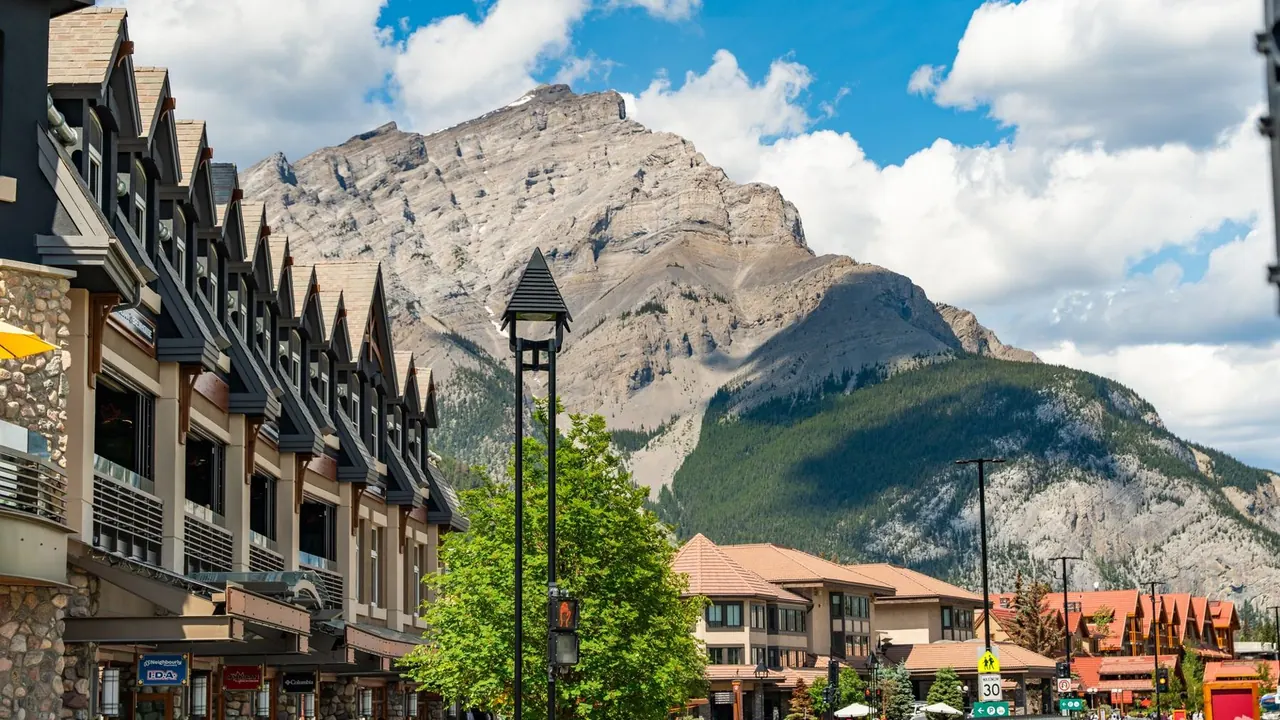
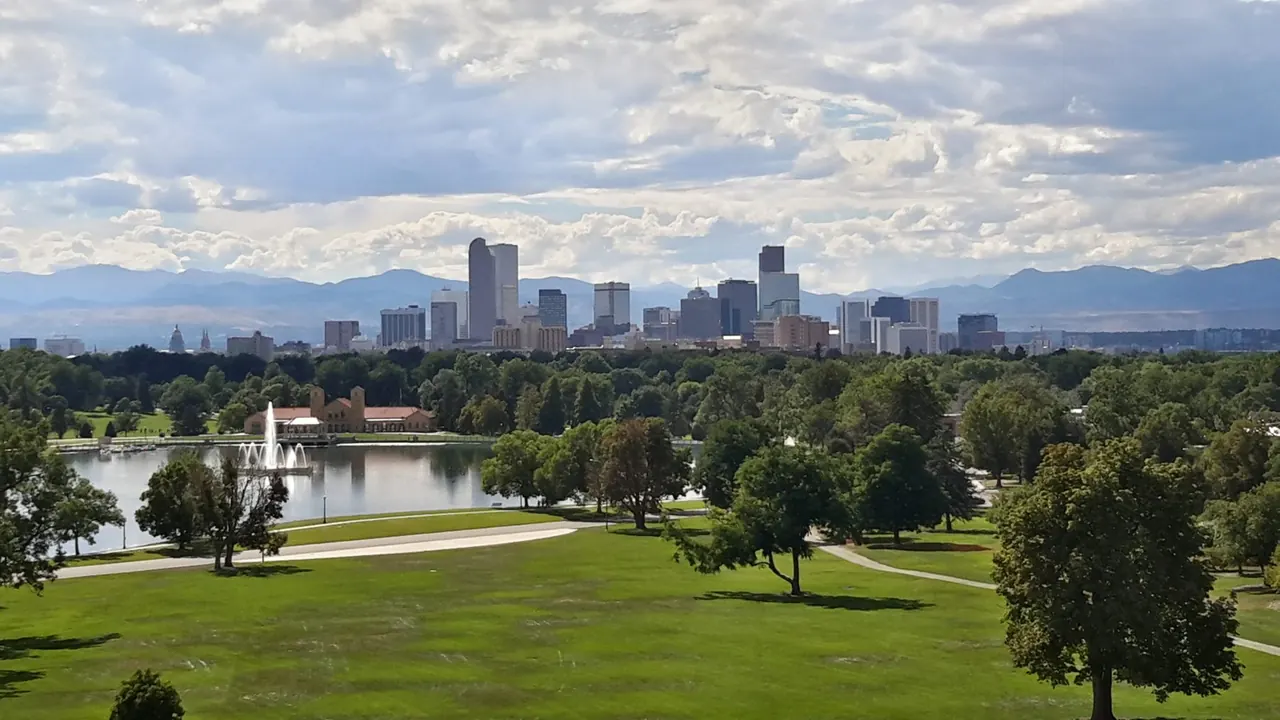
Photos: Banff by bryan pascual, Pexels License; Denver by Zenhaus, CC BY-SA 4.0, cropped.
Banff or Denver?
Our verdict in twelve categories, each scored against the same fixed benchmark cities, and the climate month by month, so you can choose for your trip.
Choose Banff for
- getting around
- nature and the outdoors
- wellness
Banff is the choice when the mountains are the whole point. You wake up inside a national park, with elk on the lawns, Cascade Mountain at the end of the main street and Lake Louise, Moraine Lake and the Icefields Parkway within reach. It suits hikers, skiers, wildlife watchers and anyone who wants a soak in a hot spring at the end of the day. You pay for it: rooms are scarce and dear, the restaurants are only adequate and the evenings are short.
Choose Denver for
- live music and the arts
- day trips
- food and drink
Travellers who want a city with the mountains on the horizon will be happier in Denver. It has far more to do after dark, from Red Rocks concerts and touring musicals to brewery taprooms in RiNo, and better museums, more varied food and a longer list of towns for day trips. It is also kinder to the budget. The trade-off is distance: the best scenery is an hour or two's drive away, and most outings need a hired car.
Scoreboard
Twelve categories on one fixed scale from 0 to 100. The shaded stretch is the gap between the two.
Your match
Pick a travel style or drag the sliders, and both match scores follow your weighting.
Wins on getting around and nature and the outdoors with your weighting.
Wins on live music and the arts and day trips with your weighting.
What matters to you?
Category by category
What the scores mean for a trip.
Beaches & swimming
Neither is a place to plan a swim around, but Banff gives the water a little more of a role. Johnson Lake warms enough on August afternoons for a proper dip, and the hot springs provide the warm water that the glacial lakes never will.
Denver, far from any coast, offers reservoir beaches at Cherry Creek and Chatfield on the city's edge, and otherwise hotel and public pools for cooling off in the summer heat.
Food & drink
Denver is the better place to eat and drink. It has some of the biggest brewing in the country, with taprooms in RiNo warehouses, plus green chile smothered over burritos, chef-run restaurants in Highland and LoHi, and long stretches of Vietnamese and Mexican cooking along Federal Boulevard.
Banff feeds hungry hikers well enough with steak, bison, elk and fondue, and the grand hotels have more ambitious menus. There are no markets, though, very little street food and less variety than you would expect in a place with so many visitors.
Culture & sights
Banff's sights all tell one story, the birth of Canada's national parks, from the Cave and Basin spring to the Banff Springs Hotel and the Whyte Museum's mountain art. You can see it all in a day.
Denver has two or three days of sightseeing. The Denver Art Museum, with its strong Native American collection, and the Clyfford Still Museum sit near the gold-domed Capitol, while the brick warehouses of LoDo, Larimer Square and the Beaux-Arts Union Station preserve the old Western commercial city.
Nightlife
Banff's nights are run by seasonal workers and skiers. A few pubs and dance bars on Banff Avenue get loud after après-ski, and everything is a short walk apart, though the scene is much the same every night and goes quiet in spring and autumn.
Denver has more variety. Sports crowds fill LoDo, RiNo has cocktail bars and taprooms, East Colfax has dives, and Highland and South Broadway offer slower neighbourhood evenings. Bars are the focus rather than clubs, and nights rarely run very late.
Nature & outdoors
Banff wins because the scenery is right outside the door. The town sits inside the national park, elk graze in the streets, and Lake Louise, Moraine Lake, Johnston Canyon and the glaciers of the Icefields Parkway are easy to reach. Hiking, paddling and three ski areas fill every season.
Denver has the Rockies on its western horizon, with Red Rocks and the Golden foothills about half an hour away and many summits over 4,000m. The national park and the big ski resorts are around two hours' drive, often in heavy traffic on I-70.
Day trips
Denver has many more towns to visit. Boulder under the Flatirons, the Victorian mining towns of Georgetown and Idaho Springs, Manitou Springs beside Colorado Springs and Breckenridge's old main street all make full days out, as long as you have a car.
From Banff, nearly every outing goes into the wilderness. For towns, the options are Canmore down the valley, a city day in Calgary, and the small stops of Field and Golden over the Continental Divide. Golden, British Columbia is a different place from Colorado's Golden.
Good for families
Both work well with children, but Denver has a slight lead because it has attractions made for them. City Park combines the zoo with the Museum of Nature & Science and its dinosaurs and planetarium, and the Children's Museum, an aquarium and an amusement park are grouped by the South Platte.
In Banff the landscape does the entertaining: the Sulphur Mountain gondola, the catwalks of Johnston Canyon, sheep beside the road and tobogganing in winter. For a zoo or science museum you have to go to Calgary.
Getting around
Banff is easier without a car. You can walk across the town in about twenty minutes, Roam Transit buses go to the gondola, Lake Minnewanka, Canmore and Lake Louise, and in summer park shuttles reach the busiest lakes. Only the Icefields Parkway and Yoho really need a car.
Denver has a walkable downtown and a train from the airport to Union Station, but outside the centre the city is built for cars. Red Rocks, the mountains and nearly every day trip mean hiring a car.
Shopping & style
Denver gives shoppers more to do. There is the upscale mall and boutique streets of Cherry Creek, vintage clothes and records on South Broadway, flagship outdoor stores and proper Western wear, from cowboy boots to hats.
Banff's shopping is limited to Banff Avenue: outfitters for forgotten boots, fudge, maple souvenirs, and a few galleries selling Indigenous art and mountain paintings, which make the best thing to take home.
Affordability
Neither is cheap, but Banff costs more. Building inside the park is restricted, so rooms are scarce, and park passes, lift passes, the gondola and resort-priced meals add up. Staying in Canmore or camping is the usual way to save.
Denver has normal big-city American prices and more ways to spend less. You can stay near the light rail and eat at taquerias and breweries, though a hire car takes a large share of most budgets.
Live music & performing arts
This is one of the biggest differences between the two. Denver has Red Rocks, a stage set between huge sandstone monoliths, and the many-block Performing Arts Complex with touring Broadway shows, the Colorado Symphony, opera and ballet. Five Points adds jazz with deep local roots.
Banff's arts life centres on the Banff Centre on Tunnel Mountain and its summer programme, plus the Mountain Film and Book Festival each autumn. On most other nights, live music means a band in a pub.
Wellness & relaxation
Banff was built around its springs, and an evening in the open-air pool of the Upper Hot Springs, ideally with snow falling, is part of many visits. The large spas in the grand hotels and the quiet out of peak season help too.
Denver has no bathing tradition of its own, so relaxing there means day spas, yoga studios and sunny parks. The mineral pools and steam caves of Idaho Springs are under an hour into the mountains.
When should you go?
Pick your month. The climate figures are measured averages, not a forecast.
Banff in July
Denver in July
Daytime high, °C
Rainfall in the month, mm
Temperature and rainfall are climate normals, averaged over the years shown. Banff: 1991-2020 normals, Banff (2 km from centre). Denver: 1991-2020 normals, Denver / Stapleton International, Co. (11.2 km from centre).
Banff has a true mountain climate. Daytime highs stay below freezing from December to February, and November and March are only just above zero, which suits skiers but makes strolling round town cold work. Summer is short and mild, with July reaching around 23°C, and these are the months for trails, lakes and the Icefields Parkway. June is the wettest month at about 66mm, while September is still pleasant for walking before the cold returns in October.
Denver is warmer in every month. Winter afternoons often reach about 8°C, so you can walk the city comfortably even in January, and its winters are drier than Banff's. July climbs to about 32°C, though, which makes midday sightseeing tiring. May and July are its wettest months, May at about 57mm, often in short showers. September and October are the easiest time to combine city streets with the foothills. In high summer the two balance each other: Denver is hot just when Banff is at its most comfortable.
Which traveller are you?
On an outdoors trip, Banff is the clear winner. The trails, lakes, glaciers and wildlife begin at the edge of town, three ski areas are close by in winter, and you can do without a car far more often than you could in Denver.
For a culture and arts trip, Denver offers much more. The Denver Art Museum and the Clyfford Still Museum stand near the State Capitol, the Performing Arts Complex covers theatre, symphony and ballet, and Red Rocks puts on summer concerts that Banff cannot match.
On a relaxing and wellness trip, Banff is the better place to slow down. It was founded as a hot-springs resort, the Upper Hot Springs pool looks across the valley, and the grand hotels have mineral pools. Denver's nearest natural springs are an hour away.
Before you go
| Measure | Banff | Denver |
|---|---|---|
| Official language | French, English | - |
| Currency | Canadian Dollar (CAD) | US Dollar (USD) |
| Sockets | AB120 V, 60 Hz | AB120 V, 60 Hz |
| Driving side | Right | Right |
| Time zone | UTC-7, UTC-6 in summer | UTC-7, UTC-6 in summer |
| Emergency number | 911 | 911 |
| Elevation | 1,400 m | 1,609 m |
| Main airport | Calgary International Airport (YYC)109 km from centre103 non-stop destinations | Denver International Airport (DEN)30 km from centre231 non-stop destinations |
| Public holidays this year | 13 days | 12 days |
By the numbers
| Measure | Banff | Denver |
|---|---|---|
| City population | 8,305 | 715,522 |
| People per km² | 1,730 | 1,783 |
| Museums within 10 km | 4 | 26 |
| UNESCO World Heritage sites within 50 km | 0 | 0 |
Where else could you go?
Every comparison below shares a destination with this one, so you can follow Banff or Denver somewhere new.