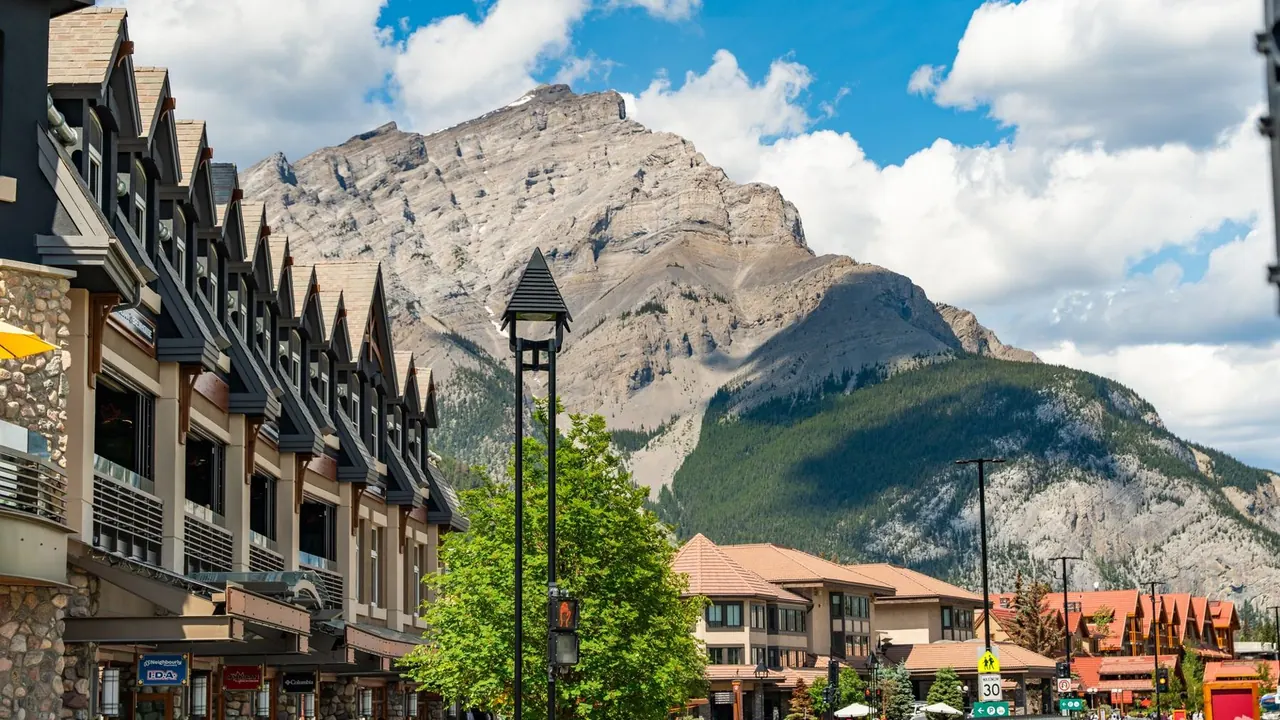
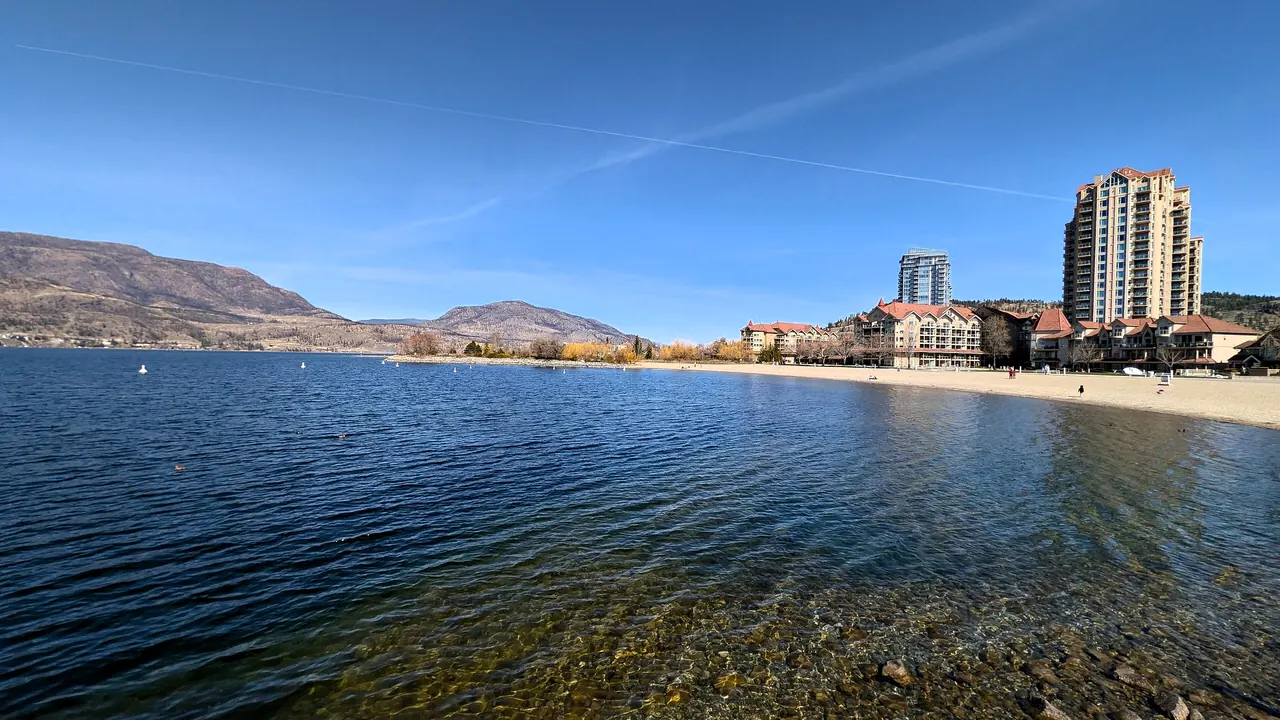
Photos: Banff by bryan pascual, Pexels License; Kelowna by Joli Rumi, CC BY-SA 4.0, cropped.
Banff or Kelowna?
Our verdict in twelve categories, each scored against the same fixed benchmark cities, and the climate month by month, so you can choose for your trip.
Choose Banff for
- getting around
- nature and the outdoors
- wellness
Banff is for travellers who want the mountains right outside the door. Glaciers, turquoise lakes, wildlife by the road, and trails or ski runs in every season are all reachable from a small town you can walk across, with buses to the main sights. Add the hot springs and the Banff Centre and it suits an active trip where the scenery is the whole point. In return you accept steep prices and fairly plain food.
Choose Kelowna for
- beaches
- food and drink
- day trips
Pick Kelowna for a warm summer by the water. Okanagan Lake gives it sandy beaches and long swims that Banff cannot match. The vineyards on the hills make eating and drinking the real pleasure of a stay, and there are wine-country towns to the south for more days out. It is a little gentler on the budget than Banff, though you will need a car to make the most of it.
Scoreboard
Twelve categories on one fixed scale from 0 to 100. The shaded stretch is the gap between the two.
Your match
Pick a travel style or drag the sliders, and both match scores follow your weighting.
Too close to call, 2 points apart
Wins on getting around and nature and the outdoors with your weighting.
Wins on beaches and food and drink with your weighting.
What matters to you?
Category by category
What the scores mean for a trip.
Beaches & swimming
The gap here is wide. Banff has no beach to speak of. Its lakes are fed by glaciers and stay cold even in midsummer, and only shallow Johnson Lake warms up enough on hot August afternoons for a short dip.
Kelowna becomes a lake resort in July and August. Hot Sands in City Park is a sandy beach right next to downtown, and Gyro and Rotary beaches lie further south, with water warm enough for long swims and paddleboarding. Outside those months its lake turns cold too.
Food & drink
Kelowna eats and drinks better. Its strength is the Okanagan wine country around it: winery terrace restaurants above the lake, summer fruit stands, a farmers' market, and cideries and distilleries, so a meal there tends to taste of the valley.
Banff's food is hearty and the choice is narrower: bison, elk, Alberta beef, fondue and pub plates along Banff Avenue, with the grand hotels for something more ambitious. Neither is a restaurant city, but only Kelowna gives food a real place in the trip.
Culture & sights
Neither town is a sightseeing destination, and each needs a day at most. Banff's sights tell a single story: the birth of Canada's national parks at the Cave and Basin, the Banff Springs Hotel built as a railway castle, and the Whyte and Buffalo Nations Luxton museums on mountain and Indigenous history.
Kelowna's sights are fewer and more local. The Okanagan Heritage Museum covers Syilx Okanagan and settler life, and with a small art gallery and the 1860s log buildings of Father Pandosy Mission, everything fits into one afternoon.
Nightlife
Going out is small-scale in both towns, but the seasons and crowds differ. Banff's pubs and dance bars on Banff Avenue run on seasonal workers and skiers, so après-ski keeps them loud through the winter, and the hotel lounges offer a quieter drink.
Kelowna's scene peaks in summer instead. Patio bars, brewery taprooms and a couple of clubs around Bernard Avenue fill with students and lake-weekend groups, then go quiet once the warm months end.
Nature & outdoors
Both are outdoor destinations, but Banff is in another league. It sits inside a national park, with Cascade Mountain at the end of the main street and elk on the lawns. Lake Louise, Moraine Lake, Johnston Canyon and the glaciers of the Icefields Parkway are all within reach, and there are three ski areas nearby.
Kelowna's landscape is gentler: dry, pine-dotted hills, vineyards and a long lake made for boating and wakeboarding. It also has the trestles of Myra Canyon, with Big White about an hour away. It is lovely country, but it lacks the high alpine scale and the wildlife that make Banff exceptional.
Day trips
Kelowna has more places to go for the day, nearly all of them in wine country. Penticton and the Naramata Bench are about an hour south, with Oliver, Osoyoos and the Nk'Mip desert cultural centre further on. Vernon has the historic O'Keefe Ranch, and Summerland runs a heritage steam train. You need a car for most of these.
From Banff, outings lead into the mountains rather than to towns. Canmore is close by, Calgary makes a big-city day about an hour and a half away, and Field and Golden are modest stops across the Continental Divide.
Good for families
A family day in Banff means mountains and animals: elk and bighorn sheep from the car window, the gondola up Sulphur Mountain, the boardwalk through Johnston Canyon and a warm soak in the hot springs. In winter there are ski schools, tobogganing and skating on frozen lakes as well.
In Kelowna the day centres on the lake in summer, with shallow, warm water, lakeside playgrounds, pick-your-own orchards and the flat Myra Canyon ride for young cyclists. Its attractions are spread along the highway, though, and midsummer heat can cut time outdoors short. Neither town has a zoo or an aquarium.
Getting around
Banff is far easier without a car. The town is compact and flat. Roam Transit buses reach the gondola, the hot springs, Lake Minnewanka, Canmore and Lake Louise, and in summer park shuttles serve the busiest lakes, so only the Icefields Parkway and the quieter trailheads really need a car.
In Kelowna, the walkable area ends with downtown and the waterfront path. Beyond that the city sprawls along Highway 97, and the wineries, Myra Canyon and Big White all practically require a car or a tour.
Shopping & style
Shopping is a sideshow in both. Banff Avenue is about outdoor gear, Canadian labels, fudge and galleries selling Indigenous and Rocky Mountain art, which is handy if you arrive without a warm layer.
Kelowna's best buys are things to eat and drink: wine from the cellar doors, cider, preserves and market produce. It also has a few boutiques on Bernard Avenue and a regional mall for the chains.
Affordability
Banff's rooms are scarce because building is restricted inside the national park, so stays in summer and over Christmas are steep. The gondola, lift passes, park pass and resort-priced restaurants keep adding to the bill, and budget travellers often sleep in Canmore or camp.
Kelowna is the smaller bill. It still charges peak rates for lakefront stays in July and August, and car hire is close to essential. Outside summer and the Big White ski weeks, though, rooms are much cheaper, and the beaches, parks and trails cost nothing.
Live music & performing arts
Banff has the slightly stronger offer, thanks to the Banff Centre for Arts and Creativity on Tunnel Mountain, which stages concerts and dance mainly in summer. The Banff Mountain Film and Book Festival each autumn is worth timing a trip around if adventure films appeal.
Kelowna's stage is regional: the Okanagan Symphony Orchestra, community theatre, touring acts at the downtown arena, and free summer concerts in the lakeside park and on winery patios.
Wellness & relaxation
Banff has the edge because it has hot springs. The Upper Hot Springs, a 1930s bathhouse with an open-air mineral pool looking across the valley, is a fine end to a day on the slopes, and the grand hotels add large spas. Still, it is one pool rather than a bathing culture.
Kelowna has no thermal water, so relaxing there means a resort spa, a long lunch on a vineyard terrace and quiet mornings on the lake.
When should you go?
Pick your month. The climate figures are measured averages, not a forecast.
Banff in July
Kelowna in July
Daytime high, °C
Rainfall in the month, mm
Temperature and rainfall are climate normals, averaged over the years shown. Banff: 1991-2020 normals, Banff (2 km from centre). Kelowna: 1991-2020 normals, Kelowna Mws0 (8.4 km from centre).
Banff has a short warm season. July and August are its best months, with highs around 23°C, ideal for hiking and the lakes but never warm enough for a proper swim. June brings the most rain, at 66mm. From November to March daytime highs sit near or below freezing, which suits skiers and evenings in the hot springs more than walking around town. September is cool and good for the trails as the larches turn gold, and October is drier but noticeably colder.
Kelowna is several degrees warmer all year. July and August reach about 30°C with little rain, and this is the only stretch when the lake is warm enough for beach days. May, June and September are pleasant for vineyards and trails without the peak heat. Winters are milder than Banff's, just above freezing, but they are a quiet season unless you are heading up to Big White to ski.
Which traveller are you?
On a beach and sun trip, Kelowna wins easily. Sandy city beaches on Okanagan Lake, hot dry summers and paddleboarding off Rotary Beach make for real lake days. Banff's glacier-fed water is for a brave plunge, and its warmth comes from the hot springs.
For an outdoors trip, Banff is the stronger base. The national park starts at the edge of town, with Lake Louise, Johnston Canyon, the Icefields Parkway, wildlife beside the roads and three ski areas. Kelowna offers fine lake sports, Myra Canyon and Big White, but on a smaller scale.
On a food and nightlife trip, Kelowna has the edge thanks to its winery terraces, orchard fruit, cideries and craft breweries. Evenings out are small and seasonal in both towns, but Banff's steakhouses and fondue make a narrower table to build a trip around.
Before you go
| Measure | Banff | Kelowna |
|---|---|---|
| Official language | French, English | French, English |
| Currency | Canadian Dollar (CAD) | Canadian Dollar (CAD) |
| Sockets | AB120 V, 60 Hz | AB120 V, 60 Hz |
| Driving side | Right | Right |
| Time zone | UTC-7, UTC-6 in summer | UTC-8, UTC-7 in summer |
| Emergency number | 911 | 911 |
| Elevation | 1,400 m | 344 m |
| Main airport | Calgary International Airport (YYC)109 km from centre102 non-stop destinations | Kelowna International Airport (YLW)10 km from centre24 non-stop destinations |
| Public holidays this year | 13 days | 11 days |
By the numbers
| Measure | Banff | Kelowna |
|---|---|---|
| City population | 8,305 | 144,576 |
| People per km² | 1,730 | 683 |
| Museums within 10 km | 4 | 0 |
| UNESCO World Heritage sites within 50 km | 1 | 0 |
Where else could you go?
Every comparison below shares a destination with this one, so you can follow Banff or Kelowna somewhere new.
- Canmorevs Banff
- Lake Louisevs Banff
- Calgaryvs Banff
- Whistlervs Kelowna
- Jaspervs Banff
- Vancouvervs Kelowna