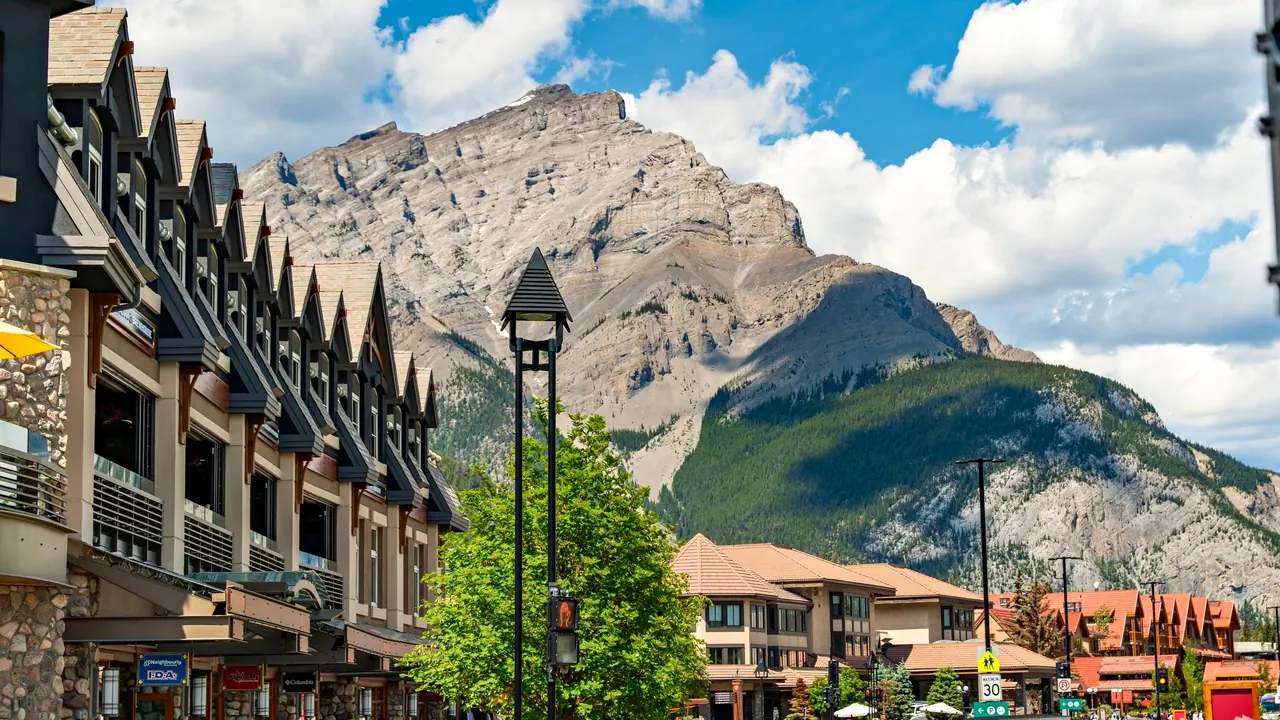
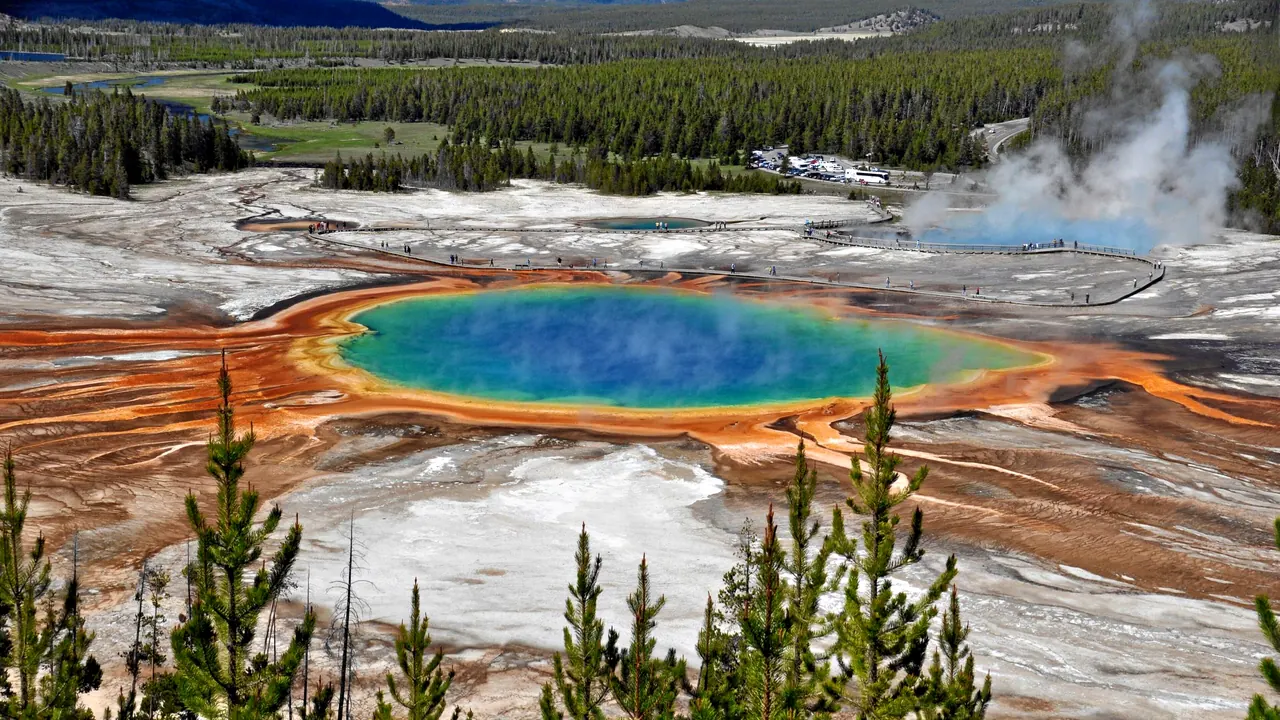
Photos: Banff by bryan pascual, Pexels License; Yellowstone by James St. John from Newark, Ohio, CC BY 2.0, cropped.
Banff or Yellowstone?
Our verdict in twelve categories, each scored against the same fixed benchmark cities, and the climate month by month, so you can choose for your trip.
Choose Banff for
- getting around
- wellness
- nightlife
Banff suits travellers who want the Rockies with a real town around them. You can walk to dinner along Banff Avenue, take a local bus to the gondola or the hot springs, and finish the day in a pub or the Upper Hot Springs pool. In winter it becomes a ski base with three ski areas within reach, something Yellowstone does not offer. It is the easier, more sociable choice, and it suits people who would rather not spend their days at the wheel.
Choose Yellowstone for
- culture and sights
- prices
- day trips
Yellowstone is for a road trip built around sights found nowhere else: erupting geysers, Grand Prismatic Spring, and wolves and grizzlies watched at dawn in Lamar Valley. The price is a hire car, hours on the Grand Loop Road and evenings that end soon after dark. In return it has the deeper national park heritage, and campgrounds and the smaller gateway towns make it somewhat easier on the budget. Choose it if wildlife and geology matter more to you than what happens after sunset.
Scoreboard
Twelve categories on one fixed scale from 0 to 100. The shaded stretch is the gap between the two.
Your match
Pick a travel style or drag the sliders, and both match scores follow your weighting.
Wins on getting around and wellness with your weighting.
Wins on culture and sights and prices with your weighting.
What matters to you?
Category by category
What the scores mean for a trip.
Beaches & swimming
Neither is a place to swim, and the cold water they have is different. Banff has Johnson Lake, a shallow lake with a small grassy shore that warms enough for a picnic and a swim on hot August afternoons, and its warm water comes from the hot springs. Yellowstone has no equivalent. Its great lake stays around 10°C, the thermal pools are off limits, and a quick plunge in the Firehole River canyon near Madison is about as far as it goes.
Food & drink
Neither is a reason to travel, but Banff feeds you more easily. Within a short walk it has steakhouses serving Alberta beef, bison and elk, fondue, pub plates and good coffee, and the grand hotels serve more ambitious menus built on mountain and prairie produce.
Eating in Yellowstone takes planning. Inside the park the choice is the historic lodge dining rooms, cafeterias and general-store counters, and they close early, so most people carry packed lunches. It has its own regional touches, such as Rocky Mountain trout and huckleberry pie, but the serious cooking is in Jackson and Bozeman, a long drive from the geyser basins.
Culture & sights
Both tell the story of how a national park system began, and Yellowstone tells it on a bigger scale. As the world's first national park, it has the Old Faithful Inn with its cavernous log-and-stone lobby, the Roosevelt Arch and the old army buildings of Fort Yellowstone at Mammoth. The Buffalo Bill Center of the West in Cody is a serious museum of Plains Indian cultures and Western art, about an hour beyond the east entrance.
In Banff the Cave and Basin site marks where Canada's parks began, and the Banff Springs Hotel, the Whyte Museum and the Luxton Museum fill a pleasant day. They are all close together in town, but there is less to see.
Nightlife
This is one of the clearest differences between them. Banff's young seasonal workers and the winter ski crowd keep a few pubs and dance bars on and around Banff Avenue busy late, and you can walk between all of them. It is casual and limited, but it exists.
Yellowstone has almost no nightlife. A drink in a lodge lounge, a ranger talk or the night sky is the evening, and because the wildlife is best at dawn, most visitors are asleep early.
Nature & outdoors
Both are superb for scenery and wildlife, but the landscapes are very different. Banff is alpine country that starts at the end of the street. Cascade Mountain closes off the view down Banff Avenue, and bighorn sheep and mountain goats are often seen along the roads. Further out are the glacier-fed turquoise lakes at Lake Louise and Moraine Lake, the catwalks of Johnston Canyon and the Icefields Parkway running north past glaciers. Summer brings rafting, climbing and high alpine passes, and in autumn the larches turn gold.
Yellowstone's wonders are volcanic and spread across a vast plateau. It has most of the world's active geysers, along with Grand Prismatic Spring, the Mammoth terraces and the yellow rock of the canyon at Lower Falls. Its wildlife is on a bigger scale, with bison herds in Hayden Valley and wolves in Lamar Valley, and the Tetons rise just to the south.
Day trips
Neither is a good base for visiting towns, and the outings they do offer are different. From Banff, Canmore is a short hop down the valley, and Calgary, about an hour and a half away, gives you a big-city day with museums and the Stampede grounds.
Yellowstone's trips are Western rather than urban: Cody, the town Buffalo Bill built, Jackson's galleries and town square, the gold-rush settlements of Virginia City and Nevada City, and the high Beartooth Highway to Red Lodge. There is a little more variety, but each one takes a long day of driving.
Good for families
Children are well looked after in both, and the difference is in how the days go. Banff keeps distances short: the gondola, a canoe on the Bow River and the hot springs are all close to your bed, and winter adds ski schools and tobogganing.
Yellowstone has the bigger thrills. Old Faithful erupts on schedule, mud pots bubble and children can earn a Junior Ranger badge. The cost is hours in the car, and parents have to keep children on the boardwalks and well back from the bison.
Getting around
Banff is much easier without a car. The town takes about twenty minutes to walk across, Roam Transit buses run to the gondola, Lake Minnewanka, Canmore and Lake Louise, and summer shuttles serve the busiest lakes. You only really need a car for the Icefields Parkway and Yoho.
In Yellowstone a car is essential. The Grand Loop Road runs about 230km at low speeds, often held up by bison and full car parks, and there is no public transport inside the park. From November to April the interior can only be reached by snowcoach or snowmobile tour.
Shopping & style
Banff gives you more to browse. Banff Avenue has well-stocked outdoor outfitters, Canadian clothing labels and a few galleries of Indigenous art and Rocky Mountain painting, which make good rainy-afternoon stops. In Yellowstone the shops are mostly lodge gift shops and general stores, and the main extras are the Western boots, hats and wildlife bronzes of Cody and Jackson.
Affordability
Both are expensive in summer, and Yellowstone is the somewhat cheaper of the two. Building limits inside Banff's park keep rooms scarce, and the gondola, lift passes and resort-priced meals push the bill up. Budget travellers there usually stay in Canmore or camp.
Yellowstone's lodges and motels are also overpriced for what they offer, and the hire car is unavoidable. Still, its many campgrounds and small gateway towns make it easier to cut costs, and once you are inside the park every geyser basin and valley is free.
Live music & performing arts
Banff has a real arts institution. The Banff Centre on Tunnel Mountain puts on concerts and dance, with its fullest programme in summer, and each autumn the Mountain Film and Book Festival brings in adventurers and filmmakers. Yellowstone's offer is thinner and more Western: the summer evening rodeo in Cody, musicals in West Yellowstone, and an orchestral season at the Grand Teton Music Festival near Jackson. Inside the park, the entertainment is a ranger talk by the campfire.
Wellness & relaxation
Banff is the place for a soak. The Upper Hot Springs is a 1930s bathhouse with a mineral-water pool overlooking the valley, and the grand hotels have large spas with mineral pools of their own.
Yellowstone's ground steams everywhere, yet you cannot bathe in any of its springs. For a soak you have to drive out to the hot-spring pools near Gardiner or in Paradise Valley. Its calm is the calm of a dawn by the lake or a backcountry trail, rather than a spa.
When should you go?
Pick your month. The climate figures are measured averages, not a forecast.
Banff in July
Yellowstone in July
Daytime high, °C
Rainfall in the month, mm
Where the figures come from
Yellowstone has no weather station within reach, so its figures come from a gridded climate model rather than a measured record, and read a broad area rather than one spot.
Temperature and rainfall are climate normals, averaged over the years shown. Banff: 1991-2020 normals, Banff (2 km from centre). Yellowstone: 2001-2020 normals, NASA POWER reanalysis grid, no weather station within 90 km.
Both are summer destinations, and July and August are the warm months in each. Banff reaches about 23°C in July, which is good weather for hiking and paddling. June is its wettest month at 66mm, so early summer can bring grey, damp days. Around the park's main visitor areas, Yellowstone is slightly warmer at about 25°C in July, and late summer is its driest stretch. September is mild and settled in both, and it is a good month for trails with fewer long, hot afternoons.
The two part ways in winter. Banff's winters are cold but fairly dry, with snow for skiing and lake skating from December onwards. Yellowstone's are colder and much wetter, with highs near -6°C, snowfall peaking around 86mm in December, and most roads closed to cars from early November to late April. That leaves its interior to snowcoach tours, so for a winter trip Banff is the far more practical choice.
Which traveller are you?
For a food and nightlife trip, Banff is clearly the better pick. Banff Avenue has steakhouses, hotel dining rooms and craft beer, and pubs and dance bars stay loud late. Yellowstone's lodge kitchens close early, and its evenings are spent stargazing.
On a trip on a tight budget, Yellowstone stretches the money a little further. Neither is cheap, but its campgrounds, picnic lunches and smaller gateway towns ease the cost, and the geysers cost nothing beyond park entry. Banff's limited rooms, gondola and lift passes add up quickly.
For skiers, only Banff makes sense. Sunshine Village, Lake Louise and Mt Norquay are all close to town, with ski schools, après-ski and the hot springs afterwards. In winter Yellowstone's roads close, and its snow is seen from a snowcoach rather than skied.
Before you go
| Measure | Banff | Yellowstone |
|---|---|---|
| Official language | French, English | - |
| Currency | Canadian Dollar (CAD) | US Dollar (USD) |
| Sockets | AB120 V, 60 Hz | AB120 V, 60 Hz |
| Driving side | Right | Right |
| Time zone | UTC-7, UTC-6 in summer | UTC-7, UTC-6 in summer |
| Emergency number | 911 | 911 |
| Elevation | 1,400 m | - |
| Main airport | Calgary International Airport (YYC)109 km from centre102 non-stop destinations | Bozeman Yellowstone International Airport (BZN)27 non-stop destinations |
| Public holidays this year | 13 days | 11 days |
By the numbers
| Measure | Banff | Yellowstone |
|---|---|---|
| Population | 8,305 | - |
| People per km² | 1,730 | - |
| Museums within 10 km | 4 | - |
| UNESCO World Heritage sites within 50 km | 1 | - |
Where else could you go?
Every comparison below shares a destination with this one, so you can follow Banff or Yellowstone somewhere new.
- Canmorevs Banff
- Lake Louisevs Banff
- Grand Tetonvs Yellowstone
- Jackson Holevs Yellowstone
- Jaspervs Banff
- Edmontonvs Banff