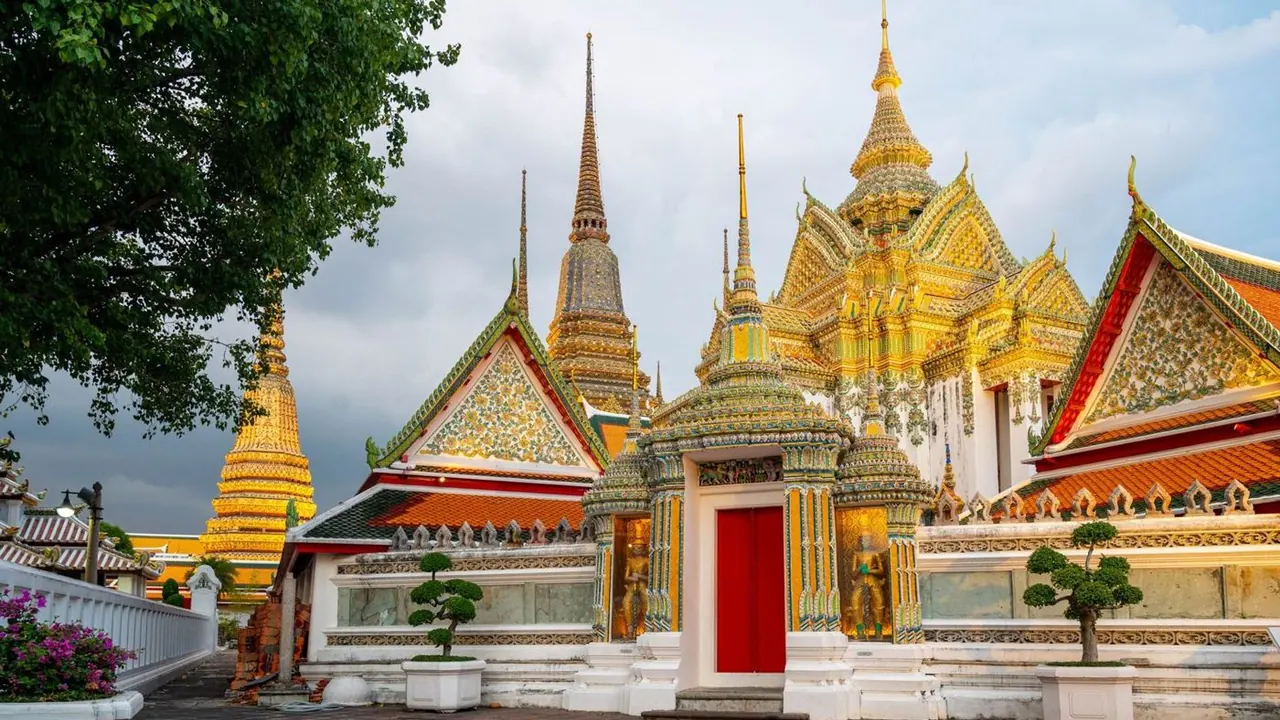
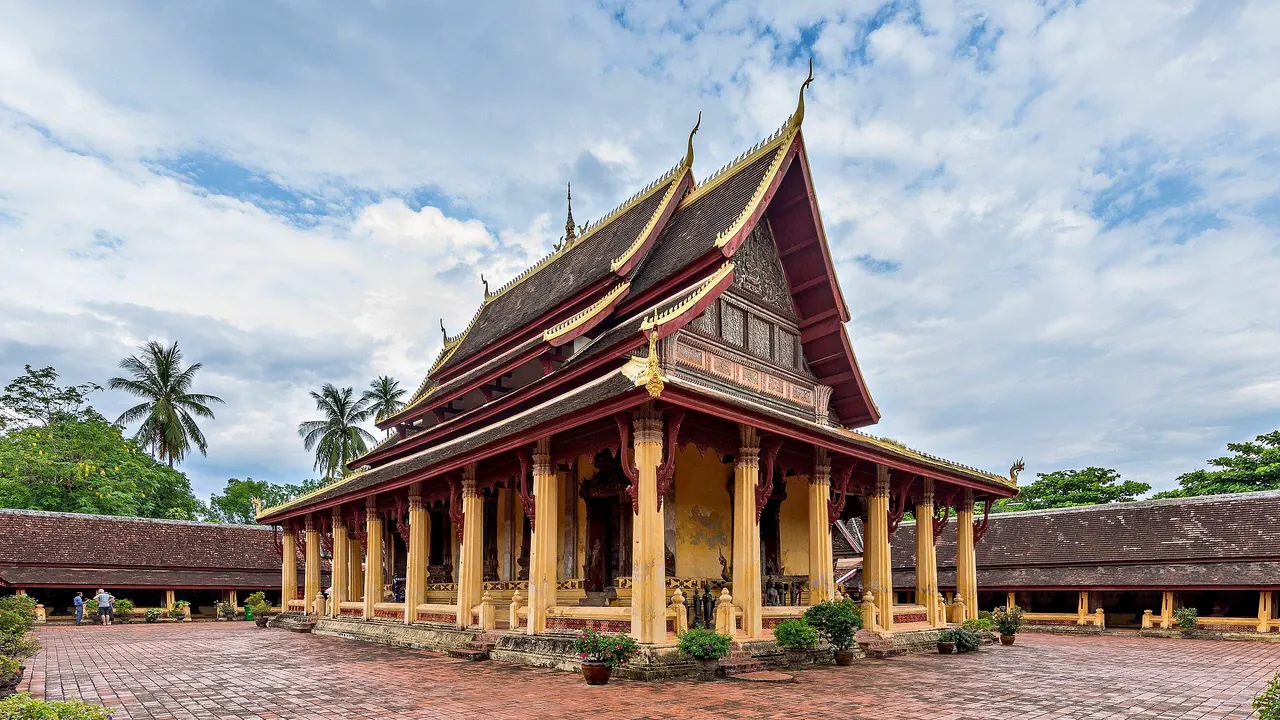
Photos: Bangkok by Lu Zhao, Pexels License; Vientiane by Basile Morin, CC BY-SA 4.0, cropped.
Bangkok or Vientiane?
Our verdict in twelve categories, each scored against the same fixed benchmark cities, and the climate month by month, so you can choose for your trip.
Choose Bangkok for
- nightlife
- shopping
- food and drink
Bangkok is the choice for a traveller who wants a big, full city. It has one of the world's great street-food scenes, the gilded temples of Rattanakosin, huge markets and malls, and nights that run until closing time. It asks more of you, with heat, traffic and hard pavements, but you get far more to do each day, and some of the best day trips in the region.
Choose Vientiane for
- nature and the outdoors
- prices
Vientiane suits a slower, quieter trip, and works well as a gateway to the north of Laos. The capital itself takes a couple of easy days: a few fine temples, Lao food by the Mekong at sunset, a herbal sauna and an early night. Its real draw lies an hour or two up the railway, in the karst country of Vang Vieng and the old royal town of Luang Prabang. Choose it for calm and the outdoors, not for the city itself.
Scoreboard
Twelve categories on one fixed scale from 0 to 100. The shaded stretch is the gap between the two.
Your match
Pick a travel style or drag the sliders, and both match scores follow your weighting.
Wins on nightlife and shopping with your weighting.
Wins on nature and the outdoors and prices with your weighting.
What matters to you?
Category by category
What the scores mean for a trip.
Beaches & swimming
Neither city is a place for a beach trip, but Bangkok at least has the sea within reach. Bang Saen and Pattaya make a long day out by road, and a few nights in Hua Hin or on the islands are easy to add to a trip.
Vientiane is landlocked, nobody swims in the Mekong, and the nearest place to get in the water is the river and lagoons around Vang Vieng. In both cities a swim usually means a hotel pool, and Bangkok's rooftop pools are the better consolation.
Food & drink
This is one of the widest gaps between the two cities. Bangkok is a city people travel to just to eat: boat noodles at plastic tables, the long open-air kitchen of Yaowarat Road after dark, the produce halls at Or Tor Kor, and a deep layer of serious restaurants reworking regional Thai cooking, plus strong Japanese and Chinese food.
Vientiane eats well but in a narrower range. Sticky rice, larb and grilled river fish, baguettes left over from the French years and Bolaven Plateau coffee are a pleasure, especially at the riverbank grills. Beyond Lao, Thai and Vietnamese cooking, though, the choice runs out quickly.
Culture & sights
Bangkok's old city can keep a temple lover busy for several days. Rattanakosin Island holds the Grand Palace and Wat Phra Kaew, Wat Pho's Reclining Buddha and, across the river, the porcelain tiers of Wat Arun, with the Golden Mount and dozens of smaller working temples beyond. The National Museum, the Jim Thompson House and the stilt houses along the Thonburi canals add variety, though the museums are a shorter list than the temples.
Vientiane's sights fit into a day or two at an easy pace: the gilded stupa of Pha That Luang, the cloister of small Buddhas at Wat Si Saket and the view down the main avenue from Patuxai. The COPE centre on unexploded ordnance is its most affecting visit and Buddha Park its oddest, but there is no great museum or large historic quarter to set beside Bangkok's riverside temples.
Nightlife
For going out, the two cities sit at opposite ends. Bangkok lets you choose your kind of night: cocktail bars and clubs in Thonglor and Ekkamai, cheap, loud street drinking on Khao San Road, Silom's gay bars, or a rooftop bar above the river, with most places going until closing around two.
Vientiane's night is a sunset Beerlao at a riverside table, maybe a backpacker bar or a club playing Lao and Thai pop, and the city is mostly quiet by midnight.
Nature & outdoors
Here Vientiane comes out ahead, mainly because of what is close by. Vang Vieng's karst peaks, caves and climbing are an hour north by train, Phou Khao Khouay has forest trails and waterfalls, and the flat lanes through rice fields on the city's edge are easy to cycle in the dry months.
Bangkok's outdoors within the city amounts to Lumphini Park's monitor lizards and an afternoon cycling the raised paths of Bang Krachao. Khao Yai's forests and elephants and the river country around Kanchanaburi are fine, but each needs an overnight stay.
Day trips
Bangkok has more choice within an easy day. Ayutthaya's ruined temples are explored best by bicycle, Amphawa and Damnoen Saduak have floating markets, the Maeklong market folds its stalls back for passing trains, and Kanchanaburi's Death Railway bridge makes a long but worthwhile day.
Vientiane relies on the railway north. Vang Vieng fits easily into a day, and Luang Prabang can be reached in about two hours, though it deserves a night. Across the Friendship Bridge, Nong Khai's sculpture garden is the other option, after which the list runs short.
Good for families
Children are welcomed warmly in both cities, but Bangkok has far more to keep them busy: the aquarium under Siam Paragon, Safari World, Dream World, KidZania and big indoor play areas in the malls for the hottest hours. Skytrain and river boat rides help too.
In Vientiane, Buddha Park's giant statues and a small water park are about all there is. Its calm streets are easier on the nerves, but in both cities the heat and poor pavements mean short days and a hotel pool.
Getting around
Bangkok has rail for the long distances. The air-conditioned BTS and MRT link Siam, Sukhumvit, Silom and Chinatown, and the Chao Phraya boats reach the Grand Palace. Between stations, though, gridlocked roads and difficult pavements make it slow going.
Vientiane has no metro and the buses are of little use, but its centre is compact enough to walk and traffic is light. A rented bicycle or a tuk-tuk covers Pha That Luang and Buddha Park.
Shopping & style
Bangkok is one of Asia's great shopping cities. The malls around Siam and Ratchaprasong are linked by Skytrain walkways, from Siam Paragon's luxury floors to MBK's bargain electronics, and Chatuchak Weekend Market can fill a morning with ceramics, plants and vintage finds.
Vientiane's shopping is mostly textiles: handwoven Lao silk and cotton in patterns that vary by ethnic group, sold in small galleries, at Talat Sao and at the riverside night market. Its malls are modest.
Affordability
Both cities are very cheap, and Vientiane is slightly cheaper. Its guesthouses, noodle soups, Beerlao and massages cost little across the board, though tuk-tuk fares should be agreed before setting off.
In Bangkok, money also goes a long way at street stalls and in comfortable hotels. Costs climb at rooftop bars, international restaurants and the Grand Palace, and when you stay in Sukhumvit or by the river rather than Banglamphu.
Live music & performing arts
Neither is a city for opera or a theatre district, but Bangkok's stage offer is far larger, with one art worth planning an evening around: khon, the masked dance drama of the Ramakien, at the Sala Chalermkrung Royal Theatre and the National Theatre. The Thailand Cultural Centre adds the symphony orchestra, and Muay Thai at Rajadamnern comes with its own ritual music.
In Vientiane, the stage amounts to Lao dance shows with the khaen mouth organ put on for visitors, a few cover bands, and music at temple festivals if your dates match.
Wellness & relaxation
For massage and spas Bangkok goes further, while Vientiane answers with quiet and a steam tradition of its own. Wat Pho still teaches and gives traditional Thai massage, parlours on every street stay open late, and the grand hotels run some of Asia's most refined spas. The catch is the heat and noise, so you unwind in short spells.
Vientiane's Lao herbal sauna is the local ritual: wooden steam rooms scented with lemongrass and tamarind, at temples such as Wat Sok Pa Luang, followed by herbal tea and a massage. The slow pace of the city does the rest, though luxury spas are few.
When should you go?
Pick your month. The climate figures are measured averages, not a forecast.
Bangkok in July
Vientiane in July
Daytime high, °C
Rainfall in the month, mm
Temperature and rainfall are climate normals, averaged over the years shown. Bangkok: 1991-2020 normals, Bangkok (5.7 km from centre). Vientiane: 1991-2020 normals, Vientiane (7.6 km from centre).
Both cities follow the same pattern: dry from November to March, a hot build-up in April, then monsoon rain from May. Bangkok is hot all year. Daytime highs never fall below 32°C and reach 36°C in April, so in any month the streets are best walked early or late. December and January are the most comfortable months, nearly dry and sunny. The rain comes late in Bangkok, peaking at about 331mm in September and staying heavy through October, and the sea at the eastern seaboard beaches is warm enough for swimming in every month.
Vientiane is a little cooler in the dry season, with highs around 29°C in December and January, the best time for cycling the rice-field lanes and walking along the river. Its rains peak earlier, at about 333mm in August, and clear sooner, so October is already fairly dry there while Bangkok is still wet. Both cities lose much of their sunshine from June to September.
Which traveller are you?
For a food and nightlife trip, Bangkok is the clear pick. Eating well costs little at any hour, the range runs from street stalls to ambitious Thai restaurants, and a night out can carry on until closing. Vientiane's evenings are pleasant but short, usually one beer by the river.
On an outdoors trip, Vientiane is the better base. Real landscape starts a short train ride away, and the quiet, flat streets are easy to cycle. From Bangkok, getting into the countryside costs nights away from the city, and the heat makes long active days hard work.
For a shopping trip, choose Bangkok for range and comfort. You can spend whole air-conditioned days moving between malls on foot, then go bargaining at the markets at weekends and after dark. Vientiane suits a shopper with one aim, fine handmade textiles, and offers little beyond that.
Before you go
| Measure | Bangkok | Vientiane |
|---|---|---|
| Official language | Thai | Lao |
| Currency | Baht (THB) | Lao Kip (LAK) |
| Sockets | ABCF220 V, 50 Hz | ABCEF230 V, 50 Hz |
| Driving side | Left | Right |
| Time zone | UTC+7 | UTC+7 |
| Emergency number | Police 191, ambulance 1669, fire 199 | Police 191, ambulance 195, fire 190 |
| Elevation | 2 m | 174 m |
| Main airport | Suvarnabhumi Airport (BKK)26 km from centre150 non-stop destinations | Wattay International Airport (VTE)7 km from centre41 non-stop destinations |
By the numbers
| Measure | Bangkok | Vientiane |
|---|---|---|
| City population | 5,676,648 | 948,487 |
| People per km² | 3,619 | 242 |
| Museums within 10 km | 61 | 2 |
| UNESCO World Heritage sites within 50 km | 0 | 1 |
| Swim season, months above 21 °C | 12 months | - |
Where else could you go?
Every comparison below shares a destination with this one, so you can follow Bangkok or Vientiane somewhere new.
- Ayutthayavs Bangkok
- Pattayavs Bangkok
- Hua Hinvs Bangkok
- Luang Prabangvs Vientiane
- Siem Reapvs Bangkok
- Chiang Raivs Vientiane