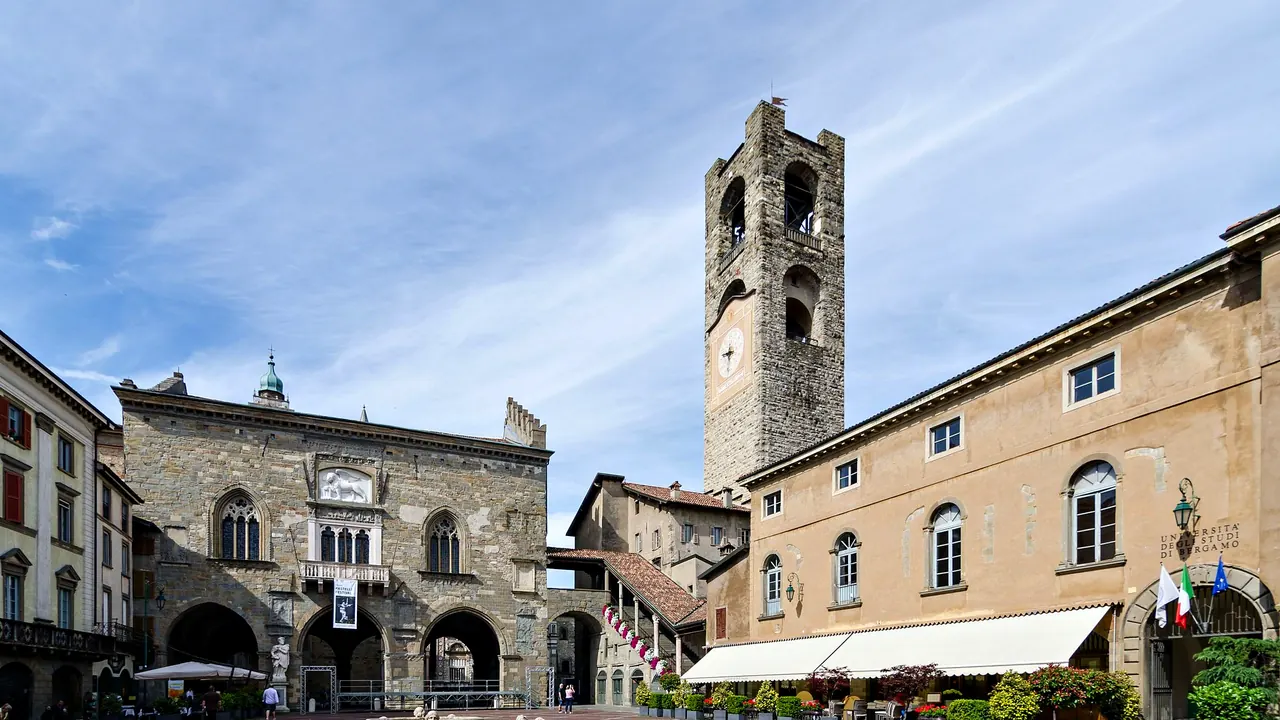
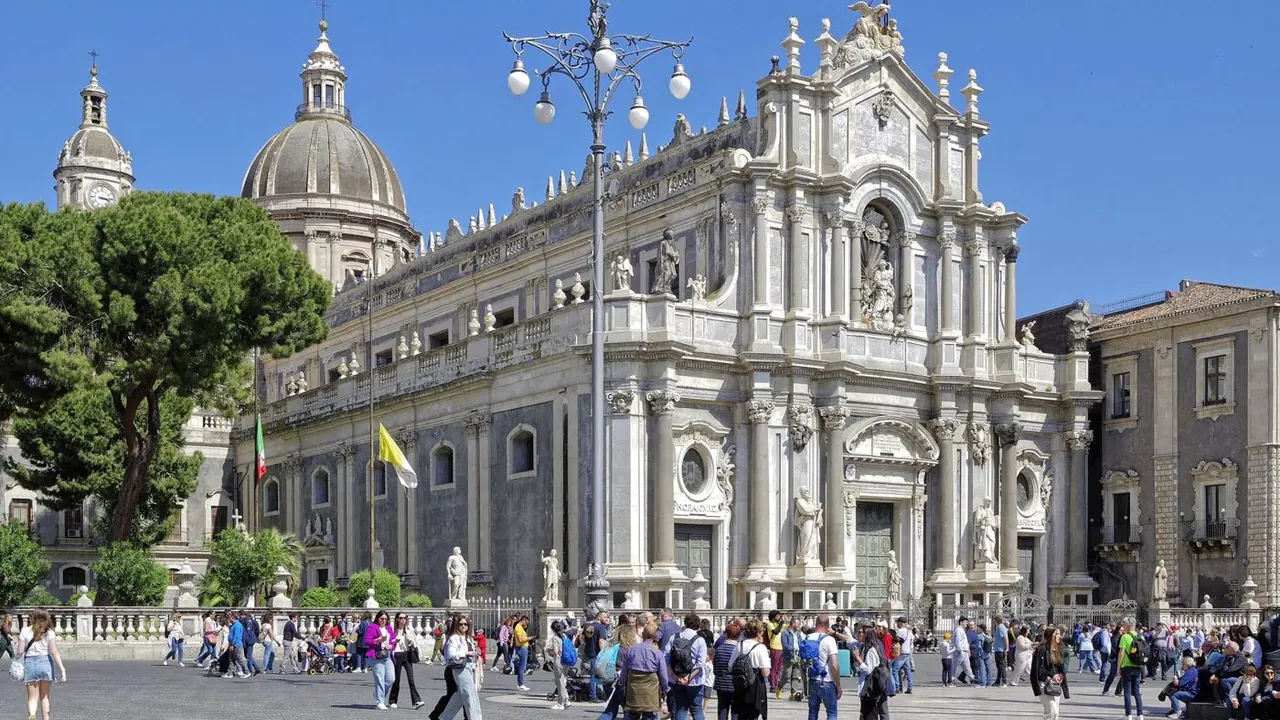
Photos: Bergamo by Steffen Schmitz, CC BY-SA 4.0, cropped; Catania by Berthold Werner, CC BY-SA 4.0, cropped.
Bergamo or Catania?
Our verdict in twelve categories, each scored against the same fixed benchmark cities, and the climate month by month, so you can choose for your trip.
Choose Bergamo for
- wellness
- getting around
- culture and sights
Bergamo suits a traveller who wants an old town to wander, easy logistics and a calm base. The walled Città Alta and the Accademia Carrara give it the richer sightseeing of the two, the funiculars and direct trains make it simple to get about without a car, and the spa towns of the valleys are close by. It also works well as a rail base for Milan, the lakes and the Orobie Alps.
Choose Catania for
- beaches
- nightlife
- food and drink
Pick Catania for heat, sea and appetite. It has real swimming on both sand and lava rock, some of the best street food in southern Italy, nights that run well past midnight, and Etna smoking above the city. It is also the cheaper place to eat and sleep. In return it is noisier and harder to get around, and a hire car helps for the volcano and the baroque towns.
Scoreboard
Twelve categories on one fixed scale from 0 to 100. The shaded stretch is the gap between the two.
Your match
Pick a travel style or drag the sliders, and both match scores follow your weighting.
Wins on wellness and getting around with your weighting.
Wins on beaches and nightlife with your weighting.
What matters to you?
Category by category
What the scores mean for a trip.
Beaches & swimming
Catania is a genuine seaside city, and Bergamo is not. Catania gives you a choice between the broad sand and beach clubs of La Playa and the platforms and ladders among the basalt stacks at Aci Trezza, with Isola Bella in Taormina an hour away if you want something prettier.
From Bergamo, swimming means a day out to Lake Iseo or the Lecco arm of Lake Como. The water is pleasant by July, but the shores are pebble, grass and concrete. That is fine for a hot afternoon, but no reason to choose the city.
Food & drink
Catania eats better, and much of the best of it is on the street: cone-shaped arancini, fried crispelle, smoky horse-meat grills on Via Plebiscito, and granita with brioche for breakfast. La Pescheria supplies the trattorias around it, and Etna's volcanic wines add real interest.
Bergamo's cooking is heavier and more rural, built on casoncelli, polenta, game and some of Italy's finest cheeses, such as Taleggio and Strachitunt, with Franciacorta sparkling wine nearby. It has the stronger fine-dining tier of the two. Catania is the place to graze cheaply, and Bergamo the place for a long sit-down meal.
Culture & sights
Bergamo has the edge, mainly because the Città Alta is so complete: a hilltop town inside UNESCO-listed Venetian walls, with Santa Maria Maggiore and the marble front of the Cappella Colleoni around Piazza Vecchia. Below the hill, the Accademia Carrara holds Raphael, Mantegna and Giovanni Bellini, a stronger collection than anything in Catania.
Catania's appeal is a whole cityscape rather than great collections. Its late-baroque streets of black lava and pale limestone, Via dei Crociferi and the vast monastery of San Nicolò l'Arena are built over Roman ruins, and its museums are modest. If you come in early February, the Feast of Sant'Agata is one of the great religious processions in Italy.
Nightlife
Catania is far livelier after dark. Crowds drink outside the small bars around Piazza Bellini and Via Gemmellaro until long after midnight, and in summer the La Playa beach clubs turn into open-air dance floors.
Bergamo's evening is a long aperitivo followed by wine bars around Borgo Santa Caterina, or drinks on the walls in summer, and it is usually over by midnight. For more, people take the train to Milan.
Nature & outdoors
Both cities have mountains on the doorstep, but Etna gives Catania the more dramatic outdoors. You can ride the cable car from the Rifugio Sapienza towards smoking summit craters, walk across recent lava flows, wade the Alcantara Gorge, or snorkel and kayak around the sea stacks.
Bergamo's version is greener and wider. Woodland paths climb straight from the upper town to San Vigilio, and Val Brembana and Val Seriana lead into the Orobie Alps, with rifugi and high lakes. There is sailing and cycling on the lakes, though the higher valleys are much easier with a car.
Day trips
Both are excellent bases, and the difference is in how you travel and what you see. From Bergamo, most outings are by train and mostly under an hour: Milan's Duomo and Last Supper, Brescia, Lake Como and Lake Iseo, with Verona and Cremona further on.
From Catania, the trips are to the ancient world and to baroque Sicily: Ortigia and the Greek theatre in Siracusa, Taormina, then Noto, Modica and the mosaics of Piazza Armerina. Buses cover the main towns, but the baroque circuit really calls for a car.
Good for families
Neither stands out for children, and the trade-offs are different. Bergamo is calm and safe, the funiculars are a treat and Leolandia and Le Cornelle are close, though the cobbled upper town is hard going with a buggy.
Catania offers more physical fun: gently shelving sand at La Playa, walking on old craters on Etna, and Etnaland's water park on a hot day. The city itself is hard work with children, with heavy traffic, narrow pavements and little shade.
Getting around
Bergamo is much easier. Two funiculars handle the steep climbs, buses link the station and the airport, and direct trains reach Milan, Brescia and Lecco, so you only need a car for the upper valleys.
Catania's centre is compact enough to walk, but beyond Via Etnea and the Duomo things slow down. There is a single metro line, buses get stuck in traffic and drivers do not always stop for pedestrians. Most visitors end up hiring a car, and then struggle to park it.
Shopping & style
Neither is a shopping destination, and both send serious buyers elsewhere, Bergamo's to Milan. What differs is the flavour. Bergamo's arcaded Sentierone has mid-range chains, and its upper-town lane is full of cheese shops and wine sellers.
Catania's Via Etnea does the same high-street job, but its loud daily La Fiera market is more fun. The things to take home are Bronte pistachio cream, Etna wine and painted Caltagirone ceramics, rather than Taleggio and Valcalepio.
Affordability
Catania goes further on a modest budget. Street food makes a full meal for little, market-side trattorias are fairly priced, and guesthouses in the old centre are reasonable for most of the year. Midsummer rooms, sunbeds, guided trips to the summit and car hire are what push the cost up.
Bergamo is comfortable rather than cheap. Lower-town hotels are fair for a base in Lombardy and the funicular costs little, but staying or eating inside the Città Alta costs noticeably more.
Live music & performing arts
Both are opera cities built around a native composer, and Catania gets more from its own. The Teatro Massimo Bellini runs a full opera and symphonic season in a grand nineteenth-century house, small companies keep the Sicilian puppet theatre of knights and Saracens alive, and summer brings concerts in courtyards and ancient theatres.
Bergamo's Teatro Donizetti has a good season and an autumn Donizetti festival that draws serious opera lovers, and Bergamo Jazz livens up the spring. Otherwise its programme is provincial, though La Scala is an easy evening away.
Wellness & relaxation
Bergamo is the better place to rest. San Pellegrino Terme, about forty minutes up the valley, has a thermal spa in a grand Belle Époque setting, the sulphur springs at Trescore Balneario go back to Roman times, and the upper town is quiet in the early morning.
In Catania, rest comes from the slow pace of the day rather than from any spa: long lunches, the evening passeggiata and a granita at breakfast. The centre itself is noisy, so a village on Etna's slopes makes a calmer base.
When should you go?
Pick your month. The climate figures are measured averages, not a forecast.
Bergamo in July
Catania in July
Daytime high, °C
Rainfall in the month, mm
Where the figures come from
Bergamo has no rain gauge within 25 km of the centre, so its rainfall comes from a gridded climate dataset read at the city rather than from a gauge further away.
Bergamo's sunshine is measured 64 km from the centre, at Lugano.
Temperature and rainfall are climate normals, averaged over the years shown. Bergamo: 1991-2020 normals, Bergamo / Orio Al Serio (3.9 km from centre). Catania: 1991-2020 (sunshine 1961-1990, rainfall 1971-2000) normals, Catania / Fontanarossa (5.2 km from centre).
Bergamo has four distinct seasons. July and August reach about 29°C, warm enough for a day at the lake lidos but sticky for the climb to the upper town. April, May and September are the most comfortable months for walking the walls and the hills, though showers are common. The rain is heaviest from September to November, and winter is cold and dull, with highs near 7°C and the least sunshine of the year.
Catania's year runs almost the other way round. Summers are hot, dry and very sunny, peaking near 32°C in August, and the sea is warm enough for swimming from June into October, reaching 26°C in August. October is the wettest month, with about 123mm of rain, and showers carry on through the winter. Winter days stay mild, though, so Catania is the better of the two for sightseeing between November and March. For walking the streets in comfort, April and May are best: warm, sunny and mostly dry.
Which traveller are you?
On a beach and sun trip, Catania is the clear choice. It has the long sand of La Playa, the clear lava-rock swimming of the Riviera dei Ciclopi, and a warm Ionian Sea for five months, while Bergamo can offer only lake lidos on pebble and grass.
For a relaxing and wellness trip, Bergamo is the better fit. The Belle Époque spa at San Pellegrino Terme and the old sulphur springs of Trescore Balneario are close, and the Città Alta goes quiet in the mornings and evenings. Catania is noisy and has no bathing tradition.
For a short city break, Bergamo is easier to manage. The airport is a short bus ride from the centre, funiculars do the climbing, and the walled upper town and the Carrara gallery fit neatly into two days. Catania needs more time and patience in its traffic.
Before you go
| Measure | Bergamo | Catania |
|---|---|---|
| Official language | Italian | Italian |
| Currency | Euro (EUR) | Euro (EUR) |
| Sockets | CFL230 V, 50 Hz | CFL230 V, 50 Hz |
| Driving side | Right | Right |
| Time zone | UTC+1, UTC+2 in summer | UTC+1, UTC+2 in summer |
| Emergency number | 112 | 112 |
| Elevation | 249 m | 7 m |
| Main airport | Il Caravaggio International Airport (BGY)4 km from centre146 non-stop destinations | Catania-Fontanarossa Airport (CTA)4 km from centre96 non-stop destinations |
| Public holidays this year | 13 days | 13 days |
By the numbers
| Measure | Bergamo | Catania |
|---|---|---|
| City population | 119,534 | 311,584 |
| People per km² | 2,973 | 1,704 |
| Museums within 10 km | 21 | 25 |
| UNESCO World Heritage sites within 50 km | 6 | 3 |
| Swim season, months above 21 °C | - | 5 months |
Where else could you go?
Every comparison below shares a destination with this one, so you can follow Bergamo or Catania somewhere new.
- Taorminavs Catania
- Milanvs Bergamo
- Comovs Bergamo
- Syracuse, Sicilyvs Catania
- Luganovs Bergamo
- Veronavs Bergamo