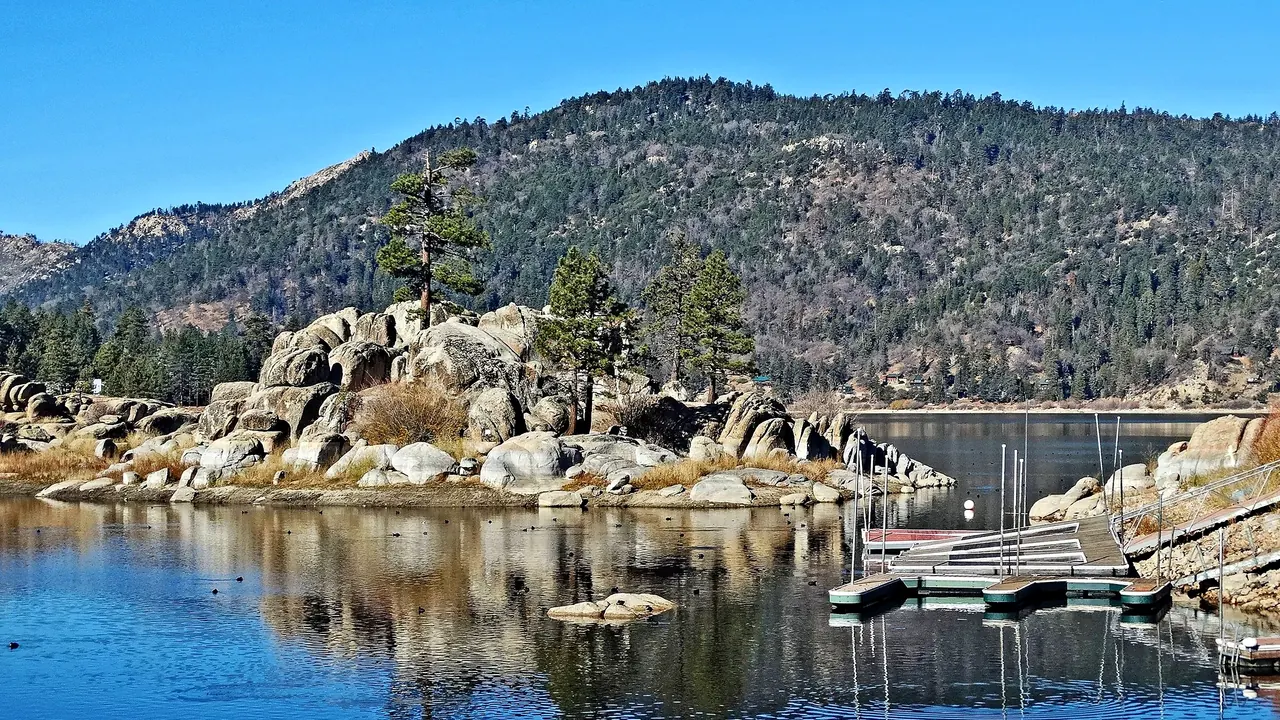
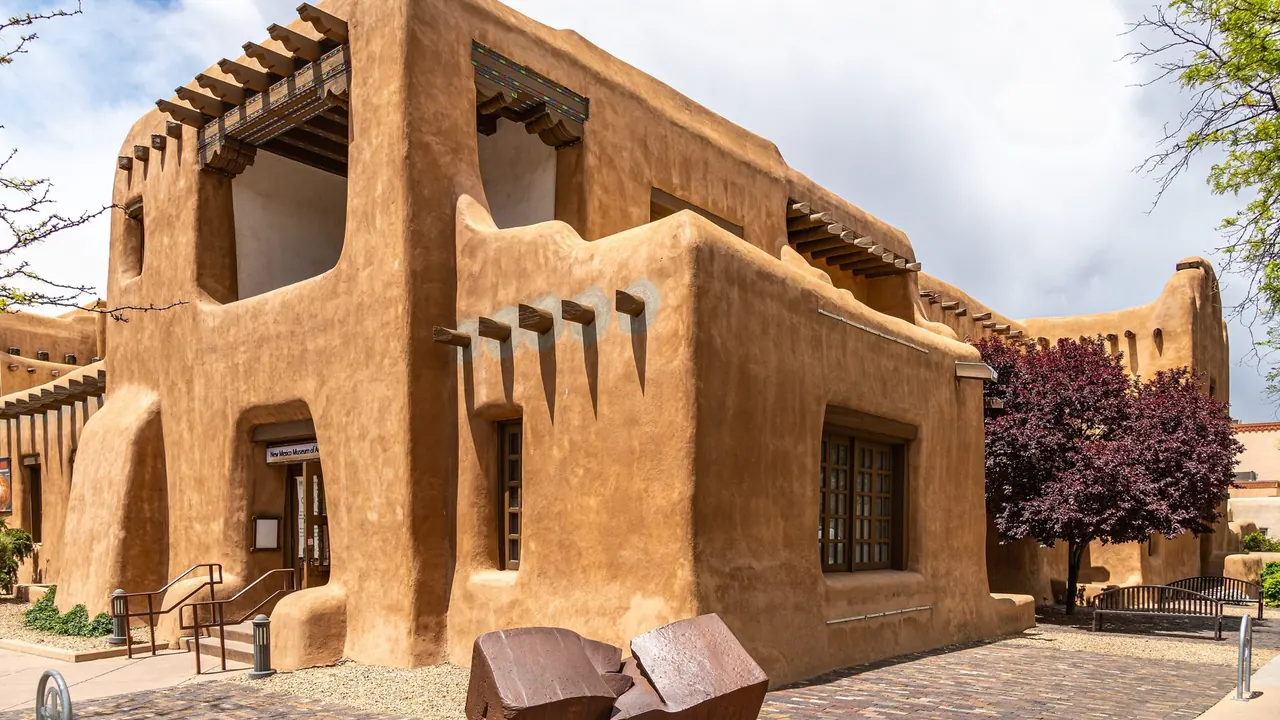
Photos: Big Bear Lake by inkknife_2000, CC BY-SA 2.0, cropped; Santa Fe by dconvertini, CC BY-SA 2.0, cropped.
Big Bear Lake or Santa Fe?
Our verdict in twelve categories, each scored against the same fixed benchmark cities, and the climate month by month, so you can choose for your trip.
Choose Big Bear Lake for
- beaches
- families
- prices
Big Bear Lake suits a trip built around the mountain itself. That means a cabin in the pines with a hot tub, sledding and ski lessons in winter, and kayaks, paddleboards and bike trails in summer. It is the better pick for families with younger children, for groups sharing a kitchen and for anyone happy to spend evenings indoors, because in town there are few sights, little memorable food and almost no night out.
Choose Santa Fe for
- culture and sights
- shopping
- live music and the arts
Choose Santa Fe if you want the same mountain air with a town worth exploring between hikes. Its adobe centre, Museum Hill, the galleries on Canyon Road, a regional cuisine built on red and green chile and the summer opera give it far more to do in town. The country around it, from Taos Pueblo to the cliff dwellings at Bandelier, fills several days of driving. It suits adults and older children better than toddlers.
Scoreboard
Twelve categories on one fixed scale from 0 to 100. The shaded stretch is the gap between the two.
Your match
Pick a travel style or drag the sliders, and both match scores follow your weighting.
Wins on beaches and families with your weighting.
Wins on culture and sights and shopping with your weighting.
What matters to you?
Category by category
What the scores mean for a trip.
Beaches & swimming
Neither is a beach destination, but Big Bear Lake at least has water on the doorstep. You can take a cool summer dip close to the shore, and the supervised swim beach at Meadow Park suits children. Kayaks and paddleboards fill the rest of the day.
Santa Fe is high desert with no lake in town. Swimming means a hotel pool, or a drive of about an hour to Abiquiu Lake or a float down the Rio Grande.
Food & drink
Santa Fe has a cuisine worth travelling for. Red and green chile, blue corn, posole and carne adovada are served in old adobe dining rooms, there is more fine dining than such a small city usually has, and the long-established farmers' market at the Railyard is worth a morning. Beyond the regional cooking, though, the choice is thin.
Big Bear Lake feeds hungry skiers and hikers with diner breakfasts, burgers, pizza and pints at a brewpub, and many visitors cook in their cabins. You eat to refuel there, not because the food is a reason to go.
Culture & sights
This is the widest gap between the two. Santa Fe has four centuries of Spanish colonial history in its adobe Plaza, the Palace of the Governors and the San Miguel and Loretto chapels. Its museums, on Museum Hill and downtown, are better than its size would suggest, and the galleries of Canyon Road are close by.
Big Bear Lake offers a forest discovery centre, a small local museum and a dirt-road drive past gold-rush remains in Holcomb Valley. Its chalet-style Village is pleasant, but the buildings are modern.
Nightlife
Both towns go to bed early, but Santa Fe gives you more of an evening. There is a long dinner, then a margarita or mezcal on a rooftop as the sun sets over the Jemez Mountains, and there are a few breweries by the Railyard and livelier summer nights on the Plaza.
In Big Bear Lake the evening is a brewpub, some après-ski in season, then the hot tub. Neither town has clubs, but from Santa Fe, Albuquerque is an hour's drive away.
Nature & outdoors
Both are genuine mountain bases, and the difference is in the landscape. Big Bear Lake is forest and water: pines around an alpine lake, two ski areas, mountain biking on the summer slopes, the Pacific Crest Trail and the San Gorgonio Wilderness close by, with bald eagles over the lake in winter.
Santa Fe mixes mountain and desert. Trails into the Sangre de Cristo foothills start at the edge of town, aspens turn gold above the ski area, and further out lie the Pecos Wilderness, Valles Caldera, rafting on the Rio Grande and the red cliffs of Abiquiu. It has no lake to paddle, but the scenery is far more varied.
Day trips
Santa Fe is by far the better base for outings. The High Road to Taos through Chimayo and Truchas, Taos Pueblo, the cliff dwellings of Bandelier, Los Alamos, Pecos and the villages of the Turquoise Trail each make a full and rewarding day, mostly by car.
From Big Bear Lake the winding mountain roads slow everything down. Lake Arrowhead and the orchards of Oak Glen are within reach, and Riverside's Mission Inn is about an hour and a half away, but most visitors simply stay up the mountain.
Good for families
Big Bear Lake is built for families, especially those from lowland cities where snow is a novelty. Winter brings sledding, snow play and beginner lessons, summer brings the alpine slide, go-karts and pedal boats, and the cabins have room to spread out.
Santa Fe is safe and calm, and the children's museum, the toys in the folk art collection and the ladders at Bandelier all help. Still, galleries and long dinners test young children's patience. Both towns sit at altitude, so small children may tire for the first day in either.
Getting around
You will want a car in both, but Santa Fe's centre works better on foot. The Plaza, the cathedral, the museums, Canyon Road and the Railyard all lie within about twenty minutes' walk of each other, and the Rail Runner train runs to Albuquerque.
Big Bear Lake's Village is walkable too, and a bus and a seasonal trolley go to the ski areas. However, the cabins are scattered through hilly forest, and the steep roads up the mountain can need snow chains in winter.
Shopping & style
Santa Fe is a serious place to buy art and craft. Native American artists sell silver and turquoise jewellery under the portal of the Palace of the Governors, galleries line Canyon Road, there are dealers in Pueblo pottery, rugs and Western boots, and the big summer markets draw collectors from far away. Big Bear Lake has a few blocks of gift shops, fudge and bear souvenirs, plus shops for gear hire, which is enough for an hour's browsing.
Affordability
A shared cabin with its own kitchen, booked midweek or outside the winter and school vacation peaks, is what keeps Big Bear Lake affordable, so it works best for groups and families who cook for themselves. Ski weekends are another matter: cabin rates jump, and lift tickets and equipment hire add up quickly.
In Santa Fe the money goes on hotels and restaurants priced for well-off visitors around the Plaza, and rooms cost even more during the summer markets, the opera season and at Christmas. A room out along Cerrillos Road costs less, and hiking and gallery browsing are free. Still, the hire car most visitors need comes on top, and a couple travelling alone has no shared cabin to split the cost.
Live music & performing arts
Santa Fe has a real summer season. The opera plays in an open-sided theatre on a hill as the sun goes down, there is a chamber music festival and a long flamenco tradition, and the historic Lensic theatre and concerts in the old churches carry on through the rest of the year. Big Bear Lake has community theatre, free concerts by the lake in summer and Bavarian bands at its autumn Oktoberfest, and little more.
Wellness & relaxation
Santa Fe makes relaxing an activity in its own right. It has Japanese-style soaking tubs in the foothills, the mineral springs at Ojo Caliente, used for bathing since the nineteenth century, and more spas, yoga studios and healers than its size would suggest. In Big Bear Lake, relaxing happens at the cabin: a private hot tub, a wood stove and a deck in the pines. That is peaceful midweek, but the town is crowded on winter weekends, and it has only a few day spas and no springs.
When should you go?
Pick your month. The climate figures are measured averages, not a forecast.
Big Bear Lake in July
Santa Fe in July
Daytime high, °C
Rainfall in the month, mm
Where the figures come from
Big Bear Lake has no rain gauge within 25 km of the centre, so its rainfall comes from a gridded climate dataset read at the city rather than from a gauge further away.
Santa Fe's station stands 199 m below the city centre, so the centre is likely a little cooler than the figures say.
Santa Fe has no rain gauge within 25 km of the centre, so its rainfall comes from a gridded climate dataset read at the city rather than from a gauge further away.
Temperature and rainfall are climate normals, averaged over the years shown. Big Bear Lake: 2014-2025 (rainfall 1991-2020) normals, Big Bear City (5 km from centre). Santa Fe: 1991-2020 normals, Santa Fe / Cieneguilla (12.4 km from centre).
Big Bear Lake has two seasons that matter. From June to September afternoons are mild and dry, reaching about 26°C in July, and this is the time for the lake, hiking and biking, though the water stays cool. From November to March it is cold and wet, with around 135mm in February, and at this altitude much of that feeds the ski runs as snow. April, May and October are cool in-between months.
Santa Fe is dry for most of the year, but June to August is hot, with highs around 31°C, and July and August bring summer storms of about 60mm a month. Late spring and September to October are the most comfortable months for walking the adobe streets and the foothill trails. Winters are as cold as Big Bear's but much drier.
Which traveller are you?
On a family trip with young children, Big Bear Lake is the easier choice. Sledding hills, beginner ski lessons, the alpine slide, pedal boats and the small zoo of rescued mountain animals keep them busy, and a cabin with a kitchen keeps the days simple.
For a culture and arts trip, Santa Fe wins by a long way. The Spanish colonial Plaza, the old chapels, Museum Hill, the O'Keeffe museum and the galleries on Canyon Road fill two or three days, and the summer opera fills the evenings. Big Bear offers little beyond a small history museum.
On a food and nightlife trip, Santa Fe is the only real option, though its evenings are long dinners rather than late nights. Red or green chile, posole and serious fine dining beat Big Bear's diners and brewpubs, where most nights end in the hot tub.
Before you go
| Measure | Big Bear Lake | Santa Fe |
|---|---|---|
| Currency | US Dollar (USD) | US Dollar (USD) |
| Sockets | AB120 V, 60 Hz | AB120 V, 60 Hz |
| Driving side | Right | Right |
| Time zone | UTC-8, UTC-7 in summer | UTC-7, UTC-6 in summer |
| Emergency number | 911 | 911 |
| Elevation | 2,058 m | 2,134 m |
| Main airport | Ontario International Airport (ONT)67 km from centre28 non-stop destinations | Santa Fe Municipal Airport (SAF)12 km from centre5 non-stop destinations |
| Public holidays this year | 13 days | 13 days |
By the numbers
| Measure | Big Bear Lake | Santa Fe |
|---|---|---|
| City population | 5,046 | 87,505 |
| People per km² | 299 | 645 |
| Museums within 10 km | 1 | 10 |
| UNESCO World Heritage sites within 50 km | 0 | 0 |
Where else could you go?
Every comparison below shares a destination with this one, so you can follow Big Bear Lake or Santa Fe somewhere new.
- Palm Springsvs Big Bear Lake
- Palm Desertvs Big Bear Lake
- Taosvs Santa Fe
- Albuquerquevs Santa Fe
- Anaheimvs Big Bear Lake
- Laguna Beachvs Big Bear Lake