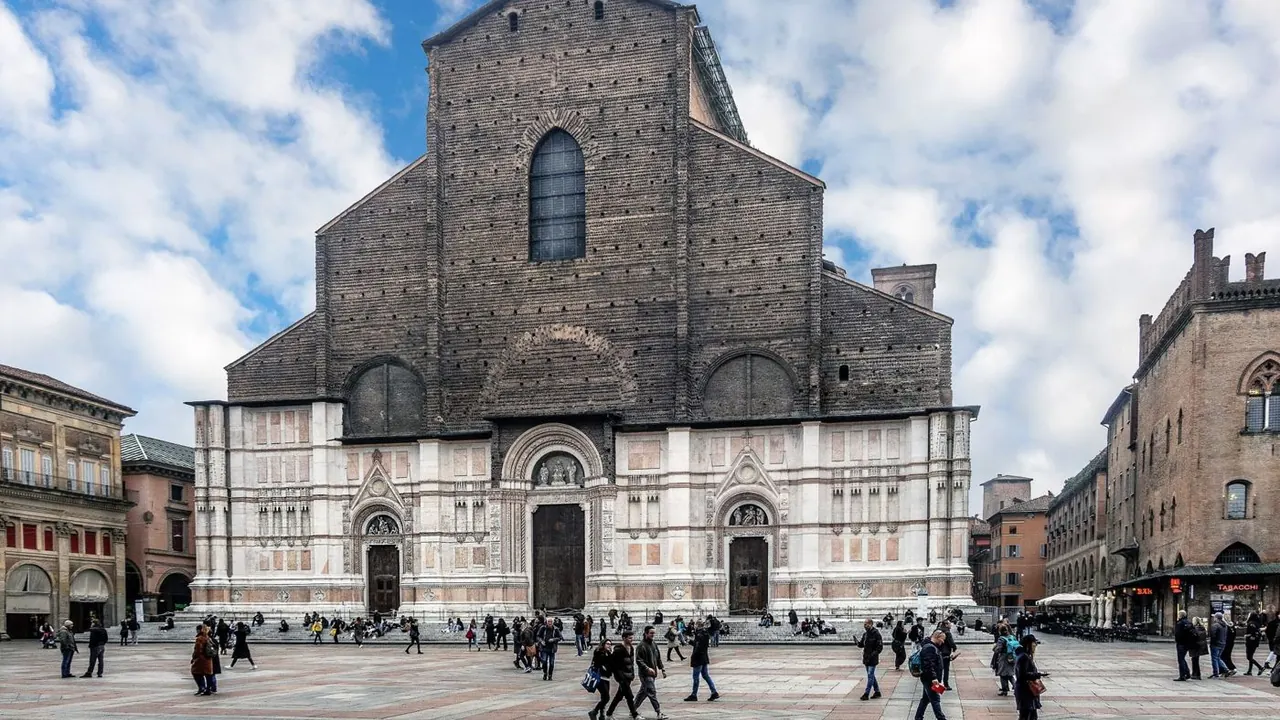
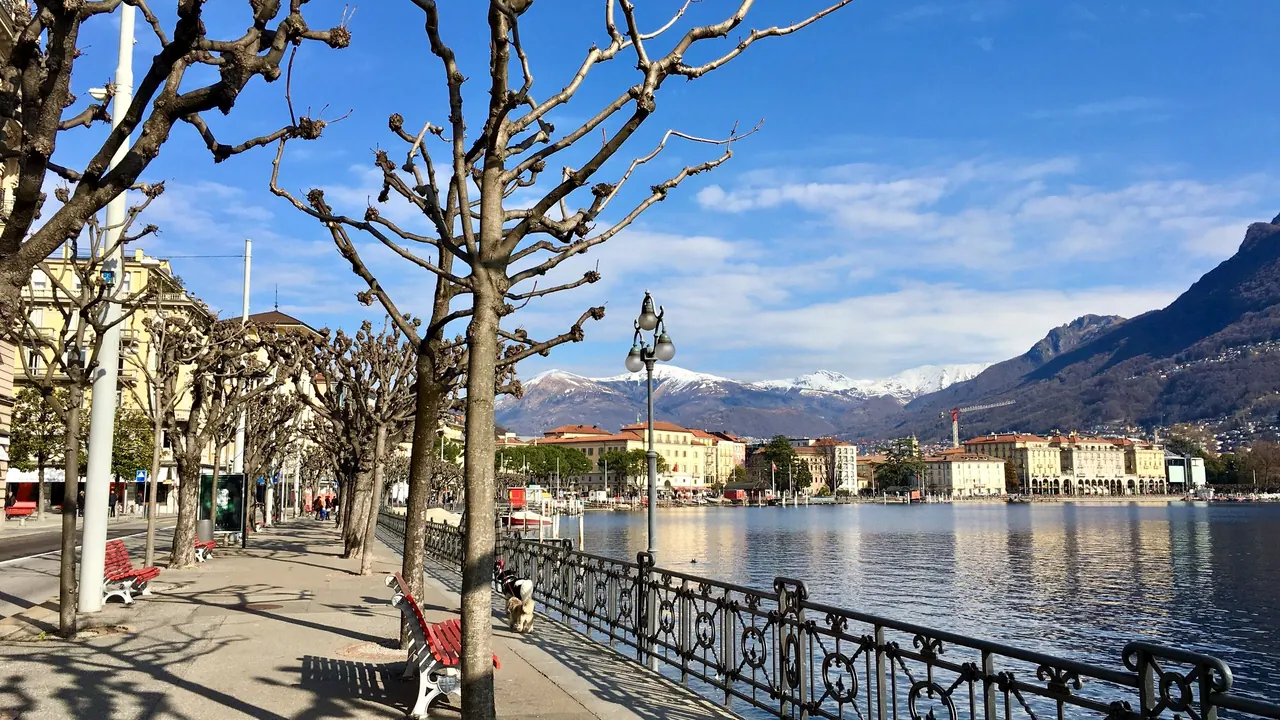
Photos: Bologna by Vanni Lazzari, CC BY-SA 4.0, cropped; Lugano by Thomas Woodtli from Zürich, Switzerland, CC BY-SA 2.0, cropped.
Bologna or Lugano?
Our verdict in twelve categories, each scored against the same fixed benchmark cities, and the climate month by month, so you can choose for your trip.
Choose Bologna for
- culture and sights
- prices
- food and drink
Bologna is for travellers who come to eat, walk and look. Its brick medieval centre under miles of porticoes, its trattorias and market lanes, and its student evenings make a full city stay. It costs far less than Lugano. Florence, Ravenna, Modena and Ferrara are all close by train, so it also makes a strong base for a week of rail trips around northern Italy.
Choose Lugano for
- nature and the outdoors
- beaches
- families
Choose Lugano when the landscape matters more than the sights. The lake, the funiculars to Monte Brè and San Salvatore, the ridge hikes and the lidos give it an outdoor life that Bologna can't match. It is calm, safe and easy with young children. It is also very expensive and quiet after dark, so it suits a restful lake stay where the budget is not the main worry.
Scoreboard
Twelve categories on one fixed scale from 0 to 100. The shaded stretch is the gap between the two.
Your match
Pick a travel style or drag the sliders, and both match scores follow your weighting.
Wins on culture and sights and prices with your weighting.
Wins on nature and the outdoors and beaches with your weighting.
What matters to you?
Category by category
What the scores mean for a trip.
Beaches & swimming
Neither city is on the sea, but in Lugano swimming is part of the stay. The lake lidos at the mouth of the Cassarate and along the shore towards Castagnola and Paradiso have lawns, decks and ladders into the water. Boats take you to small lake baths in the villages around the shore.
In Bologna, a swim means taking the train for about an hour to Rimini or Cervia. There you get rows of rented umbrellas on the Adriatic, which is fine for a day out in July but not something to plan a stay around.
Food & drink
Food is one of the clearest reasons to pick Bologna. Tagliatelle al ragù, tortellini in brodo and mortadella are made with care in old osterie. The Quadrilatero lanes are full of delicatessens, and Parmigiano and balsamic vinegar are made less than an hour away. The weak points are little choice beyond Emilian cooking and dishes that feel heavy in summer.
Lugano's best meals are in the grotti, rustic taverns under chestnut trees serving polenta, braised meats and Ticino Merlot. Beyond those, the choice is narrow and the prices high, and many visitors save their serious eating for a trip across the border into Italy.
Culture & sights
Bologna is a sightseeing city in its own right. It has a whole medieval centre in red brick, the leaning Two Towers, the seven churches of Santo Stefano, the anatomical theatre in the Archiginnasio and a fine collection of Bolognese painting. A long arcaded walk climbs to San Luca.
Lugano has a pretty Lombard-style old town, the Cathedral of San Lorenzo above the lake, Luini's Passion fresco and the art collections at LAC. It is pleasant, but a single day covers it, so culture is a side dish here rather than the reason to come.
Nightlife
Bologna's students keep its evenings going. Crowds stand outside cheap bars around Piazza Verdi, Via del Pratello's taverns stay busy late, and wine bars fill after aperitivo near the Quadrilatero. It is informal rather than polished, clubs are a taxi ride out of town, and in August the city goes quiet.
Lugano's evening usually means a lakefront aperitivo and a long dinner, among a well-dressed local crowd. A few lounges and clubs exist, but the town is mostly asleep before midnight, and young locals head to Milan to go out.
Nature & outdoors
Scenery is Lugano's great strength. Steep wooded mountains rise straight from the lake, and funiculars climb Monte Brè and San Salvatore. Monte Generoso's rack railway looks out towards the Alps, and the ridge from Monte Lema to Monte Tamaro is a fine day hike. Kayaks and paddleboards are easy to hire on the water.
Bologna offers gentler country. There is the climb to San Luca, the Colli Bolognesi paths, gypsum caves in the Parco dei Gessi, and the start of the Via degli Dei to Florence. North of the city, the plain is flat farmland, and the higher Apennines are a longer trip.
Day trips
Both are excellent bases, and Bologna has the edge in how many major art cities lie close by. Florence is barely half an hour by fast train. Ravenna's mosaics, Ferrara, Modena and Parma are all short rides, and Venice and Verona can be done in a day.
From Lugano, day trips cross a border: Milan's Last Supper, Como, the castles of Bellinzona and the islands of Lake Maggiore. Many are made by boat or mountain railway rather than fast train, so they feel more like scenic outings than a tour of cities.
Good for families
Lugano is slightly kinder to younger children, mostly thanks to the lake. Boat trips, lido slides, funicular rides, the playgrounds of Parco Ciani and the Swiss landmarks in miniature at Melide fill the days easily. The steep streets are hard work with a pushchair, though.
Bologna's flat, largely car-free centre and shady porticoes make it easy to move around with children, and climbing the Asinelli tower is a treat. Most sights, however, are aimed at adults, and the summer heat is tiring, so families tend to escape to a theme park near Ravenna or to the beach.
Getting around
Both are easy without a car, but in different ways. Bologna is flat and walkable under its arcades, with buses instead of a metro, and its main station sits at the edge of the old town with fast trains in every direction.
Lugano is a city of slopes. A short funicular links the station to the old town, lake boats serve the villages, and rack railways climb the mountains. Hotel stays usually include free regional transport, and the Swiss trains run on time.
Shopping & style
Bologna offers a little more. Most visitors take home food from the Quadrilatero, such as aged Parmigiano, fresh tortellini and balsamic vinegar. There are luxury labels in the Galleria Cavour, clothes stalls at the Montagnola market, antiques in Piazza Santo Stefano and vintage shops in the university quarter.
Lugano centres on Via Nassa, where watchmakers and jewellers serve a wealthy clientele under the arcades, with a big designer outlet near Mendrisio. There is little for younger or cheaper tastes, and serious shoppers go to Milan.
Affordability
The gap between the two is wide, and the costs fall in different places. In Bologna the main expense is the room. Old-town hotels charge northern Italian prices, and during trade fair weeks beds are scarce across the city. Once that is paid, eating out and seeing a city you can cross on foot cost relatively little.
In Lugano every part of the day is expensive, and the things you come for, the boats, funiculars and mountain railways, push the bill up further. The regional transport pass that comes with most hotel stays makes getting about cheaper, and lunch in a grotto is better value than dinner by the lake. Some visitors save their bigger meals for day trips into Italy.
Live music & performing arts
Bologna has more going on. The Teatro Comunale is a historic opera house with opera and ballet, the city is a UNESCO City of Music, basement jazz clubs play most nights, and students keep small venues busy with indie gigs. In summer there are concerts and film screenings in Piazza Maggiore.
Lugano's music is focused on LAC, whose concert hall is home to the Orchestra della Svizzera italiana, plus the free Estival Jazz concerts each summer in Piazza della Riforma. There are few small venues, and opera lovers go to La Scala in Milan.
Wellness & relaxation
Neither city has a bathing culture of its own, and they offer rest in different ways. From Bologna, real thermal water is within reach: spring-fed pools at Castel San Pietro Terme and the old spa town of Porretta Terme. The city itself, though, is noisy around the university and heavy in summer heat.
Lugano has no springs, but the place itself is restful. Afternoons on a lido, benches in Parco Ciani, a palm-lined shore and long grotto lunches set the pace, with hotel spas and a large pool complex near Rivera for wet days.
When should you go?
Pick your month. The climate figures are measured averages, not a forecast.
Bologna in July
Lugano in July
Daytime high, °C
Rainfall in the month, mm
Where the figures come from
Bologna has no rain gauge within 25 km of the centre, so its rainfall comes from a gridded climate dataset read at the city rather than from a gauge further away.
Bologna's sunshine is measured 82 km from the centre, at Cervia.
Temperature and rainfall are climate normals, averaged over the years shown. Bologna: 1991-2020, 14 years observed normals, Bologna / Borgo Panigale (5.5 km from centre). Lugano: 1991-2020 normals, Lugano (1.2 km from centre).
Bologna is at its best in May, June and September, when the days are warm without the full weight of summer, which suits long walks under the porticoes. June is the driest of the three, while May and September bring a fair number of showers, so an umbrella is worth packing. July and August are the sunniest months, but the heat on the plain reaches about 32°C and makes afternoon sightseeing hard work. The rain is heaviest in October and November, at around 95mm a month, and winter is cold and grey.
Lugano stays milder in summer, peaking near 27°C. That is warm enough for the lake lidos from June to early September and still comfortable for walking. The catch is rain: from April to November it is far wetter than Bologna, with 178mm in May. Winter is cold in both cities, and Lugano gets more rain then too. It also gets clearly more winter sunshine, though, so a bright day by the lake is more likely there than a clear day in Bologna.
Which traveller are you?
On a culture and arts trip, choose Bologna. The UNESCO-listed porticoes, Piazza Maggiore, the Archiginnasio and the Pinacoteca take two or three days to see properly, and there is opera at the Teatro Comunale. Lugano's sights take about a day.
On an outdoors trip, choose Lugano. Funiculars and a rack railway climb straight to summit paths, the lakeside walk to Gandria starts at the edge of town, and the Verzasca valley is about an hour away. Bologna has gentle hills and the Via degli Dei trail.
On a trip with a tight budget, Bologna is the sensible choice. Trattoria meals, aperitivo with food included and free churches keep daily costs reasonable. In Lugano, hotels, meals, boats and mountain railways all come at Swiss prices, with no cheap way to stay.
Before you go
| Measure | Bologna | Lugano |
|---|---|---|
| Official language | Italian | French, German, Italian, Romansh |
| Currency | Euro (EUR) | Swiss Franc (CHF) |
| Sockets | CFL230 V, 50 Hz | CJ230 V, 50 Hz |
| Driving side | Right | Right |
| Time zone | UTC+1, UTC+2 in summer | UTC+1, UTC+2 in summer |
| Emergency number | 112 | 112 |
| Elevation | 54 m | 283 m |
| Main airport | Bologna Guglielmo Marconi Airport (BLQ)6 km from centre98 non-stop destinations | Milan Malpensa International Airport (MXP)46 km from centre208 non-stop destinations |
| Public holidays this year | 13 days | 15 days |
By the numbers
| Measure | Bologna | Lugano |
|---|---|---|
| City population | 387,971 | 63,495 |
| People per km² | 2,754 | 837 |
| Museums within 10 km | 68 | 17 |
| UNESCO World Heritage sites within 50 km | 3 | 5 |
Where else could you go?
Every comparison below shares a destination with this one, so you can follow Bologna or Lugano somewhere new.