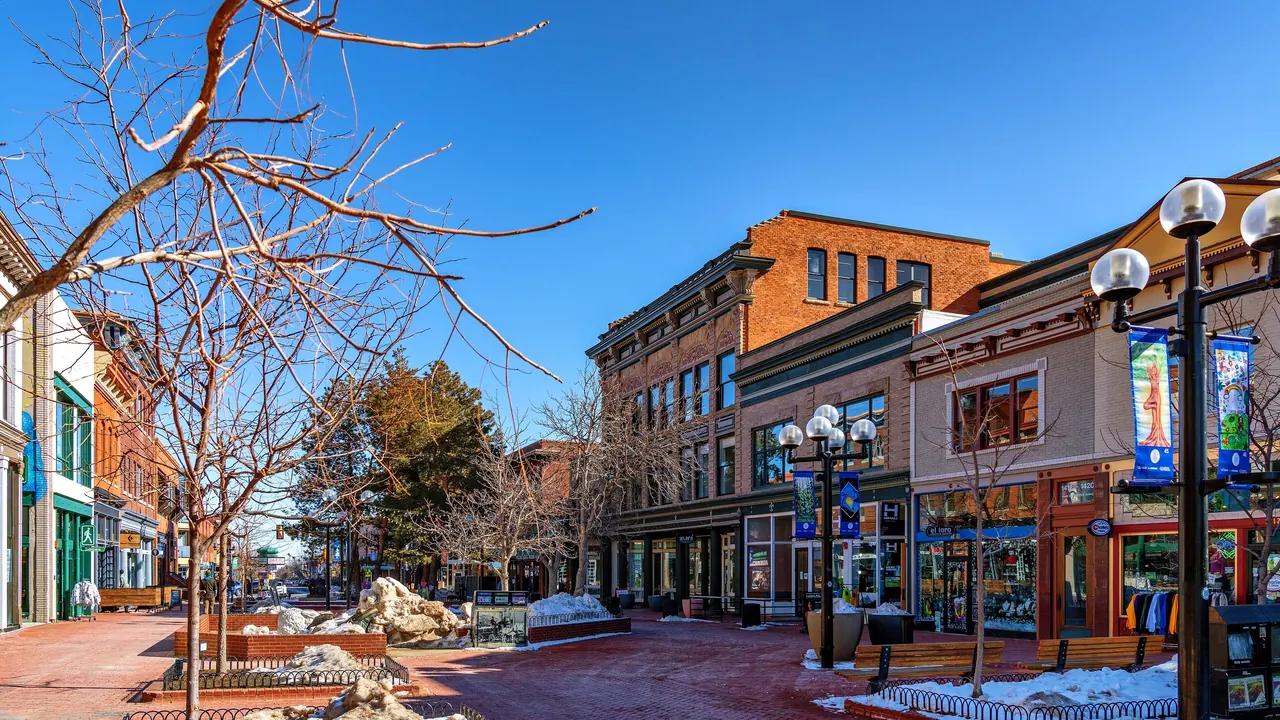
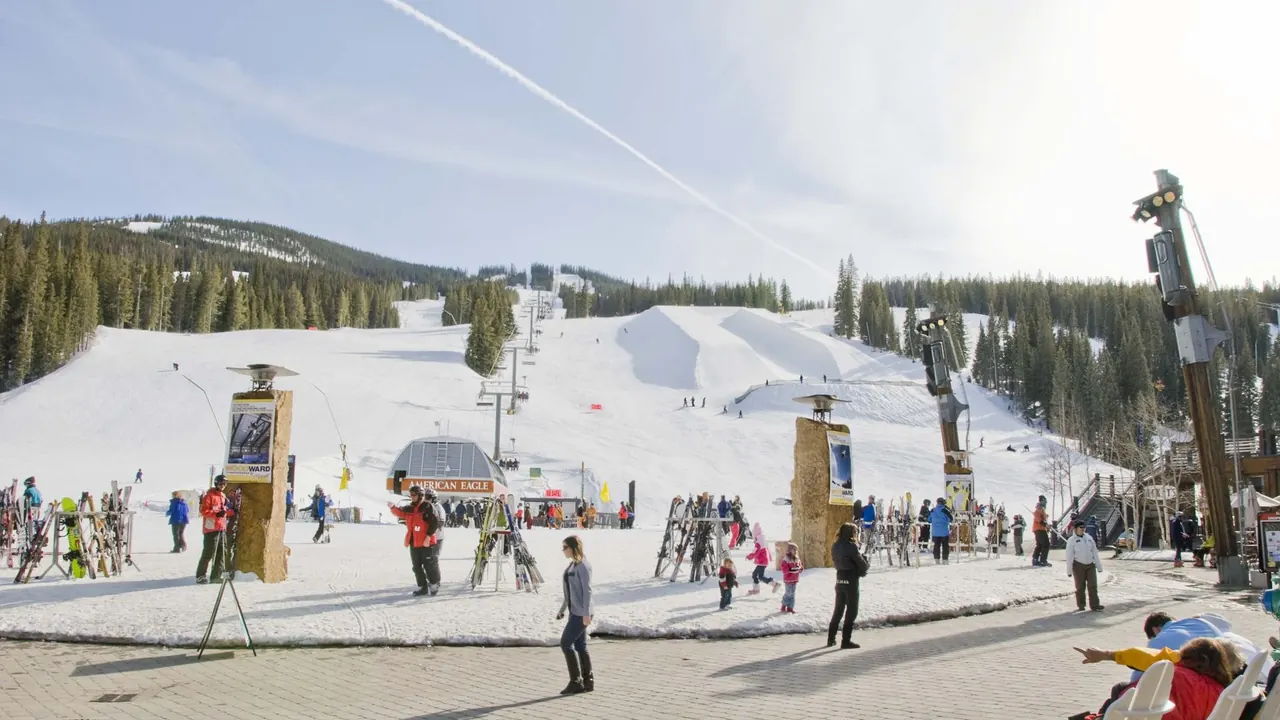
Photos: Boulder by Tony Webster, CC BY 2.0, cropped; Copper Mountain by SparkFunElectronics, CC BY 2.0, cropped.
Boulder or Copper Mountain?
Our verdict in twelve categories, each scored against the same fixed benchmark cities, and the climate month by month, so you can choose for your trip.
Choose Boulder for
- live music and the arts
- shopping
- nightlife
Boulder suits a traveller who wants the mountains and a proper town together. You can walk from breakfast on Pearl Street to the Flatirons trails, climb in Eldorado Canyon in the afternoon, and still have craft beer, a bluegrass show or a summer concert at Chautauqua in the evening. It is the better choice for a mixed trip with food, music and a little culture alongside the hiking, and Denver is close enough for a museum day.
Choose Copper Mountain for
- day trips
- families
Copper Mountain is for people who come for the mountain itself. It is a ski resort first: high bowls, a car-free village at the lifts, a children's ski school, and several other Summit County ski areas plus Vail within a short drive. In summer the same slopes are good hiking and biking country. Evenings are quiet and there is little to do away from the snow and trails, which is exactly what a ski week or a high-altitude walking trip needs.
Scoreboard
Twelve categories on one fixed scale from 0 to 100. The shaded stretch is the gap between the two.
Your match
Pick a travel style or drag the sliders, and both match scores follow your weighting.
Wins on live music and the arts and shopping with your weighting.
Wins on day trips and families with your weighting.
What matters to you?
Category by category
What the scores mean for a trip.
Beaches & swimming
Neither place is a beach destination, so pack swimwear for pools. Boulder has a little more to offer in summer: a small sandy swim area at the Boulder Reservoir and lazy inner-tube floats down Boulder Creek.
At Copper Mountain the lakes are fed by snowmelt and stay cold even in July, so swimming means a heated lodge pool or a hot tub.
Food & drink
Boulder eats noticeably better. It cooks seasonally from Front Range produce, does vegetarian food well, and has good bakeries, a farmers' market by the creek that is a social event in its own right, and taprooms all over the east side. Lunch at the hand-carved Dushanbe Teahouse is a pleasure you will not find in a ski village.
Copper Mountain's food is fuel for skiers: burgers and chilli in the mid-mountain lodges, plus a few pizza, Mexican and pub places in the village. Many guests cook in their condos, and anyone wanting a better dinner drives to Frisco or Breckenridge.
Culture & sights
Boulder's sights are modest, but they exist. There is the wooden Chautauqua colony below the Flatirons, the sandstone and red-tile university campus, the Pei-designed atmospheric research centre on its mesa, and a few small museums, enough for a pleasant day.
Copper Mountain is a village of condos and lodges built around the lifts, with nothing historic to see. For mining-era history you have to visit Breckenridge or Leadville.
Nightlife
Boulder gives you more choice after dark. There are brewery taprooms and cocktail bars around Pearl Street, and loud student bars on University Hill during term. Nights still end early in a town of dawn hikers, though, and anyone wanting clubs heads to Denver.
Copper Mountain's evening is mostly après-ski: bars at the foot of the lifts full of people in ski boots, and some music on the plaza on busy winter weekends. By late evening the village has gone to bed, and it is very quiet outside the ski season. Breckenridge, half an hour away, is the nearest place for a later night.
Nature & outdoors
Both places are first-rate for the outdoors, but they are different kinds of mountain. Boulder's outdoors starts at the edge of town, with the Flatirons, a large ring of protected open space and trails up Green Mountain and Bear Peak. Eldorado Canyon is a famous climbing wall, the canyon roads draw serious cyclists, and Rocky Mountain National Park is about an hour away.
Copper Mountain is higher and more alpine. Its focus is lift-served skiing below the Tenmile Range, with several other resorts close enough to ski a different one each day. In summer the Colorado Trail and the Vail Pass path pass through, and fourteen-thousand-foot peaks are within an hour. The village sits at about 2,960m, much higher than Boulder's 1,655m, so expect the thin air to take some getting used to.
Day trips
The two are about even for day trips, but they point in different directions. From Boulder, Denver's art museum, capitol and Union Station are an easy express-bus ride away. Golden, Fort Collins and Estes Park need a car and make pleasant rather than memorable outings.
Copper Mountain is surrounded by more characterful mountain towns: Breckenridge's Victorian main street and weathered Leadville are both about half an hour away, and Vail is just over the pass. Denver is further and depends on I-70 traffic. Georgetown's old mining streets and narrow-gauge railway are an easy reach from either base.
Good for families
Both are good with children, though in different ways. Boulder suits outdoorsy families who like a gentle pace: the creek path, the Chautauqua meadow, tubing and the reservoir beach, plus the planetarium and street performers on Pearl Street. Its relatively modest altitude is easier on small children.
Copper Mountain is more organised: a car-free core, a children's ski school at the heart of the resort, snow tubing, a mountain coaster and an indoor trampoline centre. Against that, nearly 3,000m of altitude often brings headaches and poor sleep for the first couple of days, and there is little for children beyond the resort.
Getting around
Boulder is the easier place to manage without a car. Downtown, the university and Chautauqua are all within walking distance. The off-street bike paths along the creek are excellent, and an express bus runs to Denver. You will still want a car for trailheads further out and for the national park.
At Copper Mountain, walkways, lifts and a free shuttle cover the resort, and county buses run to Frisco. Getting there is the hard part: there is no train, Denver's airport is about two hours away by road, and winter driving on I-70 over snowy passes can be slow.
Shopping & style
Boulder has a real shopping street. The Pearl Street Mall's brick blocks are lined with independent bookshops, galleries and boutiques, and the climbing, running and cycling shops are unusually good for a town this size.
At Copper Mountain, shopping means ski rental, sunglasses and resort-branded clothing. The outlet mall at Silverthorne and Breckenridge's boutiques are the nearby options.
Affordability
Both are expensive, and the main difference is when they are cheapest. Boulder costs most in summer and on graduation and football weekends, and meals come at affluent American prices. Its trails are free, though, and staying in Denver keeps costs down.
Copper Mountain is at its dearest in winter, when lift access, rental and slope-side rooms add up, although it is a little gentler than the grander neighbouring resorts. A condo with a kitchen or a room in Frisco or Silverthorne helps, and summer is noticeably cheaper.
Live music & performing arts
Boulder is far ahead here. Small downtown and Hill venues host rock, bluegrass and roots acts most nights. In summer the Colorado Music Festival fills the 1898 Chautauqua Auditorium and the Colorado Shakespeare Festival plays outdoors on campus. Red Rocks Amphitheatre is about 45 minutes away.
At Copper Mountain, live music means bands on the village plaza on summer concert weekends and acoustic sets at après-ski. For theatre or classical music, the nearest option is Breckenridge.
Wellness & relaxation
Boulder has a wellness culture of its own: yoga and meditation studios everywhere, a Buddhist-inspired university, and plenty of massage and acupuncture. The spring-fed pool at Eldorado Springs is close by, and the hot-spring caves at Idaho Springs are about an hour away.
At Copper Mountain, relaxing means an outdoor hot tub facing the slopes and a massage at the athletic club. The air is clean and the evenings are calm, but there is no spa culture, and the altitude can disturb sleep for the first few nights.
When should you go?
Pick your month. The climate figures are measured averages, not a forecast.
Boulder in July
Copper Mountain in July
Daytime high, °C
Rainfall in the month, mm
Where the figures come from
Boulder has no rain gauge within 25 km of the centre, so its rainfall comes from a gridded climate dataset read at the city rather than from a gauge further away.
Copper Mountain's temperatures are measured 35 km from the centre, at Leadville / Stringtown.
Copper Mountain has no rain gauge within 25 km of the centre, so its rainfall comes from a gridded climate dataset read at the city rather than from a gauge further away.
Temperature and rainfall are climate normals, averaged over the years shown. Boulder: 2010-2025 (rainfall 1991-2020) normals, Boulder / Valmont (6.1 km from centre). Copper Mountain: 2006-2020 (rainfall 1991-2020) normals, Leadville / Stringtown (35.2 km from centre).
These two places sit at very different heights, and their seasons run almost in opposite directions. Boulder is at its best in late spring and early autumn, when the weather is ideal for the trails and for walking around town. High summer reaches about 31°C in July, warm enough for the reservoir swim area and for tubing on the creek, though the hottest afternoons are better spent in the shade than on exposed trails. May is the wettest month at around 61mm. Winter days stay mild at around 7°C and are very dry, so town walks and the lower trails often stay open.
Copper Mountain spends winter below freezing, with daytime highs around -2°C from December to February, and snow usually lasts from November into spring. That is the season the resort is built for. Summer is short and cool, peaking around 21°C in July, which suits hiking and biking well, but July and August bring regular afternoon storms, so set off early. Late spring and October are the in-between months, too thin for skiing and still chilly for the high trails.
Which traveller are you?
For a culture and arts trip, Boulder is the clear pick. It has the 1898 Chautauqua with its summer orchestral season, outdoor Shakespeare on campus, I.M. Pei's atmospheric research lab and Red Rocks nearby. Copper Mountain has no sights and almost no performances.
For a food and nightlife trip, choose Boulder. Its farm-to-table kitchens, Saturday farmers' market, teahouse and east-side taprooms beat Copper's resort lodges and pizza places, and Pearl Street and the Hill stay lively long after Copper's après-ski bars have emptied.
For skiers and snowboarders, Copper Mountain is the place. It has lift-served terrain sorted by ability, treeless bowls above 3,600m, and Vail and other Summit County resorts close by. Boulder's nearest skiing is the small Eldora area, a drive up the canyon.
Before you go
| Measure | Boulder | Copper Mountain |
|---|---|---|
| Currency | US Dollar (USD) | US Dollar (USD) |
| Sockets | AB120 V, 60 Hz | AB120 V, 60 Hz |
| Driving side | Right | Right |
| Time zone | UTC-7, UTC-6 in summer | UTC-7, UTC-6 in summer |
| Emergency number | 911 | 911 |
| Elevation | 1,655 m | 2,955 m |
| Main airport | Denver International Airport (DEN)56 km from centre231 non-stop destinations | Denver International Airport (DEN)132 km from centre231 non-stop destinations |
| Public holidays this year | 12 days | 12 days |
By the numbers
| Measure | Boulder | Copper Mountain |
|---|---|---|
| City population | 108,250 | 650 |
| People per km² | 1,628 | 8 |
| Museums within 10 km | 4 | 0 |
| UNESCO World Heritage sites within 50 km | 0 | 0 |
Where else could you go?
Every comparison below shares a destination with this one, so you can follow Boulder or Copper Mountain somewhere new.