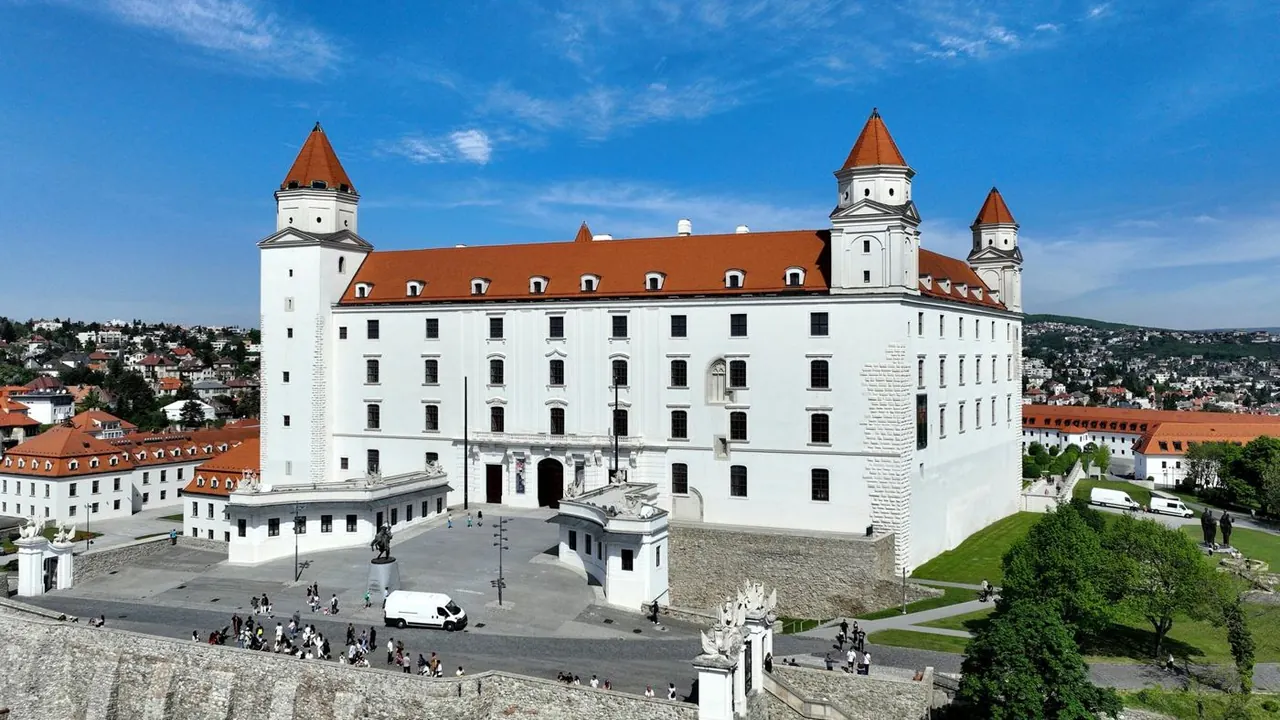
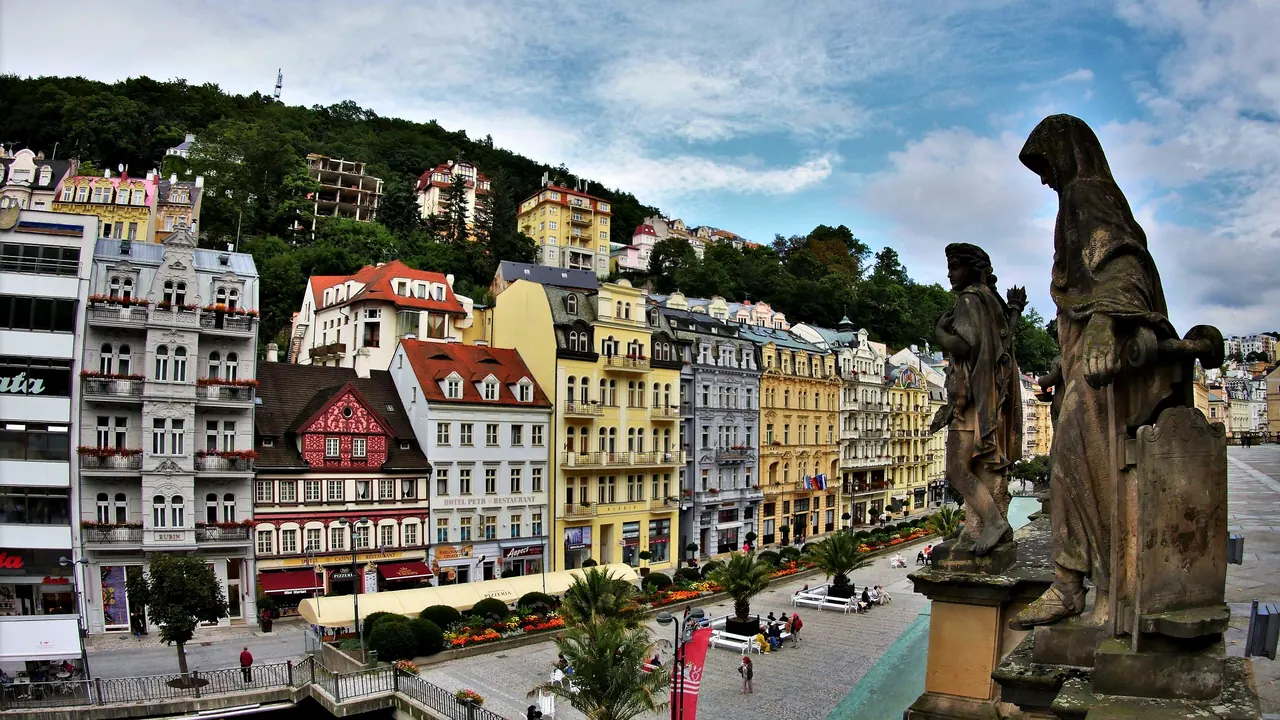
Photos: Bratislava by C.Stadler/Bwag, CC BY-SA 4.0, cropped; Karlovy Vary by Rolf Dietrich Brecher from Germany, CC BY-SA 2.0, cropped.
Bratislava or Karlovy Vary?
Our verdict in twelve categories, each scored against the same fixed benchmark cities, and the climate month by month, so you can choose for your trip.
Choose Bratislava for
- nightlife
- day trips
- live music and the arts
Bratislava suits travellers who want a compact capital with something to do after dark: Old Town wine bars and pubs, an evening at the opera or ballet, and Small Carpathian wine poured a few kilometres from where it grows. Its strongest card is where it sits. Vienna is an easy day out, and wine villages, Roman ruins and Moravian chateaux are close by, so it makes a good base for a varied week.
Choose Karlovy Vary for
- wellness
- culture and sights
- shopping
Pick Karlovy Vary for a slow, restorative stay. The town exists for taking the waters, with drinking cures along the colonnades, spa hotels offering treatments and pools of warm spring water, and forest paths laid out for convalescents. The pastel Belle Époque valley is lovely to look at, but evenings end early, so it suits people who want rest more than a night out.
Scoreboard
Twelve categories on one fixed scale from 0 to 100. The shaded stretch is the gap between the two.
Your match
Pick a travel style or drag the sliders, and both match scores follow your weighting.
Too close to call, 1 point apart
Wins on nightlife and day trips with your weighting.
Wins on wellness and culture and sights with your weighting.
What matters to you?
Category by category
What the scores mean for a trip.
Beaches & swimming
Neither city is a place to swim, but Bratislava has the slightly better option. Zlate piesky has a sandy shore you can reach by tram and warm water in July and August, and the bigger Senec lakes are half an hour away. In Karlovy Vary the nearest real lake is Lake Medard, a flooded mine near Sokolov, so most swims there are in the warm, spring-fed outdoor pool.
Food & drink
Bratislava eats and drinks better, mostly because of its wine. The Small Carpathian vineyards begin at the edge of the city, and local Veltliner, Riesling and Frankovka come with sheep's-cheese dumplings, roast duck with lokse and beer from small breweries that brew on the premises.
Karlovy Vary's cooking is narrower: Czech roasts and dumplings in the pubs, and international menus aimed at hotel guests on the promenade. What it does have is warm spa wafers from the colonnade stalls, Becherovka distilled in town and a good café-and-cake habit.
Culture & sights
Karlovy Vary has the stronger sight, because the whole town is the attraction. Pastel tiers of Belle Époque hotels and bathhouses fill the Teplá valley, the colonnades frame the springs and the Vřídlo throws hot water several metres into the air. Its museums are small and specialised.
Bratislava offers history on a national scale instead. St Martin's Cathedral, where Hungarian kings were crowned, the castle museum, the Primate's Palace, the Slovak National Gallery and the ruins of Devin above the rivers tell a longer story, though the setting is less of a piece. Each takes a day or two.
Nightlife
For a night out, Bratislava is far ahead. On Fridays and Saturdays the Old Town's pubs, wine bars and cocktail bars stay loud and full until late, helped by students and visiting groups, though it is a pub crawl rather than a club scene.
Karlovy Vary goes to bed early. A hotel bar, a casino or a quiet glass of wine is the usual evening, and the only time the valley really parties is the week of the film festival.
Nature & outdoors
The two are close here, with green, gentle country rather than drama. Bratislava's outdoors is shaped by the river. There are floodplain forests, the flat Danube cycle route into Austria and whitewater rafting at Cunovo, and beech-wood trails climb the Little Carpathians towards Kamzik.
Karlovy Vary's forest starts right at the edge of the spa quarter, with graded old paths up to the Diana tower and on into the Slavkov Forest moors. It also has the edge in winter, with skiing around Klínovec in the Ore Mountains, while the Ohře gives easy canoeing in summer.
Day trips
Bratislava is the better base. Vienna is about an hour away by train or boat, and Austria, Hungary and Moravia are all close, from Carnuntum's Roman ruins to the chateaux of Lednice-Valtice. Wine towns such as Modra and Pezinok are closer still.
Karlovy Vary's outings are more local but good. Loket's castle in its river loop is twenty minutes away, the sister spa towns of Mariánské and Františkovy Lázně are about an hour, and Plzeň and Cheb are within reach. Prague, though, is a long day of about two hours each way by coach.
Good for families
Both are safe and calm, and both run short of things for children after a few days. Bratislava's are more ordinary family outings: the hillside zoo, playgrounds and a chairlift around Kamzik, bronze statues to spot in the Old Town and the water park at Senec.
Karlovy Vary's appeal for children is novelty: watching the geyser, sipping warm spring water from spouted cups, and riding the funicular to the Diana lookout and its animal enclosure. Its steep valley sides are harder going with a pushchair.
Getting around
Both centres are easy to explore on foot. They differ in shape. Bratislava's sights lie within about twenty minutes of each other, trams and trolleybuses reach Devin and the lakes, and the lack of a metro only slows longer trips across the river.
Karlovy Vary is a long, narrow strip along the river, with steep climbs that buses and the funicular help with. Its links to the outside are weaker, with slow regional trains and coaches to Prague, while Bratislava has direct trains to Vienna.
Shopping & style
Karlovy Vary has more worth buying. Moser crystal comes from the firm's own showroom, Karlovy Vary porcelain from the factories nearby, and Bohemian garnets and jewellers and boutiques line Stará louka for wealthy spa guests.
Bratislava's best finds are Small Carpathian wine and genuine folk craft such as Modra majolica and blue-print cloth from the state craft centre. Beyond those it is mostly chain stores in riverside malls, and serious fashion shopping means a train to Vienna.
Affordability
Costs are much the same in both, and the advice is the same too: eat a street back from the showpiece spots. In Bratislava the main squares and the riverside glass complexes cost more, while beer, transport and museums elsewhere stay cheap.
Karlovy Vary costs more than ordinary Czech towns, and the colonnade restaurants and grand spa hotels charge for the setting. Strolling the colonnades and tasting the springs costs nothing, and staying outside summer and festival week keeps rooms affordable.
Live music & performing arts
Bratislava offers the fuller evening. The Slovak National Theatre stages opera and ballet in its ornate house on Hviezdoslav Square, the Slovak Philharmonic plays in the Reduta, and tickets are easy to get. An autumn music festival and a long-running jazz festival add to the season.
Karlovy Vary has the charm of the old spa orchestras. Its symphony orchestra plays light classical programmes, sometimes outdoors on the colonnades, and the Fellner and Helmer theatre hosts operetta and touring drama. It makes a pleasant evening rather than a programme to plan a trip around.
Wellness & relaxation
This is where Karlovy Vary is in a different league. Thirteen springs feed the colonnades for the centuries-old drinking cure, and sanatoria offer carbonated baths, peat wraps, massages and medical consultations, several with pools of warm spring water. Booking a proper spa stay is the way to get the full experience.
Bratislava has no thermal baths of its own, only hotel spas and quiet riverside cafés. A soak means a trip out to Senec or the spa town of Piestany.
When should you go?
Pick your month. The climate figures are measured averages, not a forecast.
Bratislava in July
Karlovy Vary in July
Daytime high, °C
Rainfall in the month, mm
Where the figures come from
Bratislava has no rain gauge within 25 km of the centre, so its rainfall comes from a gridded climate dataset read at the city rather than from a gauge further away.
Bratislava's sunshine is measured 56 km from the centre, at Wien / Hohe Warte.
Karlovy Vary's station stands 156 m above the city centre, so the centre is likely a little warmer than the figures say.
Karlovy Vary has no rain gauge within 25 km of the centre, so its rainfall comes from a gridded climate dataset read at the city rather than from a gauge further away.
Karlovy Vary's sunshine is measured 37 km from the centre, at Cheb.
Temperature and rainfall are climate normals, averaged over the years shown. Bratislava: 1991-2020 normals, Bratislava Ivanka (8.6 km from centre). Karlovy Vary: 1999-2020 (sunshine 1981-2010, rainfall 1991-2020) normals, Karlovy Vary (4.6 km from centre).
Bratislava is the warmer and sunnier of the two all year. In July and August afternoons reach about 27°C, warm enough for the lake at Zlate piesky. May, June and September are the most comfortable months for walking the Old Town and the wine villages. Karlovy Vary sits higher and cooler. Its summer highs stop around 22°C, which makes forest walks and promenade strolls pleasant but makes swimming in its lakes a bracing choice.
Both get their heaviest rain in high summer, usually as showers. July is the wettest month in both, with Karlovy Vary the damper at about 95mm. Winters are cold and grey in each. Karlovy Vary hovers near 1°C in January and gets very little sunshine, so the snow on the nearby Ore Mountains and the warm spa pools are the reasons to go then. In Bratislava the cold months are for opera evenings and cafés rather than sightseeing outdoors.
Which traveller are you?
For a relaxing and wellness trip, Karlovy Vary is the clear choice. Bratislava has cafés and hotel spas, but a real soak means a train out. In Karlovy Vary the cure sets the day: morning treatments, spring water sipped on slow walks, early nights.
On a food and nightlife trip, Bratislava is the better choice. Local wine, brewpubs and generous Slovak plates lead into loud weekend nights in the Old Town, while Karlovy Vary offers a glass of Becherovka and an early bed.
On a culture and arts trip, the choice depends on taste. Bratislava pairs a coronation cathedral and a national gallery with opera, ballet and the Philharmonic. Karlovy Vary is the finer sight in itself, a whole Belle Époque spa town listed by UNESCO.
Before you go
| Measure | Bratislava | Karlovy Vary |
|---|---|---|
| Official language | Slovak | Czech |
| Currency | Euro (EUR) | Czech Koruna (CZK) |
| Sockets | CE230 V, 50 Hz | CE230 V, 50 Hz |
| Driving side | Right | Right |
| Time zone | UTC+1, UTC+2 in summer | UTC+1, UTC+2 in summer |
| Emergency number | 112 | 112 |
| Elevation | 152 m | 447 m |
| Main airport | M. R. Štefánik Airport (BTS)8 km from centre68 non-stop destinations | Václav Havel Airport Prague (PRG)100 km from centre178 non-stop destinations |
| Public holidays this year | 15 days | 13 days |
By the numbers
| Measure | Bratislava | Karlovy Vary |
|---|---|---|
| City population | 480,902 | 49,073 |
| People per km² | 1,308 | 830 |
| Museums within 10 km | 22 | 2 |
| UNESCO World Heritage sites within 50 km | 2 | 3 |
Where else could you go?
Every comparison below shares a destination with this one, so you can follow Bratislava or Karlovy Vary somewhere new.
- Viennavs Bratislava
- Dresdenvs Karlovy Vary
- Praguevs Karlovy Vary
- Brnovs Bratislava
- Leipzigvs Karlovy Vary
- Nurembergvs Karlovy Vary