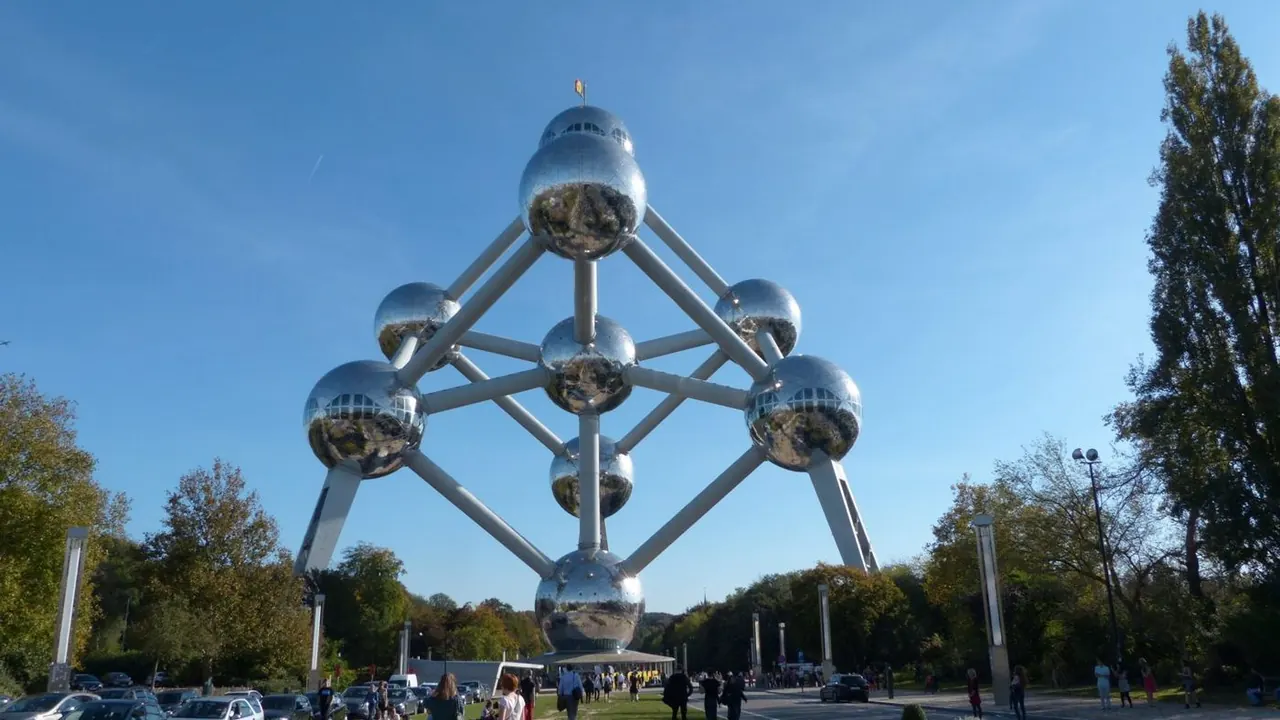
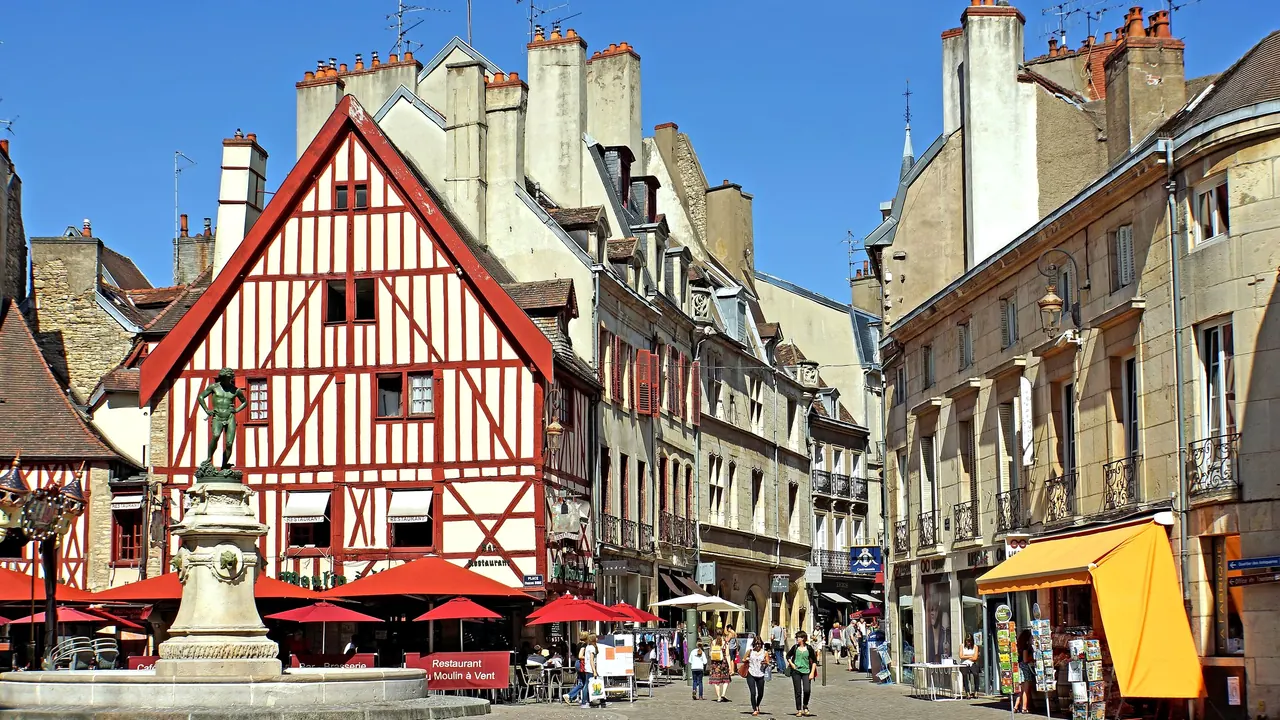
Photos: Brussels by Ettanghe, CC BY-SA 4.0, cropped; Dijon by Dennis G. Jarvis, CC BY-SA 2.0, cropped.
Brussels or Dijon?
Our verdict in twelve categories, each scored against the same fixed benchmark cities, and the climate month by month, so you can choose for your trip.
Choose Brussels for
- nightlife
- live music and the arts
- shopping
Brussels suits the traveller who wants a capital's range in one stay. It has the Grand-Place, Bruegel and Magritte, Horta's Art Nouveau houses, an opera house with a European name and a beer culture with no real equal. After dark there are bars and late cafés, and for children there are the Atomium and the dinosaurs. Its rail links are the clinching argument, with Ghent, Bruges and Antwerp each close enough for an easy day out.
Choose Dijon for
- prices
- nature and the outdoors
Choose Dijon for a slower, cheaper and more focused trip built around food and wine. The old ducal capital is small enough to cross on foot in minutes, Les Halles feeds the city, and the Burgundy vineyards begin at its southern edge, ready to explore by bike or car. Summers are warmer and sunnier than in Brussels, and the evenings are quieter. It is better for a couple tasting their way down the Côte than for a group after nightlife or a family needing entertainment.
Scoreboard
Twelve categories on one fixed scale from 0 to 100. The shaded stretch is the gap between the two.
Your match
Pick a travel style or drag the sliders, and both match scores follow your weighting.
Wins on nightlife and live music and the arts with your weighting.
Wins on prices and nature and the outdoors with your weighting.
What matters to you?
Category by category
What the scores mean for a trip.
Beaches & swimming
Neither city is a place for a swimming vacation, but Brussels at least has the sea within reach. The Belgian coast at Ostend, De Haan and Knokke is a little over an hour by train, with wide sands and long promenades. The North Sea only warms to about 18°C, though, and the wind is often up, so it makes a day for walking by the water rather than bathing. In the city there are Art Deco indoor pools, and open-air basins in summer.
Dijon has no coast within several hours. Its stand-in is Lac Kir on the town's western edge, where local families swim and lie on the grass in hot weather. It is a much smaller outing than a day on the Belgian sands, but you can get there on local transport instead of taking the train.
Food & drink
Both reward eating well, but they eat very differently. Brussels is a beer city first: Trappist ales and the sour lambics brewed only in its area, served with frites, carbonnade and shrimp croquettes. Its immigrant quarters add real range, from Matonge to the Moroccan and Turkish kitchens of Saint-Josse.
Dijon goes deeper and narrower. The cooking is classic Burgundian, with boeuf bourguignon, jambon persillé and Époisses from the stalls of Les Halles, and the wine comes from vineyards a short drive south. There is little beyond French regional food, but within that range it is hard to beat.
Culture & sights
Brussels has more to see and more of it is of the first rank. The Grand-Place is one of Europe's great squares, the Royal Museums hold Bruegel, Rubens and a whole museum given to Magritte, and Horta's UNESCO-listed houses in Saint-Gilles and Ixelles make it a pilgrimage for Art Nouveau. The drawback is the setting, with grand buildings broken up by office blocks.
Dijon is smaller but more of a piece. Its half-timbered streets and Renaissance mansions surround the Palace of the Dukes, whose fine arts museum holds the Valois tombs with their sculpted mourners. Two or three days covers it, including the gargoyles of Notre-Dame and Sluter's Well of Moses.
Nightlife
Brussels is much the livelier city after dark. Drinkers fill the streets around Saint-Géry and the Bourse, Flagey and Châtelain draw a local crowd, and Saint-Gilles cafés stay busy late. A long-established techno club in the Marolles and a queer scene around Rue du Marché au Charbon give it some range beyond the bars.
In Dijon, a night out means wine, beer and a late dinner, mostly along Rue Berbisey and around Place Émile Zola. The students keep it going during term, but the clubs are few and the streets are quiet by around midnight.
Nature & outdoors
Dijon has the better outdoors on its doorstep. The combes just west of town offer walking trails, limestone cliffs for climbing and views over the roofs. The Burgundy Canal towpath and the signed vineyard route towards Beaune make for easy, scenic cycling, and the Morvan hills and lakes are about an hour and a half away.
Brussels relies mostly on the Sonian Forest, whose tall beech stands are lovely for a walk or a ride, and on city parks such as the Bois de la Cambre. Beyond them the land is flat, and real hills mean a longer trip to the Meuse valley and the Ardennes.
Day trips
Both are excellent bases, but Brussels is the more complete one, and almost everything is reachable by frequent trains. Ghent and its Van Eyck altarpiece are about half an hour away, Antwerp a little more and Bruges about an hour, and Paris is a realistic day out by high-speed train.
Dijon's excursions centre on wine and abbeys: the Grands Crus villages, Beaune's Hospices, Fontenay Abbey and the ramparts of Semur-en-Auxois. They are memorable, but apart from Beaune and Besançon most need a car, a bike or a small tour.
Good for families
Brussels does much more to keep children busy. The Atomium and Mini-Europe stand side by side, the Natural Sciences museum has its herd of Iguanodons, the comic murals turn a walk into a treasure hunt, and Walibi and Pairi Daiza are close enough for a day out. Traffic and cobbled pavements are the main nuisances.
Dijon is calmer and safer to wander, with a pedestrian centre, the planetarium at the Jardin de l'Arquebuse and the lawns of the Colombière. After that, the vineyards and tastings appeal to parents rather than children.
Getting around
Both are easy to manage without a car, but in different ways. Brussels is a capital spread over a lower and an upper town joined by a steep hill, so a stay usually means using the metro, trams and buses as well as walking. Its strongest point is the rail link, with the main stations running straight to the airport and on across Belgium.
Dijon is small enough that a visitor hardly needs public transport at all, because the station, the market and the ducal palace are a few minutes apart on flat, mostly pedestrian streets. The catch is outside town. In Brussels a car only gets in the way, but the Burgundy wine villages away from the railway call for a hire car, a bike or a tour.
Shopping & style
Brussels gives a browser far more to explore. There are master chocolatiers in the Galeries Royales and on the Sablon, antiques on the Sablon too, and an early-morning flea market on Place du Jeu de Balle. Rue Antoine Dansaert has the Belgian designers and Avenue Louise the luxury labels.
Dijon's shopping is mostly for the table: mustard in many flavours, pain d'épices, cassis and Burgundy from the wine merchants. Rue de la Liberté has a department store and the familiar chains, but little for anyone shopping for fashion.
Affordability
Dijon is the easier city on the wallet. Prices are those of a French regional city, the set lunch in a bistro is an affordable way to eat well, and you can walk everywhere. The bill climbs only when cellar tastings, wine tours and serious restaurants take over.
Brussels has Northern European costs, and its weekday hotel rates are set for EU and business travellers. Weekend stays bring those rates down, and frites, immigrant cooking and good-value beer help keep daily costs reasonable.
Live music & performing arts
Brussels belongs to a different league here. La Monnaie is known for adventurous opera, Bozar and Flagey host the national orchestra and visiting ensembles, and the Queen Elisabeth Competition is a fixture of the classical year. Add contemporary dance and theatre in French and Dutch, and rock halls that every European tour stops at.
Dijon has a respectable programme for its size, with the Opéra de Dijon in the old Grand Théâtre and in the Auditorium, which is known for its acoustics. The season follows the academic year and thins out to outdoor events in summer.
Wellness & relaxation
Neither has a bathing tradition, so the difference lies in the pace. Brussels offers hammams run by its North African community and its Art Deco public pools, but the rhythm of a working capital and its traffic rarely lets you switch off. Dijon has only a few hotel spas, some with grape-based treatments, but its quiet squares and slow afternoons in the vineyards make it the more restful place to stay.
When should you go?
Pick your month. The climate figures are measured averages, not a forecast.
Brussels in July
Dijon in July
Daytime high, °C
Rainfall in the month, mm
Temperature and rainfall are climate normals, averaged over the years shown. Brussels: 1991-2020 normals, Uccle (5.2 km from centre). Dijon: 1991-2020 normals, Dijon (7 km from centre).
Both cities are pleasant for walking from May to September and grey and chilly in winter, when daytime highs in each settle around 6°C and the days are short. The difference shows in summer. Brussels stays mild, peaking near 23°C in July and August, and the rain never really stops: August is one of its wettest months at about 90mm, so pack a jacket whatever the season. Dijon heats up more, reaching about 27°C in July, and gets noticeably more sunshine from spring to early autumn. That makes it the better choice for long days outdoors among the vineyards, and for a swim at Lac Kir on the hottest afternoons.
Dijon's wetter spells come at different times: late spring, with May near 77mm, and then October and November. Its finest walking and cycling weather is usually June and September, warm without the July heat. In Brussels, late spring and early autumn are the most comfortable times for walking the streets, and neither city is a sun-and-sea destination in any month.
Which traveller are you?
On a food and nightlife trip, Brussels is the stronger pick. Dinner can range from mussels to Congolese cooking in Matonge, followed by lambics in wood-panelled taverns, terraces in Saint-Géry and a techno club in the Marolles. Dijon's evenings mostly wind down by midnight.
On a trip with a tight budget, Dijon stretches money further. It has French regional prices, set lunch menus in bistros and inexpensive wine by the glass, and the centre is walkable. Brussels has Northern European costs and weekday hotel rates set for business travellers.
For wine lovers, Dijon has what Brussels cannot offer: the Route des Grands Crus starting at the edge of town and Beaune twenty minutes away by train. Its wine bars also serve village Burgundies by the glass. Brussels answers with beer rather than wine.
Before you go
| Measure | Brussels | Dijon |
|---|---|---|
| Official language | French, German, Dutch | French |
| Currency | Euro (EUR) | Euro (EUR) |
| Sockets | CE230 V, 50 Hz | CE230 V, 50 Hz |
| Driving side | Right | Right |
| Time zone | UTC+1, UTC+2 in summer | UTC+1, UTC+2 in summer |
| Emergency number | 112 | 112 |
| Elevation | 70 m | 220 m |
| Main airport | Brussels Airport (BRU)11 km from centre191 non-stop destinations | Lyon Saint-Exupéry Airport (LYS)178 km from centre141 non-stop destinations |
| Public holidays this year | 14 days | 11 days |
By the numbers
| Measure | Brussels | Dijon |
|---|---|---|
| City population | 195,546 | 161,830 |
| People per km² | 5,908 | 3,890 |
| Museums within 10 km | 106 | 8 |
| UNESCO World Heritage sites within 50 km | 10 | 1 |
Where else could you go?
Every comparison below shares a destination with this one, so you can follow Brussels or Dijon somewhere new.