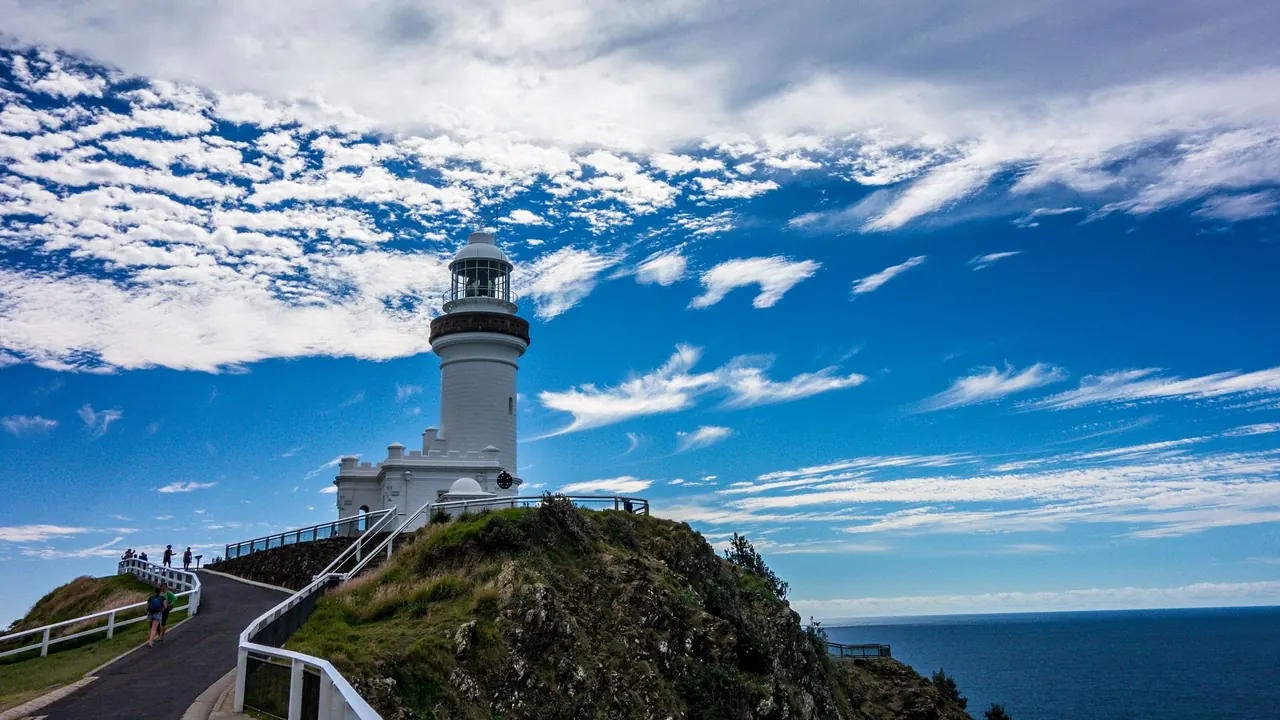
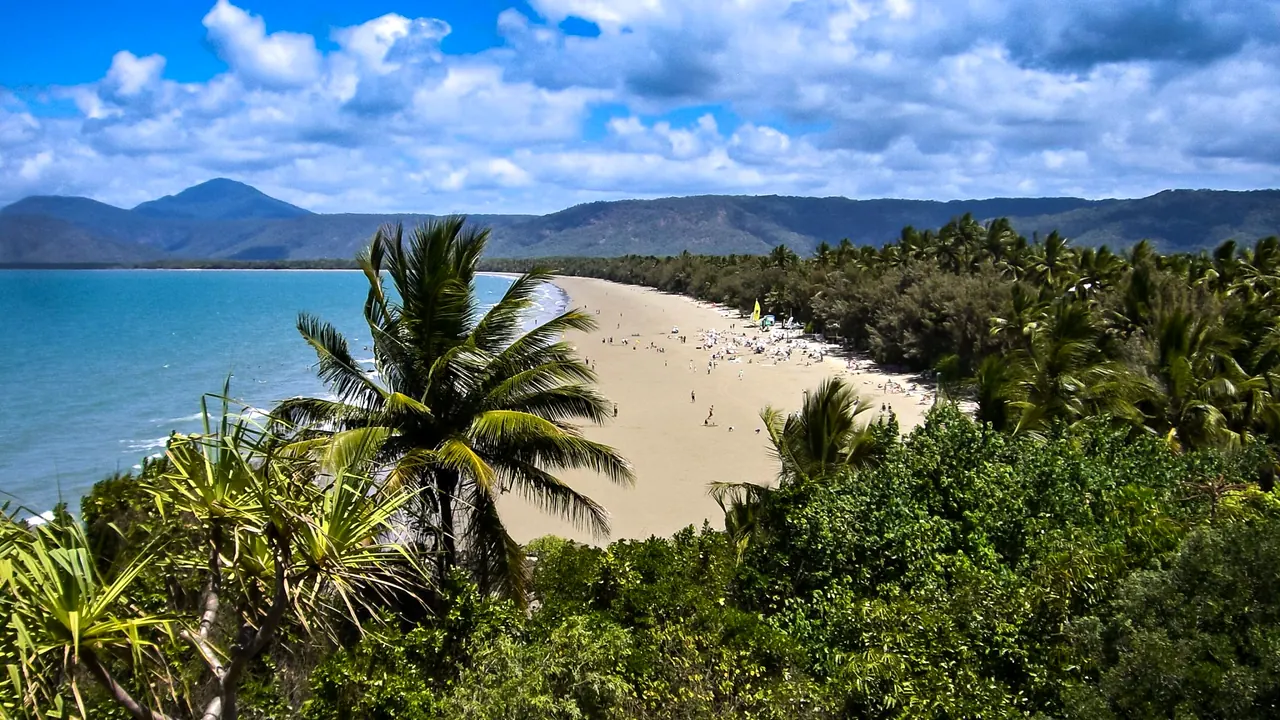
Photos: Byron Bay by Visions of Domino, CC BY 2.0, cropped; Port Douglas by dronepicr, CC BY 2.0, cropped.
Byron Bay or Port Douglas?
Our verdict in twelve categories, each scored against the same fixed benchmark cities, and the climate month by month, so you can choose for your trip.
Choose Byron Bay for
- wellness
- nightlife
- live music and the arts
Byron Bay suits travellers who want the beach itself to be the vacation. Its bay has a different stretch of sand for every mood, from patrolled surf to a sheltered point break and quiet coves, and around it sit yoga studios, hinterland retreats, good cafés and pubs that stay busy until after midnight. It is the better pick for surfers, couples and friends who want a gentle wellness routine by day and some company in the evening.
Choose Port Douglas for
- nature and the outdoors
- getting around
- prices
Port Douglas is for people who come to see the natural world rather than lie in it. The Great Barrier Reef is a boat ride from the marina and the Daintree rainforest begins just up the road, so days are spent snorkelling, diving and walking among ancient trees. Evenings are quiet and the swimming is restricted for half the year, but nowhere else in Australia puts reef and rainforest this close together.
Scoreboard
Twelve categories on one fixed scale from 0 to 100. The shaded stretch is the gap between the two.
Your match
Pick a travel style or drag the sliders, and both match scores follow your weighting.
Wins on wellness and nightlife with your weighting.
Wins on nature and the outdoors and getting around with your weighting.
What matters to you?
Category by category
What the scores mean for a trip.
Beaches & swimming
Byron Bay is the better beach town by some distance. Because the bay faces north, a short walk takes you from the patrolled surf at Main Beach and Clarkes to the point break at The Pass, the little morning-sun cove at Wategos and the long empty arcs of Tallow and Belongil. The sea stays swimmable all year, though rips mean staying between the flags.
Port Douglas has one beach, Four Mile Beach, a long palm-backed sweep of firm sand that is lovely for walking. Swimming is another matter: from about November to May box jellyfish and irukandji keep bathers inside a small netted enclosure, the water is often milky green, and crocodiles rule out the creeks. The dry winter months are when it works as a swimming beach.
Food & drink
Byron Bay eats better, mostly at breakfast and lunch. Its strength is coffee, long brunches and produce from the hinterland farms, macadamias, avocados, tropical fruit and grass-fed beef, shown off at weekly farmers' markets, with a few ambitious farm restaurants and Bangalow nearby for more.
Port Douglas is about a long seafood dinner outdoors on Macrossan Street or by the marina: reef fish, prawns and mud crab, plus tropical fruit at the Sunday market in Anzac Park. The choice is pleasant but shaped by the resort trade, and after a week it starts to repeat itself.
Culture & sights
Neither town is a place for sightseeing. Byron's one landmark is the Cape Byron lighthouse at mainland Australia's most easterly point, while Port Douglas has two small buildings worth a few minutes, the old Court House museum and St Mary's by the Sea with its window onto the water. In both, the most rewarding heritage is Aboriginal and met on guided walks, with the Arakwal people around the cape and the Kuku Yalanji at Mossman Gorge.
Nightlife
Byron Bay has a real night out by small-town standards. Big pubs and beer gardens near Main Beach, cocktail bars and a couple of late venues fill with backpackers and young travellers, above all on summer weekends, and things wind down not long after midnight.
Port Douglas is an early-to-bed town. Evenings mean dinner and a drink on Macrossan Street or at the marina, perhaps with a cover band, and with reef boats leaving at dawn most people are asleep well before midnight. A proper night out means driving an hour to Cairns.
Nature & outdoors
Port Douglas has the bigger natural setting, where the Great Barrier Reef and the Daintree rainforest meet. Boats run about ninety minutes out to the outer ribbon reefs for coral walls, turtles and reef sharks, Low Isles makes a gentler reef day, and on land there is Mossman Gorge, crocodile cruises on the Daintree River and cassowaries towards Cape Tribulation.
Byron Bay is very good on a smaller scale. The Cape Byron track crosses rainforest and clifftops above a bay where dolphins are common and humpbacks pass from about June to November, Julian Rocks is a fine dive and snorkel site, and the old volcanic hinterland hides waterfalls and old-growth forest in Nightcap National Park and the Border Ranges.
Day trips
Byron Bay has more places to go for a day. Bangalow's heritage main street, easygoing Mullumbimby, counterculture Nimbin and the regional gallery at Murwillumbah are all close, and the Gold Coast's theme parks are about an hour away, with Brisbane reachable in about two hours.
From Port Douglas, most outings head into reef and rainforest rather than to other towns. Cairns is an hour south, Kuranda above the Barron Gorge makes a day of markets and wildlife sanctuaries via the old mountain railway, and the crater lakes of the Atherton Tablelands take most of a day. Beyond those, towns are few and far apart.
Good for families
Both work well for families, in different ways. Byron's appeal is beach days: patrolled sand, the gentler water at The Pass and Wategos, rock pools and the lighthouse walk with whales and dolphins below. Children's attractions mean a drive to the Gold Coast, and the backpacker crowd makes the centre loud on weekend nights.
Port Douglas trades surf for wildlife. The Wildlife Habitat puts koalas, crocodiles and cassowaries in front of children, Low Isles offers snorkelling straight off the sand, and glass-bottom boats show coral to the youngest. The price is tropical caution: nets for summer swimming, crocodile warnings on every creek and sticky heat in the wet.
Getting around
Getting around is much the same in both: a small, flat centre you can walk or cycle, and a car needed for anything further. In Byron the walk up to the lighthouse is steep, summer beach parking is tight and the hinterland is impractical without wheels.
Port Douglas is a little easier without a car, because a shuttle runs the main road and most reef and rainforest tours collect you from your hotel. Arrival is a road transfer of about an hour from Cairns, against a flight into Ballina or Gold Coast for Byron.
Shopping & style
Byron Bay is the better place to shop, because it has a look of its own: loose linen, surfwear and bohemian resort fashion from local labels, plus makers and designers at the Arts and Industry Estate and handmade goods at the artisan markets. It still takes only an afternoon.
Port Douglas is evening browsing along Macrossan Street and the marina, with resort-wear, South Sea pearl jewellery and galleries of Aboriginal and tropical art, plus crafts at the Sunday market. The selection is small, and anything more means Cairns.
Affordability
Both are expensive, and the costs fall in different places. In Byron the bed is the big expense, steeper still over summer, school vacations and festival weekends with long minimum stays, but the beaches, the cape walk and the waterfalls cost nothing, and hostels and campsites suit backpackers.
In Port Douglas resort accommodation is dear too, and the reef trips and rainforest tours you come for are paid extras that soon add up. Self-catering, takeaway seafood on the beach and the cheaper rates of the wet season help.
Live music & performing arts
Byron Bay has a small but genuine live scene. Original songwriters and touring folk, roots and surf-rock acts play the pubs and beer gardens, buskers work the main streets in the warm months, the community centre hosts touring comedy and theatre, and the long-running writers' festival brings readings each year.
Port Douglas offers little beyond a cover band or acoustic set on a bar terrace and the outdoor music of its autumn carnival. For anything formal, Byron visitors head to Brisbane or the Gold Coast and Port Douglas visitors to Cairns.
Wellness & relaxation
Byron Bay builds its identity around wellbeing. Yoga studios run classes through the day, sound healing, breathwork and alternative therapies are everywhere, and residential retreats sit in the hinterland hills, though the best are costly and the centre loses its calm in peak season.
Port Douglas is restful in a more passive way. Resort spas use native botanicals, there are massage studios and yoga in town, and much of the relaxing happens on a lounger beside a lagoon pool under the palms. Neither town has hot springs or a bathing tradition.
When should you go?
Pick your month. The climate figures are measured averages, not a forecast.
Byron Bay in July
Port Douglas in July
Daytime high, °C
Rainfall in the month, mm
Temperature and rainfall are climate normals, averaged over the years shown. Byron Bay: 1991-2020 normals, Cape Byron (5.6 km from centre). Port Douglas: 1991-2020 normals, Low Isles (17.1 km from centre).
Byron Bay has a subtropical year with no truly bad month. December to March brings the warmest sea, around 26°C, along with humid heat and the heaviest rain, and June has a damp spell of its own. Winter days settle near 19°C, mild for walking but brisk for the beach. Spring, from September to November, is the best balance: the driest months, warm days and the sea warming up again.
Port Douglas follows the tropical wet and dry. From January to March rainfall tops 400mm a month in heat above 30°C, seas can be too rough for reef trips and stingers keep swimmers inside the nets. The dry season from June to October turns that around, with little rain, highs in the high twenties and calm water. The two fit together neatly: Port Douglas for the southern winter, Byron for spring and early summer.
Which traveller are you?
On a beach and sun trip, Byron Bay gives far more choice: patrolled surf at Main Beach, the sheltered break at The Pass and quiet coves like Wategos, with swimmable sea all year. Port Douglas is warmer, but stingers confine summer swimming to a netted enclosure.
For an outdoors trip, Port Douglas is the stronger base. Boats leave daily for the outer Great Barrier Reef, and Mossman Gorge, the Daintree and Cape Tribulation are close by. Byron's cape walk, Julian Rocks and hinterland waterfalls are good, but smaller in scale.
On a relaxing and wellness trip, Byron Bay is the natural choice, with yoga several times a day, massage, breathwork and residential retreats in the green hinterland hills. Port Douglas offers resort spas and palm-shaded lagoon pools, restful but without Byron's culture of wellbeing.
Before you go
| Measure | Byron Bay | Port Douglas |
|---|---|---|
| Official language | English | English |
| Currency | Australian Dollar (AUD) | Australian Dollar (AUD) |
| Sockets | I230 V, 50 Hz | I230 V, 50 Hz |
| Driving side | Left | Left |
| Time zone | UTC+10, UTC+11 in summer | UTC+10 |
| Emergency number | 000 | 000 |
| Elevation | 5 m | 24 m |
| Main airport | Ballina Byron Gateway Airport (BNK)21 km from centre2 non-stop destinations | Cairns International Airport (CNS)53 km from centre32 non-stop destinations |
| Public holidays this year | 11 days | 11 days |
By the numbers
| Measure | Byron Bay | Port Douglas |
|---|---|---|
| City population | - | 3,650 |
| Museums within 10 km | 1 | 2 |
| UNESCO World Heritage sites within 50 km | 1 | 1 |
| Swim season, months above 21 °C | 11 months | 12 months |
Where else could you go?
Every comparison below shares a destination with this one, so you can follow Byron Bay or Port Douglas somewhere new.
- Cairnsvs Port Douglas
- Gold Coastvs Byron Bay
- Brisbanevs Byron Bay
- Noosavs Byron Bay
- Sydneyvs Byron Bay
- Canberravs Byron Bay