Canada
Montreal
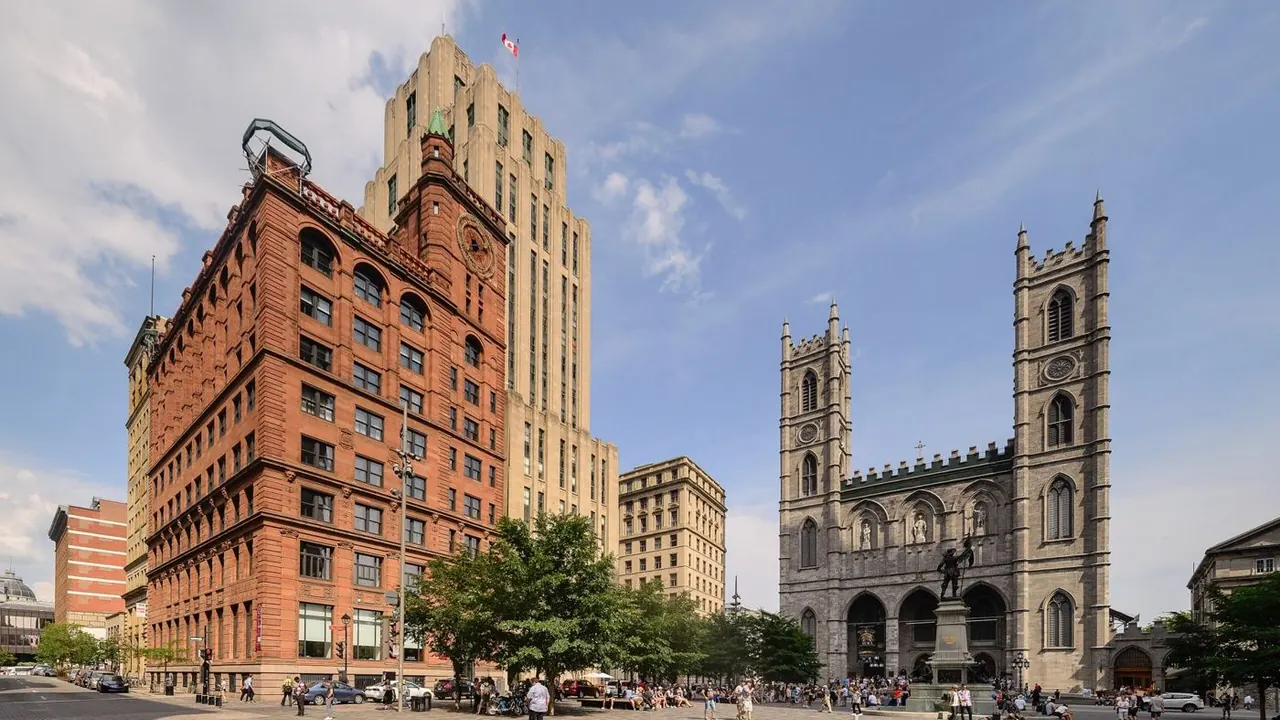
Place d'Armes and Notre-Dame Basilica
- Food & drink78
- Live music & the arts76
- Nightlife75
Photo: Arild Vågen, CC BY-SA 4.0, cropped
Match
61
Every category weighted equally
- Beach & sun57
- Culture & arts65
- Food & nightlife66
- Family trip58
- Outdoors59
- Relax & unwind58
- Shopping & style65
- On a budget60
Montreal in twelve categories
Our verdict on each, scored 0 to 100 against the same fixed benchmark cities, so a score means the same thing on every page.
Beaches & swimming. Scores 25 out of 100.
Food & drink. Scores 78 out of 100.
Culture & sights. Scores 60 out of 100.
Nightlife. Scores 75 out of 100.
Nature & outdoors. Scores 66 out of 100.
Day trips. Scores 55 out of 100.
Good for families. Scores 68 out of 100.
Getting around. Scores 72 out of 100.
Shopping & style. Scores 60 out of 100.
Affordability. Scores 45 out of 100.
Live music & performing arts. Scores 76 out of 100.
Wellness & relaxation. Scores 57 out of 100.
Montreal category by category
Beaches & swimming
25Montreal is an island city in a river, not a beach destination. In summer the main swimming spot is the supervised sand beach at Parc Jean-Drapeau on Île Notre-Dame, a lake fed by filtered river water. It reaches about 22°C in July and gets crowded on hot weekends. Verdun has a small urban river beach for paddling and sunbathing, and the larger sandy shore at Oka National Park, on the Lac des Deux Montagnes, is about an hour west.
The swimming season runs from late June to late August, and for the rest of the year the water is far too cold. Treat a beach afternoon as an occasional summer extra rather than a reason to come.
Food & drink
78Eating is one of the main reasons to visit Montreal. The city has its own staples: wood-fired bagels from Mile End bakeries that run through the night, hand-cut smoked meat, poutine, and in early spring, sugar-shack meals built around maple syrup. On top of that comes a Québécois bistro culture with French roots, which favours game, offal, local cheeses and generous plates.
The Jean-Talon and Atwater markets are full of Quebec produce, ciders and ice wines. The Plateau, Mile End and Little Italy are lined with neighbourhood restaurants, and many of them are bring-your-own-wine places. Portuguese, Haitian, Lebanese and Vietnamese communities widen the range further. What the city lacks is the endless street-food depth of the world's largest food capitals.
Culture & sights
60Old Montreal is the heart of the city's heritage: grey-stone warehouses and counting houses from the 18th and 19th centuries, cobbled streets running down to the Old Port, and the Notre-Dame Basilica with its deep blue, gilded Gothic Revival interior. Pointe-à-Callière, built over the city's founding site, tells the archaeological story. On the slope of Mount Royal stands Saint Joseph's Oratory, whose huge dome is visible across the west of the island.
The Museum of Fine Arts on Sherbrooke Street is the strongest collection. The McCord Stewart Museum and the Contemporary Art Museum add history and modern work, and the Expo 67 site on the islands keeps the Biosphere geodesic dome. It is a satisfying two or three days of sights rather than an inexhaustible list.
Nightlife
75Montreal stays out later than almost anywhere else in North America. Bars serve until 3am, and a young, bilingual student population fills them every night of the week. Boulevard Saint-Laurent is the main spine, with cocktail bars, dive bars and clubs running from the Plateau down towards downtown. Rue Saint-Denis and Mile End have quieter wine bars and taverns, and the Village has a long-established gay scene with large clubs.
Summer changes the city. Terraces spill onto pedestrianised streets and people stay outside until late. The electronic scene is strong too, with after-hours parties and big outdoor dance events on Île Sainte-Hélène. In the deep of winter the energy moves indoors but does not really fade.
Nature & outdoors
66Mount Royal, the low wooded mountain that gives the city its name, rises right beside downtown. Its park was laid out by the designer of Central Park and has trails, a lookout over the skyline and a lake used for skating in winter. The Lachine Canal path and a network of separated bike lanes make cycling easy. The St Lawrence offers kayaking, and there is even river surfing on a standing wave below the Lachine Rapids.
Within about an hour and a half you reach the Laurentian hills, with lakes, forest trails and ski slopes around Mont-Tremblant, and the rolling Eastern Townships. Autumn colour in early October is the high point. Winter brings cross-country skiing and snowshoeing, but also cold that can shut down outdoor plans.
Day trips
55The most rewarding easy outing is Ottawa, about two hours by train. The national capital has its Gothic Revival Parliament buildings, the Rideau Canal and major national museums. The Eastern Townships, about an hour and a half away, make a gentler day out: Loyalist villages such as Knowlton and North Hatley, covered bridges, abbeys, and a wine and cider route. To the north, the pedestrian resort village at Mont-Tremblant is a popular stop in any season.
Quebec City, with its walled old town, is the trip everyone wants to make. At about three hours by train or car each way, though, it works far better as an overnight stay than a day out.
Good for families
68Montreal is an easy city with children. The Olympic Park area groups several attractions together: the Biodome, with its recreated rainforest and polar habitats, the Insectarium, and the large Botanical Garden, which glows with Chinese lanterns in autumn. In the Old Port, the Science Centre has hands-on galleries, and in winter there is skating by the river. The amusement park on Île Sainte-Hélène dates from Expo 67, and the Granby Zoo is about an hour away.
The city is safe and relaxed, its parks have good playgrounds, and the families who live here make children feel welcome in cafés and restaurants. The drawback is winter, when deep cold makes getting around with small children hard work. Summer and early autumn are the easiest seasons.
Getting around
72The central neighbourhoods, Old Montreal, downtown, the Plateau and Mile End, are compact enough to walk or cycle between. In the warm months the public bike-share and the separated bike lanes are the nicest way to move around. The metro has four colour-coded lines on rubber tyres. It is clean and simple to learn, covers the main sights, and reaches the Olympic Park and the islands of Parc Jean-Drapeau. Buses fill the gaps.
In winter the underground pedestrian network links downtown malls, offices and metro stations, so you can stay out of the cold. Snow and ice still make the streets slippery. A car is unnecessary in the city and useful only for the countryside beyond it.
Shopping & style
60Rue Sainte-Catherine is the long main shopping street, with chain stores, malls and big department stores, and many of them connect to the underground passages. Rue Sherbrooke and the Golden Square Mile carry the luxury end, around the historic Ogilvy department store. The Plateau, Mile End and Saint-Henri are better for independent boutiques, Quebec designers, vintage clothing and record shops.
For something to take home, the Jean-Talon and Atwater markets sell maple products, ice cider and local cheeses, and Inuit and First Nations art is found in specialist galleries. It is good for browsing and local design rather than a city you would travel to for shopping.
Affordability
45Montreal is the most affordable of Canada's big cities, but it is not cheap. Hotels downtown and in Old Montreal are priced like those in other North American cities, and they cost the most during the summer festival season and the Grand Prix weekend. Restaurant bills have sales tax and a customary tip added on top. Drinks in bars are expensive, which is one reason the bring-your-own-wine restaurants are so popular.
Much of the city's best eating is casual: bagels, smoked meat, market food and neighbourhood bistros. Public transport is reasonably priced, and many summer festival concerts are free. Winter, outside Christmas and New Year, is the cheapest time to stay.
Live music & performing arts
76Place des Arts, the downtown arts complex, is the centre of performing life. It is home to the Montreal Symphony Orchestra, which plays in a hall known for its warm acoustics, as well as the Opéra de Montréal and Les Grands Ballets. A large French-language theatre scene, with houses such as the Théâtre du Nouveau Monde, stages everything from classics to new Québécois writing. Montreal is also a world centre of contemporary circus. It is home to the National Circus School and to TOHU, a performance hall in Saint-Michel built for circus, so acrobatic shows are a local strength.
In summer the Quartier des Spectacles becomes an open-air stage. The International Jazz Festival, held every year since 1980, brings hundreds of concerts, many of them free, and comedy and circus festivals fill out the season. All year round, small venues in Mile End and the Plateau showcase the city's well-regarded indie music scene.
Wellness & relaxation
57Quebec has made the Nordic spa its own. You move from outdoor hot pools, saunas and steam rooms to a cold plunge and then a rest by the fire, and locals do this all year, often in the snow. In the city there are spa circuits on Nuns' Island and aboard a converted ferry moored in the Old Port, which looks out on the skyline. Larger forest spas line the rivers of the Laurentians, about an hour north.
The city has no thermal springs. A few spas in Old Montreal and the Plateau offer hammam steam rooms and scrubs, but the Nordic circuit is the real bathing culture. The pace of daily life is easygoing, and in summer long café mornings, picnics in Parc La Fontaine and afternoons on terraces are part of how the city lives.
When should you go?
Pick a month to see what it is like. The climate figures are measured averages, not a forecast.
Montreal in July
Daytime high, °C
Rainfall in the month, mm
The whole year
Shaded against this city’s own year: the deepest cell is its best month for that figure and the palest its weakest.
Temperature and rainfall are climate normals, averaged over the years shown. Montreal: 1991-2020 normals, Montreal McTavish (3.2 km from centre).
Before you go
| Measure | Montreal |
|---|---|
| Official language | French, English |
| Currency | Canadian Dollar (CAD) |
| Sockets | AB120 V, 60 Hz |
| Driving side | Right |
| Time zone | UTC-5, UTC-4 in summer |
| Emergency number | 911 |
| Elevation | 31 m |
| Main airport | Montreal / Pierre Elliott Trudeau International Airport (YUL)16 km from centre166 non-stop destinations |
| Public holidays this year | 10 days |
By the numbers
| Measure | Montreal |
|---|---|
| City population | 1,895,211 |
| People per km² | 3,806 |
| Museums within 10 km | 37 |
| UNESCO World Heritage sites within 50 km | 0 |
Compare Montreal with
Every comparison with a written verdict behind it.