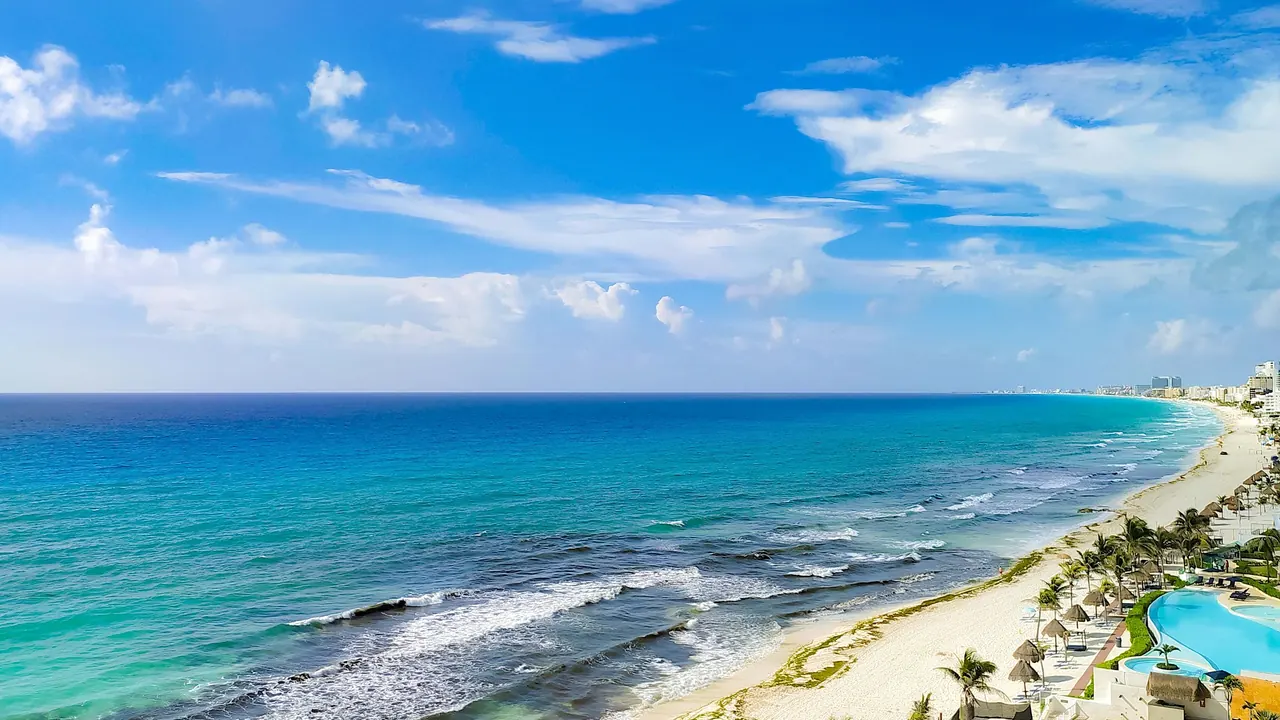
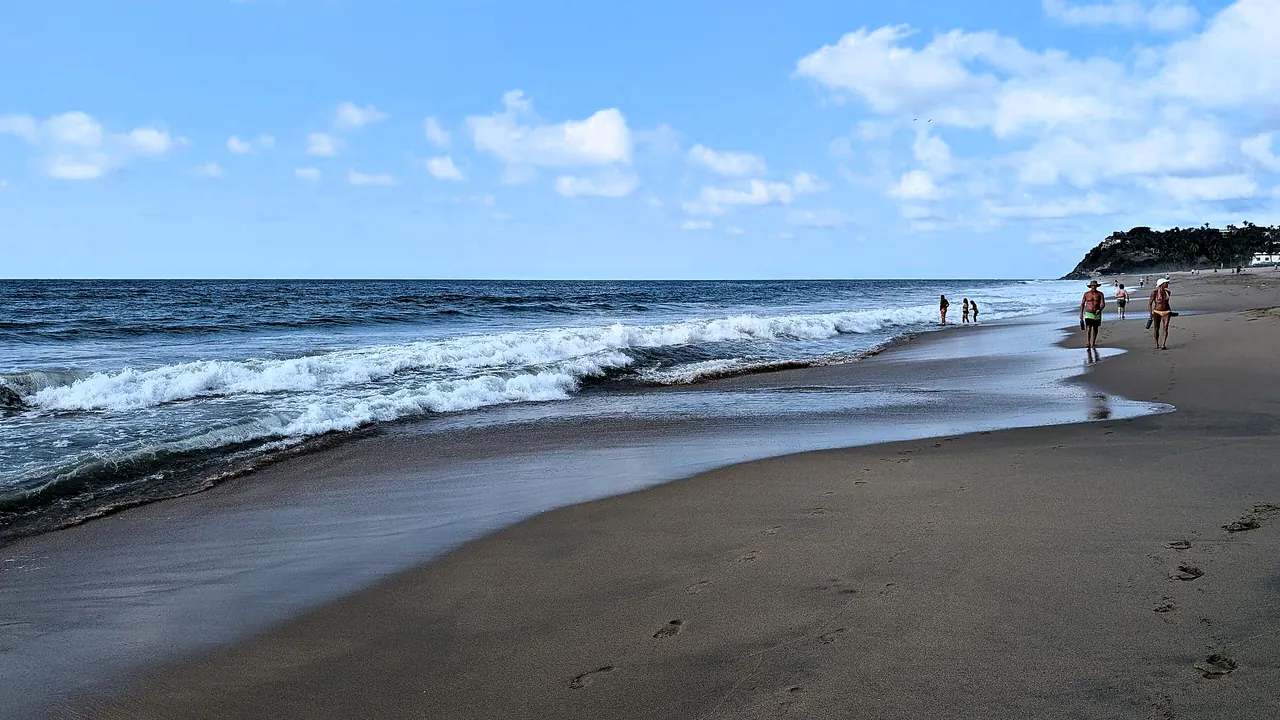
Photos: Cancun by Tellez Erik, Pexels License; Riviera Nayarit by গীতাশ্ৰী গগৈ আপ্তে, CC BY-SA 4.0, cropped.
Cancun or Riviera Nayarit?
Our verdict in twelve categories, each scored against the same fixed benchmark cities, and the climate month by month, so you can choose for your trip.
Choose Cancun for
- nightlife
- day trips
- beaches
Cancun suits travellers who want the classic Caribbean beach and want everything laid on. The Hotel Zone gives you one long run of pale coral sand on turquoise water, with big all-inclusive resorts that make life easy for families. It also has the loudest nightlife on either coast and the great Maya sites of the Yucatan within a day's reach. You give up character: the food on the strip is generic and the city itself has little history.
Choose Riviera Nayarit for
- food and drink
- getting around
- nature and the outdoors
Riviera Nayarit is the better pick for a slower, more varied coast. It is a string of Pacific beach towns rather than one resort strip, so you can choose between the calm bay at Nuevo Vallarta, surf and yoga in Sayulita and San Pancho, or quiet coves further north. Wildlife is stronger here, with whales in the bay and birds at San Blas, and so is the seafood at the beach shacks. Expect quiet evenings and plan on a hire car or a lot of bus rides.
Scoreboard
Twelve categories on one fixed scale from 0 to 100. The shaded stretch is the gap between the two.
Your match
Pick a travel style or drag the sliders, and both match scores follow your weighting.
Wins on nightlife and day trips with your weighting.
Wins on food and drink and getting around with your weighting.
What matters to you?
Category by category
What the scores mean for a trip.
Beaches & swimming
Cancun has the finer beach. Its 22km of pale, powdery coral sand forms a single unbroken shore with the clear turquoise water that defines the Caribbean, and the water is warm enough to swim in all year. The calm bay beaches on the northern arm and the wave-washed eastern shore give two kinds of swimming within one stretch, though sargassum can foul the eastern side in some summers.
Riviera Nayarit's beaches spread across many towns rather than one strip. There are wide, shallow sands at Nuevo Vallarta and Bucerías, surf beaches at Sayulita and San Pancho, and sheltered coves such as Chacala and Rincón de Guayabitos. That gives you more variety, but the Pacific is darker and cooler in the winter season, and rip currents are common on the open beaches.
Food & drink
Riviera Nayarit eats better, mainly because its best food is right on the beach. Pescado zarandeado grilled over coals, aguachile and shrimp tamales are served at shacks on the sand, and Bucerías and La Cruz de Huanacaxtle have relaxed seafront restaurants with the feel of a fishing port.
In Cancun the good food is inland. Yucatecan cooking such as cochinita pibil and sopa de lima is excellent at the downtown taco stands, at Mercado 28 and around Parque de las Palapas, but the Hotel Zone itself runs mostly on buffets and international menus.
Culture & sights
Neither place is a heritage destination, and the little each offers is different. Cancun was planned as a resort, and its one real sight is the Maya Museum, which has the small San Miguelito ruins in its grounds. Riviera Nayarit has older traces: the hilltop fort and church at San Blas, and the Altavista petroglyphs, which the Huichol still treat as sacred. Either way, culture is an outing rather than the reason to go.
Nightlife
Cancun is far livelier after dark. The Party Center at the bend of the Hotel Zone has huge clubs with acrobats, confetti and open-bar wristbands, and they stay full until four or five in the morning. It is all one style, though, and quieter local bars are mostly downtown.
Riviera Nayarit goes to bed early. Sayulita's plaza fills with surfers and young travellers in beach bars and mezcal spots, and Bucerías has some seafront music, but anyone who wants a club takes a taxi to Puerto Vallarta.
Nature & outdoors
Riviera Nayarit has the richer outdoors because it has land as well as sea. Jungle-covered foothills of the Sierra Madre rise behind the coast, with trails to waterfalls. Humpback whales come into Banderas Bay from December to March, the Marietas Islands are a protected park, and La Tovara at San Blas has crocodiles, mangroves and fine birdwatching.
Cancun's outdoors is almost all water: diving and snorkelling on the Mesoamerican Reef, the underwater sculptures of MUSA, swimming in cenotes inland and seeing whale sharks in summer. The flat scrub inland gives you no hiking at all.
Day trips
Cancun has the bigger day trips. It is the base for the great Maya sites: Chichen Itza and Valladolid make one long day, and Coba or Ek Balam another. Closer by are the cliff-top ruins at Tulum, the ferry to Isla Mujeres and the pedestrian street of Playa del Carmen.
From Riviera Nayarit, most trips go to other places along the same coast. Puerto Vallarta's old town and malecón are close by, and boats run from there to Yelapa, which has no road. Further out are the old silver-mining town of San Sebastián del Oeste in the hills and the colonial ruins at San Blas. They make pleasant outings, but none of them is a site you would cross the country to see, as people do for Chichen Itza.
Good for families
Both coasts make a resort vacation easy, but Cancun gives children more to do. Its all-inclusive hotels have kids' clubs and shallow pools beside the calm bay beaches, and there is an aquarium in the Hotel Zone as well as eco-parks with underground rivers and animal encounters down the coast.
Nuevo Vallarta offers the same gently shelving sand and resort set-up, and Riviera Nayarit has outings that children remember, such as whale watching and releasing baby turtles. Beyond one water park, though, there are no big attractions.
Getting around
Riviera Nayarit is a little easier to get around. The airport sits at the southern end of the coast, close to the resorts, and villages such as Sayulita and Bucerías are small enough to explore on foot, though their streets are often cobbled and hilly. Between villages there is only the coastal highway, so a hire car helps.
In Cancun everything runs along Boulevard Kukulcan, which frequent buses make simple, but the Hotel Zone is too long and too hot to walk. The ADO coaches to Playa del Carmen, Tulum and Valladolid are a real strength for longer journeys.
Shopping & style
Cancun is the stronger place to shop. The big air-conditioned malls along the Hotel Zone carry international fashion, luxury labels and duty-free, so you can do a proper shopping afternoon without leaving the beach strip. Downtown, Mercado 28 adds hammocks, embroidered huipiles, silver and vanilla, though the stalls repeat each other and you should expect to bargain.
Riviera Nayarit's offer is narrower and mostly about crafts. Huichol beadwork and yarn paintings are the purchase to look for, sometimes sold by the artisans themselves, and there are small boutiques in Sayulita and galleries in Bucerías. With no department stores or fashion streets, anything beyond that means a trip to Puerto Vallarta.
Affordability
The two cost much the same overall, with Riviera Nayarit slightly cheaper. In Cancun most of the cost is in the Hotel Zone, and staying downtown with taco stands and local buses cuts it sharply.
In Nayarit the range is wider. Punta de Mita is a luxury enclave, but Bucerías, Lo de Marcos, Rincón de Guayabitos and San Blas have simple guesthouses aimed at Mexican visitors, so you can be cheap and still sleep near the sea.
Live music & performing arts
Neither is a place to go for performances, and on both coasts what exists is put on for visitors. Cancun has the bigger shows: folkloric dinner shows and the large evening spectacles at the eco-parks. Riviera Nayarit has more informal music, with acoustic sets in Sayulita and Bucerías bars and mariachi in town plazas, and for anything more you drive to Puerto Vallarta.
Wellness & relaxation
Riviera Nayarit is the more restful choice. San Pancho and Sayulita have a strong yoga culture, with open-air studios in the jungle and week-long retreats, and the spas on the Punta de Mita headlands look out over the sea. The slow pace of the villages helps too.
Cancun has large, well-equipped resort spas with hydrotherapy circuits and temazcal rituals, but traffic on the boulevard and noise from the Party Center mean that real quiet means heading to the southern end of the strip or to Isla Mujeres.
When should you go?
Pick your month. The climate figures are measured averages, not a forecast.
Cancun in July
Riviera Nayarit in July
Daytime high, °C
Rainfall in the month, mm
Where the figures come from
Cancun has no weather station within reach, so its figures come from a gridded climate model rather than a measured record, and read a broad area rather than one spot.
Riviera Nayarit has no weather station within reach, so its figures come from a gridded climate model rather than a measured record, and read a broad area rather than one spot.
Temperature and rainfall are climate normals, averaged over the years shown. Cancun: 2001-2020 normals, NASA POWER reanalysis grid, no weather station within 90 km. Riviera Nayarit: 2001-2020 normals, NASA POWER reanalysis grid, no weather station within 90 km.
Cancun is warm all year. Highs run from the mid-twenties in winter to about 30°C from May to September, and the Caribbean stays warm enough to swim in every month. February to April is the driest stretch. Showers pick up from May, and autumn is the wettest time, peaking in October at around 224mm. In summer it is too hot and humid for much walking away from the sand.
Around Banderas Bay, Riviera Nayarit's year divides more sharply. From November to May the coast is almost rainless and pleasantly warm, with highs in the mid-twenties, though the Pacific is cooler then, dipping to about 24°C in March. From July to September the rainy season brings heavy downpours, close to 384mm in August, along with sticky heat and a sea as warm as the Caribbean. For a dry, comfortable winter, Nayarit is the more reliable choice. Over the rest of the year Cancun's weather is steadier, but its autumn is wet.
Which traveller are you?
For a beach and sun trip, Cancun has the edge. Its Hotel Zone is one continuous strip of fine coral sand on warm turquoise water, swimmable in any month, and the calm bay side sits within a short ride of the open-surf eastern shore.
On an outdoors trip, Riviera Nayarit is the stronger choice. Humpback whales calve in Banderas Bay in winter, the Marietas Islands offer snorkelling and seabirds, there are surf breaks at Punta de Mita and Sayulita, and jungle trails lead to waterfalls. Cancun has no real hiking.
On a family trip with children, Cancun makes things easier. The resorts have kids' clubs and shallow pools, and the calm northern beaches suit small swimmers. There is also an aquarium and a choice of large eco-parks down the coast, whereas Nayarit has no aquariums or theme parks.
Before you go
| Measure | Cancun | Riviera Nayarit |
|---|---|---|
| Official language | Spanish, Nahuatl, Yucatec Maya | Spanish, Nahuatl, Yucatec Maya |
| Currency | Mexican Peso (MXN) | Mexican Peso (MXN) |
| Sockets | AB127 V, 60 Hz | AB127 V, 60 Hz |
| Driving side | Right | Right |
| Time zone | UTC-5 | UTC-6 |
| Emergency number | 911 | 911 |
| Elevation | 5 m | - |
| Main airport | Cancún International Airport (CUN)14 km from centre136 non-stop destinations | Puerto Vallarta International Airport (PVR)52 non-stop destinations |
| Public holidays this year | 9 days | 9 days |
By the numbers
| Measure | Cancun | Riviera Nayarit |
|---|---|---|
| Population | 888,797 | - |
| Museums within 10 km | 1 | - |
| UNESCO World Heritage sites within 50 km | 0 | - |
| Swim season, months above 21 °C | 12 months | 12 months |
Where else could you go?
Every comparison below shares a destination with this one, so you can follow Cancun or Riviera Nayarit somewhere new.
- Isla Mujeresvs Cancun
- Puerto Vallartavs Riviera Nayarit
- Playa del Carmenvs Cancun
- Riviera Mayavs Cancun
- Cozumelvs Cancun
- Akumalvs Cancun