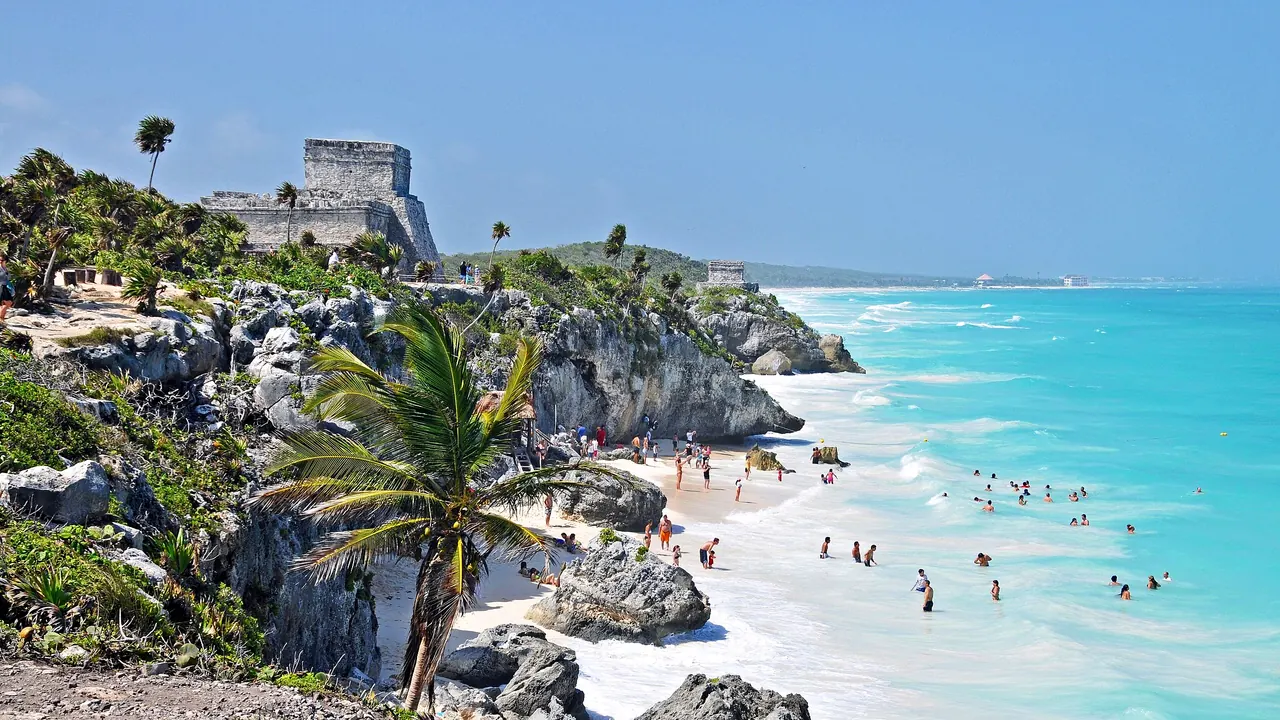
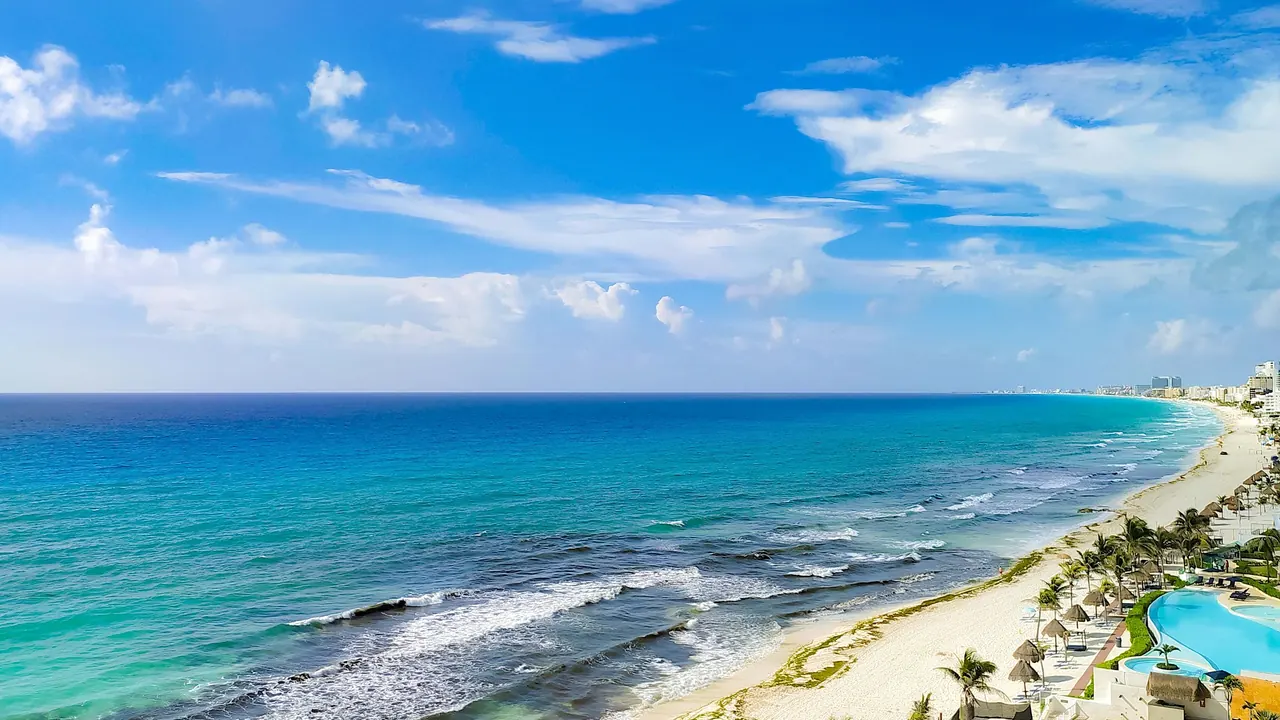
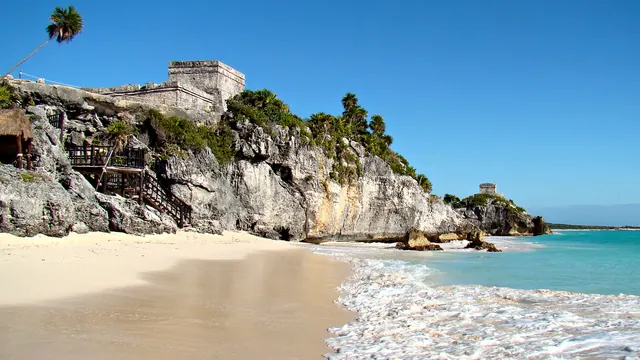
Photos: Riviera Maya by Dennis G. Jarvis, CC BY-SA 2.0, cropped; Cancun by Tellez Erik, Pexels License.
Riviera Maya or Cancun?
Our verdict in twelve categories, each scored against the same fixed benchmark cities, and the climate month by month, so you can choose for your trip.
Choose Riviera Maya for
- culture and sights
- getting around
- wellness
Riviera Maya is the better pick for a trip with more movement and more variety. Its coast takes in Playa del Carmen's late bars, Tulum's ruins on their cliff, reef bays where turtles feed, and cenotes in the jungle. It is stronger on nature, wellness and food, and the colectivos make moving along the highway easy. In return you give up Cancun's single compact strip, and you have to decide where along the coast to stay.
Choose Cancun for
- day trips
- beaches
- prices
Cancun suits a straightforward beach vacation from a single base. Everything sits on one strip of sand, with calm bay water for small children on the northern arm and open Caribbean surf on the eastern shore. The Party Center gives the nights a reliable, very loud focus. It also makes a sensible hub for day trips to Isla Mujeres and the inland Maya sites. Choose it if you want to unpack once and spend most days on the beach.
Scoreboard
Twelve categories on one fixed scale from 0 to 100. The shaded stretch is the gap between the two.
Your match
Pick a travel style or drag the sliders, and both match scores follow your weighting.
Wins on culture and sights and getting around with your weighting.
Wins on day trips and beaches with your weighting.
What matters to you?
Category by category
What the scores mean for a trip.
Beaches & swimming
Both coasts have warm, clear Caribbean water and fine white sand, but Cancun comes out a little ahead because everything is concentrated in one place. Its seven-shaped Hotel Zone lets you choose between the shallow, sheltered bay at Playa Langosta and Playa Tortugas and the rolling surf at Chac Mool or Delfines, all on the same strip. When sargassum arrives on the eastern shore, the bay side is a dependable fallback.
Riviera Maya's beaches spread across more than 100km, so the variety is wider and the beaches lie further apart. You get turtle bays at Akumal and Xpu-Ha, the busy town front of Playa del Carmen, and empty sand running toward Sian Ka'an. The catch is that each beach comes with a choice of base, and public stretches can stay clogged with seaweed for weeks.
Food & drink
Both serve the same Yucatecan cooking: cochinita pibil, sopa de lima, panuchos and fresh ceviche. In Cancun, though, the good food means getting off the Hotel Zone and taking the bus downtown to Mercado 28 or the stalls around Parque de las Palapas. Back on the beach strip, buffets and steakhouses are the norm.
Riviera Maya gives you more to work with. Taquerias a few streets back from Playa del Carmen's Quinta Avenida and family-run places in Tulum town are easy to reach. Tulum's beach road adds a layer of wood-fired, chef-led kitchens that Cancun does not really have outside its larger hotels.
Culture & sights
Riviera Maya has much more heritage on its own doorstep. Tulum's walled city stands above the sea, and Coba has tall pyramids and raised roads you can cycle between in the jungle. Smaller sites at Muyil and on Cozumel fill out the picture.
Cancun was built as a resort from the 1970s. Its offer is an afternoon at the Maya Museum with the San Miguelito ruins in its grounds, plus the modest El Rey site. Neither has a colonial centre, and both send visitors inland for Chichen Itza and Valladolid.
Nightlife
Cancun keeps its nights in one place, the Party Center at the bend of the Hotel Zone. Huge clubs there run acrobatic shows, confetti drops and open-bar wristbands until four or five in the morning. It is easy to find and hard to avoid. For something less staged, take the bus downtown to the bars around Avenida Tulum, where residents drink.
Riviera Maya splits its nightlife between two towns that feel quite unlike each other. Playa del Carmen is the late, loud one, with bars, rooftop terraces and clubs around Calle 12. Tulum is the place for electronic music, with DJ nights in jungle clearings and at beach clubs, and it is busiest in winter. If you stay in Akumal or Puerto Morelos, the evenings end early.
Nature & outdoors
Riviera Maya has the richer outdoors, and most of it is water. Dos Ojos and Gran Cenote are classic spots for cenote snorkelling and cave diving. The reef walls off Cozumel draw divers from all over the world, and boats into the Sian Ka'an reserve find dolphins, crocodiles and birdlife.
Cancun has the same reef and its own attractions: the sunken sculptures of MUSA, kayaking through the Nichupte mangroves, the bird island of Isla Contoy, and whale-shark swims from June to September. On either coast the land is flat, so there is no hill walking.
Day trips
Cancun makes the more useful hub. Isla Mujeres is a short ferry ride away and Playa del Carmen is about an hour by road. Chichen Itza with Valladolid, Ek Balam and Coba are all workable inland outings, even if they make long days.
Many of the places Cancun visitors travel out to, such as Tulum and the cenotes, are already part of a Riviera Maya stay. That leaves its own list of trips shorter. Chichen Itza is about two hours from Tulum, Cozumel is under an hour by ferry from Playa del Carmen, and Bacalar is too far south to do in a day.
Good for families
For families the two are about level, and both rely on big all-inclusive resorts with kids' clubs and shallow pools. Cancun's advantage is its calm bay beaches and an aquarium on the Hotel Zone. Riviera Maya's is snorkelling with turtles at Akumal, plus the eco-parks with underground rivers and zip lines close by. On both coasts the heat is hard work and anything outside the hotel needs transport.
Getting around
In Cancun, life runs along Boulevard Kukulcan. Frequent buses make the Hotel Zone and downtown easy to cover, but long distances, patchy pavements and heat make walking pleasant only near your hotel.
Riviera Maya is easier to move around. Colectivo vans run along the coastal highway and stop on request at beaches and cenote turnoffs. Playa del Carmen's centre is easy to walk, and bicycles link Tulum town, the beach road and the ruins. The weak points are expensive taxis in Tulum and resorts set well back from the road.
Shopping & style
There is little to separate them, but the shopping is quite different in character. Cancun means air-conditioned malls with luxury labels and duty-free, plus haggling for huipiles and hammocks at Mercado 28. Riviera Maya shops along a street instead: Playa del Carmen's pedestrian Quinta Avenida, and small boutiques in Tulum selling linen, woven baskets and boho fashion. For good crafts, Valladolid beats both coasts.
Affordability
Neither is cheap by Mexican standards, and both cost the most in the winter high season. In Cancun the big difference is between the beachfront and downtown: small hotels inland, taco stands and local buses cost a fraction of what the Hotel Zone charges. On the Riviera, Tulum's design hotels and beach-road restaurants are the costliest part of the coast. Staying a few blocks back from the sea in Playa del Carmen or Puerto Morelos and travelling by colectivo keeps costs down.
Live music & performing arts
Neither is a place to plan a trip around the stage, and almost everything on offer is put on for visitors. Cancun has folkloric dinner shows with mariachi, plus some evenings of music in its downtown squares and a small theatre. Riviera Maya has the large eco-park spectacles with Maya ball games and folk dance, and its bars in Playa del Carmen and Tulum book live reggae, rock and Latin bands.
Wellness & relaxation
Riviera Maya is clearly the place to rest. Tulum has jungle yoga shalas, breathwork and sound-healing sessions, and spas built of wood and palm thatch. Further up the coast, the big resorts have hotel spas on a large scale, and Puerto Morelos and Akumal move at an unhurried pace.
Cancun's wellness happens mostly inside its resorts, with good spas and the traditional temazcal sweat lodge. Beyond the spa doors, traffic on the boulevard and noise from the Party Center get in the way. Visitors to Cancun who want real quiet usually end up heading to Isla Mujeres or Puerto Morelos.
When should you go?
Pick your month. The climate figures are measured averages, not a forecast.
Riviera Maya in July
Cancun in July
Daytime high, °C
Rainfall in the month, mm
Where the figures come from
Riviera Maya has no weather station within reach, so its figures come from a gridded climate model rather than a measured record, and read a broad area rather than one spot.
Cancun has no weather station within reach, so its figures come from a gridded climate model rather than a measured record, and read a broad area rather than one spot.
Temperature and rainfall are climate normals, averaged over the years shown. Riviera Maya: 2001-2020 normals, NASA POWER reanalysis grid, no weather station within 90 km. Cancun: 2001-2020 normals, NASA POWER reanalysis grid, no weather station within 90 km.
The two share almost the same weather, since one runs straight into the other. December to April is the best stretch for either. Daytime highs sit in the high twenties, from about 26°C in January, and the sea stays warm enough to swim every day. March and April are the driest months. From May the heat builds to around 30°C, which makes long walks through Cancun's Hotel Zone or between Tulum's ruins and beach hard going in the middle of the day. Rain also picks up, with a first peak in June.
The wettest month on both coasts is October, with around 224mm. September and November are also wet. The sea holds at 26°C to 29°C all year, so the swimming never really stops. What changes is the rain, and the chance of sargassum on the open-sea beaches through spring and summer. Cancun's sheltered bay shore is a better fallback then than most stretches of the Riviera.
Which traveller are you?
On a beach and sun trip, Cancun has the edge. Its 22km of pale sand runs unbroken along one bus route, so you can pick calm bay water or open surf on any given day without moving hotel or hiring a car.
On a culture and arts trip, Riviera Maya is the better base. Tulum's walled city above the sea and the tall pyramids of Coba are close at hand. From Cancun, the Maya Museum is the only real sight within the city.
On a relaxing and wellness trip, choose Riviera Maya. Tulum's jungle yoga shalas, retreats and thatched spas, plus the slow pace of Akumal and Puerto Morelos, offer far more calm than Cancun's resort spas beside a busy boulevard.
Before you go
| Measure | Riviera Maya | Cancun |
|---|---|---|
| Official language | Spanish, Nahuatl, Yucatec Maya | Spanish, Nahuatl, Yucatec Maya |
| Currency | Mexican Peso (MXN) | Mexican Peso (MXN) |
| Sockets | AB127 V, 60 Hz | AB127 V, 60 Hz |
| Driving side | Right | Right |
| Time zone | UTC-5 | UTC-5 |
| Emergency number | 911 | 911 |
| Elevation | - | 5 m |
| Main airport | Cancún International Airport (CUN)136 non-stop destinations | Cancún International Airport (CUN)14 km from centre136 non-stop destinations |
| Public holidays this year | 9 days | 9 days |
By the numbers
| Measure | Riviera Maya | Cancun |
|---|---|---|
| Population | - | 888,797 |
| Museums within 10 km | - | 1 |
| UNESCO World Heritage sites within 50 km | - | 0 |
| Swim season, months above 21 °C | 12 months | 12 months |
Where else could you go?
Every comparison below shares a destination with this one, so you can follow Riviera Maya or Cancun somewhere new.
- Isla Mujeresvs Cancun
- Cozumelvs Riviera Maya
- Playa del Carmenvs Cancun
- Cozumelvs Cancun
- Isla Mujeresvs Riviera Maya
- Akumalvs Cancun