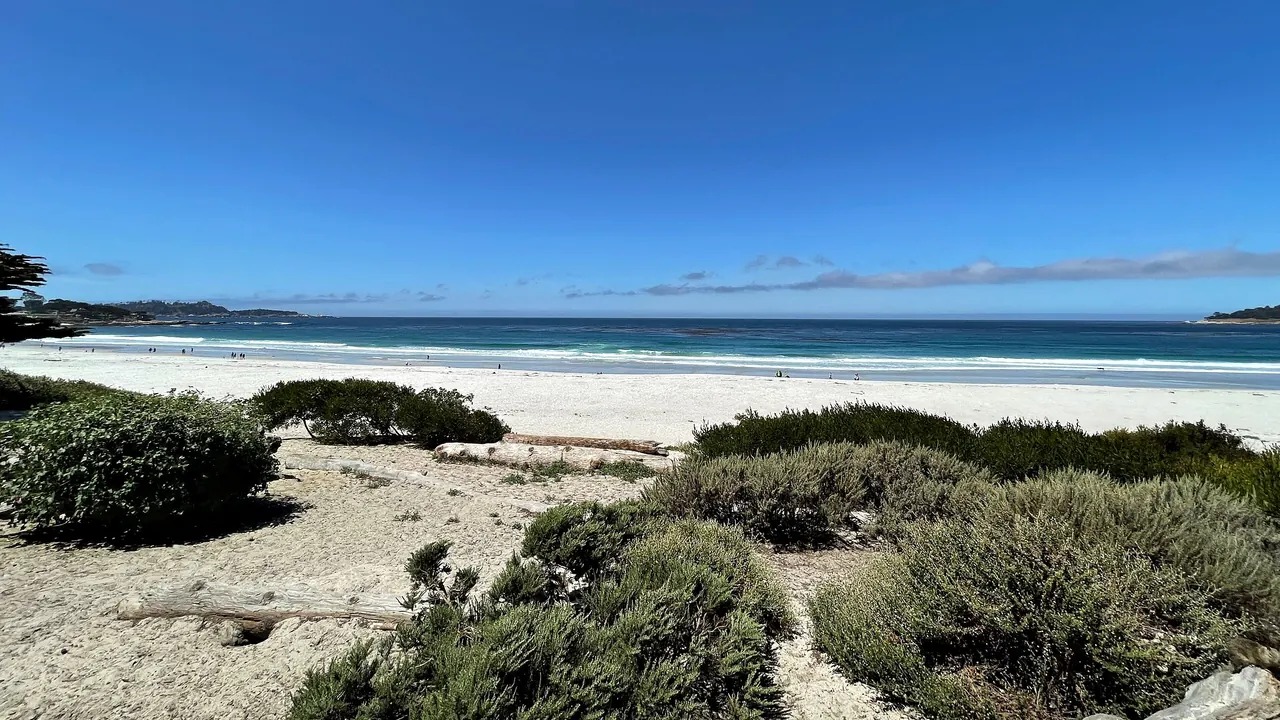
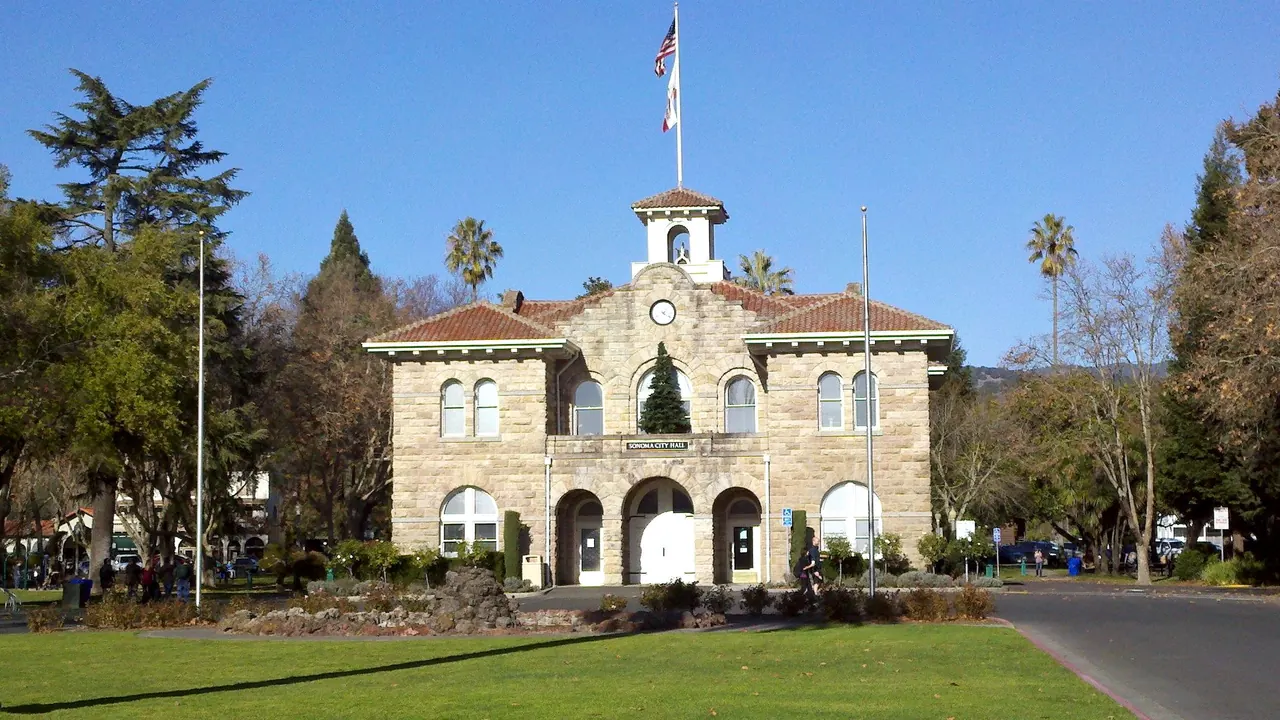
Photos: Carmel-by-the-Sea by Gregory Ford Henderson, CC BY-SA 4.0, cropped; Sonoma by Cullen328, CC BY-SA 3.0, cropped.
Carmel-by-the-Sea or Sonoma?
Our verdict in twelve categories, each scored against the same fixed benchmark cities, and the climate month by month, so you can choose for your trip.
Choose Carmel-by-the-Sea for
- families
- nature and the outdoors
- beaches
Carmel-by-the-Sea is the choice if you want the coast on foot. Point Lobos is five minutes away, the Big Sur cliffs are within half an hour, and there is a white-sand beach for walking at sunset. It is also the better place to bring children, thanks to the Monterey Bay Aquarium and the tide pools, and its small village grid is easier to manage once you've parked the car.
Choose Sonoma for
- food and drink
- day trips
- wellness
Pick Sonoma if the trip is about eating and drinking. The valley's wineries, the restaurants on the plaza and the cheese, olive oil and oysters of the surrounding countryside make food the point of the stay. San Francisco and Napa are each within about an hour for a change of scene. It suits couples more than families, and people who like a warm, sunny inland summer.
Scoreboard
Twelve categories on one fixed scale from 0 to 100. The shaded stretch is the gap between the two.
Your match
Pick a travel style or drag the sliders, and both match scores follow your weighting.
Wins on families and nature and the outdoors with your weighting.
Wins on food and drink and day trips with your weighting.
What matters to you?
Category by category
What the scores mean for a trip.
Beaches & swimming
Carmel at least has a beach at the bottom of its main street: a long curve of fine white sand under the cypresses, good for walking the dog at sunrise or sitting out at sunset. Cold surf and morning fog rule out swimming for most people, and Monastery Beach and Carmel River State Beach are lovely to look at but dangerous in the water.
Sonoma has no beach of its own. The coast around Bodega Bay is over an hour away and just as cold, so a summer swim means a hotel pool or the gravel shore of the Russian River. In fairness, the river gets warmer than any water off Carmel.
Food & drink
In Sonoma, food and wine are the reason to come. The valley's own Cabernet, old-vine Zinfandel and Carneros Pinot Noir are poured at wineries a short drive from the plaza, and the cooking is built on local cheese, olive oil and produce. It is ideal for a long lunch over a good bottle.
Carmel eats very well for a village, with candlelit French and Italian dining rooms, Dungeness crab and sand dabs from the bay, and tasting rooms for Santa Lucia Highlands wines. Still, it is a place for a refined dinner rather than a wine valley, and for anything cheap or casual you drive into Monterey.
Culture & sights
Neither town keeps you busy for long, and on sights they are evenly matched, so the difference lies in what you go to see. Both have a Franciscan mission, and between them they mark the two ends of the story: Junípero Serra, who founded the chain, lies buried at Carmel, while Sonoma's was the last mission to be built. Beyond its mission, Carmel is about how the place looks. You wander the lanes for the fairy-tale cottages, the timber houses left by the early painters and writers, and Robinson Jeffers's stone tower on the shore, with galleries in between.
Sonoma is about what happened there. Its sights stand together around the plaza, where the mission, the adobe barracks and the site of the 1846 Bear Flag Revolt form one state historic park you can see in a single loop. Vallejo's house and Jack London's ruins are close by. Choose Carmel to enjoy an artists' village, and Sonoma for the story of how California changed hands.
Nightlife
Neither town is for a night out, and both are quiet by late evening. In Carmel an evening means a wine bar and a nightcap in a hotel lounge. Sonoma's plaza has a little more going on, with a brewpub, a couple of saloons and pleasant summer nights on the square. For anything livelier you drive to Monterey from Carmel, or to Santa Rosa or San Francisco from Sonoma.
Nature & outdoors
Carmel has the more spectacular setting. Point Lobos, with its granite headlands, sea otters and grey whales passing in winter and spring, is five minutes south. Bixby Bridge and the redwoods of Pfeiffer Big Sur are within an hour, and Monterey Bay adds kayaking and whale-watching.
Sonoma's countryside is softer and more pastoral. There are back roads through the vines for cycling, the Sonoma Overlook trail starting near the plaza, and the meadows and redwood groves of Sugarloaf Ridge. Point Reyes and the wild coast are about an hour away, and in high summer the valley floor can be hot and smoky.
Day trips
Sonoma is the better base for day trips. San Francisco is about an hour away, close enough for a full day in the city. Napa and its wine towns are just over the hills, and Healdsburg, Petaluma and Sausalito are all within reach, though many of these outings are another wine town.
From Carmel, Monterey and Pacific Grove are so close they barely count as trips, and Salinas, San Juan Bautista and the Santa Cruz boardwalk make good outings. San Francisco, though, is two and a half hours away, which makes it a long day.
Good for families
Carmel is the easier choice with children, mostly because of its neighbour. The Monterey Bay Aquarium, with its otters and kelp forest tank, can fill a whole day, and the tide pools and the Dennis the Menace Playground fill others. The sea is too cold and rough for small children to paddle in, though.
Sonoma has a playground on the plaza, a miniature railway and an African wildlife park near Santa Rosa, but little else for children once the tasting rooms take over. Families usually do better visiting for a day from a base in San Francisco.
Getting around
You need a car in both for the main things worth doing, but Carmel's village is a self-contained grid of about a square mile that you can walk from Ocean Avenue down to the beach. Buses, though infrequent, run to Monterey and Carmel Valley. Expect a steep hill, unlit lanes and tight parking in summer.
In Sonoma only the plaza and the tasting rooms close to it are within walking distance. The wineries, parks and coast are spread across the valley, and many visitors book a driver or a tour so that nobody has to drive after tasting. Cycling the flat valley roads is a pleasant alternative.
Shopping & style
Carmel has slightly more to browse. It has an unusual number of galleries for its size, selling plein-air painting, photography and sculpture, plus courtyard boutiques for cashmere and jewellery and two small open-air shopping centres. Sonoma's plaza is more about food and drink to take home, from olive oil and cheese to bottles bought at the winery, with a farmers' market in summer. Neither has a department store, and neither is worth the trip for shopping alone.
Affordability
Both are expensive in much the same way, with boutique rooms priced for well-off weekend visitors and costly dinners. The extra costs fall differently. In Sonoma, tasting fees and drivers for tasting days add up, while Carmel makes up a little with a free beach, free village streets and coastal walks that cost nothing. The usual way to save is to sleep elsewhere: Monterey or Seaside for Carmel, Santa Rosa or Petaluma for Sonoma.
Live music & performing arts
Both are summer towns for live performance, and both go quiet out of season. Carmel has the longer tradition. The Bach Festival has filled its summers with Baroque concerts since 1935, the Forest Theater stages plays under the pines, and the Monterey Jazz Festival is close by every September.
Sonoma answers with Broadway-style evenings among the ruins and oaks of Jack London State Historic Park, plus concerts at the wineries. For classical music, the Green Music Center's fine concert hall, half an hour away, draws touring orchestras.
Wellness & relaxation
Carmel offers spa lodges rather than spring water. The spas of the Pebble Beach lodges and the Carmel Valley resorts are well regarded, and some village inns bring treatments to your room. Misty mornings, fireside rooms and dark, still evenings make it a good place for a slow, comfortable weekend for two.
Sonoma has hot water coming out of the ground. At Boyes Hot Springs, on the edge of town, natural mineral water feeds the pools of a historic resort spa that sells day passes, and the mud baths of Calistoga are about an hour over the hills. Away from the springs, the slow days and quiet terraces of the plaza are what make it restful.
When should you go?
Pick your month. The climate figures are measured averages, not a forecast.
Carmel-by-the-Sea in July
Sonoma in July
Daytime high, °C
Rainfall in the month, mm
Where the figures come from
Sonoma has no rain gauge within 25 km of the centre, so its rainfall comes from a gridded climate dataset read at the city rather than from a gauge further away.
Sonoma's sunshine is measured 87 km from the centre, at Sacramento Executive Airport.
Temperature and rainfall are climate normals, averaged over the years shown. Carmel-by-the-Sea: 1991-2020 normals, Monterey / Pacific Grove Acres (8.7 km from centre). Sonoma: 1991-2020 (sunshine 1981-2010) normals, Napa / Middleton (17.8 km from centre).
Carmel-by-the-Sea changes little through the year. Daytime highs stay between the high teens and the low twenties, and the warmest days come from August to October, at about 23°C. The dry season starts earlier, running from May to September with almost no rain in midsummer, while October brings the first light showers. The wet months are December to March, with January the wettest at about 86mm. The sea never gets much above 15°C, so the beach is for walking in any month, and the mild days make the village pleasant to wander all year.
Sonoma has a proper summer. From June to September highs reach 26°C, the sunshine is at its longest and the valley floor is hot by the afternoon. Winters are cooler and much wetter than on the coast, with around 169mm of rain in December and almost as much in January. May and October, warm but not hot and still fairly dry, are the best months for strolling the plaza and walking the hill trails.
Which traveller are you?
On an outdoors trip, Carmel-by-the-Sea is the stronger base. Point Lobos is on the doorstep, the Big Sur coast and its redwood canyons are within an hour, and Monterey Bay adds kayaking among otters and diving in kelp forest. Sonoma's vineyard trails are gentler.
On a family trip with children, Carmel-by-the-Sea works much better. The Monterey Bay Aquarium is fifteen minutes away, the tide pools at Point Lobos and Pacific Grove keep children busy and the sand is good for digging. In Sonoma, days revolve around tasting rooms.
For a food and nightlife trip, Sonoma is better on the food side. Its plaza restaurants and dozens of nearby wineries put eating at the centre of the stay, with Carneros Pinot Noir and old-vine Zinfandel close by. Neither town offers much after dinner, so expect early nights.
Before you go
| Measure | Carmel-by-the-Sea | Sonoma |
|---|---|---|
| Currency | US Dollar (USD) | US Dollar (USD) |
| Sockets | AB120 V, 60 Hz | AB120 V, 60 Hz |
| Driving side | Right | Right |
| Time zone | UTC-8, UTC-7 in summer | UTC-8, UTC-7 in summer |
| Emergency number | 911 | 911 |
| Elevation | 68 m | 26 m |
| Main airport | Monterey Regional Airport (MRY)8 km from centre11 non-stop destinations | Charles M. Schulz Sonoma County Airport (STS)39 km from centre14 non-stop destinations |
| Public holidays this year | 13 days | 13 days |
By the numbers
| Measure | Carmel-by-the-Sea | Sonoma |
|---|---|---|
| City population | 3,220 | 10,739 |
| People per km² | 1,150 | 1,513 |
| Museums within 10 km | 5 | 7 |
| UNESCO World Heritage sites within 50 km | 0 | 0 |
| Swim season, months above 21 °C | None | None |
Where else could you go?
Every comparison below shares a destination with this one, so you can follow Carmel-by-the-Sea or Sonoma somewhere new.
- Montereyvs Carmel-by-the-Sea
- Napavs Sonoma
- San Franciscovs Sonoma
- San Josevs Carmel-by-the-Sea
- San Josevs Sonoma
- San Franciscovs Carmel-by-the-Sea