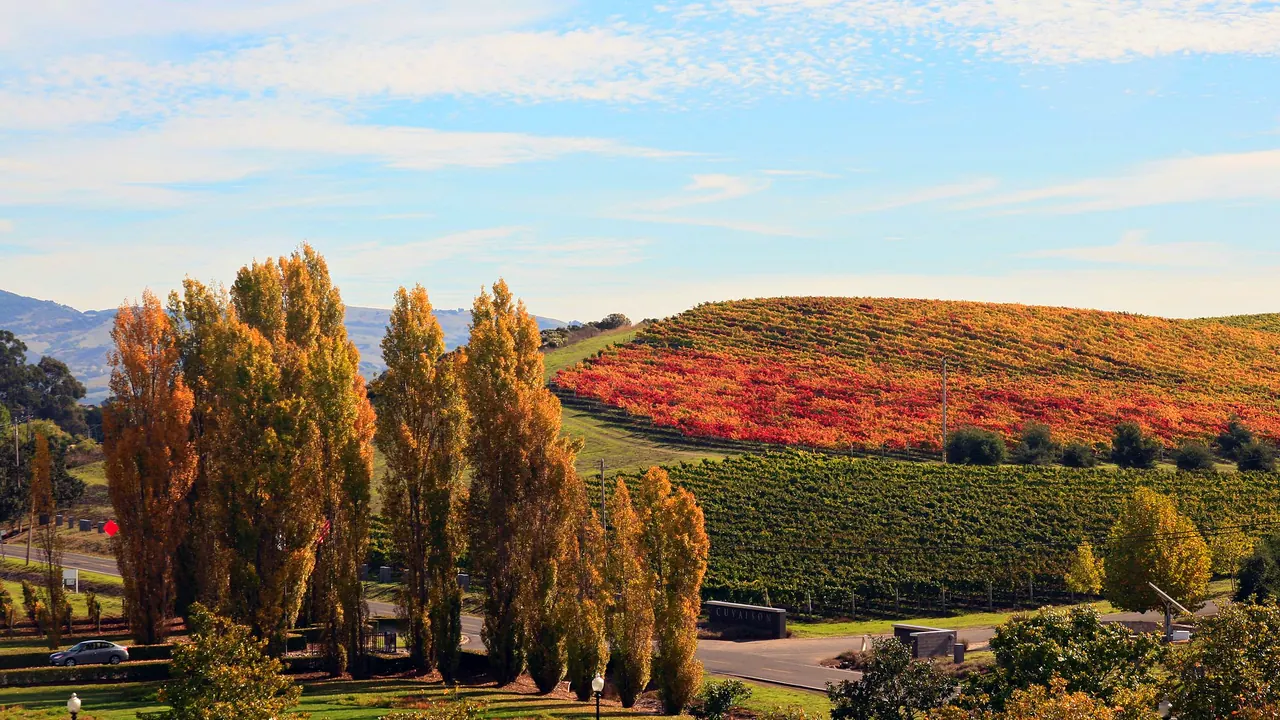
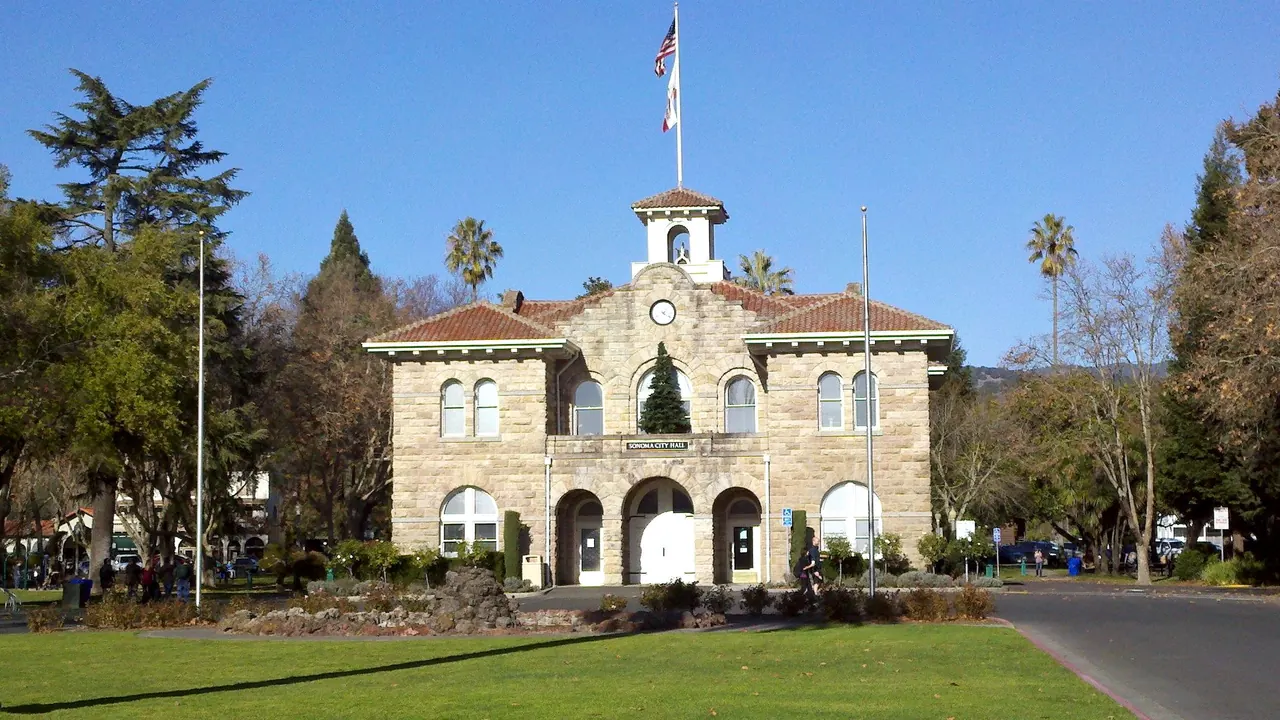
Photos: Napa by Brocken Inaglory, CC BY-SA 3.0, cropped; Sonoma by Cullen328, CC BY-SA 3.0, cropped.
Napa or Sonoma?
Our verdict in twelve categories, each scored against the same fixed benchmark cities, and the climate month by month, so you can choose for your trip.
Choose Napa for
- food and drink
- wellness
- shopping
Napa is the one for a wine-and-dining trip with some indulgence built in. The valley has the deeper run of celebrated restaurants in Yountville and St Helena, Calistoga's mud baths and mineral pools at its northern end, and a little more to buy and to visit nearby. It suits a couple who plan their days around tastings, a spa afternoon and a long dinner, and who want San Francisco within reach.
Choose Sonoma for
- culture and sights
- nature and the outdoors
- beaches
Sonoma is better if you want a small town with a history you can walk around. Its plaza, mission and barracks give a stay a centre, trails climb into the hills almost from the square, and the pace is gentler than Napa's. It suits travellers who like a morning walk, a slow lunch and a quiet evening more than a list of famous tables to book.
Scoreboard
Twelve categories on one fixed scale from 0 to 100. The shaded stretch is the gap between the two.
Your match
Pick a travel style or drag the sliders, and both match scores follow your weighting.
Wins on food and drink and wellness with your weighting.
Wins on culture and sights and nature and the outdoors with your weighting.
What matters to you?
Category by category
What the scores mean for a trip.
Beaches & swimming
Neither town is a place for the sea. Both are well over an hour from the cold, rough water at Bodega Bay, and hotel pools do most of the work in summer.
The difference is in where you go for a freshwater swim. From Napa, locals head east to Lake Berryessa, a large reservoir where you can boat as well as swim. From Sonoma, the pull is north to the gravel beaches of the Russian River, where you can spend a lazy afternoon in the shallows.
Food & drink
Both places revolve around wine, but Napa goes further on the plate. Yountville and St Helena hold a cluster of restaurants famous across the country, and Napa town adds the Oxbow market hall, a riverfront of wine bars and taquerias run for vineyard workers. Cabernet is the signature, with Carneros Pinot and sparkling wine to the south.
Sonoma eats well but on a smaller stage, with a handful of restaurants around the plaza and in Glen Ellen. Old-vine Zinfandel is its distinctive glass. It is ideal for a long, unhurried lunch, but over a week you will find less variety than in Napa.
Culture & sights
Sonoma has the more interesting history. The broad plaza where the California Republic was briefly declared in 1846 is still the heart of town, with Mission San Francisco Solano, the adobe barracks and General Vallejo's Gothic house all within a short walk. Jack London's ruined Wolf House is nearby in Glen Ellen.
Napa offers less: some Victorian streets downtown, the 1880 opera house, the di Rosa contemporary art estate in Carneros and the old stone wineries up the valley. Neither is a museum destination, but Sonoma's past is more tangible.
Nightlife
Both towns are quiet by late evening, and neither has clubs. Napa's evenings have a little more choice, with cocktail bars and pubs along First Street and the river that fill up on summer weekends. Sonoma's are centred on the plaza's wine bars, a brewpub and a couple of saloons. For a real night out, people go to San Francisco from Napa, or to Santa Rosa or the city from Sonoma.
Nature & outdoors
The two valleys look much alike, vineyard floors between wooded ranges with balloons rising over the vines at dawn, but Sonoma makes it easier to get out into the hills. Napa's outdoors is mostly on the flat and on the water. A paved trail runs through much of the valley for cycling and the river can be paddled near town. Walkers have Skyline park on the edge of town, the redwoods at Bothe-Napa and the long climb of Mount St Helena, though each takes a drive.
In Sonoma the hills begin almost at the plaza, with a trail up to the Sonoma Overlook. Jack London park and Sugarloaf Ridge, with redwood groves, oak meadows and the view from Bald Mountain, are a short drive up the valley. Quiet back roads through the vines suit cycling, and the wild Sonoma Coast headlands and Point Reyes are within about an hour, close enough for an easy day out.
Day trips
Each town is the obvious day out from the other, and both are about an hour from San Francisco. Napa has slightly more range. Sacramento's old town and capitol are a little over an hour east, and you can reach the city by ferry from Vallejo without driving all the way.
From Sonoma, the closer outings include Petaluma's Victorian riverfront, Healdsburg and Sausalito and Tiburon on the bay. Outside the city, though, most of them are yet another wine town.
Good for families
Both are adult places built around tasting rooms, and both are safe and calm with children who are content to tag along. Napa has the theme and animal park in Vallejo and a geyser near Calistoga. Sonoma has a miniature railway just south of town and an African wildlife park near Santa Rosa. With young children, either works best as a day trip from a city base.
Getting around
Both have walkable centres, Napa's around the riverfront and market hall and Sonoma's around the plaza, where several tasting rooms are a few blocks apart. Sonoma's centre is slightly easier on foot for a tasting day. Napa's wineries are strung along some 50km of valley, with a cycle trail and slow summer traffic on the main road. Either way, a car, a driver or a tour is the realistic answer.
Shopping & style
Wine shipped home from the cellars is the main purchase in both. Napa has more to browse beyond the cellars: the market hall for olive oil and kitchenware, the cookware and design shops on St Helena's main street, and an outlet mall for familiar brands.
Sonoma keeps it smaller. You stroll the plaza's arcades for galleries, cheese and home goods, and the summer farmers' market sells local produce. Neither offers much fashion.
Affordability
Both are expensive, so the choice here comes down to how you save. Around Napa, the cheaper option is a chain hotel further south, with meals at the taquerias and the market hall. From Sonoma, budget travellers tend to sleep in Santa Rosa or Petaluma and picnic among the vines. In either valley, tasting fees and the cost of a driver add up quickly.
Live music & performing arts
Both have a thin year-round programme and send serious opera and theatre fans to San Francisco, but their summer highlights differ. Napa has a classical festival in winery venues and a large rock and pop festival at the fairgrounds in late spring. Sonoma has outdoor concerts among the ruins at Jack London park and, about half an hour away, the Green Music Center, a fine hall that attracts touring orchestras.
Wellness & relaxation
Napa's valley includes Calistoga, a hot spring town since the nineteenth century, where mud baths and mineral pools are the traditional way to finish a day of tastings. Closer to town, the large resort spas in Carneros and the hills add plenty of choice.
Sonoma has one historic source at Boyes Hot Springs, feeding a single resort spa with day passes, and Calistoga is about an hour away over the hills. What it offers instead is its slow, quiet days on the plaza.
When should you go?
Pick your month. The climate figures are measured averages, not a forecast.
Napa in July
Sonoma in July
Daytime high, °C
Rainfall in the month, mm
Where the figures come from
Napa has no rain gauge within 25 km of the centre, so its rainfall comes from a gridded climate dataset read at the city rather than from a gauge further away.
Napa's sunshine is measured 73 km from the centre, at Sacramento Executive Airport.
Sonoma has no rain gauge within 25 km of the centre, so its rainfall comes from a gridded climate dataset read at the city rather than from a gauge further away.
Sonoma's sunshine is measured 87 km from the centre, at Sacramento Executive Airport.
Temperature and rainfall are climate normals, averaged over the years shown. Napa: 1991-2020 (sunshine 1981-2010) normals, Napa / Middleton (9.8 km from centre). Sonoma: 1991-2020 (sunshine 1981-2010) normals, Napa / Middleton (17.8 km from centre).
The two valleys share almost the same weather. Both are dry and warm from June to September, with daytime highs around 26°C and almost no rain. The heat makes the middle of the day hard work, so walks and cycling are best done early. Spring and the October harvest are the most comfortable months for being outdoors, and early spring adds green hills and wildflowers. The sea off the nearby coast stays at about 12°C to 14°C all year, too cold for swimming in either case.
The rain comes from November to March, and Sonoma gets noticeably more of it, with about 169mm in December against Napa's 133mm. A winter trip to either is mild rather than cold, with highs of about 13°C in January. It is better suited to tasting rooms, spas and restaurants than to hiking.
Which traveller are you?
On a food and nightlife trip, Napa is the stronger choice for the food. It has more serious restaurants up the valley, the Oxbow market hall and wine bars downtown. Nightlife is quiet in both, but Napa's riverfront has a few more cocktail bars.
For a culture and arts trip, Sonoma gives you more to see on foot. The plaza where the Bear Flag Revolt happened, the last Franciscan mission, the barracks and Vallejo's house make a real half day of history. Napa's sights run out sooner.
On a relaxing and wellness trip, Napa has the advantage because Calistoga's hot springs and mud baths are part of its valley, and the resorts in Carneros nearly all have large spas. Sonoma is restful, but its bathing is mostly a single resort spa.
Before you go
| Measure | Napa | Sonoma |
|---|---|---|
| Currency | US Dollar (USD) | US Dollar (USD) |
| Sockets | AB120 V, 60 Hz | AB120 V, 60 Hz |
| Driving side | Right | Right |
| Time zone | UTC-8, UTC-7 in summer | UTC-8, UTC-7 in summer |
| Emergency number | 911 | 911 |
| Elevation | 6 m | 26 m |
| Main airport | San Francisco International Airport (SFO)76 km from centre143 non-stop destinations | Charles M. Schulz Sonoma County Airport (STS)39 km from centre14 non-stop destinations |
| Public holidays this year | 13 days | 13 days |
By the numbers
| Measure | Napa | Sonoma |
|---|---|---|
| City population | 79,246 | 10,739 |
| People per km² | 1,686 | 1,513 |
| Museums within 10 km | 3 | 7 |
| UNESCO World Heritage sites within 50 km | 0 | 0 |
| Swim season, months above 21 °C | None | None |
Where else could you go?
Every comparison below shares a destination with this one, so you can follow Napa or Sonoma somewhere new.
- San Franciscovs Sonoma
- San Franciscovs Napa
- San Josevs Napa
- San Josevs Sonoma
- Montereyvs Napa
- Montereyvs Sonoma